.avif)
Mastering How to Respond to Email Introduction Effectively

.avif)
You open your inbox and see an introduction email from a colleague, customer, investor, or former teammate. Two names are on the thread. One person expects you to take it from here. The other person is deciding, often in seconds, whether this new conversation is worth their time.
That moment matters more than most reps think.
A weak reply keeps the thread alive but goes nowhere. A sharp reply gives the other person a reason to engage, makes the connector look smart, and starts a real sales or partnership motion. If you work in B2B, learning how to respond to email introduction messages well isn't soft-skill polish. It's pipeline discipline.
Table of Contents
- 1. High-priority prospect introduction
- 2. Partner or channel introduction
- 3. Job candidate or hiring-related introduction
- 4. Customer referral from an existing contact
- 5. Dubious or low-context introduction
- 6. Stranger introduction with no clear referral value
- What to enrich before you reply
- How enriched data changes the message
- A fast personalization workflow for SDRs
- The standard to hold your team to
Why Your Response to an Email Introduction Matters
An introduction email isn't a formality. It's a transfer of trust.
When someone puts you on a thread, they're lending you some of their credibility. Your reply either compounds that trust or burns it. A common response is a polite thank-you and a vague ask for time. That keeps things cordial, but it rarely creates momentum.

The bar for earning a response is already low across B2B email. The average cold email response rate in B2B sales is 3.43%, with roughly 19 out of 20 outreach attempts being ignored, according to Martal's write-up of the Instantly benchmark data. A warm introduction gives you better odds than a true cold outbound touch, but only if you act like the intro actually means something.
The real mistake reps make
New SDRs usually make one of two errors.
They either respond too casually, which makes the exchange feel low-effort, or they overcompensate with a long, polished note that asks for too much too soon. Neither works well. Buyers don't need elegance. They need context, relevance, and a next step that feels easy.
Practical rule: Treat every introduction like a live opportunity review. Before you reply, decide what outcome you want from the thread.
That outcome might be a discovery call. It might be a referral to the right owner. It might be confirmation that the intro is relevant. The point is to move the conversation forward with intent.
Good etiquette is not enough
Plenty of advice on how to respond to email introduction messages stops at manners. Thank the connector. Say nice to meet you. Suggest a time. That's fine as a baseline, but it ignores how B2B conversations convert.
A strong response does three things at once:
- Protects the connector's reputation by showing professionalism
- Gives the new contact a reason to care by making the message relevant
- Creates motion by offering a clear next step
If your reply only checks the first box, you left value on the table.
The First 24 Hours What to Do Immediately
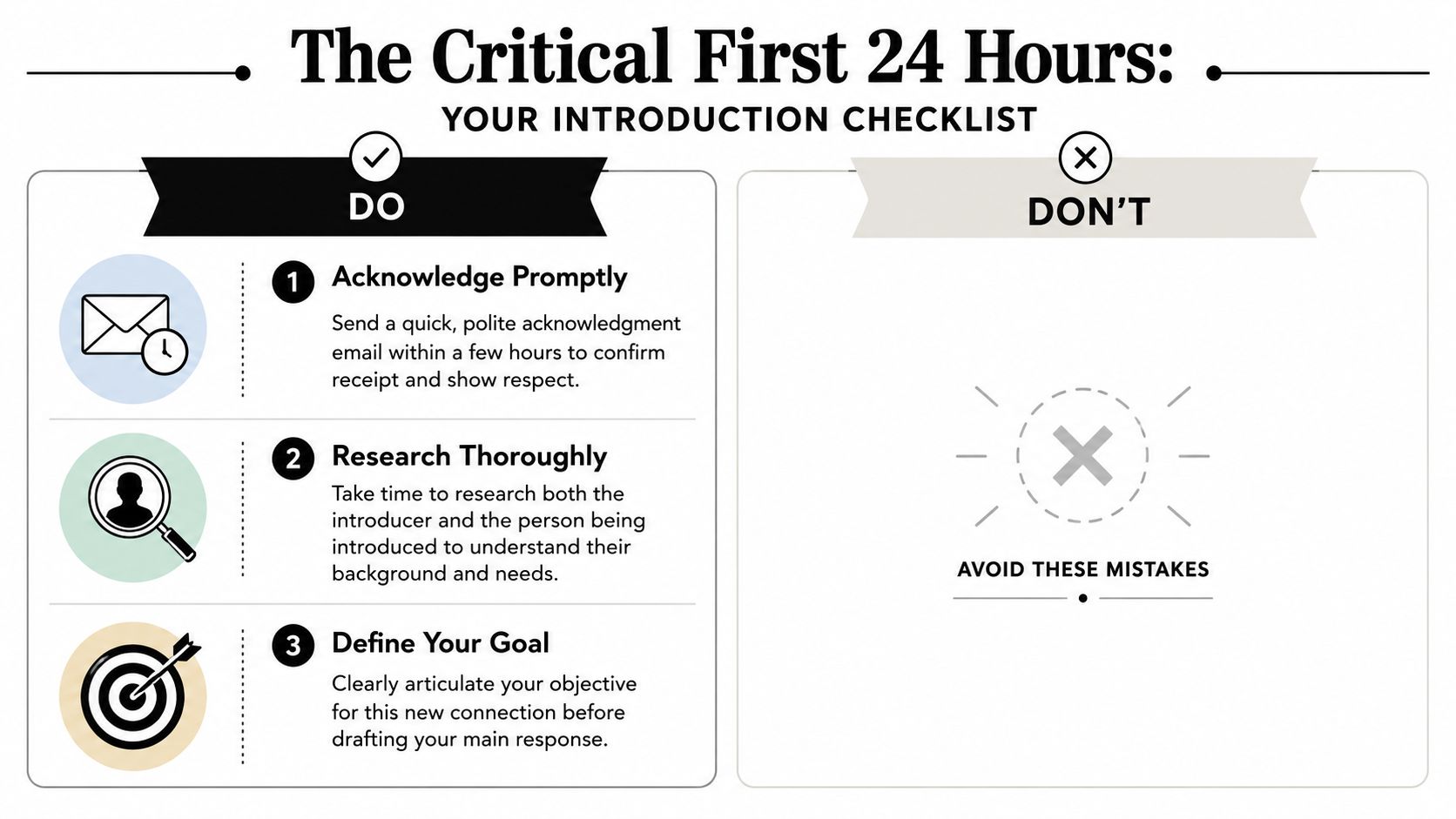
The first reply starts before you write a single sentence. Fast reactions help, but rushed reactions create sloppy threads. In practice, I coach reps to handle intro emails with a short checklist.
Start with inbox hygiene
The first move is simple. Read the original intro carefully and identify who initiated it, why they made it, and whether there's an implied ask.
Then clean up the thread before it turns messy.
- Acknowledge quickly. Reply within the business day if you can. A delayed response makes the connector wonder whether they should've made the intro at all.
- Thank the connector by name. Do it in the first line so both parties see that you recognized the favor.
- Move the connector to BCC after the handoff. This is one of those small habits that experienced operators notice immediately. It keeps them out of scheduling noise and lets the new conversation breathe.
Once the connector has done their job, don't make them sit through six emails about calendar slots.
Research before drafting
The next step is where most generic advice falls apart. Don't reply off the introduction alone if the context is thin.
Check the recipient's role, company page, LinkedIn presence, recent launch activity, and anything else that tells you why this intro happened now. If you're building a repeatable process, it also helps to study how teams are using automation around email triage and routing. Samuel Woods has a useful 2026 playbook for AI email that shows how operators structure inbox workflows without losing the human touch.
A fast research pass should answer these questions:
| Question | Why it matters |
|---|---|
| What does this person own? | It tells you whether your ask fits their role. |
| Why now? | Timing changes the tone of your reply. |
| What would be useful to them? | Relevance beats politeness. |
Define the objective before you hit send
Not every introduction deserves the same response.
Sometimes the right move is to push toward a call. Sometimes it's smarter to ask one clarifying question. Sometimes the introduction is broad enough that you should offer help first and let the other person choose the path.
Use this quick filter:
- If the intro is high-fit, propose a clear next step.
- If the intro is vague, ask for context before offering time.
- If the intro is strategic but early, send a concise note and leave room for them to engage on their terms.
That discipline keeps you from sounding overeager, which is one of the fastest ways to lose momentum on a warm thread.
Anatomy of a Perfect Response Structure and Tone
The best intro replies are engineered for easy reading. They don't try to impress. They reduce friction.
There's useful data behind that. For maximum engagement, the optimal email length is between 50 and 125 words, and emails written at a 3rd-grade reading level get a 36% higher response rate than those written at a college level, according to Boomerang's response study. That should change how you write immediately.
The four-part structure that works
A solid response to an email introduction usually has four parts.
1. A simple subject line
If you're replying in-thread, keep the original subject unless it is completely unclear. If you need to change it later, make it easy to track. Something like "Re: Intro from Sarah" is better than a clever line no one will search for.
2. A gracious opening
Thank the connector once. Acknowledge the new contact by name. Keep it warm and brief.
3. A value-driven middle
In this phase, experienced reps separate themselves. Don't jump straight to "would love 30 minutes." Give a reason the conversation is worth having.
4. A low-friction CTA
Ask for one next step. Not three.
Tone wins when it feels easy to answer
A lot of SDRs write intro replies like they're submitting a formal application. That tone creates distance.
Use plain English. Short sentences. Everyday verbs. If you want a good reminder on stripping out stiff language, this guide from HumanizeAIText on clear professional writing is worth bookmarking. The same principle shows up in effective cold outreach too, which is why this Icypeas article on how to write the best cold email is useful even when you're replying to a warm thread.
Write the reply so the other person can answer from their phone in under a minute.
A simple blueprint
Use this as a base:
- Line 1: Thank the connector
- Line 2: Show you've understood who the recipient is or what they do
- Line 3: Offer one relevant reason to connect
- Line 4: Suggest one easy next step
Here is the shape:
Thanks, Priya, for making the intro.
Great to meet you, Alex. I saw you're leading partnerships at [Company].
I think there may be a fit around [specific area], especially given [relevant context].
If useful, happy to send a short note with ideas or find time next week.
That's short enough to read instantly and specific enough to earn a response.
6 Response Templates for Common B2B Scenarios
Templates help when you're moving fast, but they only work if you understand the job each one is doing. Below are six practical patterns I use with teams.
1. High-priority prospect introduction
This is the one reps tend to overwork. Don't.
Template
Hi [Name], thanks [Connector Name] for the introduction.
Great to meet you. I understand you're focused on [priority or function] at [Company]. I think there may be a relevant conversation around [specific problem or initiative].
If helpful, I'm happy to send a short overview by email or find a time next week to compare notes.
Best,
[Your Name]
Why it works
It shows relevance without assuming too much. It also gives the buyer an easier path than committing to a meeting immediately.
2. Partner or channel introduction
Partnership threads die when both sides stay vague.
Template
Hi [Name], thanks [Connector Name] for connecting us.
I've followed [Company] for a while, especially your work in [area]. There may be overlap between your team and ours around [shared motion, market, or customer type].
Open to a quick exchange by email first, or we can set up a call if that's easier.
Best,
[Your Name]
Why it works
It positions the exchange as mutual, not one-sided.
3. Job candidate or hiring-related introduction
When the intro is about talent, speed matters and tone matters more.
Template
Hi [Name], thanks [Connector Name] for making the intro.
Great to meet you. Your background in [function or industry] looks relevant to what we're building. I'd be glad to learn more about your experience and share a bit more context on the role.
If you're open, send over a few times that work for you and we'll get something scheduled.
Best,
[Your Name]
Why it works
It's direct and respectful. No fluff, no forced enthusiasm.
4. Customer referral from an existing contact
This one should feel warmer, but don't assume a sale.
Template
Hi [Name], thanks [Connector Name] for connecting us.
It's great to meet you. [Connector Name] mentioned you may be looking at ways to improve [problem area]. We spend a lot of time with teams working through that exact issue.
Happy to share a few ideas over email first, or we can set up time if a conversation would be more useful.
Best,
[Your Name]
Why it works
It respects the referral while keeping pressure low.
5. Dubious or low-context introduction
Many reps fall into a trap. They don't want to be rude, so they accept the intro at face value and waste time.
Many professionals struggle with these situations. A better move is to ask the connector privately, "Did you see a specific opportunity in mind?" According to Taylor Jacobson's LinkedIn article on introduction etiquette, that approach can improve meaningful connection conversions by 25%.
Template to the connector, sent privately
Hi [Connector Name], thanks for thinking of me here.
Before I reply in detail, did you see a specific opportunity in mind between us? I want to make sure I respond in a way that's useful to both sides.
Best,
[Your Name]
Why it works
You protect everyone's time without embarrassing the connector on-thread.
6. Stranger introduction with no clear referral value
Sometimes you get looped into a thread where the other person isn't really referred. They're just adjacent.
Template
Hi [Name], thanks for reaching out, and thanks [Connector Name] for making the connection.
Good to meet you. I don't have much context yet, but I took a quick look at your role at [Company]. I thought [specific observation] stood out.
If you'd like, send over a bit more on what would be most useful to discuss, and I can point you in the right direction or continue the conversation directly.
Best,
[Your Name]
Why it works
It doesn't fake familiarity. It also invites context instead of forcing a meeting.
If the introduction is unclear, clarity is more professional than enthusiasm.
Personalize Your Response with Enriched Data
Templates get you to acceptable. Personalization gets you remembered.
That matters because highly personalized emails achieve 18% response rates, compared with 9% for non-personalized messages, according to Stripo's email follow-up statistics. In practical terms, a personalized intro reply doesn't just sound better. It changes the odds that the other person answers.
What to enrich before you reply
Most reps personalize too shallowly. They mention the company name, title, maybe a generic compliment, and call it a day.
Useful personalization is tied to a signal. Good signals include:
- Role-based context such as ownership of partnerships, revenue ops, or hiring
- Company events like a launch, product update, expansion, or leadership hire
- Category fit based on customer segment, market focus, or team structure
- Operational clues from public pages, job posts, or product messaging
If you want a broader framework for this kind of outreach, Salesmotion has a strong piece on signal-driven email personalization. The principle is simple. Relevance starts with a real trigger, not a compliment.
How enriched data changes the message
Compare these two replies.
Generic
Thanks for the intro. Great to meet you. I'd love to connect and learn more about your business.
Signal-based
Thanks for the intro. Great to meet you. I saw your team recently launched a new integration and that you're leading partnerships. That usually creates a lot of pressure around sourcing and activating the right ecosystem relationships. Happy to share a few ideas if useful.
The second version feels human because it is grounded in something observable.
For teams building this into process, data enrichment tools help pull the right context quickly. This overview of B2B data enrichment tools is useful if you're standardizing what reps should check before replying.
A fast personalization workflow for SDRs
Use a one-minute workflow.
- Check the person's current role.
- Scan the company homepage and recent announcements.
- Look for one signal that relates to your product, market, or function.
- Write one sentence connecting that signal to a likely business issue.
- Offer one next step that matches the maturity of the conversation.
Here's a useful walkthrough before the video:
The standard to hold your team to
Personalization shouldn't sound like surveillance. It should sound like preparation.
That means you don't need five details. You need one sharp detail that proves your reply wasn't automated in the lazy sense. The sweet spot is a message that feels informed, concise, and easy to answer.
The best personalized reply usually includes one signal, one implication, and one invitation.
After the Response Your Follow-up and Tracking Strategy
Most introduction threads don't fail because the first reply was bad. They fail because nobody runs a process after the first reply.
You need a follow-up rhythm and a place to track the relationship. Otherwise good introductions disappear into inbox clutter.
Follow up with a reason, not a nudge
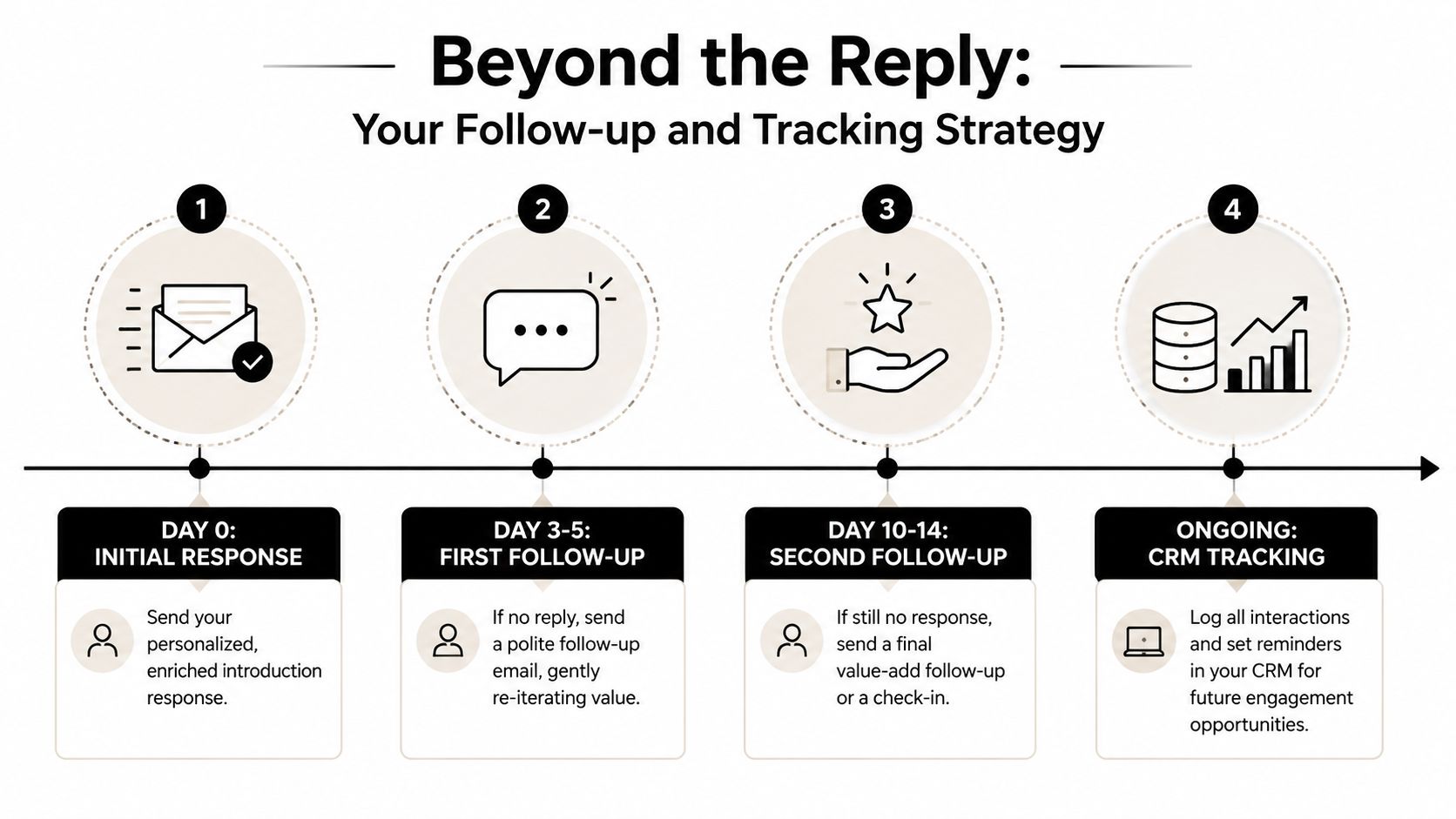
If the contact doesn't answer, don't send "just bumping this." Add context or value.
For cold intros lacking a clear referral, a value-first pivot that offers a micro-insight relevant to the person's role can increase reply rates by 35% compared with standard meeting-ask templates, according to Indeed's guidance on responding to an email introduction.
A practical follow-up looks like this:
Hi [Name], circling back in case useful. I noticed [specific signal]. That often creates challenges around [relevant issue]. Happy to share a few ideas by email if a call isn't the best use of time right now.
That works because it gives them a reason to respond without demanding one.
Track the intro like an opportunity
Every introduction should go into your CRM or tracking system the same day. Not because every intro will close, but because you need memory.
Log:
- Who introduced whom
- Why the introduction happened
- What you sent back
- What signal or context you used
- When you should follow up next
If your team runs outreach in sequences, it's worth aligning intro follow-up with your broader cadence rules. This breakdown of the definition of cadence in business is useful for making sure warm intros don't get treated like random one-off emails.
A simple operating rhythm
Use a lightweight system:
| Stage | Action |
|---|---|
| Initial reply sent | Log the intro and desired outcome |
| No response | Send a value-first follow-up |
| Still no response | Send one final low-pressure note |
| Later trigger appears | Re-open with new relevance |
This is basic sales hygiene, but it matters. Warm introductions are easier to waste than cold outbound because people assume the relationship alone will carry the conversation. It won't. Good process will.
If your team wants to turn introductions into qualified conversations faster, Icypeas helps enrich professional contact and company data so reps can write sharper, more relevant replies without wasting research time. That makes it easier to respond to email introduction threads with real context, stronger personalization, and cleaner handoffs into your CRM.



















































.png)



.webp)