.avif)
Marketing Data Analyst: The Ultimate 2026 Career Guide


.avif)
Your dashboard says paid search is up, social engagement looks healthy, and website traffic jumped. Revenue didn't move. Sales says the leads are weak. Demand gen says attribution is broken. The web team thinks the form is dropping submissions. Nobody is lying, but nobody is looking at the same truth.
That's the moment a good marketing data analyst earns their seat.
The role matters because modern marketing produces constant signals and constant noise. A marketing data analyst turns those signals into decisions. The job sits between analytics and strategy, using marketing, brand, competitor, and consumer data to explain who the audience is, what changed, and why performance moved in one direction instead of another. That's not just reporting. It's pattern finding, hypothesis testing, and translating metrics like conversion rate, click rate, ROI, and brand recognition into action, as described in Indeed's overview of the marketing data analyst role.
What separates strong analysts from average ones isn't prettier dashboards. It's the discipline underneath them. The best analysts know a metric is only as credible as the pipeline that produced it. If campaign naming is inconsistent, if lead records are duplicated, if channels aren't stitched cleanly, the charts may still render beautifully while the business makes bad decisions.
Table of Contents
- A large share of the job is protecting decision quality
- The work sits between systems and strategy
- Communication matters because confidence levels matter
- Build from the data outward
- A useful stack has clear handoffs
- Skills that separate solid analysts from trusted ones
The Analyst Who Answers Why Not Just What
A weak analyst tells the team what happened. A strong one explains why it happened, whether the data deserves trust, and what to do next.
That distinction changes how marketing operates. Anyone can export channel metrics and stack them into a dashboard. A marketing data analyst earns value by tracing the path from activity to business outcome. Traffic rose. Fine. Was it qualified traffic? Did the conversion path break? Did lead scoring shift? Did campaign targeting broaden so far that click rate improved while pipeline quality fell?
The job starts with a business question
Actual work usually begins with a messy question from a stakeholder, not a clean table in a warehouse. “Why are we getting more demos but fewer deals?” “Why does paid social look efficient in-platform but weak in CRM?” “Why are branded terms converting differently this quarter?”
A capable analyst breaks that into testable parts:
- Define the event: What exactly changed?
- Check the measurement: Did tracking, naming, or attribution rules change?
- Segment the data: Which audience, channel, geo, or campaign drove the movement?
- Tie it to an action: Should the team reallocate spend, fix instrumentation, or change messaging?
A marketing team rarely needs more charts. It needs fewer arguments about whose chart is right.
The role is strategic because it forces discipline. The analyst becomes the person who can say, “This result is real,” or, equally, “This result is an artifact of bad data.”
Where the role sits relative to adjacent jobs
This is also where confusion starts for junior candidates. A marketing data analyst isn't the same as every data-flavored title around marketing.
| Role | Primary focus | Core question |
|---|---|---|
| Marketing data analyst | Performance, audience, channel, campaign insight | What happened, why, and what should marketing change? |
| Business analyst | Broader business process and operational requirements | How should a process or system improve? |
| Data scientist | Advanced modeling and algorithmic work | Can we predict or automate at scale? |
| Marketing technologist | Tool implementation and platform operations | How do systems connect and run? |
A good way to think about it is translation. The analyst speaks SQL, spreadsheets, experimentation, and statistics. The marketing team speaks CAC, funnel stages, content performance, and pipeline. The job is to move fluently between both languages.
What a Marketing Data Analyst Actually Does
Monday at 9:07 a.m., paid social leads are up, sales says lead quality fell off a cliff, and the dashboard shows a healthy cost per conversion. A good marketing data analyst does not rush to explain performance from the chart alone. They check whether the form changed, whether duplicate records inflated lead volume, whether UTMs broke, and whether CRM stage mapping still matches the reporting logic.
That is the job in real life. The work starts before analysis and often below the dashboard layer. Strong analysts spend a surprising amount of time making sure marketing data is collected, labeled, joined, and interpreted correctly enough to support a decision.
A large share of the job is protecting decision quality
The visible part of the role is reporting, analysis, and recommendations. The part that saves companies money is quieter. It is data validation, taxonomy discipline, attribution checks, and ongoing cleanup across ad platforms, analytics tools, CRM records, and conversion events.
On a normal week, a marketing data analyst might:
- Audit incoming data from ad platforms, web analytics, CRM systems, and marketing automation tools to confirm it is complete and mapped correctly.
- Standardize naming and definitions so campaign names, channels, conversion events, and date logic mean the same thing across reports.
- Investigate reporting breaks such as lead spikes caused by duplicates, missing source data, sudden drops in tracked conversions, or mismatched spend totals.
- Analyze performance across funnel stages, audience segments, cohorts, experiments, and source-to-revenue paths.
- Recommend action on budget shifts, creative changes, audience targeting, lead routing, measurement fixes, or reporting changes.
The best analysts reduce bad decisions before they produce new insights.
Practical rule: If the analysis does not lead to a change in spend, targeting, creative, measurement, or process, the work is still incomplete.
For teams comparing reporting platforms and BI options, this roundup of marketing analytics tools for growing teams is useful. The right tool matters less than whether your team can trust the inputs feeding it.
The work sits between systems and strategy
Junior analysts often expect a research-heavy role. In practice, the job sits in the middle of operations, analytics, and communication. One hour might go to debugging a broken campaign parameter. The next might go to explaining why paid search looks efficient only because offline revenue is missing from the attribution model.
That mix is what makes the role valuable. Marketing leaders rarely need another export of numbers. They need someone who can tell the difference between a performance problem, a tracking problem, and a definition problem.
A strong analyst translates that clearly:
- Conversion rate fell after a landing page update increased mobile form friction.
- Lead volume rose because one source started duplicating contacts.
- Retargeting appears efficient because branded search is capturing demand created elsewhere.
- A content campaign is influencing pipeline earlier in the funnel than last-click reporting shows.
Those are different business situations. They need different responses.
When content teams want a structured way to review which topics, formats, and message patterns are contributing to performance, this guide to content analysis is a useful reference. It helps connect qualitative review with measurable marketing outcomes.
Communication matters because confidence levels matter
A marketing data analyst is expected to explain what is reliable, what is directional, and what should not be used yet. That requires more than technical skill. It requires judgment.
Clear analysts state trade-offs plainly. They tell stakeholders when the answer is strong enough to act on, when attribution is incomplete, and when the pipeline needs cleanup before anyone should change budget. That is often the difference between an analyst who builds reports and one who shapes decisions.
The Essential Skills and Tech Stack
A junior analyst can build a beautiful dashboard and still send the team in the wrong direction if the joins are broken, campaign names are inconsistent, or CRM stages changed without warning. That is why the best marketing data analysts treat tools as part of a measurement system, not a badge collection.
Build from the data outward
The stack matters. The order matters more.
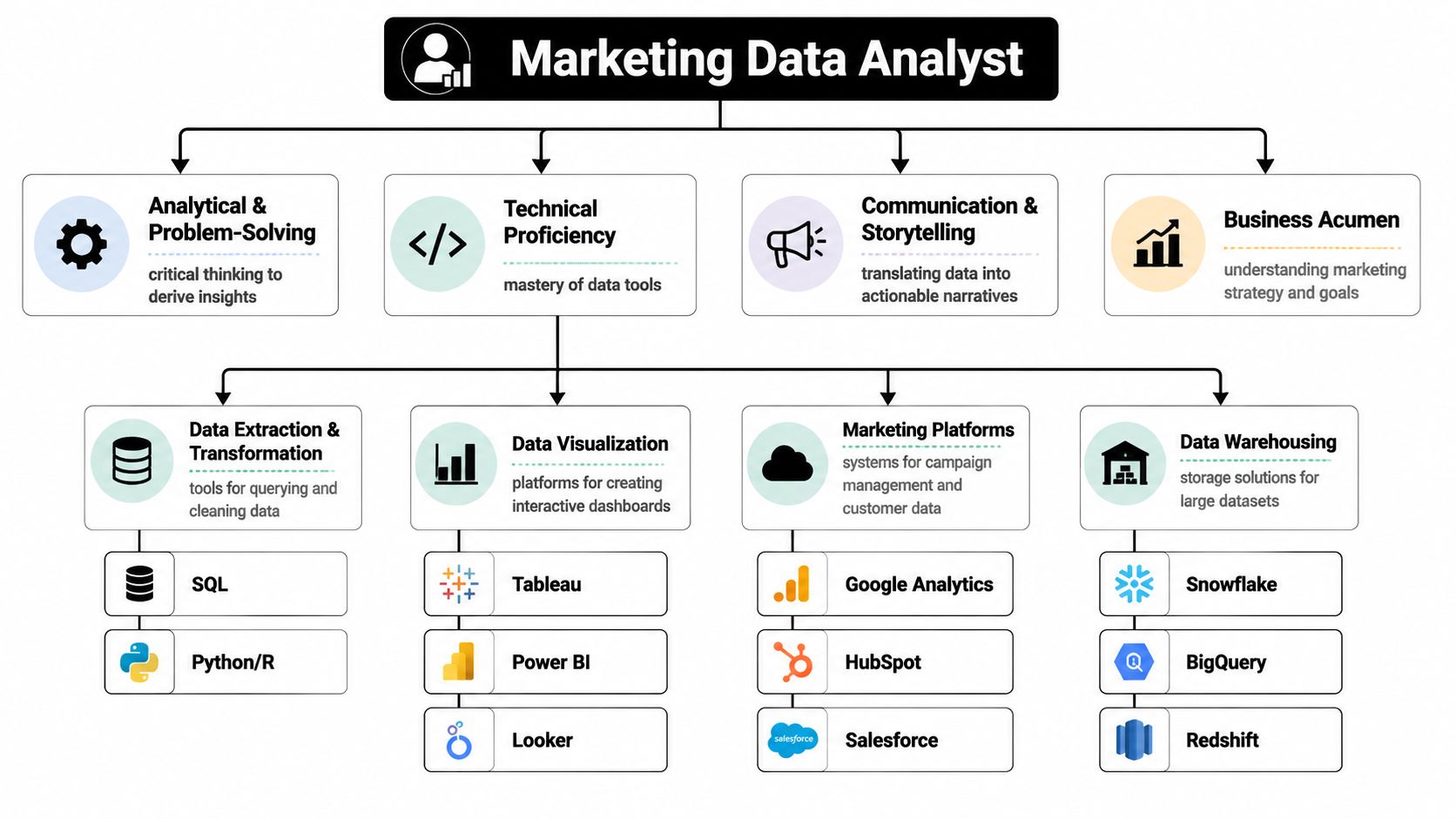
I usually coach analysts to learn in three layers, because each layer supports the next:
- Foundation layer: Excel, SQL, basic statistics, and spreadsheet hygiene. With this foundation, analysts learn to inspect joins, catch duplicate records, validate totals, and trace a metric back to its source.
- Working layer: Google Analytics, CRM reporting, and BI tools such as Tableau, Power BI, or Looker. These tools help teams monitor performance, but only if KPI definitions stay consistent across systems.
- Advanced layer: Python or R for automation, experiment analysis, forecasting, and repeatable data preparation. This layer saves time and reduces manual reporting errors once the basics are under control.
That sequence reflects real trade-offs. An analyst who knows SQL and metric logic can become productive quickly in almost any stack. An analyst who only knows a dashboard interface often gets stuck the moment attribution breaks or finance asks for a number reconciliation.
A useful stack has clear handoffs
Marketing analytics usually fails between systems. A platform logs a conversion one way, the CRM labels the lead another way, and the dashboard blends both without enough validation. The chart looks clean. The underlying record logic is not.
A practical stack usually includes:
| Capability | What it's for | Common tools |
|---|---|---|
| Extraction and transformation | Querying, cleaning, joining | SQL, Python |
| Visualization | Reporting and stakeholder access | Tableau, Power BI, Looker |
| Measurement platforms | Behavioral and campaign data | Google Analytics, HubSpot, Salesforce |
| Storage | Durable analysis layer | Snowflake, BigQuery, Redshift |
Strong analysts pay attention to naming conventions, source-of-truth rules, refresh schedules, and identity resolution. Those are not side concerns. They determine whether a CAC trend is real or whether a campaign appears to outperform because two systems count conversions differently.
For a broader platform comparison, this guide to best marketing analytics tools by use case is useful.
Skills that separate solid analysts from trusted ones
Technical skill gets an analyst into the room. Judgment keeps them there.
The non-technical skills that matter most are:
- Judgment: knowing whether a result is reliable enough to change budget, or only useful as a directional signal
- Communication: explaining the same issue differently to a CMO, paid media manager, and RevOps lead
- Business acumen: tying channel metrics to pipeline quality, revenue, margin, or payback period
- Skepticism: checking downstream outcomes before accepting platform-reported success
I would add one more skill that gets underestimated. Analysts need the discipline to document definitions and workflows. If no one knows how "marketing qualified lead" is being filtered in the dashboard, the report becomes fragile the second a field changes upstream. In practice, that documentation work protects more decision quality than another certification ever will.
Common Analyses and Key Performance Indicators
The cleanest way to understand the role is to watch the work through a normal operating week. Not a textbook week. A real one, where the analyst jumps between campaign triage, recurring reporting, and deeper diagnostic work.

A typical analysis week
On Monday, the analyst checks channel performance. Paid search is producing conversions, but lead quality looks mixed. The task isn't to admire CTR. It's to compare source performance against CRM outcomes and ask whether spend is producing valuable pipeline.
On Tuesday, they may run a funnel analysis. Where are people dropping out between landing page, form start, form completion, and qualified lead stage? Funnel work is useful because it isolates friction. If a campaign looks weak, the issue may be the handoff page, not the targeting.
Midweek often brings cohort analysis. How do leads from one campaign month behave versus another? Do they progress to meetings, opportunities, or renewals differently? Cohorts stop teams from overreacting to short-term spikes.
By Thursday, it may be segmentation. Enterprise prospects respond differently than SMB buyers. Existing customers behave differently than net-new visitors. Mixed audiences create misleading averages.
And when the business needs a tougher answer, strong analysts apply statistical analysis, attribution modeling, forecasting, and experimentation to determine which channels move revenue, using methods like regression and significance testing to separate signal from noise, as outlined by Harvard DCE's guidance on marketing analyst skills.
KPIs that deserve attention
The right KPI depends on the question. The mistake is treating all metrics as equally meaningful.
| Analysis type | Business question | Useful KPIs |
|---|---|---|
| Campaign performance | Which efforts deserve more budget? | ROI, conversion rate, CPA, CTR |
| Funnel analysis | Where are we losing people? | Step conversion rates, abandon points |
| Segmentation | Which audience behaves differently? | LTV, churn rate, AOV |
| Web and app behavior | Is the experience helping or blocking intent? | Bounce rate, time on page, page views |
| Experimentation | Did the change produce a real lift? | Conversion change, significance outcome |
For a more hands-on breakdown of methods and reporting logic, this guide to marketing data analysis is a practical companion.
The best KPI is the one that helps you make a decision. The worst one is the one that makes a slide look busy.
The Unsung Hero Data Quality and Enrichment
Most analysts learn this lesson the hard way. The model isn't wrong because regression is flawed. The model is wrong because the inputs were sloppy.
That's why data quality is the most impactful skill in marketing analytics. Not the flashiest. The most valuable.

Why messy inputs ruin smart analysis
Industry guidance notes that data preparation tasks such as identifying duplicates, handling null values, and standardizing formats can consume about 70% of an analyst's time, which is why data quality drives model accuracy and campaign measurement reliability, according to BrainStation's breakdown of data analyst skills.
That figure makes sense to anyone who has inherited a messy CRM. One lead exists three times under slightly different company names. Job title fields are blank or inconsistent. UTM fields aren't standardized. Sales updated one lifecycle stage manually while automation updated another. The dashboard still loads, but the analysis is compromised from the start.
A few common failure modes:
- Duplicate leads inflate volume and distort conversion rates.
- Missing fields weaken segmentation, routing, and scoring.
- Invalid emails create false negatives in nurture performance.
- Inconsistent naming breaks rollups across campaigns and channels.
- Unclear keys cause bad joins between ad, web, and CRM datasets.
Clean joins beat clever models.
A practical cleanup workflow
A disciplined analyst builds a repeatable process instead of fixing records by hand forever.
- Audit first. Profile the dataset before changing anything. Check nulls, unique values, duplicate patterns, and field completeness.
- Define business rules. Decide what counts as a valid lead, a usable company name, a standard country format, or a trustworthy source field.
- Normalize structure. Standardize naming conventions, date formats, casing, field types, and source mappings.
- Validate identity. Confirm whether contacts and companies are real, reachable, and consistently represented.
- Enrich where needed. Add missing professional context so segmentation and routing become usable.
- Transform for analysis. Create trusted reporting tables, not ad hoc one-off exports.
Enrichment earns its keep. If inbound records arrive with weak company, role, or contact detail, the analyst can't segment accurately. Enrichment closes those gaps so performance can be evaluated by persona, company type, or account segment instead of by a pile of “unknown” values.
A helpful reference on that workflow is this overview of marketing data enrichment, especially if you're trying to bridge CRM hygiene with campaign measurement.
What changes after enrichment
Before cleanup, the analyst spends time arguing about whether the numbers are believable. After cleanup, the conversation shifts to what the business should do.
That's the payoff.
A cleaned and enriched dataset supports better decisions in ways that matter immediately:
- Segmentation improves. You can compare performance by role, company type, or customer segment with more confidence.
- Attribution gets less fragile. Channel paths still won't be perfect, but they become more defensible.
- ROI analysis gets sharper. Costs and outcomes line up more reliably when duplicates and broken mappings are reduced.
- Recommendations carry weight. Stakeholders trust analysis that survives basic scrutiny.
The analysts who advance fastest are usually the ones who learn this early. They don't treat data cleaning as grunt work. They treat it as strategy protection.
Career Path Salary and Future Outlook
A lot of analysts picture the job as building dashboards and learning new tools. The people who rise fastest usually become trusted for something less visible. They protect data quality well enough that leadership will use the numbers to make budget decisions.

How the career usually develops
Compensation is solid because the work sits close to revenue, spend, and planning. Pay tends to rise as your scope expands from reporting outputs to measurement design, data governance, and decision support.
That progression usually looks like this:
| Stage | What you own |
|---|---|
| Early-career analyst | Reporting, QA checks, recurring dashboards, basic segmentation |
| Mid-level analyst | Funnel analysis, campaign diagnosis, attribution support, stakeholder recommendations |
| Senior analyst | Cross-channel strategy support, experimentation design, mentoring, trusted data definitions |
| Analytics or RevOps leader | Team process, measurement architecture, forecasting, executive guidance |
The title will vary by company. You'll see growth analyst, revenue analyst, lifecycle analyst, and marketing operations analyst. Ignore the label and read the operating reality of the role. Who owns source-of-truth definitions? Who fixes broken campaign mappings? Who is expected to explain why pipeline changed, not just report that it changed? Those details matter more than the title.
After the infographic, it's useful to hear how practitioners describe the work:
What the role is becoming
The market has less patience for passive reporting than it did a few years ago. Teams can get charts from almost any BI tool. What they still struggle to get is analysis built on clean joins, stable definitions, and enough process discipline that this month's dashboard matches last month's logic.
That changes the career path.
Junior analysts often start by pulling reports and checking numbers. Mid-level analysts get pulled into diagnosis. Senior analysts are often the people who notice that lead source values changed after a CRM sync update, or that paid social campaign names broke the cost mapping and made ROI look better than it was. That kind of judgment is what makes someone promotable.
The future outlook is strong for analysts who can handle imperfect measurement conditions. Privacy changes, platform discrepancies, and fragmented customer journeys mean exact attribution is often out of reach. Good analysts still produce useful answers. They define acceptable confidence, use multiple data points to test a conclusion, and say clearly where the limits are.
If I were advising a junior analyst on where to invest, I would put data QA, metric definitions, and pipeline debugging near the top of the list. SQL and dashboards get you in the door. Trust in your data gets you bigger scope, better pay, and a path into senior analytics, marketing operations, or RevOps leadership.
How to Land Your First Marketing Analyst Job
Getting hired for your first marketing data analyst role is less about claiming passion for data and more about proving you can solve small real problems cleanly.
A hiring manager usually wants evidence of three things. Can you work with messy data? Can you connect analysis to a business question? Can you communicate without hiding behind jargon?
Build proof not just a resume
A strong entry resume is focused, not broad. Don't list every platform you've ever touched. Highlight the handful you can use under pressure.
Your best moves:
- Show concrete projects. Build a portfolio with a funnel analysis, a cohort analysis, and one cleanup project where you explain how you fixed inconsistent data before analyzing it.
- Use realistic source material. Public datasets are fine, but marketing-flavored projects work better when they include campaign, CRM, or web behavior logic.
- Write like an analyst. Each project should state the question, dataset problems, method, findings, and recommendation.
- Include business language. Explain what decision the analysis supports.
A useful starter project is to take a sample lead list, identify duplicates, standardize company names, fill obvious missing fields, and then show how segmentation changes after cleanup. That demonstrates the exact judgment many junior candidates skip.
Interview for judgment not trivia
Technical interviews matter, but most hiring teams aren't trying to catch you on obscure syntax. They want to know how you think.
Expect prompts like these:
- A channel shows strong click performance but weak pipeline. How would you investigate?
- You find conflicting conversion numbers in GA and CRM. Which system do you trust?
- A stakeholder wants a dashboard by tomorrow, but the source data looks inconsistent. What do you do?
- How would you explain statistical significance to a non-technical manager?
Good answers share a pattern. Start with validation, define assumptions, segment the issue, and recommend a decision path.
A concise answer often beats a sprawling one.
“First I'd verify the tracking and definitions. Then I'd compare performance by segment and handoff stage. If the top-of-funnel metrics are strong but downstream quality is weak, I'd inspect audience mix, conversion path friction, and lead qualification rules before changing budget.”
That sounds like someone ready for the job because it reflects actual operating discipline.
If you're transitioning from another field, lean into overlap. Paid media specialists already understand campaign structure. SDRs understand lead quality and CRM friction. Marketing ops coordinators understand systems and lifecycle stages. The move is easier when you package your prior experience as evidence of analytical thinking, not just task execution.
If your team is spending too much time fixing contact records before you can trust your analysis, Icypeas is worth a look. It helps marketing, sales, and RevOps teams verify and enrich professional data so your reporting, segmentation, and downstream decisions start from cleaner inputs.



















































.png)



.webp)