.avif)
Biotechnology Sales Jobs: Your 2026 Career Guide


.avif)
Compensation in biotech sales can swing from a solid base-and-bonus corporate role to a field job where top performers more than double their base pay. That spread is why candidates get this market wrong. “Biotech sales” sounds like one career path, but hiring managers treat pharma, device, and supplier or vendor roles as different commercial tracks with different buyers, sales cycles, quotas, and promotion timelines.
I've seen candidates apply to all three as if the same resume will carry them. It usually does not. A rep selling into health systems, a specialist covering bioprocessing accounts, and an inside seller working lab budgets may all sit under the biotech umbrella, but they are not competing in the same lane.
The fastest way in is specificity.
Pick the sub-field that fits your background and tolerance for the job's realities. Pharma often rewards clinical fluency, patience, and strict compliance. Device sales tends to favor urgency, procedural credibility, and comfort in high-pressure accounts. Vendor and supplier roles usually put more weight on technical curiosity, account growth, and disciplined prospecting habits, including the kind of process covered in these B2B sales prospecting tools.
Candidates who break in faster do three things well. They choose a category early. They build proof that matches how that category sells. They interview with a clear view of how reps in that niche make quota, protect margin, and earn promotions.
Table of Contents
- The High-Stakes World of Biotech Sales
- The real job is translation
- What the work looks like day to day
- The baseline gets you into the process
- What hiring teams actually look for
- How to position a nontraditional background
- Interview performance matters more here than in many sales categories
- Why salary expectations go wrong
- How pay changes by sub-field
- What a real comp plan is paying you for
- What ambitious candidates should target
- Path one the field sales ladder
- Path two the technical commercial track
- How advancement really differs by sub-field
- What senior people look for before they promote you
The High-Stakes World of Biotech Sales
Top performers in biotech sales can build very different careers, and that is the first thing candidates usually miss. A rep selling capital equipment into hospital systems, an account executive selling lab platforms to research teams, and a vendor rep selling software or services into biotech companies may all carry a "biotech sales" label, but the pay structure, sales cycle, and promotion path are rarely the same.
That variance is the opportunity, and the risk.
Some roles offer faster closes and tighter territories. Others demand months of clinical, procurement, or budget review before a deal moves. Some jobs reward technical depth. Others reward new business discipline and account penetration. Candidates who treat biotech sales as one job category often aim at the wrong companies, quote the wrong compensation targets, and undersell the experience that matters for that niche.
I have seen strong candidates from research, pharma, device, and straight B2B sales win in this field. The ones who break through understand the business model behind the seat. Pharma can be driven by formulary access, physician relationships, and territory execution. Device often puts more weight on procedure support, stakeholder management, and comfort in clinical environments. Vendor and services roles usually demand cleaner prospecting, sharper pipeline control, and a higher tolerance for quota pressure. If you are building that side of your process, a solid stack of B2B sales prospecting tools helps you focus on the right accounts instead of burning time on broad outreach.
The money can be excellent. So can the pressure. Long sales cycles, technical products, and demanding buyers create a field where a good quarter can change your income, and a weak territory plan can bury it.
The fastest way to stall in biotech sales is to chase the title and ignore the business model behind the role.
What Exactly is a Biotechnology Sales Job
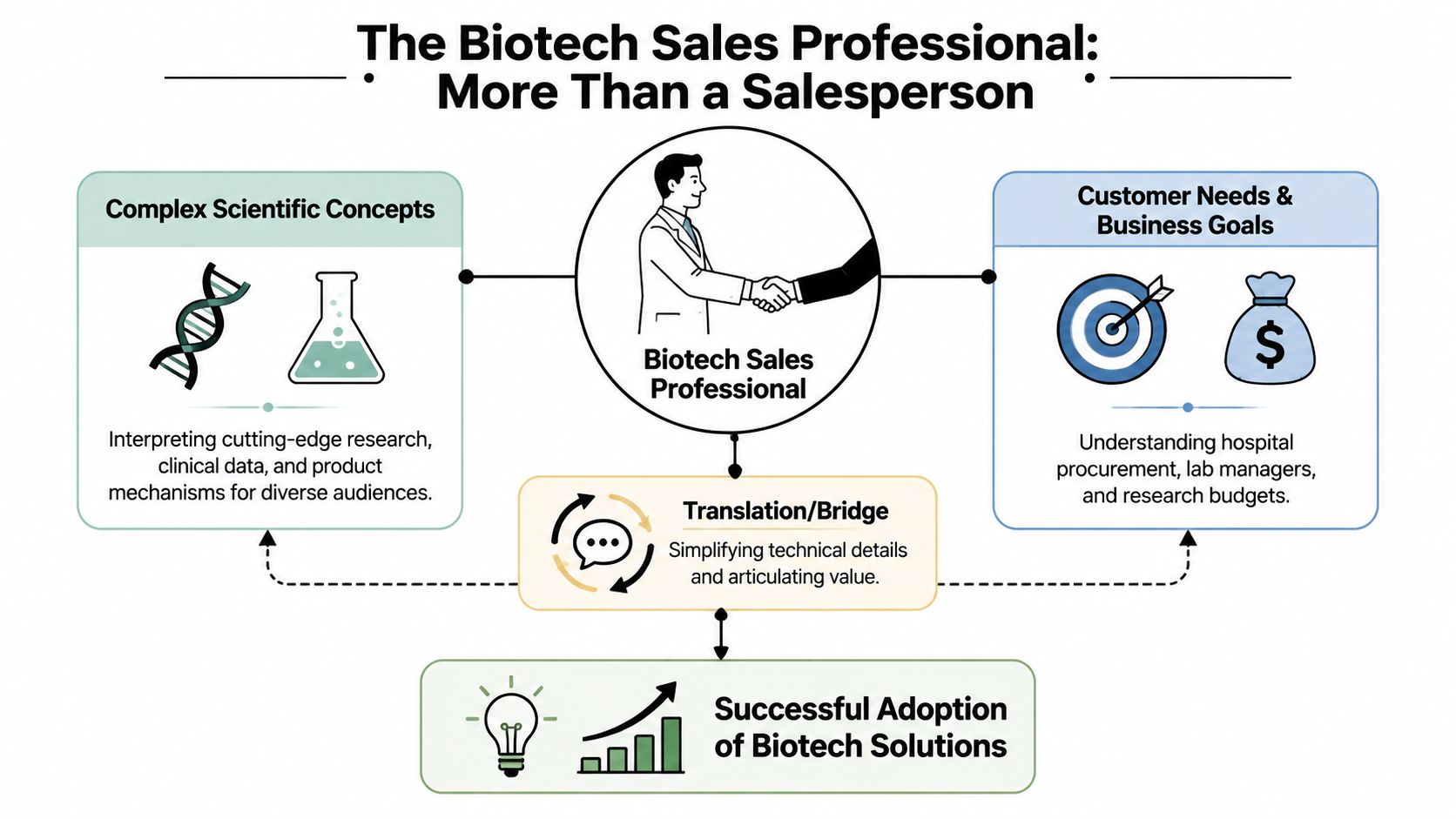
A biotechnology sales job is a translation job disguised as a sales role. You stand between technical innovation and a buyer who needs to justify risk, cost, workflow impact, and expected outcome.
The real job is translation
Scientists build products around mechanisms, data, process improvements, and performance characteristics. Buyers rarely purchase for those reasons alone. A hospital administrator wants to know whether the purchase fits budget and workflow. A principal investigator wants confidence in reproducibility and support. A procurement team wants contract clarity. A clinician wants to understand practical relevance.
The rep connects those priorities.
Done well, that means you don't recite product features. You convert technical detail into buyer-specific value. For one account, that could mean explaining a therapy's clinical rationale in plain language. For another, it could mean showing a lab manager why a platform fits existing protocols better than a rival system.
What the work looks like day to day
The daily work changes by sub-field, but the core pattern stays consistent:
- Educate customers: You explain mechanism of action, assay workflow, product fit, or process implications without drowning the buyer in jargon.
- Qualify buying intent: You learn whether the account has budget, urgency, a real use case, and internal alignment.
- Coordinate internal teams: You often work with field application scientists, medical affairs, marketing, legal, and operations before a deal closes.
- Defend value: In biotech, buyers often compare not just price, but validation burden, implementation friction, and long-term support.
- Manage long follow-up windows: Deals rarely close because of one meeting. They close because the rep keeps momentum alive across multiple stakeholders.
A strong biotech rep also knows when not to push. If the account isn't ready, overselling hurts trust. In this field, bad selling doesn't just lose a deal. It can knock you out of future opportunities in the territory.
Practical rule: If you can't explain a product to both a scientist and a finance-minded buyer, you're not ready for a serious biotech sales role.
The mission is straightforward. Help the right customer adopt the right scientific solution with enough confidence to act.
Decoding the Types of Biotechnology Sales Roles
Most candidates make the same mistake early. They search “biotech sales” and assume every posting leads to the same career economics. It doesn't. The role type shapes your training curve, your day, and your earning path.

Inside sales versus field sales
Start with operating model.
| Role type | Typical customer interaction | Work environment | Sales motion | Best fit |
|---|---|---|---|---|
| Inside sales | Remote calls, email, demos, distributor coordination | Office or home-based | Higher volume, shorter conversations, tighter activity metrics | Candidates with strong phone presence and process discipline |
| Field sales | In-person meetings, onsite demos, account visits, conferences | Territory-based travel | Lower volume, deeper account development, more autonomy | Candidates who build trust face to face and manage territories well |
Inside sales can be a strong entry point, especially for people moving in from adjacent B2B roles. Field sales usually carries more travel, more independence, and more direct ownership of major accounts.
The three buckets that matter most
The label matters less than the sub-field. These are the distinctions that shape real careers.
| Sub-field | Main buyers | What you sell | Technical depth required | Career reality |
|---|---|---|---|---|
| Pharmaceutical sales | Physicians, specialty clinics, health systems | Therapies and treatment portfolios | Clinical fluency and strong compliance awareness | Relationship-heavy, access-dependent, often structured territories |
| Medical device sales | Surgeons, hospitals, procedural teams | Devices, capital equipment, procedural tools | Product and procedure expertise, fast problem solving | High pressure, hands-on, often tied to live clinical workflows |
| Biotech vendor sales | Labs, bioprocess teams, research institutions, pharma manufacturing groups | Reagents, instruments, software, consumables, single-use systems | Often the deepest technical knowledge of the three | Strong fit for former scientists and application specialists |
Here's where the compensation myth breaks apart. Some major-market oncology biotech sales roles have total compensation targets exceeding $200,000 per year, and senior oncology roles can reach $500,000 annually with about half from commission, based on the market discussion summarized in this 2026 biotech sales compensation thread. That doesn't mean every biotech sales job works like oncology.
Research and vendor roles often reward technical credibility more than polished brand selling. Device roles can favor competitive stamina and procedural comfort. Pharma can reward persistence, territory discipline, and account access strategy.
What works in one category can fail in another:
- Pharma applicants often miss by sounding too technical and not commercial enough.
- Device applicants often fail when they underestimate the intensity of surgeon-facing environments.
- Vendor sales applicants often lose out when they can't prove enough scientific fluency to gain customer trust.
The right move is to choose the lane that matches your existing proof. If your background is lab-heavy, lean toward vendor or technical specialist roles. If you already know clinical environments and can handle field pressure, device or specialty pharma may fit better.
The Skills and Qualifications You Need to Succeed
Biotech sales hiring is less forgiving than candidates expect. Managers are not screening for general polish. They are asking a narrower question: can this person get productive fast in this specific sales motion?
That standard changes by sub-field.
A pharma team usually wants proof that you can work a territory, earn repeat access, and stay organized across long sales cycles. A device team cares more about composure in clinical settings, competitive grit, and the ability to influence under pressure. A vendor or research tools team often puts technical credibility much higher on the list because the buyer will test your understanding in the first conversation.
The baseline gets you into the process
For many roles, the starting point is simple. A bachelor's degree helps. So does some sales experience, customer-facing experience, or scientific training that clearly connects to the product and buyer.
That gets you considered. It does not get you hired.
I've seen candidates with strong biology credentials lose to reps with weaker academics but better commercial proof. Hiring managers will train product knowledge. They are much less interested in teaching resilience, objection handling, and quota discipline from scratch.
What hiring teams actually look for
Strong candidates usually show four things:
- Evidence you can sell: quota attainment, new account wins, competitive takeaways, renewal growth, or expansion inside existing accounts
- Relevant market fluency: familiarity with lab workflows, clinical environments, reimbursement pressure, provider offices, hospital systems, or procurement depending on the role
- Clear communication with technical buyers: the ability to explain a product accurately without sounding like a slide deck
- Operational discipline: account plans, call planning, follow-up habits, CRM hygiene, and a realistic approach to territory coverage
The weighting changes by lane. That is the part many applicants miss.
A candidate targeting pharma should sound commercially sharp and disciplined. A candidate targeting device should be ready to talk about urgency, presence, and how they perform in demanding buyer interactions. A candidate targeting research tools or diagnostics should show enough scientific fluency to earn trust quickly, then connect that knowledge to budget, workflow, and business value.
How to position a nontraditional background
Candidates break into biotech sales from a lot of starting points. Bench science, SDR work, clinical support, field applications, nursing, lab operations, and adjacent healthcare sales can all work. The trick is translation.
A research project is not just a research project. It can show that you handled complex information, influenced stakeholders with different priorities, and kept momentum through ambiguity. A lab support role can show customer empathy, troubleshooting discipline, and product fluency. An SDR background can show prospecting stamina, activity management, and comfort hearing no for weeks at a time.
What hurts candidates is presenting their background in the language of tasks instead of results.
If your resume reads like an academic CV, a hiring manager will assume you still think like a technical contributor. Biotech sales teams want signs of ownership. Lead with outcomes, then explain the environment. Name the account type, the problem, what you did, and what changed.
Interview performance matters more here than in many sales categories
Biotech interviews often test whether you can hold a credible business conversation with an educated buyer. You need enough technical grasp to avoid obvious mistakes, but you also need to move the conversation forward.
That means asking good questions, qualifying urgency, handling skepticism, and advancing next steps. If you need to sharpen that part, review this guide on closing a sale in a way that actually moves the deal forward.
One more reality check. The “right” skill profile depends on the role you choose. A scientist trying to break into vendor sales should emphasize credibility and customer conversations. A former B2B rep aiming for device should prove toughness and field readiness. A pharma candidate should show consistency, planning, and the patience to build access over time. Candidates who match their proof to the sub-field get interviews. Candidates who apply to all biotech sales jobs with the same pitch usually stall out.
Compensation Unpacked Salaries and Commissions
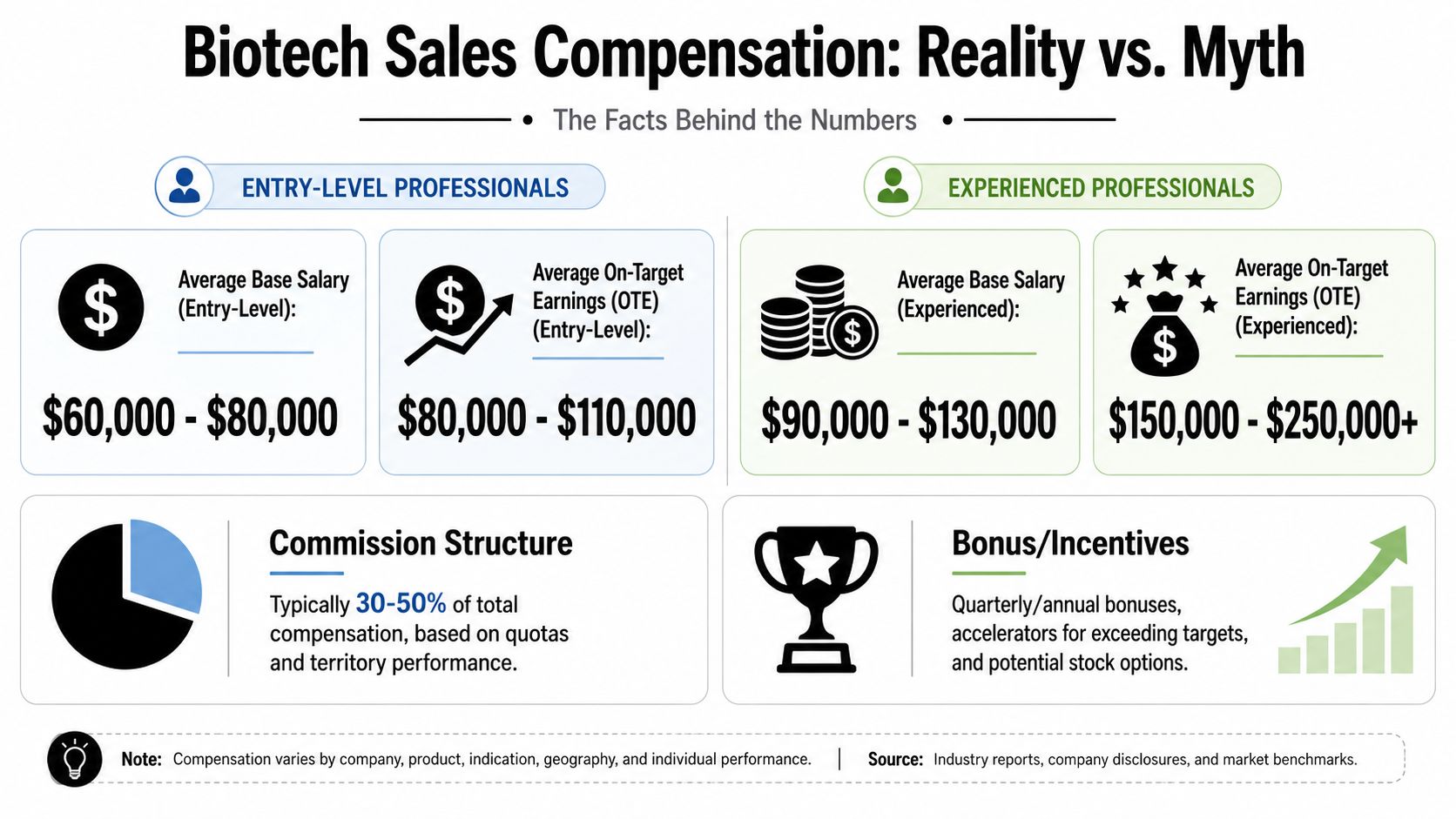
A candidate targeting "biotech sales" can be comparing a $55,000 starter package to a $200,000-plus earnings path and still be using the same job label. That gap is why compensation conversations go sideways.
Why salary expectations go wrong
Candidates often anchor on the highest number they saw on a job board. Hiring teams do the opposite. They price the role based on product complexity, quota risk, deal cycle, territory quality, and how long it takes a new rep to become productive.
That creates wide variance even before industry segment enters the picture. A local market snapshot from ZipRecruiter shows biotech sales openings in one city ranging from about $51,000 on the low end to about $150,000 on the high end, depending on seniority and fit, in this Pittsburgh biotech sales market snapshot from ZipRecruiter.
The mistake is treating that spread like one career ladder. It is several.
How pay changes by sub-field
Pharma, device, and vendor sales do not pay on the same logic.
Pharma sales usually offers steadier base salary, structured bonuses, and slower upside early on. The trade-off is predictability. Reps who perform consistently can build a solid income, but the jump to much higher earnings often takes a move into specialty territory, hospital accounts, or leadership.
Medical device and capital equipment roles tend to put more money at risk. Base pay can be lower relative to total on-target earnings, but strong closers in the right territory can out-earn many pharma reps. The trade-off is pressure. Fewer deals, higher stakes, and more volatile commission checks.
Vendor and life science tool sales sits in the middle, but the range is wide. An inside rep selling research consumables has a different pay profile from a field seller covering bioprocessing systems or enterprise software. Technical depth usually raises the base. Long sales cycles and complex accounts can also raise total comp once you prove you can carry a number.
One live example makes the point. A Senior Technical Sales Specialist listing for bioproduction in Southern California shows a base salary range of $113,000 to $168,000. That is not entry-level pay. It reflects a role where the employer expects product fluency, account strategy, and the ability to sell into a specialized buying group.
If you want a useful rule, use this one. The harder the product is to explain, the longer the sales cycle, and the more expensive a bad hire becomes, the more likely the company is to protect the rep with stronger base salary.
What a real comp plan is paying you for
Base salary pays for judgment, consistency, and the difficulty of the sale.
Commission pays for execution. Territory coverage, quota design, renewals, new logo wins, product mix, and margin all shape what you take home. Two reps with the same OTE can finish the year very far apart if one inherited a healthy book and the other had to build from scratch.
This is why smart candidates ask sharper questions in the interview process. Ask how many reps hit quota last year. Ask how long ramp takes. Ask whether commissions are paid on bookings, revenue, placements, or collected cash. Ask what percentage of the territory is existing business versus true hunting. Talent Pronto on complex role hiring makes the broader point well. Complex commercial roles need tighter screening because the wrong comp expectations and the wrong talent profile both get expensive fast.
What ambitious candidates should target
Early-career candidates often benefit from choosing the role that builds the right proof, not the one with the biggest advertised upside. A lower first-year package in the right niche can set up a much bigger move 18 to 36 months later.
In practice, that usually looks like this:
- Pharma path: Get in, learn territory management, hit plan, then move toward specialty, rare disease, oncology, or hospital-facing roles.
- Device path: Expect more field pressure and more variable pay, but stronger upside if you can handle procedural selling and quota swings.
- Vendor path: Use technical credibility to enter lab tools, diagnostics, bioprocessing, or software sales, then move toward larger accounts and more strategic products.
Compensation also changes by geography and access. A strong title in a secondary market may still pay less than a mid-level title in Boston, San Diego, or the Bay Area. That does not always make the lower-paying job a bad move. If the territory gives you real customer exposure and a chance to post numbers, it can be the better career bet.
One practical tactic helps here. Before interviews, identify the manager or recruiter and verify the right contact using tools for finding business email addresses for biotech hiring teams. Direct outreach can get you the comp details that never make it into the posting.
Do not ask, "What does biotech sales pay?" Ask, "What does this exact role pay in this sub-field, this market, with this quota design, and what does first-year attainment usually look like?"
Your Step-by-Step Biotechnology Job Search Strategy
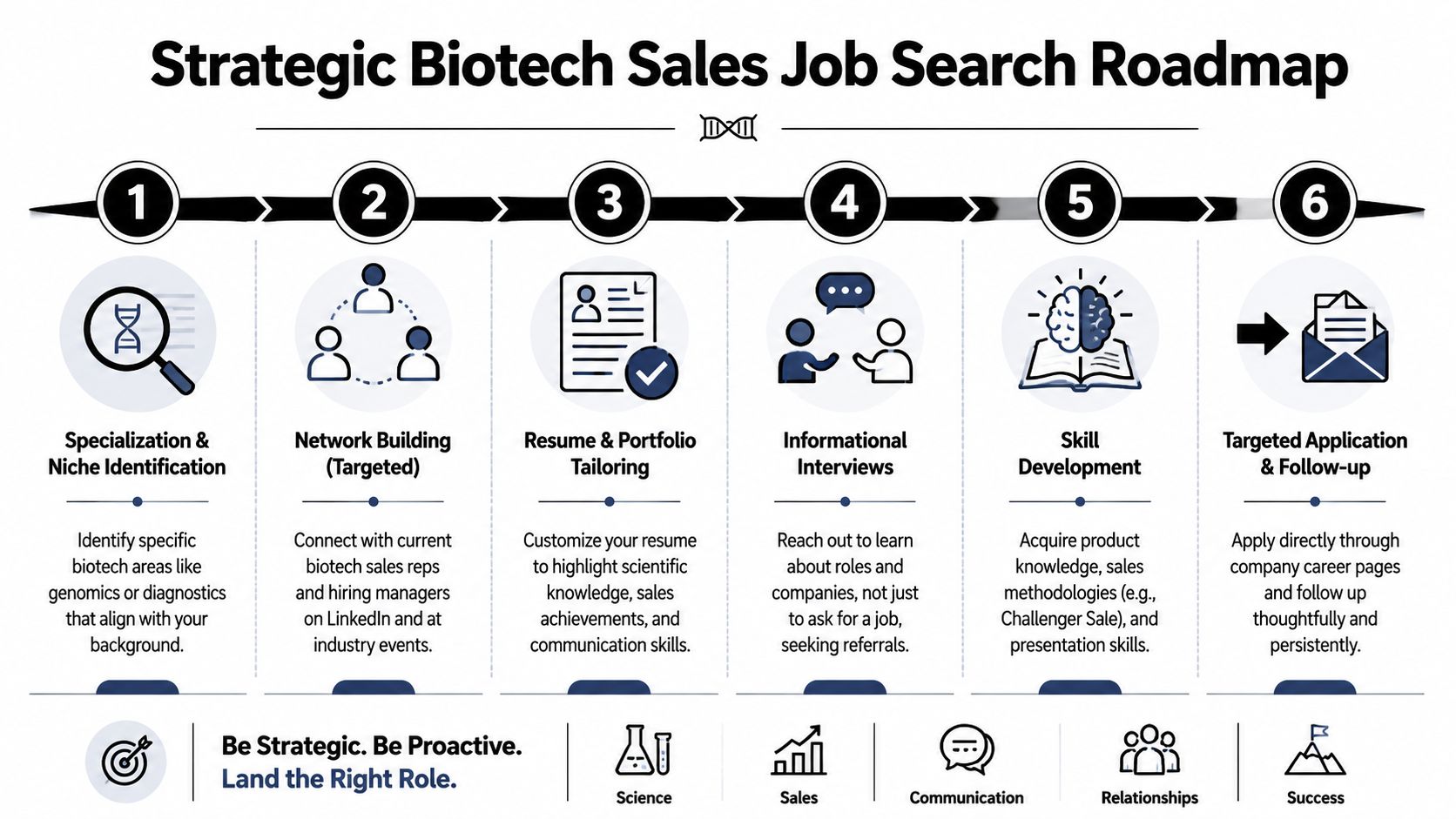
A generic application strategy won't get you far in biotechnology sales jobs. Too many applicants blast resumes at postings and hope the title does the work. It won't. You need a narrow target, direct outreach, and interview prep that shows commercial maturity.
Start with the roadmap below.
Build a focused target list
Don't begin on job boards. Begin with categories.
Pick one lane first. Clinical diagnostics, oncology, lab tools, bioprocessing, capital equipment, research software, or another niche that matches your background. Once the niche is clear, build a company list from manufacturers, distributors, and adjacent suppliers in that segment.
Then sort your list into three tiers:
- Best-fit companies where your background aligns naturally with product and buyer.
- Reach companies where the brand is strong but your profile may need a referral.
- Bridge companies that can give you the right first title even if they aren't your end goal.
For complex commercial roles, hiring teams often screen for niche fit more carefully than candidates expect. That's why this piece on Talent Pronto on complex role hiring is useful. It explains why generic applicant tracking filters often miss the signals that matter in specialized hiring.
A short video can help you think about how to approach the search with more intent:
Run a recruiter-friendly process
Once your list is built, your materials need to look like they belong to a seller, not a passive applicant.
- Tailor the resume: Mirror the language of the job description where it's honest to do so. If the role asks for territory management, pipeline generation, scientific communication, and cross-functional work, those concepts should appear in your experience.
- Write a useful message: Don't send “I'm interested in opportunities.” Send a tight note explaining why your background fits that product category and buyer type.
- Target people, not portals: Reach out to sales managers, directors, recruiters, and sometimes current reps in the geography.
If you need a clean process for finding the right decision-makers, this guide on how to find business email addresses is practical because targeted outreach is often what moves you from applicant pile to first conversation.
Most biotech sales interviews are won before the formal interview starts. The rep who got warm introductions and asked informed questions already looks lower risk.
Interview for commercial credibility
Biotech interviews often test three things at once. Can you learn technical material. Can you communicate it clearly. Can you move a deal forward.
Expect some version of these:
- A product explanation test where you simplify a technical concept for a mixed audience.
- A role-play involving objection handling, account prioritization, or a stalled deal.
- A strategy discussion about how you'd enter a territory or build a book of business.
Bring a point of view. If they ask for a 30-60-90 day plan, don't make it vague. Talk about product immersion, territory analysis, top account mapping, internal shadowing, and early customer discovery.
The candidate who sounds operational gets remembered.
Career Paths and Long-Term Advancement
A candidate who says they want "a biotech sales career" is usually describing three very different careers without realizing it. Pharma, device, and life-science vendor roles can all sit under the biotech umbrella, but the income profile, sales cycle, buyer pressure, and promotion path are not the same.
That matters over the long run. The rep who thrives selling capital equipment into hospital systems may stall in a reagent or platform role. The seller who dominates in research tools may hate formulary access work or procedural selling in the OR.
Path one the field sales ladder
This is the classic revenue track. You start as an associate rep, inside rep, or junior territory rep. The first milestone is not your title. It is a year or two of clean execution, quota progress, account coverage, and a manager who trusts your forecast.
After that, the road splits by sub-field.
In pharma, advancement often means larger territories, better call plans, tougher access environments, and eventually specialty products or key accounts. The title may change slowly while the compensation changes fast.
In device, the path can accelerate faster for reps who can handle case support, surgeon relationships, and procedural pressure. The upside can be excellent, but the lifestyle cost is real. Early cases, late add-ons, and unpredictable schedules wash out plenty of smart candidates.
In life-science vendor sales, which includes instruments, diagnostics, software, CRO services, and lab suppliers, the ladder usually rewards account growth, technical fluency, and multi-stakeholder selling. You may move from territory ownership to strategic accounts, enterprise sales, or regional leadership without ever looking like a traditional pharma rep.
Strong field reps usually move into one of four destinations:
- larger territories with bigger numbers
- national or strategic accounts
- district or regional management
- business development or commercial strategy
Managers do not promote charisma. They promote repeatable performance, sound judgment, and reps who make the team better.
Path two the technical commercial track
This route fits candidates whose advantage is scientific credibility paired with selling discipline. Typical entry points include applications, product specialist roles, technical support with a quota component, or specialist overlays tied to a platform.
These jobs often look less glamorous from the outside. They are not. In many companies, the technical commercial seller becomes the person who rescues a complex deal, handles the evaluation, and gives the buyer enough confidence to move. That makes this path valuable and, in the right organization, very well paid.
The trade-off is clear. You may have less territory autonomy than a pure hunter, but you can build stronger defensibility because your expertise is harder to replace.
Over time, this track can lead to:
- senior specialist roles across a product family
- strategic account coverage for complex portfolios
- product marketing
- sales enablement or training for technical teams
- commercial leadership over a specialized segment
I have seen candidates underestimate this route because they assume "real sales" only happens in a territory bag-carrying role. That is a rookie mistake. In diagnostics, instruments, and advanced platforms, the technical seller often influences the biggest deals in the region.
The best long-term career move is not choosing the most impressive title first. It is choosing the lane where your advantage compounds.
How advancement really differs by sub-field
Here, candidates make better career decisions.
Pharma tends to offer clearer brand recognition and structured training. It also tends to have tighter message control, more compliance constraints, and less room for technical differentiation at the rep level. Good for candidates who want a polished commercial system and can win on consistency.
Device often rewards intensity, resilience, and comfort in high-pressure clinical environments. Promotion can come quickly, but so can burnout. Good for candidates who want direct procedural impact and can tolerate a schedule that regularly ignores personal plans.
Vendor and tools sales usually give you the widest range of exits. You can move into enterprise accounts, product, partnerships, market development, or broader commercial leadership. Good for candidates who want variety and are comfortable selling to scientists, lab managers, procurement, and finance in the same deal cycle.
If you are also comparing biotech sales against adjacent field roles, this medical science liaison content helps clarify the difference between a quota-carrying commercial path and a medically focused scientific path.
What senior people look for before they promote you
Past a certain point, quota attainment alone is not enough.
Promotion decisions usually come down to a short list. Can you grow revenue without constant intervention. Can you handle a messy account without creating internal chaos. Can you coach newer reps, influence cross-functional teams, and protect margins while still closing business.
That is why some top individual contributors never become strong managers, and why some mid-pack reps with sharp operational judgment move up faster than flashier peers.
Choose your lane early, but not blindly. A biotech sales career can lead to excellent money and real leadership opportunities. The candidates who advance farthest are the ones who understand that "biotech sales" is not one job type. It is a collection of commercial careers with different reward curves, different stress profiles, and different definitions of winning.
Is a Career in Biotech Sales Right for You
Biotech sales is a strong fit for a specific kind of person. You probably belong in it if you like competition, don't mind accountability, and enjoy turning complex material into decisions customers can act on. You probably won't enjoy it if you want a low-pressure schedule, dislike follow-up, or hope the science alone will carry the conversation.
The attraction is obvious. You can build a career close to innovation, work on products that matter, and earn exceptionally well in the right niche. The friction is just as real. Travel can be heavy, sales cycles can drag, and buyers often require proof from multiple angles before they move.
If you're still comparing paths, it helps to contrast biotech sales with adjacent scientific careers. This medical science liaison content is useful for that because it highlights a different kind of field-based science role, one that's less quota-driven and more medically focused.
Ask yourself a few hard questions. Do you want to own a number. Can you recover fast from rejection. Are you comfortable persuading highly educated buyers. Can you stay sharp when the product, market, and territory all shift at once.
If the answer is yes, this field is worth pursuing seriously.
If you're building outbound lists for biotech hiring outreach, prospecting into life sciences accounts, or enriching recruiter and hiring-manager data at scale, Icypeas is a practical option. It helps teams find and verify professional contact data, enrich records, and keep outreach cleaner so you spend less time guessing and more time getting real conversations started.


































































.png)



.webp)