.avif)
Best Email Validation Software: Top Tools 2026


.avif)
You spent weeks building the campaign. The copy is tight, the targeting feels right, and the list looked solid in a spreadsheet. Then the bounce notifications start rolling in. A bad list doesn't just waste sends. It drags down sender reputation, puts your domain at risk, and can shut off a channel your team depends on.
That risk is bigger now because validation isn't a nice-to-have anymore. By 2025, more than 70% of mid-size and large B2B firms routinely validate and re-screen prospect email lists before major campaigns, up from roughly 35% to 40% at the start of the 2020s, according to research summarized in Hunter's guide to email verifiers. Major mailbox providers have also become less forgiving, and promotional sends with hard bounce rates above the low single digits can trigger throttling or reputation damage, which is one reason validation is now part of CRM onboarding and outbound workflows rather than an occasional cleanup step.
If you're comparing the best email validation software, feature checklists won't get you far. Most tools can run syntax checks and DNS lookups. The key question is which one helps you send safely, classify risk accurately, and fit the way your team works.
How We Evaluated These Tools
To cut through the noise, we analyzed each tool based on four practical criteria:
- Accuracy & Reliability: We looked beyond marketing claims, focusing on real-world performance, especially with tricky catch-all, Google, and Microsoft servers.
- Core Features & Use Case: How well does the API work? What are the rate limits? Is it built for bulk cleaning, real-time form validation, or both?
- Best-Fit Persona: Is this tool best for a developer, an SDR, a marketing agency, or a CRM manager?
- Pricing & Compliance: We examined pricing models, credit expiration policies, and GDPR/CCPA alignment.
For a broader stack decision, it also helps to compare platforms with Toolradar.
Table of Contents
1. Free Email Verifier Verify B2B Contacts Instantly | Icypeas
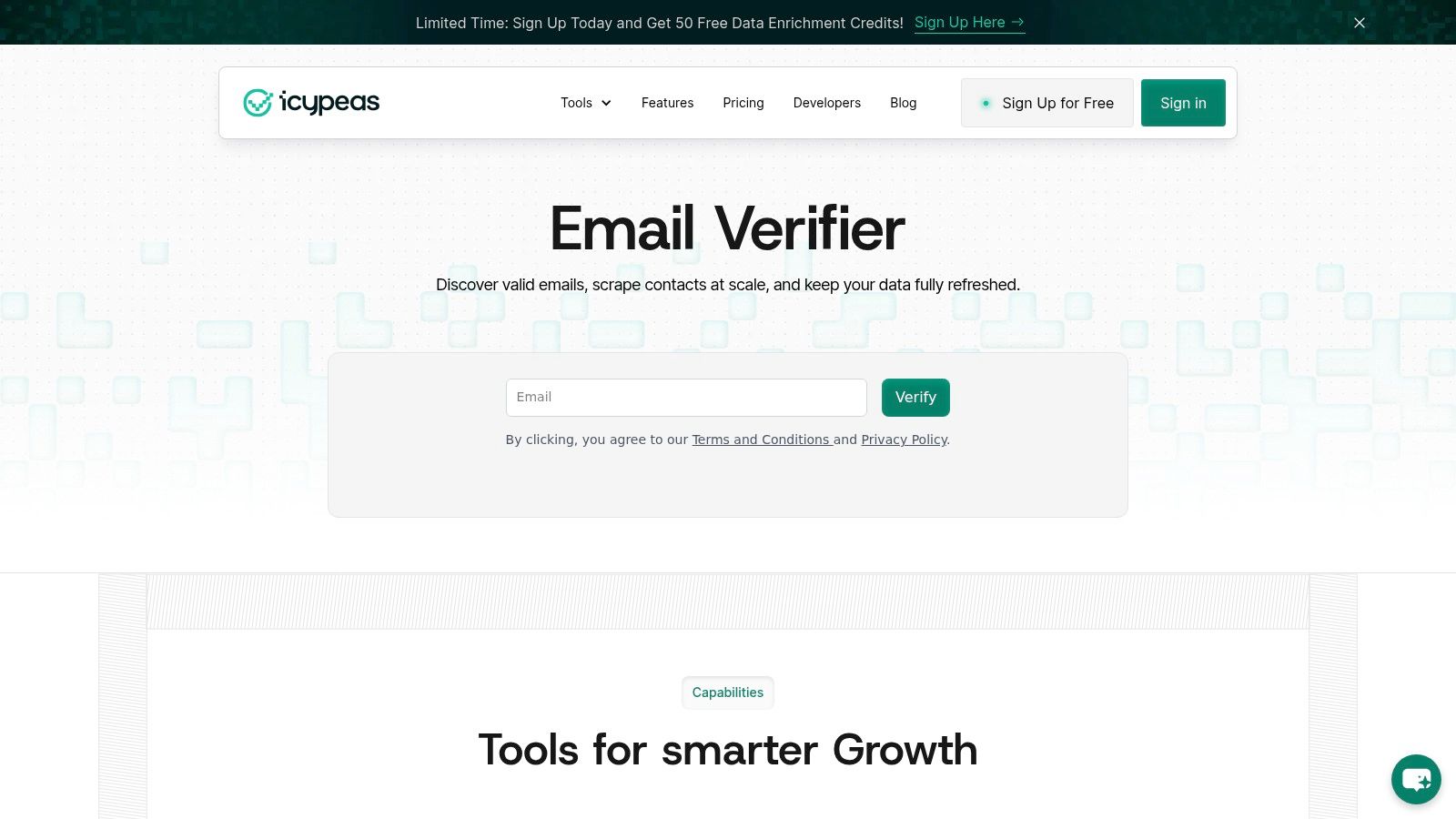
Icypeas Free Email Verifier is the one I'd put in front of a B2B sales team that cares about deliverability first and convenience second. That's an important distinction. Plenty of tools are fine for a quick yes or no check, but Icypeas is built around professional contact data, catch-all handling, and the reality that most outbound damage comes from sending to risky work addresses that looked valid on paper.
The free verifier is useful for spot checks, but the bigger value is how the full platform fits into real workflows. You can use it for bulk cleaning, API-based validation, and reverse lookup when a contact needs more context before outreach. That matters for SDRs and RevOps teams because validation rarely happens in isolation. It usually sits next to enrichment, routing, and CRM syncs.
Why Icypeas stands out
The strongest part of Icypeas is its B2B specialization. It isn't trying to be everything to everyone. It's tuned for work emails, major provider behavior, and catch-all environments that routinely trip up lightweight verifiers. For teams prospecting into Google Workspace and Microsoft-heavy companies, that focus is practical, not cosmetic.
It also helps that the platform is built for operators, not just list uploaders.
- Flexible usage: Credits don't expire, which is much easier to manage when verification happens in bursts.
- Developer-friendly setup: API access, high uptime, and generous rate limits make it easier to plug into forms, CRMs, and outbound systems.
- Compliance posture: Icypeas aligns with GDPR and CCPA, uses open-source intelligence, and is hosted on ISO 27001 infrastructure.
- Workflow depth: Reverse email lookup and broader data enrichment give teams a path from validation to action.
Practical rule: If your pipeline lives on outbound prospecting, a validator that understands professional addresses is usually worth more than a cheaper tool built mainly for generic consumer list cleaning.
Best fit and trade-offs
Icypeas is best for B2B sales teams, lead-gen agencies, CRM owners, and product teams that need validation inside a broader contact-data workflow. It's especially strong when you want one vendor to help with finding, checking, and enriching professional contacts instead of stitching together several point tools.
The trade-off is straightforward. The free verifier is excellent for instant checks, but serious bulk usage and automation require a paid plan. It's also primarily optimized for B2B addresses, so if your world is mostly personal inboxes or fresh signup traffic from mixed consumer domains, another tool may be a better fit.
2. ZeroBounce
ZeroBounce has been around long enough that most email operators have either used it or evaluated it. That maturity shows up in the product. You get bulk cleaning, a real-time API, broad integrations, and a detailed result taxonomy that gives RevOps and deliverability teams more control than basic pass-fail tools.
What I like most about ZeroBounce is that it behaves like an operational platform rather than a simple checker. It gives teams enough classification detail to make policy decisions inside their CRM or sending workflow. If your rule set varies by segment, source quality, or campaign type, that flexibility matters.
Where ZeroBounce is strongest
ZeroBounce is a good fit for teams that want mature documentation, a recognizable brand, and more nuanced filtering. If you're comparing vendors and want a second opinion on how providers differ in classification depth and workflow fit, this email verification services comparison from Icypeas is a useful companion read.
The trade-offs are mostly around cost and expectations. ZeroBounce tends to sit above budget tools on pricing, and no provider can perfectly resolve every catch-all mailbox because that's an industry-wide limitation, not a product flaw.
Some teams buy ZeroBounce for peace of mind as much as for validation itself. That's reasonable if you need process, SLAs, and broad ecosystem support, not just cheap credits.
For enterprise-style teams with compliance review, multiple stakeholders, and a need for granular statuses, ZeroBounce remains one of the safer picks in the best email validation software category.
3. Bouncer
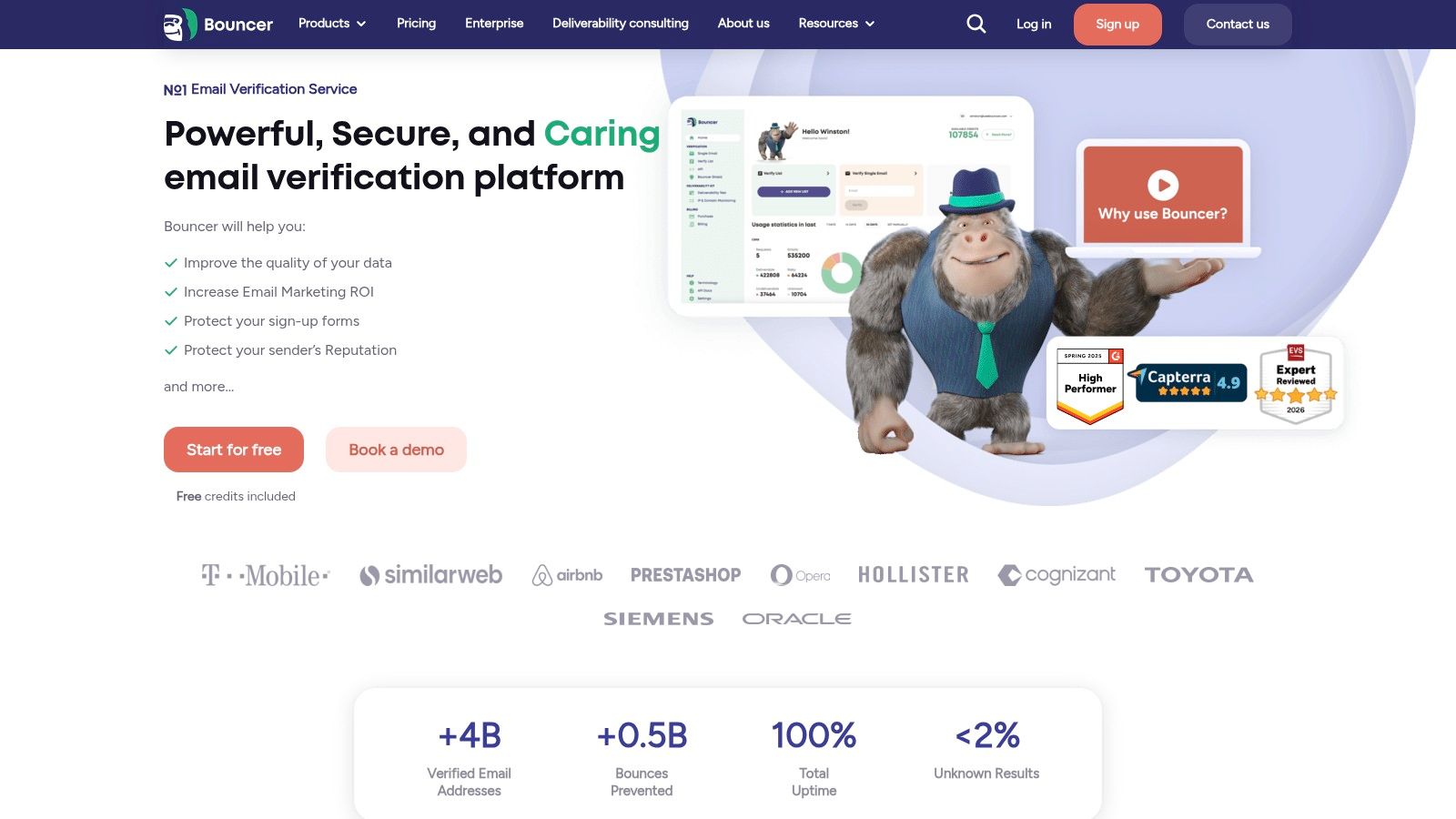
Bouncer makes sense for teams that validate in bursts, not on a rigid schedule. A sales team buys a list before a quarterly outbound push. RevOps cleans records ahead of a CRM migration. Marketing scrubs old newsletter segments before reactivation. In those cases, non-expiring credits are more than a pricing detail. They reduce waste and make the tool easier to keep on hand without forcing monthly volume commitments.
From a deliverability-first standpoint, Bouncer does its job well because it stays focused on one thing: helping teams remove bad addresses before they hurt bounce rates and sender reputation. That focus matters if the primary goal is inbox placement, not just a cleaner spreadsheet. Bouncer gives teams bulk verification, API access, and clear handling for risky, unknown, and catch-all outcomes, which is usually enough to set practical sending rules.
Why teams pick Bouncer
Bouncer fits operators who want a verifier that is easy to run and easy to justify financially. Its credit system and product documentation are built around flexible usage, which is useful for agencies, outbound teams, and companies with irregular list-cleaning cycles.
The trade-off is depth outside the core verification workflow. You are not buying a broader data platform or a large integration marketplace. For some teams, that is a limitation. For others, it is exactly the point. If your stack already covers enrichment, CRM automation, and deliverability monitoring, a narrower verifier can be the cleaner choice.
I usually place Bouncer in the shortlist for CRM hygiene projects, pre-campaign list scrubs, and smaller outbound programs that care about protecting domain health without paying for extra modules they will not use. Teams that need a wider process for improving email deliverability across list quality, segmentation, and sending behavior should treat Bouncer as one layer of the system, not the whole answer.
If you're evaluating strictness and status quality across vendors, the Icypeas benchmark on email verifiers is a smart reference point.
4. Kickbox
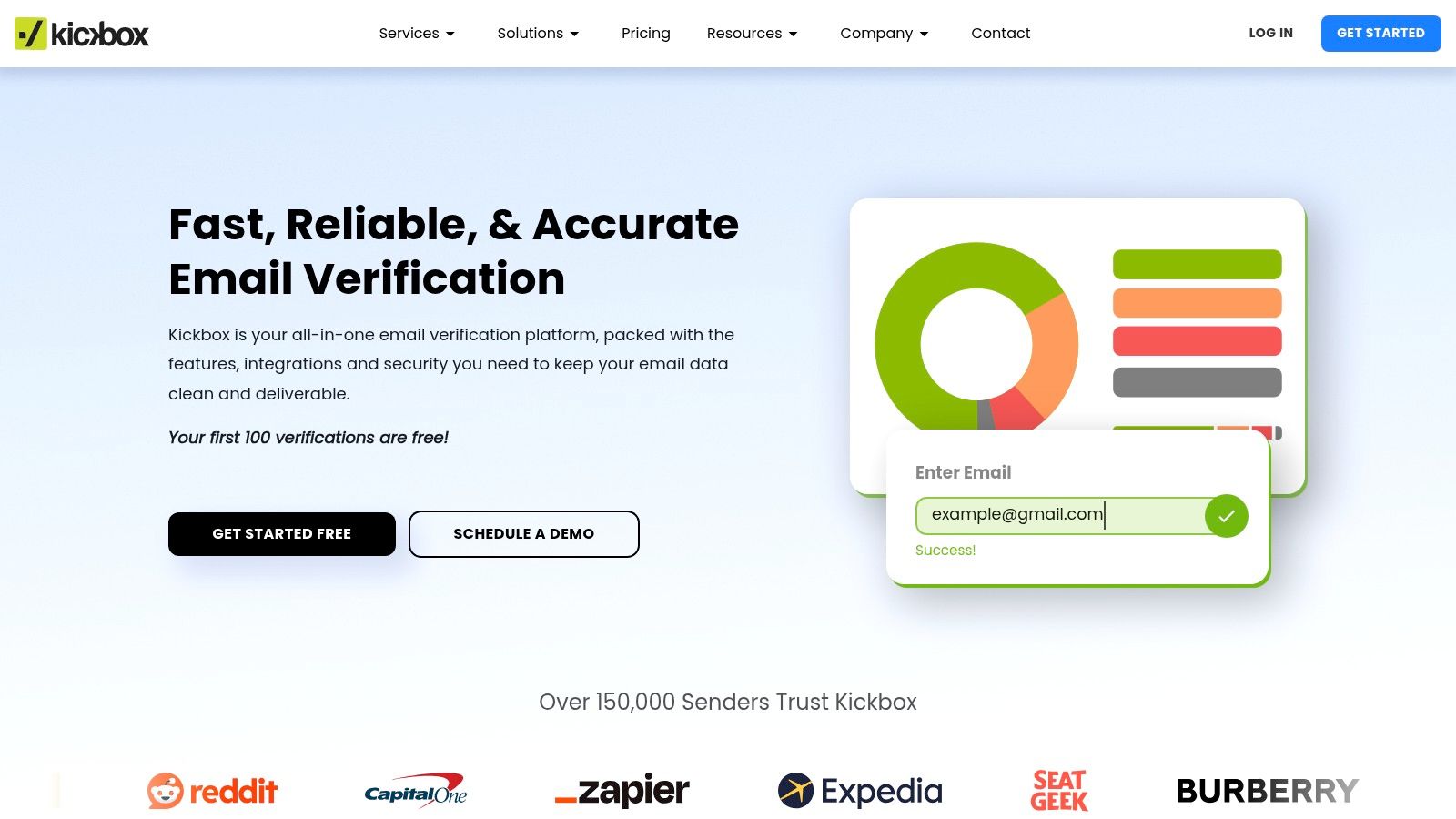
Kickbox is one of the easiest tools to pilot if you want fast onboarding and low friction. It covers the basics well: bulk verification, a real-time API, and form-time validation flows that work for lead capture and ecommerce-style entry points.
That form-layer usefulness is where Kickbox often earns its keep. If the problem starts at the moment a user types an address into a form, catching bad entries before they reach the CRM is often better than cleaning them after the fact. Kickbox has long been popular because it makes that use case approachable.
Where Kickbox fits best
Kickbox is a strong choice for marketing teams, SaaS companies, and operators who want a familiar verifier with marketplace availability and straightforward setup. It doesn't ask for a lot of technical investment to get value from it.
The downside is that it stays fairly focused on verification. If you also need enrichment or broader contact intelligence, you'll likely pair it with another vendor. At high volumes, per-unit pricing can also become less attractive than some value-focused competitors.
For teams trying to improve inbox placement, it's worth remembering that validation alone doesn't solve everything. List quality, segmentation, cadence, and sending behavior all matter, which is why guidance on how to improve email deliverability is often just as important as the verifier you choose.
Kickbox isn't the most feature-dense option on this list. It is one of the cleaner ones.
5. Clearout
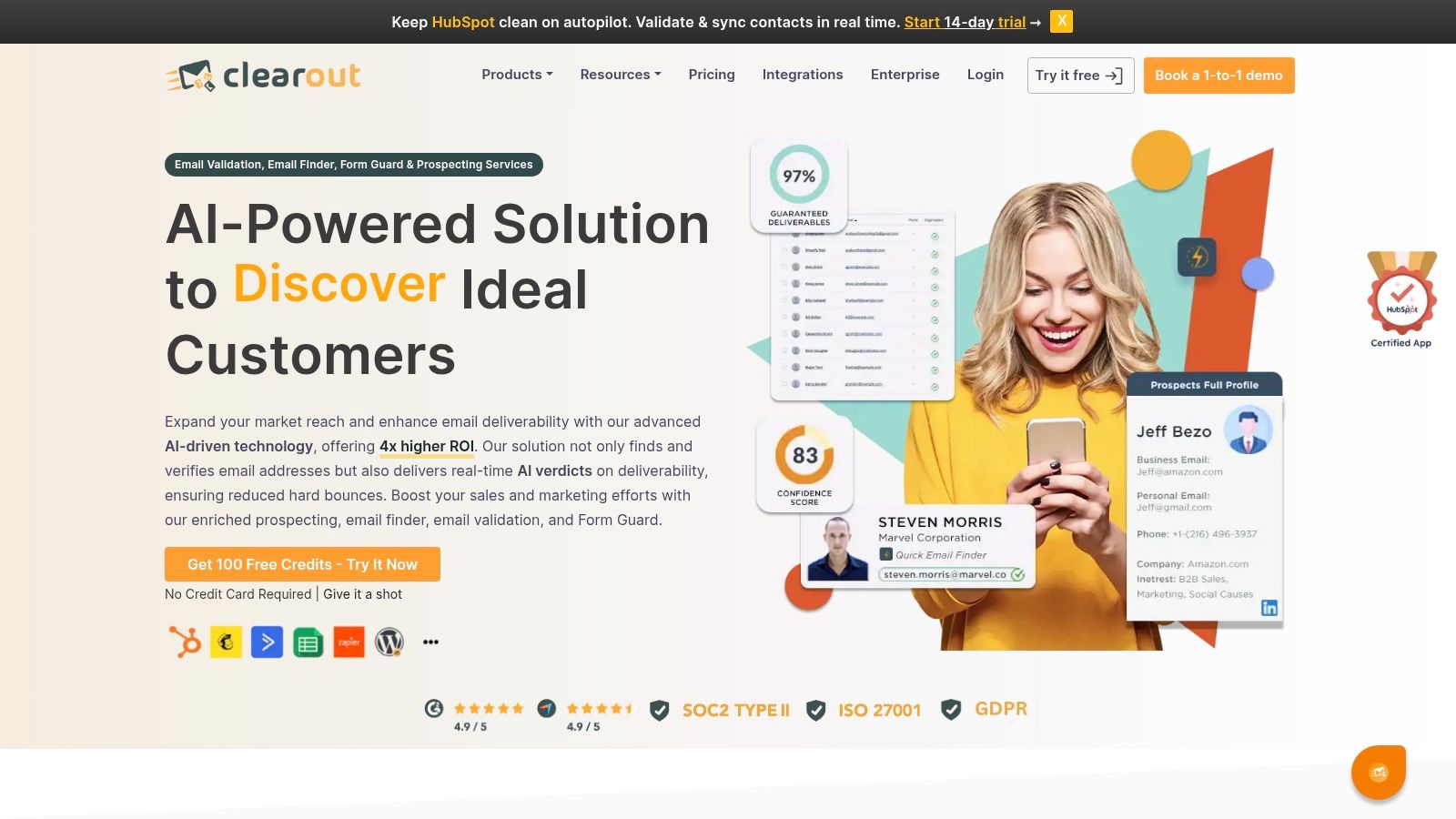
Clearout stands out because it tries to reduce ambiguity for operators. A lot of validation tools talk about accuracy in broad terms, but Clearout is more explicit about its Safe-to-Send and Guaranteed Deliverable framework for certain result categories. That kind of written guardrail is useful when a sales leader asks, "Can we mail this segment or not?"
The product also gives teams more than one entry point. You can use batch cleaning, API validation, and form-time checks, then extend into add-ons like Google Sheets and WordPress when non-technical users need access.
What makes Clearout different
Clearout is a practical fit for teams that want operational rules, not just raw outputs. If several people touch data quality decisions, having documented sending criteria can help keep everyone aligned.
Cadence and consistency affect deliverability outcomes. Independent deliverability research summarized by Mailtrap notes that B2B senders who clean and validate lists before every campaign see median bounce reductions of 40% to 60% compared with one-time list hygiene, and a 2024 M3AAWG report cited there found that senders with consistent validation, segmentation, and list hygiene saw 30% to 50% fewer blocks from major mailbox providers than teams validating only once or sporadically, as covered in Mailtrap's review of email verification tools.
Don't treat validation as a one-and-done import task. The teams with the best sending reputation build it into campaign operations.
The trade-off with Clearout is that its guarantee only applies to specific statuses under specific timing conditions. That's still useful, but you need to read the rules carefully. The interface also feels more functional than polished.
6. DeBounce
DeBounce is the budget-conscious operator's pick. It offers the core pieces that are generally required, bulk verification, API access, a form widget, duplicate removal, and non-expiring credits, without trying to package itself as an all-purpose sales data platform.
That simplicity works in its favor. If your goal is list hygiene and you don't want to pay for adjacent features you won't use, DeBounce is easy to understand and easy to budget.
Where DeBounce earns its place
DeBounce is a good fit for small teams, agencies, and in-house marketers who need to stretch verification spend. Public pricing, clear packaging, and duplicate handling make it easier to estimate cost before procurement gets involved.
The biggest caution is the same one that applies across the category. Catch-all validation remains imperfect industry-wide, so budget tools and premium tools alike have to manage uncertainty there. DeBounce also keeps enrichment fairly light, so teams that want contact context or account-level intelligence will need another product in the stack.
There is a broader market reason these focused verification tools keep showing up in serious stacks. Independent market research projects the global email verification software market to grow from about USD 1.4 billion in 2025 to roughly USD 3.8 billion by 2034, a projected CAGR of about 11.6%, according to Dataintelo's market report. Buyers keep funding this category because clean sends are directly tied to channel health.
If low-friction verification is the main requirement, DeBounce does the job.
7. Emailable
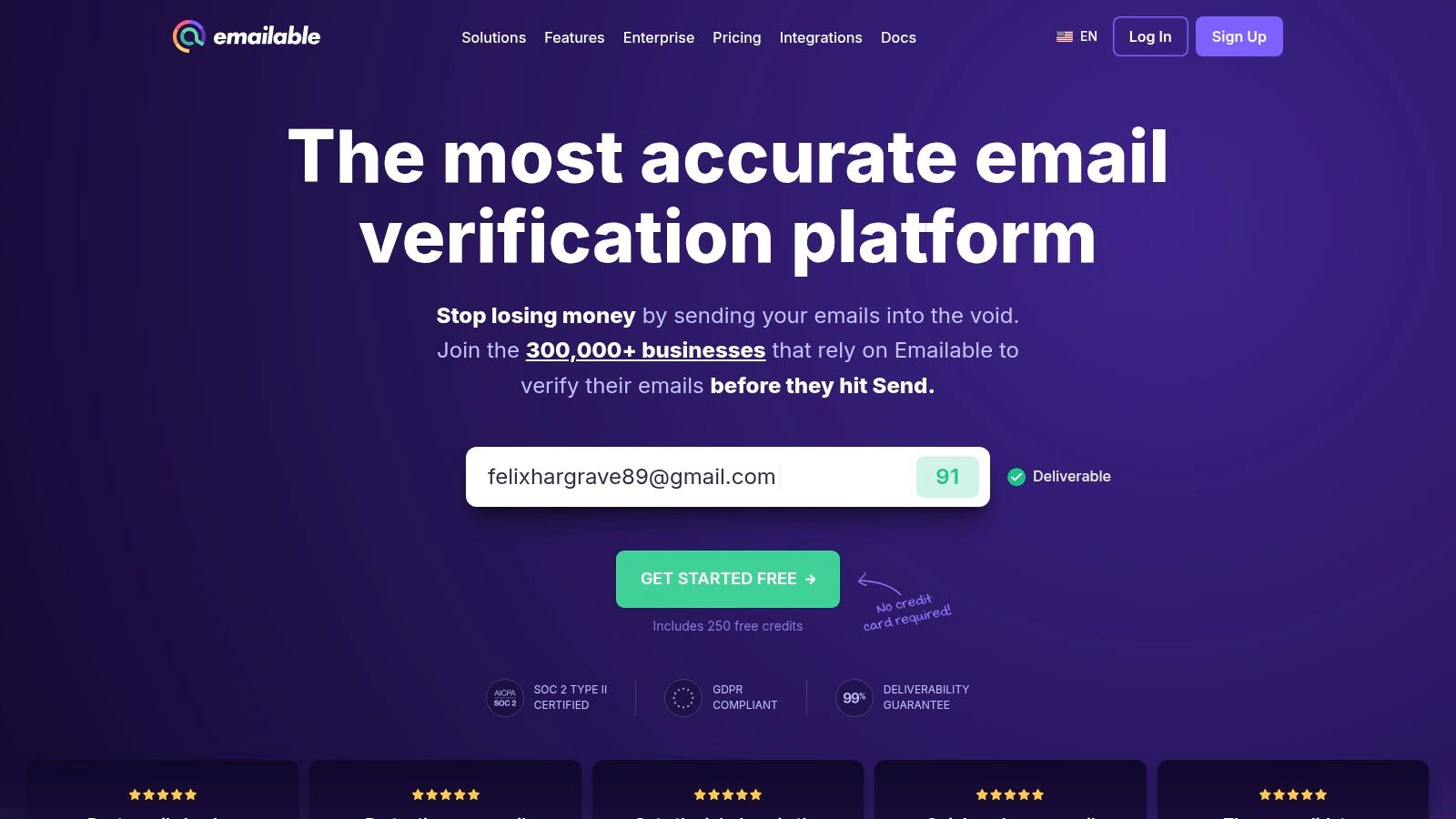
A common ops problem looks like this. Marketing needs a bulk cleanup before a campaign, sales wants real-time checks on form fills, and RevOps needs a vendor they can defend in a security review. Emailable is one of the few tools in this tier that handles that mix cleanly without turning into a broader data platform.
From a deliverability-first perspective, that matters. Verification only helps sender reputation if the process is consistent, the statuses are understandable, and the team trusts the results enough to use them before every send. Emailable does a good job on that operational side with bulk verification, single checks, API access, and form verification, plus clear policies around refunds for unknown results.
That last point is more important than it sounds. If a vendor is vague about what happens to inconclusive addresses, teams either over-trust the output or waste time second-guessing it. Emailable reduces some of that friction.
Why Emailable works in real workflows
Emailable fits teams that want email validation to protect list quality first, then add deliverability monitoring if needed. Its inbox placement and blacklist monitoring features are useful for diagnosing reputation issues, but they stay adjacent to the core verification product instead of overshadowing it.
I also rate it well for procurement and compliance conversations. Emailable publishes a status page and trust-center style documentation, which helps security, legal, and RevOps evaluate how the service is run before it touches production data. That does not replace a full internal data-mapping exercise, but it gives buyers more to work with than a thin marketing page.
The trade-off is scope. Emailable is not the pick for teams that expect built-in lead finding, enrichment, or account intelligence. If your job is sales prospecting, you will still need another tool for sourcing contacts. If your job is CRM hygiene and protecting inbox placement, Emailable is a stronger fit.
For operators who care about sender reputation more than feature sprawl, that is a sensible trade.
8. Verifalia
Verifalia feels like it was built by people who expect developers to ask detailed questions. That's a compliment. Adjustable quality levels, asynchronous jobs, and daily free credits make it a good testing ground for technical teams that want control rather than a heavily simplified UX.
If you run verification inside product workflows, not just campaign prep, Verifalia's approach makes sense. You can tune how aggressively you want checks to run, queue work in the background, and combine recurring free usage with purchased credits.
Why technical teams like Verifalia
The daily free-credit model is one of Verifalia's most useful features. It lowers the friction for dev and QA environments because teams can test implementations without immediately committing to a paid usage pattern.
It's also a strong fit for teams that don't mind a more technical interface. Documentation is clear, and the product is transparent enough that engineers can reason about behavior instead of guessing what happened under the hood.
The trade-off is user friendliness for non-technical teams. Sales ops users who just want a simple dashboard may find the taxonomy and queueing concepts less intuitive. Daily free credits also expire each day, so they don't behave like a banked reserve.
If your buyer is a developer, Verifalia feels thoughtful. If your buyer is an SDR manager, it can feel more technical than necessary.
For API-first teams building validation into apps, signup flows, or CRM sync layers, Verifalia deserves a serious look.
9. EmailListVerify
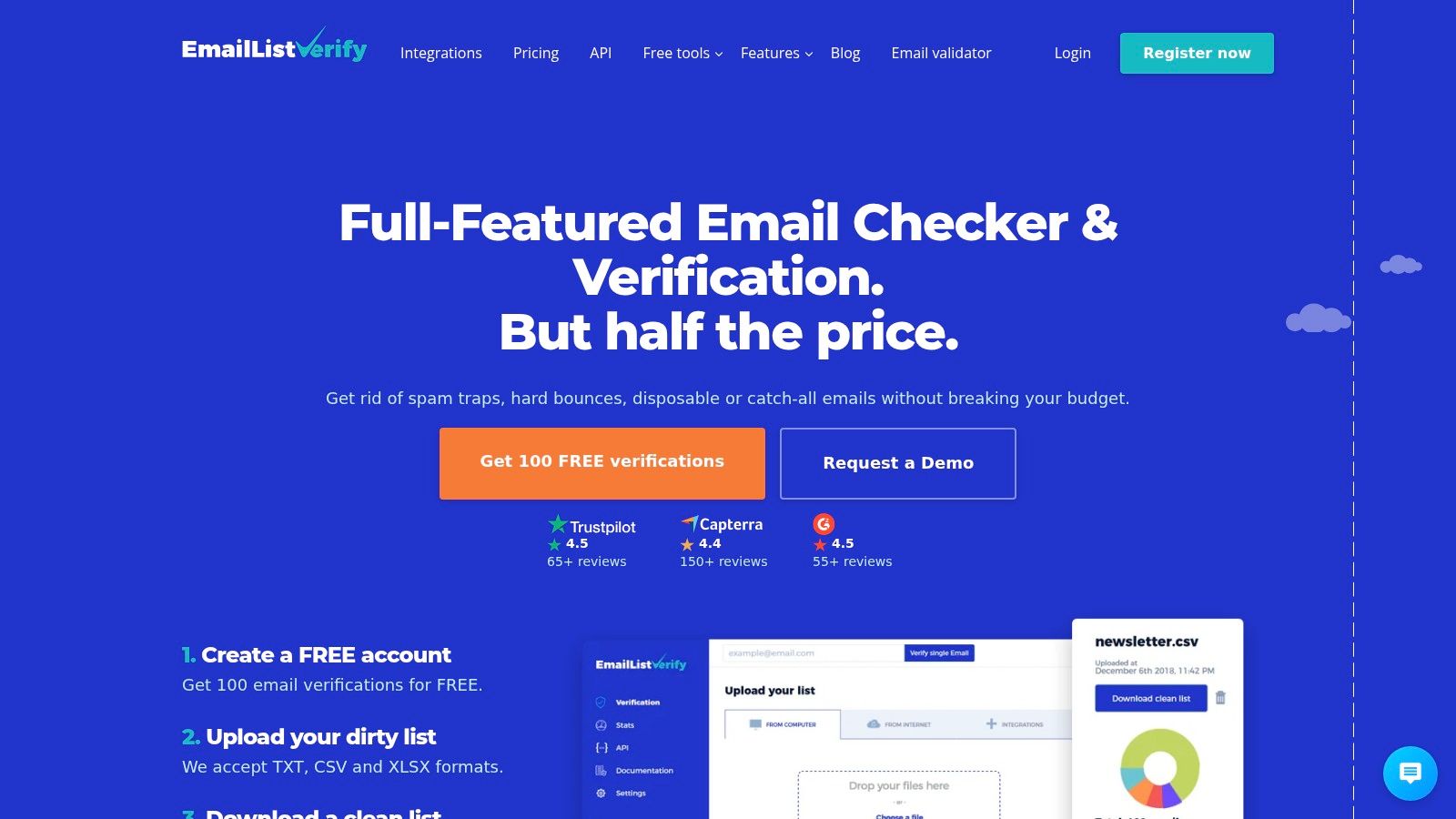
EmailListVerify makes sense in a common situation: a team needs to clean a large file fast, stay inside budget, and avoid introducing more process than the list itself justifies. That is why agencies, brokers, and teams working through old CRM data keep it on the shortlist.
From a deliverability-first perspective, the appeal is simple. A cheaper verifier can still do useful work if the main job is reducing obvious hard bounces before a send. If the file is cold, inherited, or poorly sourced, though, low cost alone does not protect sender reputation. The main question is how much uncertainty your program can tolerate.
Where EmailListVerify works well
EmailListVerify fits bulk list hygiene better than high-stakes reputation management. It is a practical choice for cleaning event lists, rechecking older CRM segments, or processing client uploads where speed and unit cost matter more than investigative detail on every risky address.
Its real-time API also gives teams a way to screen addresses at the point of capture. That can help reduce junk entries before they hit the CRM, which matters if sales and marketing are feeding the same database.
The trade-off is visibility. Compared with more premium tools, EmailListVerify gives you less context for making difficult deliverability calls around catch-alls, role accounts, and questionable acquisition sources. That matters for teams sending from a primary domain with little margin for error.
Compliance deserves a separate decision, not an assumption. Validation confirms whether an address can likely receive mail. It does not establish consent, lawful basis, or whether a purchased list belongs anywhere near your outbound program. Teams that blur those lines can clean a file successfully and still create inbox placement problems later.
I would consider EmailListVerify for cost-controlled cleanup jobs and broad CRM maintenance. I would be more cautious using it as the only gatekeeper for outbound campaigns tied closely to domain reputation, especially if the list includes catch-alls or older third-party data. For budget-sensitive teams with realistic expectations, it is a useful operator tool.
10. MillionVerifier
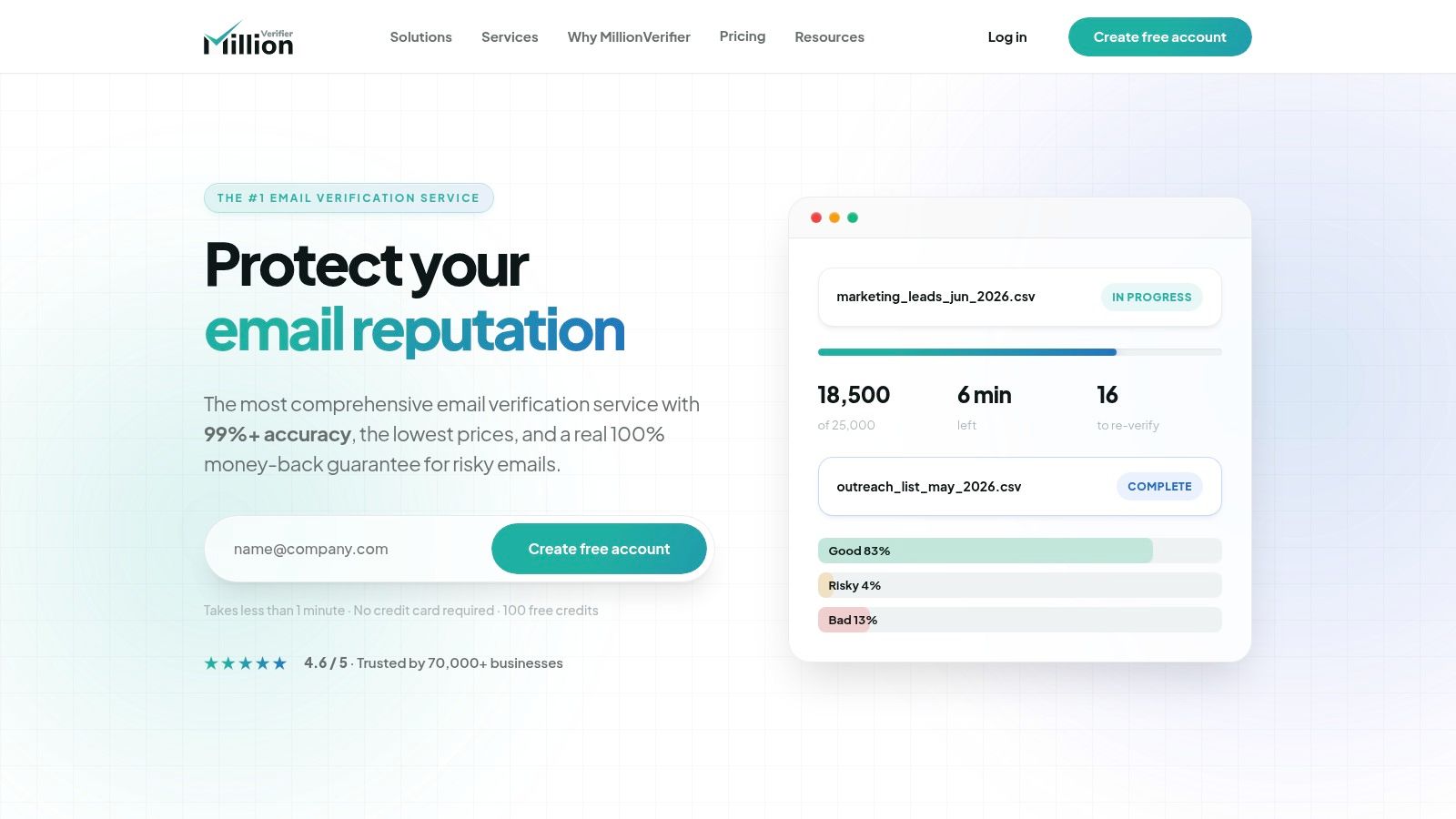
A familiar ops problem looks like this: a team inherits a large list, needs it cleaned fast, and cannot justify premium verification costs for every record. MillionVerifier is built for that job. Its appeal is straightforward. High throughput, aggressive pricing, and a low-friction way to process large batches.
That makes it a practical fit for agencies, data providers, and revenue teams working through old prospect databases before any outreach starts. It can also work for periodic CRM cleanup where the main goal is removing obvious invalids before they hurt bounce rates.
My concern is not speed. It is decision quality on the addresses that affect sender reputation. Deliverability problems rarely come from the easy records. They come from catch-alls, role accounts, dormant domains, and the gray area between risky and safe enough to mail. If a validator is light on nuance there, the low price can get expensive later through avoidable bounces and weaker inbox placement.
MillionVerifier is worth testing if volume is the constraint. I would not make it the only line of defense for outbound sent from a primary domain without running a sample first. Compare its output on a representative slice of your data, especially older B2B records and lists with a high share of catch-alls. Look closely at how many addresses end up in uncertain buckets and what guidance the platform gives you on whether to suppress, segment, or send carefully.
As noted earlier, the strongest validation tools separate more than valid versus invalid. They help operators make mailing decisions that protect domain reputation. MillionVerifier can still be a good fit, but mainly for high-volume cleanup and cost-sensitive workflows. For deliverability-first teams, the right question is not whether it verifies addresses quickly. It is whether its risk signals are strong enough for the kind of sending you do.
Top 10 Email Validation Software Comparison
| Solution | Core features | Deliverability / Accuracy (★) | Price / Value (💰) | Target & Unique Strength (👥 / ✨) |
|---|---|---|---|---|
| Free Email Verifier (Icypeas) 🏆 | Email Finder & Verifier, catch‑all & Google/Microsoft checks, Reverse Lookup, People Scraper, API, 575M profiles ✨ | ★★★★★, strict low‑bounce, monthly data refresh, deliverability‑first | 💰 Free instant checks + scalable paid bulk; flexible credits never expire | 👥 Sales/marketing/product/devs, privacy‑first, ISO27001, GDPR/CCPA compliant, developer‑friendly ✨ |
| ZeroBounce | Bulk + real‑time API, 30+ result statuses, ESP/CRM integrations | ★★★★☆, granular taxonomy, claimed high accuracy | 💰 Premium pricing vs budget tools | 👥 Teams needing SLAs & deep deliverability controls, mature partner ecosystem ✨ |
| Bouncer | Bulk + real‑time API, pay‑as‑you‑go credits (no expiry), status details | ★★★★, reliable catch‑all handling | 💰 Cost‑friendly for burst usage; transparent pricing | 👥 Ops/devs who verify intermittently, predictable costs, simple packaging ✨ |
| Kickbox | Bulk, real‑time API, form‑time widget, marketplace availability | ★★★★, easy onboarding for marketing stacks | 💰 Pay‑as‑you‑go; starter tiers for pilots | 👥 Ecommerce & marketing teams, easy pilot & app store presence ✨ |
| Clearout | Bulk/API/form checks, Safe‑to‑Send guarantee program, integrations | ★★★★, documented ≤3% bounce promise for specific flags | 💰 Moderate; guarantee limited to timing/flags | 👥 Teams needing operational guarantees, clear guarantee criteria ✨ |
| DeBounce | Bulk/API/JS widget, free dedupe, non‑expiring credits, list monitoring | ★★★★, good catch‑all checks (industry limits remain) | 💰 Budget‑friendly; public pricing calculator | 👥 Agencies & price‑sensitive teams, transparent pricing, value mix ✨ |
| Emailable | Bulk/single/API/form, unknown‑result refunds, inbox & blacklist add‑ons | ★★★★, refund policy improves trust on unknowns | 💰 Credits never expire; deliverability add‑ons billed separately | 👥 Teams wanting clear finance/ops rules, refund policy & SOC2 presence ✨ |
| Verifalia | Adjustable quality levels, async queues, daily free credits, dev docs | ★★★★, configurable quality for different needs | 💰 Free daily credits for dev/test; pay packs available | 👥 Developers & ops, fine‑grained control, always‑on free tier ✨ |
| EmailListVerify | Bulk, real‑time API, common ESP/CRM integrations, volume tiers | ★★★☆, pragmatic hygiene for large lists | 💰 Very competitive unit economics at scale | 👥 Agencies & large list owners, cost‑effective, straightforward integration ✨ |
| MillionVerifier | Bulk + API, high‑volume pricing, fast throughput claims | ★★★★, good for large batches (pilot recommended) | 💰 Very aggressive large‑volume pricing | 👥 Agencies & high‑volume processors, fastest/cheapest at scale ✨ |
From Data Hygiene to Deliverability Making Your Final Choice
A familiar failure pattern looks like this. Sales uploads a fresh prospect list, marketing pulls older CRM contacts back into a sequence, and bounce rates climb before anyone notices. The validator you choose determines whether that send goes out with avoidable risk or with enough filtering to protect the domain.
That is why I assess these tools through a deliverability-first lens. Accuracy claims matter, but classification logic matters more in practice. A validator has to help you decide what to send, what to suppress, and what to review manually, especially for catch-all domains, role accounts, and unknown results. If the output is hard to operationalize, the tool creates extra work without giving much protection.
Choice depends on the job.
For outbound prospecting, stricter handling usually wins. Sales teams working from purchased, scraped, or enriched B2B data need a tool that is conservative with risky addresses and clear about catch-all treatment. A slightly lower "valid" rate is often a good trade if it prevents bounce spikes and keeps campaign volume stable.
For CRM hygiene, the balance changes. Teams cleaning older house lists often need lower cost per record, bulk throughput, and status labels that map cleanly to suppression rules. In that case, the best option is often the one that fits existing workflows, supports recurring rechecks, and does not force the team to over-review edge cases.
For product and signup flows, speed and API reliability matter more than enrichment or list-management extras. The priority is stopping bad data at the point of entry without adding friction to the user experience.
Quick Recommendations by Use Case
- Best for B2B sales and growth teams: Icypeas fits teams that care about business-contact validation, strict catch-all handling, and adjacent enrichment workflows.
- Best for agencies and high volume: MillionVerifier and EmailListVerify are practical picks when cost per record and batch throughput drive the decision.
- Best for developers and testing: Verifalia stands out for API-first teams that want daily test credits and adjustable verification levels.
- Best for predictable budgets: Bouncer and DeBounce work well for teams that validate in waves and want credits that do not expire.
- Best for enterprise process and controls: ZeroBounce suits teams that need detailed statuses, broad integrations, and mature documentation.
- Best for teams that want explicit sending guardrails: Clearout is useful when teams want status definitions that translate cleanly into send or suppress rules.
A short pilot beats any feature comparison table. Pull a sample that reflects real sending conditions: recent prospects, stale CRM contacts, known catch-all segments, and a few addresses you already know are bad. Run the same file through two or three finalists, then compare more than pass rates. Look at how often each tool returns unknown, how aggressive it is on catch-alls, whether the statuses are easy for ops to act on, and whether the results line up with your bounce tolerance.
That usually makes the decision clear. Some tools are built to reduce risk aggressively. Others are built to lower cost on very large files. The right choice is the one that supports a repeatable sending policy and keeps list cleaning tied to inbox placement, not just database tidiness.
If you want a validator built for B2B outreach rather than generic list cleaning, Icypeas is worth testing first. Its free email verifier lets teams check work addresses quickly, and the broader platform adds bulk validation, API workflows, reverse lookup, and enrichment for prospecting and CRM hygiene.






















































































.png)



.webp)