.avif)
How to Close the Deal: A B2B Sales Playbook for 2026


.avif)
Only 2% of deals close on the first contact, and by the 5th to 12th contact, about 80% have either closed or gone dark, according to Qwilr's roundup of sales closing data. That should change how you think about closing. Closing is still often treated like a line to deliver at the end of a call, when in practice the close is a timing problem, a process problem, and an information problem.
The strongest closers don't push harder. They read the buying environment better. They know when a prospect is asking implementation questions because they're leaning in, and when they're asking them because they're stalling. They know whether the person in the room can sign, influence, or just gather information. They tighten the path to decision with clear next steps, solid follow-up, and better stakeholder intelligence.
Table of Contents
- Why Most Deals Stall Before the Finish Line
- What real readiness looks like
- How enriched data sharpens your timing
Why Most Deals Stall Before the Finish Line
Speed helps, but stalled deals usually come from poor diagnosis, not poor enthusiasm. Reps mistake a positive meeting for buying progress, then chase the account with generic follow-up instead of testing whether the buyer can make a decision.
That gap shows up in predictable places. The champion is interested but cannot bring in finance. Procurement appears after the proposal instead of before commercial terms are discussed. Legal raises issues nobody surfaced in discovery. The rep keeps hearing "this looks good" and treats it like momentum.
Teams that get serious about preventing stalled sales deals usually find the same breakdowns in their process. Follow-up lives in memory instead of in a system. Next steps are vague. Urgency goes unconfirmed after the first call. By the time the rep asks for commitment, the buyer still has internal work to do.
Practical rule: If a rep says, "They loved the call," but cannot name the business problem, the decision path, and the next calendar event, the deal is not close.
I see another pattern in underperforming pipelines. Sellers treat hesitation like resistance when it is often incomplete readiness. A buyer may need security review, budget signoff, implementation detail, or proof they can share internally. None of that is a pricing objection, and forcing a close at that point usually slows the deal down.
Better account intelligence changes the work. A rep who uses enriched contact and company data can spot missing stakeholders earlier, verify who owns the budget, and adjust outreach before the deal drifts. The same discipline that improves top-of-funnel targeting in personalized cold email outreach also improves late-stage execution. You close more deals when you know who needs to be in the room and when the account is ready for that conversation.
Closing starts long before the proposal. It starts with disciplined follow-up, clear mutual next steps, and a hard read on whether the buyer is advancing toward a decision or just being polite.
Reading the Room Before You Ask for the Close
The biggest closing mistake isn't failing to ask. It's asking on schedule instead of asking on signal.
A lot of mainstream advice still treats the end of the meeting as the moment of truth. That's too simplistic for modern B2B buying. A more useful view is that many deals are lost before the close because the buyer isn't ready yet, needs more stakeholder alignment, or still needs validation around the decision itself, as noted in this discussion of closing technique gaps and buyer readiness.
What real readiness looks like
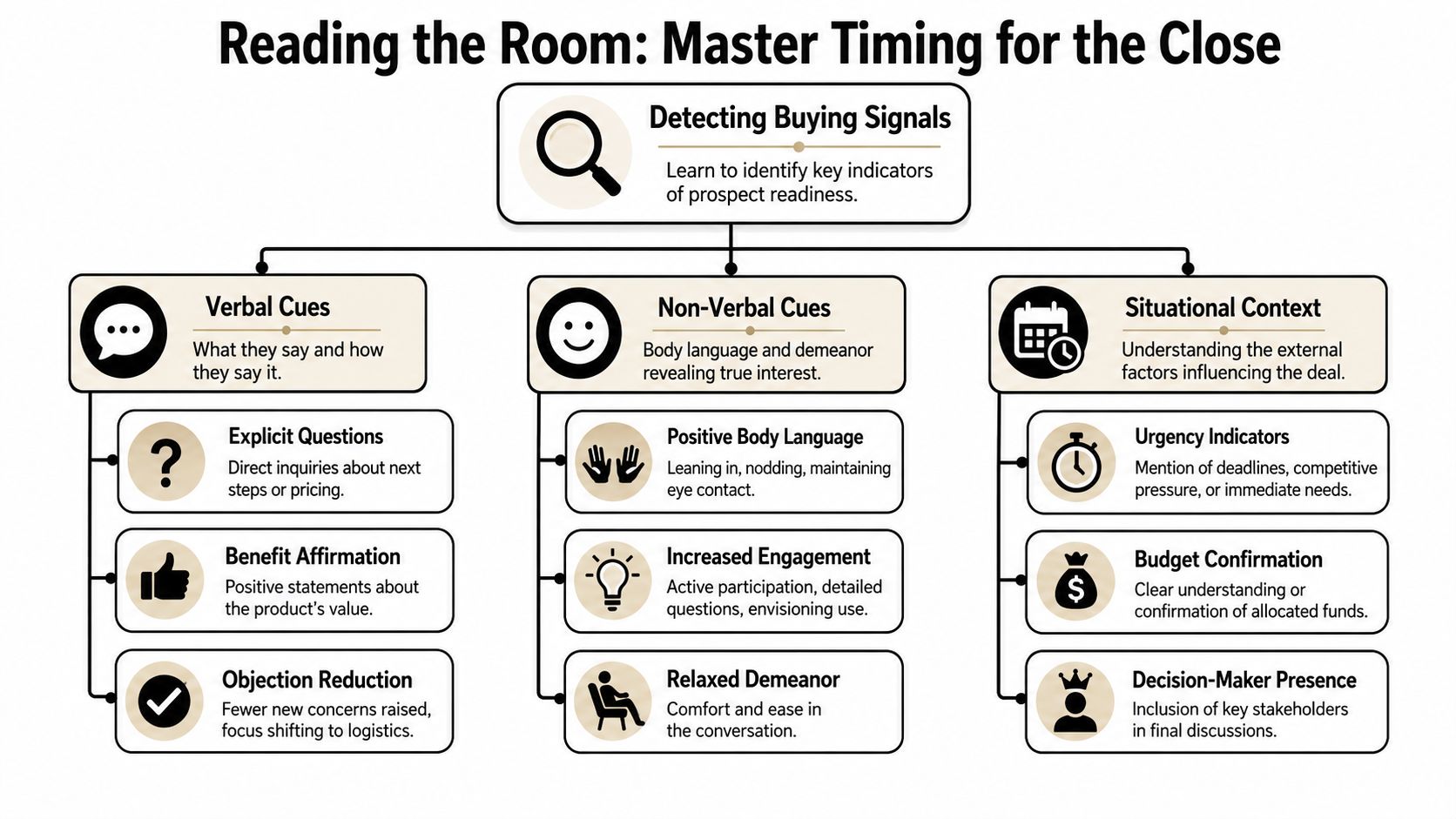
Readiness has a pattern. Buyers stop asking broad "what does it do?" questions and start asking "how would this work for us?" questions. The conversation shifts from product curiosity to operational reality.
Look for signals across three layers:
- Language shift: They ask about rollout, contract process, stakeholder involvement, or timing.
- Commercial behavior: They want pricing framed around a use case, team size, or package comparison.
- Internal movement: They add finance, legal, IT, or an executive sponsor to the thread.
Those signals matter together. One signal by itself can be misleading. A prospect can ask for pricing just to benchmark the market. A champion can sound enthusiastic but still lack the political weight to get the deal through.
If the buyer is still trying to understand the problem, you're not closing a purchase. You're still closing belief.
Readiness diagnosis also improves outreach before the meeting. Good outbound doesn't just book time. It frames the problem in a way that helps the prospect organize their own thinking. That's one reason teams studying how to write the best cold email often improve downstream close quality, not just reply rates. Better early messaging attracts buyers with a clearer reason to engage.
How enriched data sharpens your timing
Data intelligence gives a rep an edge. If you know the exact title, reporting line, and likely function of each participant, you can interpret the room correctly.
A few examples:
| Signal in the meeting | What it may actually mean | What to do next |
|---|---|---|
| A director asks deep workflow questions | Strong interest, but not necessarily budget authority | Confirm who signs and who approves |
| Procurement appears early | Buying process is formal and timeline may depend on vendor review | Tighten paperwork and security answers |
| A founder joins late-stage calls | Priority just went up | Re-anchor on business impact, not features |
| A manager stays engaged but avoids next steps | You may have a user, not a buyer | Ask who else needs confidence before moving |
Used well, enriched contact data helps you avoid the classic mistake of mistaking access for authority. It also lets you map missing stakeholders before the deal slows down. If legal never appears in your motion and this company typically routes contracts through legal, that isn't a detail. That's a future stall.
The close should happen when three things line up: the pain is clear, the path to decision is visible, and the people in the room match the scope of the purchase. If one of those is missing, forcing the ask usually creates fake momentum.
The Modern Closer's Toolkit Techniques and Scripts
Good closing language sounds calm because the work behind it is disciplined. The rep has already uncovered the problem, tied it to business impact, matched the solution, and narrowed the decision.

That sequence matters. Process-focused sales guidance on complex B2B closes emphasizes moving from rapport-building to diagnosing the underlying problem, then restating the business impact, then presenting a tightly matched solution, and only then asking for commitment. It also makes a point too many reps ignore: the close begins with the first ask, not the final negotiation.
Use a sequence not a trick
If you want reps to consistently close the deal, stop teaching "magic lines" in isolation. Teach a repeatable conversation shape.
Diagnose the problem
Ask questions that surface operational pain, decision risk, and urgency. If the buyer can't describe the cost of staying with the current approach, the deal is still soft.
Restate the impact
Say it back in business terms. "You don't just want faster handoff. You need fewer missed follow-ups and clearer ownership once multiple stakeholders enter the process."
Match the solution tightly
Don't pitch the whole platform. Match only the capabilities that solve the stated problem. Broad pitching creates doubt at the moment you need clarity.
Ask for a concrete commitment
Not "What do you think?" Ask for the next business step.
Teams building tighter prospecting and qualification workflows often support this stage with better research stacks and B2B sales prospecting tools, because cleaner account context usually produces sharper diagnosis and cleaner closes.
Closing approaches that fit the deal
Different deals need different closing language. Here are three useful patterns.
The next-step close works when the buyer is engaged and the path is mostly clear.
Sample script: "It sounds like the use case is validated. Do you want me to send the proposal today, or would you rather start with terms and bring procurement in first?"
This works because it keeps the decision concrete. You're not asking whether they vaguely like the idea. You're narrowing the route forward.
The summary close fits multi-stakeholder deals.
Sample script: "You've said the priorities are visibility, handoff discipline, and a cleaner approval path. The workflow supports each of those. If those are still the decision criteria, are we at the point where it makes sense to move to paperwork?"
This is effective when different people need to hear the decision logic restated in one place.
The risk-reduction close helps when hesitation is real but not fatal.
Sample script: "It seems the value is clear, but the team wants lower implementation risk. We can start with a controlled rollout and define success criteria up front. If that addresses the concern, should we move to the agreement?"
This keeps the conversation on solvable friction instead of emotional resistance.
A quick training asset for reps working on live call execution can help reinforce the difference between pressure and precision:
What weak closers say instead
Weak closers tend to reach for broad, low-commitment lines:
- "What are your thoughts?" This invites drift.
- "Just checking in." This creates no decision pressure.
- "Let me know if you have questions." It hands control back without a next step.
Stronger language is narrower and more useful:
"Based on what you've said, the next decision is whether to review terms now or align the internal stakeholders first."
That sentence does three things. It shows you've listened, it frames the decision, and it keeps the deal moving without sounding theatrical.
Handling Objections Without Losing Momentum
An objection isn't the end of the close. It's the point where the buyer tells you what still feels unsafe.
Most reps lose momentum because they answer too fast. They hear "price" and jump into discounting. They hear "timing" and start chasing a vague future date. They hear a competitor's name and begin defending product features. All three are mistakes if you haven't identified the underlying concern.
A simple objection framework
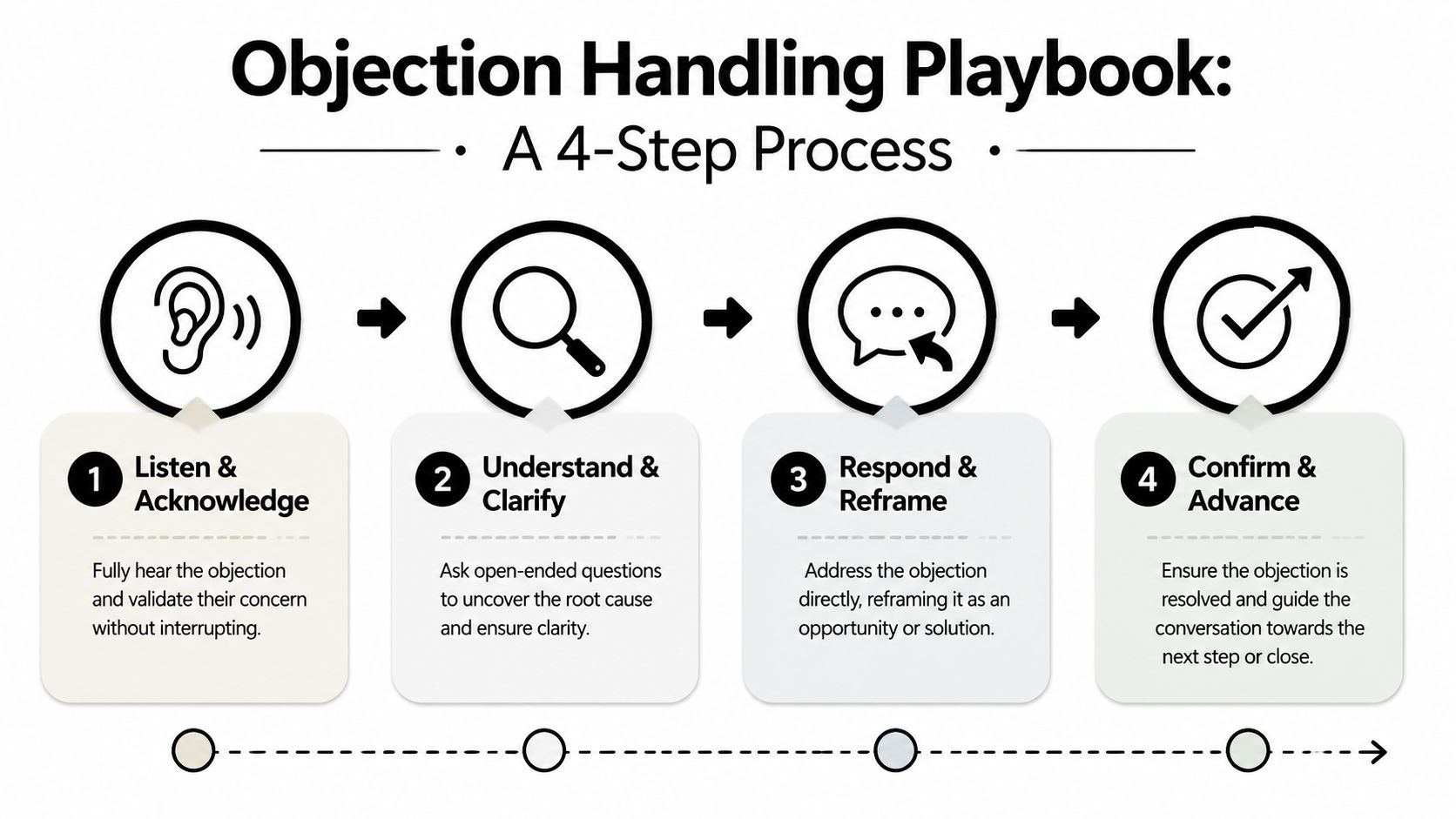
Use a four-part response:
- Acknowledge: Show you heard the concern without becoming defensive.
- Isolate: Find out whether this is the issue or just one of several.
- Reframe: Put the concern back in the context of value, process, or risk reduction.
- Confirm: Check whether the concern is resolved enough to move forward.
That sounds simple because it is. Simplicity is what makes it repeatable under pressure.
Coaching note: If a rep can't isolate the objection, they shouldn't answer it yet.
How to answer the objections that matter most
Price objection
Start with acknowledgment: "I understand. Budget scrutiny is real."
Then isolate: "Is price the main blocker, or are there also concerns about adoption or rollout?"
Now reframe. If the issue is really budget timing, don't argue value in the abstract. Tie the conversation back to the cost of delay, the operational friction they're trying to remove, or the option to structure the scope differently. Then confirm: "If we can align the package to the current priority, are you comfortable moving to the agreement?"
Timing objection
This one often hides lack of internal ownership. A buyer who says "not now" may mean "I don't have everyone lined up."
Try: "That makes sense. What's driving the timing. Internal bandwidth, stakeholder alignment, or another initiative already in flight?" Once they answer, you can address the actual issue. If alignment is missing, propose a stakeholder meeting. If bandwidth is the concern, simplify the rollout path.
Competitor objection
Don't go feature by feature unless the buyer asks. Start here: "Understood. When you compare the options, what matters most in the decision?" That question pulls the conversation out of product theater and back into criteria.
From there, reframe around fit. The goal isn't to prove the other vendor is weak. The goal is to show why your approach matches the buyer's priorities more tightly.
A clean objection response sounds like problem-solving, not rebuttal. Buyers can feel the difference immediately.
Negotiation Tactics and Sealing the Contract
Negotiation usually looks spontaneous from the outside. In reality, the strongest negotiators did their work before the call. They mapped the stakeholders, understood who cares about price versus risk, and decided where they'll hold the line.
That preparation matters because buyers don't experience negotiation as one issue. Finance sees budget. Legal sees exposure. An executive sponsor sees speed and confidence. A user sees disruption. If you present one generic pitch to all four, you create friction you could've prevented.
Negotiate with structure not improvisation
One practical rule improves late-stage conversations fast: use closed-ended, next-step-oriented questions. Pipedrive's guidance on closing a sale recommends that approach because it reduces ambiguity versus open-ended asks. The same guidance also recommends presenting multiple pricing options and handling price objections before asking for the signature.
That advice works because it gives buyers direction without making them feel cornered.
Compare the difference:
| Weak negotiation language | Stronger negotiation language |
|---|---|
| "What do you want to do?" | "Would you prefer I send the standard terms or the proposal with the scoped option?" |
| "Let me know what works." | "Is the decision between the annual package and the phased rollout option?" |
| "Can you sign this?" | "If legal is comfortable with these terms, can we route this for signature today?" |
Presenting options is especially useful when a buyer wants control. A single package can trigger resistance. A small set of clear choices lets them participate in the decision while keeping the conversation anchored to value.
Make the signature easy
Late-stage deals often die from avoidable operational mistakes. The contract goes to the wrong person. The champion forwards it without context. The actual signatory never sees the message in time.
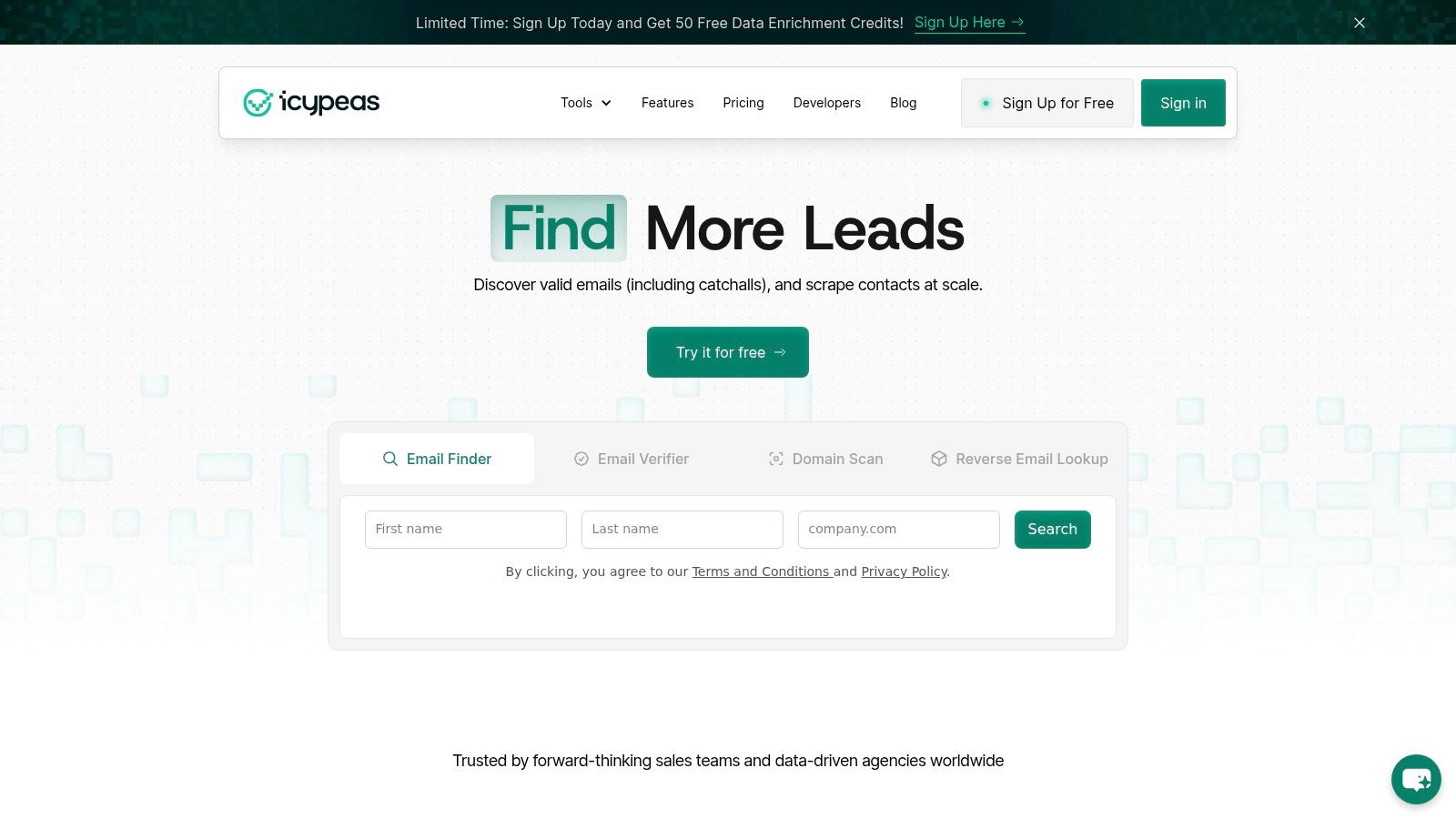
That's where accurate stakeholder and contact data helps. A platform such as Icypeas can be used to verify professional emails and enrich contact records so the agreement reaches the right approver and the rep can tailor negotiation to each participant's role.
A few habits tighten the last mile:
- Route intentionally: Send the agreement to the signatory, not only to your champion.
- Summarize the decision: Include a short recap of scope, terms, and intended next step.
- Pre-handle friction: If pricing, security review, or implementation timing caused concern earlier, address it in the send-along note.
- Own the follow-up: Don't wait for silence to turn into a problem. Set the next check-in while the contract is in motion.
Closing the deal at this stage is less about persuasion and more about removing uncertainty from the path to signature.
The Post-Close Handoff and Measuring Success
A signed agreement isn't the finish line if the customer starts confused. Bad handoffs create buyer's remorse, slow adoption, and make the sales team look sloppy even when the close itself was strong.
The handoff checklist
The cleanest handoffs are short, specific, and usable. The account executive should transfer context that helps onboarding or customer success start with confidence.
Include these items:
- Business problem: What the customer is trying to fix right now.
- Success definition: What outcome the buyer expects in the early phase.
- Stakeholder map: Who signed, who sponsored, who will use the product, and who may become a blocker later.
- Commercial boundaries: Agreed scope, timing expectations, and any commitments made during the close.
- Known sensitivities: Procurement concerns, rollout constraints, or internal politics that matter.
A structured internal summary works better than scattered call notes. Teams that already use marketing data analysis to improve segmentation and reporting usually adapt quickly to this discipline, because they already understand the cost of incomplete records and vague attribution.
A strong close creates trust twice. First when the buyer signs, then again when the delivery team shows up informed on day one.
The metrics that show whether your process works
You don't need a complicated reporting layer to know whether your closing motion is healthy. Track a few operational indicators and review them by rep, segment, and source.
Watch for:
- Close rate: Are qualified opportunities ending in signed business often enough to justify pipeline assumptions?
- Sales cycle length: Are deals moving with predictable timing, or are they sitting late stage without clear cause?
- Average deal size: Are reps protecting value, or trading margin for speed?
- Stage-to-stage conversion quality: Where do deals slow down, and what pattern shows up before they stall?
- Post-sale stability: Do closed deals hand off cleanly, or do they reopen old promises during onboarding?
The point isn't to chase a perfect spreadsheet. It's to see whether your team is improving at the job of closing: reading readiness, guiding decisions, handling resistance, and making commitment easy.
Icypeas helps revenue teams support that process with verified professional contact data, email finding, email verification, and enrichment workflows that can clean CRM records and clarify stakeholder mapping before outreach, negotiation, and handoff. If your team wants cleaner account context before you ask prospects to commit, take a look at Icypeas.


















































.png)


.webp)