.avif)
Top 10 B2B Data Enrichment Tools for 2026

.avif)
Your data is decaying. Reps still see a name and company in the CRM, but the person has changed roles, the domain has been reconfigured, and the email that looked safe last quarter now hurts deliverability. That decay rarely announces itself. It shows up as bounced sequences, weak routing, bad segmentation, and lead scores built on half-empty records.
That's why B2B data enrichment tools have become a real operating layer, not just a nice-to-have add-on. The category is growing fast. Grand View Research estimates global data enrichment solutions revenue at USD 2.37 billion in 2023, with a projected 10.1% CAGR from 2024 to 2030 in its data enrichment solutions market report. In practice, that means more vendors, more overlap, and more confusion for buyers.
The hard part isn't finding a vendor list. It's figuring out which tool works for your workflow. CRM enrichment has different requirements than outbound list building. Batch cleanup has different economics than real-time product enrichment. If you're also implementing lead scoring models, bad enrichment can poison the whole system.
This benchmark gets to the point. It compares 10 B2B data enrichment tools through a practitioner lens: data quality, implementation friction, API reality, and whether the tool holds up in production.
Table of Contents
1. Icypeas
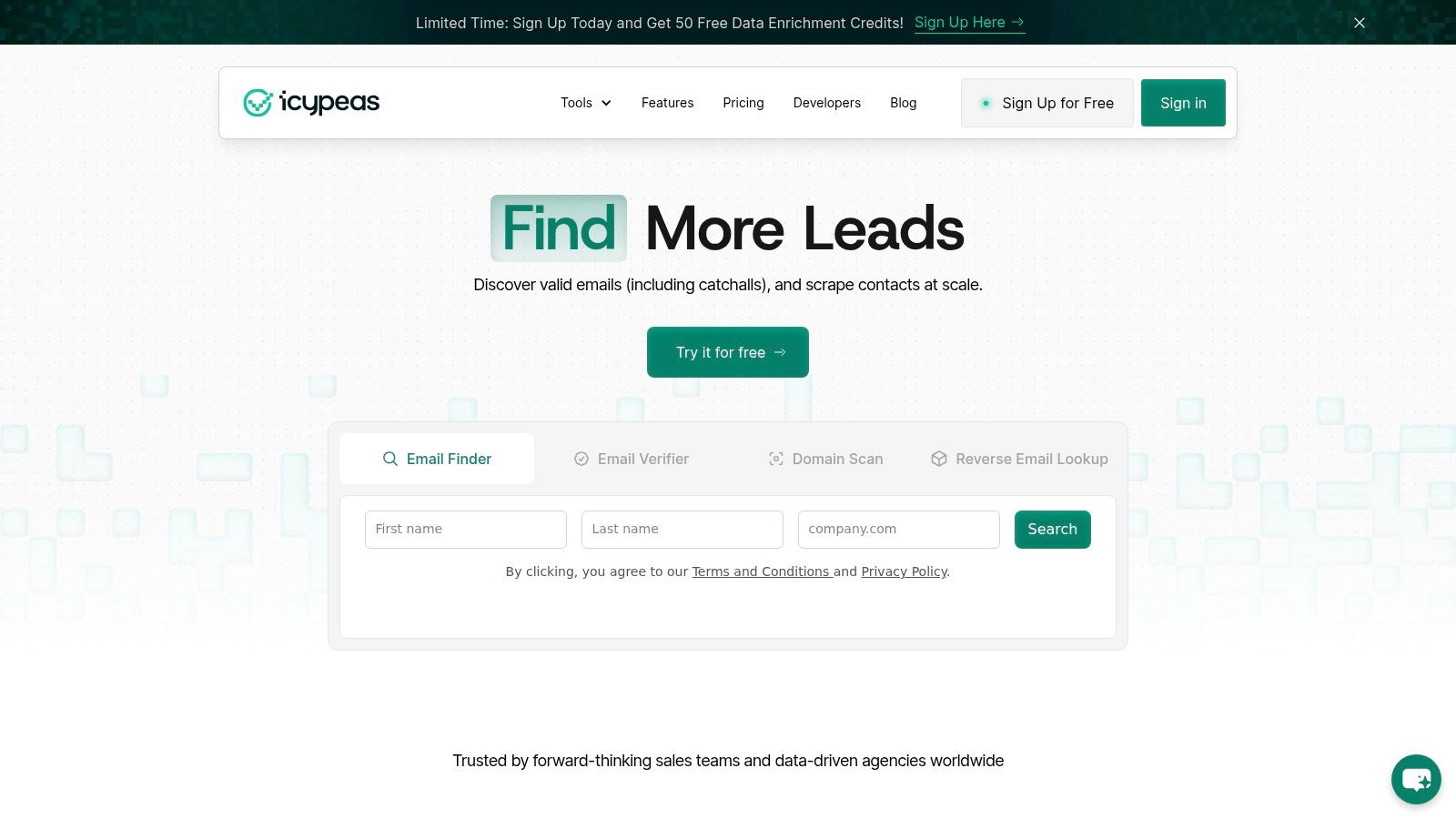
Icypeas is the specialist pick on this list. It isn't trying to be your full outbound stack. It focuses on the part that breaks most often in practice: finding and verifying contact data reliably enough that your CRM syncs, list cleaning, and automated outreach don't create downstream damage.
That focus shows up in the product design. Icypeas offers email finding, strict verification, reverse email lookup, domain scan, and a people scraper that adds titles and profile context. For operators who care about implementation details, it also leans heavily into API usability and workflow embedding through its contact data discovery knowledge base.
Why Icypeas stands out
The biggest practical difference is verification strictness. A lot of B2B data enrichment tools can append a field. Fewer tools are disciplined about whether that field should be trusted in a sending workflow. Icypeas is built around that stricter standard, including validation for catch-all environments used by Google and Microsoft.
Its coverage is also substantial. Icypeas states that its database includes 575M people profiles and 62M company profiles, refreshed monthly. It also positions its infrastructure around developer needs, with 99.9% uptime, flexible credits that don't expire, and privacy controls built around open-source intelligence and audited GDPR/CCPA alignment.
Practical rule: If your first KPI is bounce reduction, don't start by comparing headline database size. Start by testing verification behavior against your own stale CRM sample.
Best fit and trade-offs
Icypeas is strong for four use cases: real-time CRM enrichment, inbound signup enrichment, list cleaning before outbound sends, and product integrations where an internal app or workflow engine needs contact resolution behind the scenes.
Pros are straightforward:
- Strict verification: Better suited to deliverability-sensitive workflows than tools that optimize for sheer volume.
- Large refreshed dataset: Monthly refreshes on people and company profiles support both prospecting and record hygiene.
- Developer-first setup: API stability and flexible credits make it easier to operationalize than many sales-led platforms.
- Compliance posture: Useful for teams that need legal and governance conversations early, not after rollout.
Cons matter too:
- Not an all-in-one sales platform: If you want sequencing, intent, and engagement in one purchase, you'll need adjacent tools.
- Pricing modeling takes testing: Public per-credit economics aren't the headline, so cost-per-usable-record is best validated in a pilot.
Website: Icypeas
2. ZoomInfo OperationsOS Enrich
A common RevOps scenario looks like this: Salesforce has years of inconsistent account data, marketing needs cleaner routing rules, and leadership wants one enrichment layer that can run on a schedule instead of through manual CSV work. ZoomInfo OperationsOS Enrich is built for that kind of environment.
Its practical strength is operational control. Teams can run real-time enrichment, scheduled refreshes, batch updates, and CRM or MAP syncs from one system. That matters less for a five-rep outbound team and a lot more for companies with territory logic, lead scoring, account assignment, and downstream reporting tied to field quality.
ZoomInfo also tends to perform best at the account level. Large teams often buy it for standardized firmographics, company hierarchies, technographics, and broad coverage across a mature CRM, not just for finding one more direct dial. In day-to-day use, that makes it closer to a data operations platform than a lightweight prospecting add-on.
Where ZoomInfo earns its cost
The best use case is a company that already knows how enrichment will be used. If RevOps has clear field mappings, defined ownership rules, and a backlog of broken records to clean, ZoomInfo can support that work well. If those basics are missing, the platform usually exposes process problems rather than fixing them.
That trade-off matters. ZoomInfo is rarely the first tool I'd recommend to an early-stage team still testing ICP, messaging, and outbound channels. The spend is harder to justify when the CRM itself is still messy and the team mainly needs affordable contact coverage or list cleaning. In those cases, a narrower tool or a stack of sales prospecting tools for smaller workflow setups is often easier to implement and easier to measure.
A few caveats come up in real deployments:
- Strongest in mature systems: The value shows up when enrichment flows into routing, segmentation, scoring, and reporting.
- Implementation takes work: Field mapping, deduplication logic, and refresh policies need attention before rollout.
- Cost pressure is real: Enterprise packaging can make sense for large databases, but smaller teams should calculate cost per usable enriched record, not cost per license.
- Less attractive for simple use cases: If the main job is verifying emails before outbound or enriching a small inbound stream, the platform can be more than you need.
ZoomInfo usually pays off after a company has enough operational complexity to benefit from centralized enrichment rules. Before that point, it often feels heavier than necessary.
Website: ZoomInfo
If you're comparing premium vendors directly, it's worth reviewing a more focused ZoomInfo alternative breakdown.
3. Apollo.io Enrichment + sales intelligence
A common buying scenario looks like this. The sales team wants more than appended contacts. They also want a place to build lists, run outbound, and give reps account context without adding three separate tools. Apollo is attractive in that setup because it combines enrichment with prospecting and execution in one product.
That combination is Apollo's real differentiator. It is less of a pure data utility than vendors built only for CRM hygiene or API-based enrichment. For a lean revenue team, that can be a strength. Fewer tools usually means faster rollout, fewer integration points, and less operational overhead in the first few months.
Where Apollo performs well
Apollo works best when the same team owns sourcing, enrichment, and outbound. Reps can build a list, enrich it, segment it, and move straight into sequences without waiting on ops to wire together separate vendors. For SMB and mid-market teams, that convenience often matters more than squeezing out the last bit of match-rate performance from a specialist provider.
It also fits teams that are still refining territory, messaging, and account selection. In that stage, buying a standalone enrichment layer plus a separate prospecting stack can create more process than value. Apollo keeps the workflow compact, which is why it often appears on shortlists for sales prospecting tools used by growing outbound teams.
Where the trade-offs show up
The trade-off is that convenience and data quality are not the same thing.
Apollo can cover a lot of day-to-day prospecting work, but I would still test it against your own ICP before treating it as a system of record for broad CRM enrichment. Coverage may look fine at the top of funnel and then weaken on specific segments, such as niche industries, regional markets, or seniority bands that matter to your routing and scoring rules. Teams usually discover this after rollout, not during the demo.
A few implementation realities matter:
- Best for blended use cases: Apollo makes the most sense when enrichment is tied directly to list building and rep execution.
- Less ideal for pure ops needs: If the main goal is large-scale CRM standardization, refresh logic, and field-level governance, a dedicated enrichment product is usually easier to control.
- Credits need monitoring: Heavy list building and frequent enrichment runs can make usage harder to predict than the headline plan suggests.
- Validation still matters: Teams should sample records by segment and check whether the enriched fields are accurate enough for routing, personalization, and reporting.
Apollo is usually a smart first pass for teams that want one platform to support prospecting and enrichment together. It is a weaker fit for companies that already know they need strict data governance, large database refreshes, or specialist coverage in hard-to-match segments.
Website: Apollo.io
4. Lusha Prospecting, enrichment, and B2B signals
Lusha is built for speed. If your team wants a browser extension, quick CRM pushes, CSV enrichment, and a credit model that's easy to understand, Lusha is one of the simpler products to operationalize.
That simplicity is the appeal. A rep can move from profile lookup to CRM update without a major ops project. Marketing ops can enrich a CSV with company attributes without involving engineering. For a lot of smaller teams, that's enough.
Who should use Lusha
Lusha works best for quick prospecting workflows, especially when speed of lookup matters more than building a full enrichment architecture. The unified credit system across products helps because reps, ops, and managers don't have to decode different usage logic for every channel.
The limitation is coverage consistency by region. In practice, teams with concentrated North American prospecting tend to find Lusha easier to justify than globally distributed teams that need stronger match rates across multiple markets.
Good use cases include:
- Rep-led prospecting: Browser-first enrichment during list building.
- Light CSV cleanup: Fast appends for company and contact data.
- Simple CRM handoff: Minimal setup for getting enriched records into the sales stack.
Less ideal use cases are heavier batch hygiene projects, engineering-led API enrichment, and highly regulated workflows where provenance and governance need deeper attention.
Website: Lusha
5. People Data Labs PDL

A common PDL scenario looks like this: the sales team wants fresher records in the CRM, the product team wants person and company data inside the warehouse, and ops wants one matching system instead of three disconnected tools. People Data Labs fits that kind of environment better than tools built around browser prospecting or rep-first workflows.
PDL is strongest when enrichment is part of your data stack, not just a point solution for sellers. Teams use it to append firmographic and person data in batch jobs, support identity resolution inside internal systems, and feed downstream scoring or routing models. That flexibility is the draw. It also means implementation quality matters more here than with a more opinionated CRM plugin.
The commercial appeal is usually cost control at volume. PDL is often evaluated by teams that want API access, bulk processing, and room to build custom logic around match confidence, retries, and field-level write rules. In the right setup, that can produce better ROI than paying for a rep-centric platform with features your team will never use.
The trade-off is ownership.
PDL makes sense for product, data, and revops teams that are comfortable defining how enrichment should run. That includes decisions like when to overwrite CRM fields, how to handle partial matches, which records should be rechecked, and how to monitor degradation over time. If those questions are still unresolved, PDL can expose process gaps instead of solving them.
A few practical realities matter before you buy:
- Engineering time is part of the cost: API access and bulk enrichment are useful only if someone owns setup, monitoring, and failure handling.
- CRM outcomes depend on your rules: Bad overwrite logic can create just as much mess as missing data.
- PDL is infrastructure, not a sales suite: It can feed your GTM systems, but it does not replace prospecting, sequencing, or rep workflow tools.
- Data governance stays on your side: Your team still needs policies for consent, provenance, retention, and refresh cadence.
For teams that want a packaged workflow, PDL can feel too open-ended. For teams that already run enrichment through their warehouse or internal services, that openness is the advantage.
Website: People Data Labs
6. Cognism CRM enrichment and DaaS
A common buying scenario looks like this. The sales team wants higher contact coverage, RevOps wants cleaner CRM writes, and legal wants proof that enrichment workflows will hold up under scrutiny. Cognism tends to enter the shortlist in exactly that kind of environment.
Its practical appeal is less about having the broadest possible dataset and more about fit for teams with meaningful UK and European coverage requirements. If your pipeline depends on EMEA accounts, that focus can matter more than a vendor's generic global positioning. If your market is mostly US mid-market or SMB, the decision gets less obvious and match testing should carry more weight than brand recognition.
Where Cognism is strongest
Cognism works well for CRM enrichment programs that need structure. Teams can run one-time updates, scheduled refreshes, or ongoing enrichment tied to CRM workflows, and the product is designed to support operational use instead of only rep-side prospecting.
That makes it a reasonable option for RevOps teams trying to solve specific system problems, such as stale contacts, incomplete account records, or inconsistent field coverage across regions.
The trade-off is that Cognism is usually easiest to justify when compliance and regional coverage are part of the buying case. If those are secondary concerns, other tools may deliver similar enrichment outcomes with a simpler rollout or a lower total cost.
A few implementation realities are worth pressure-testing before you buy:
- Run a regional match-rate test: Check performance against your actual countries, segments, and job functions, not a blended sample.
- Define CRM write rules early: Decide which fields Cognism can overwrite, which should append, and which should stay system-of-record only.
- Separate enrichment value from prospecting value: A strong sales database does not automatically translate into clean CRM operations.
- Review governance with your legal and data teams: The compliance burden does not disappear because the vendor has a strong reputation in this area.
That last point matters more than many buying teams admit. The nrich industry write-up on compliant enrichment tool selection makes the same operational point practitioners run into during implementation: vendor claims help, but your team still owns lawful basis, retention rules, transparency, and data handling policy.
Cognism is a strong candidate for organizations that treat enrichment as a controlled CRM process, not just a faster way to give reps more contacts.
Website: Cognism
7. Hunter Domain, company, and lead enrichment
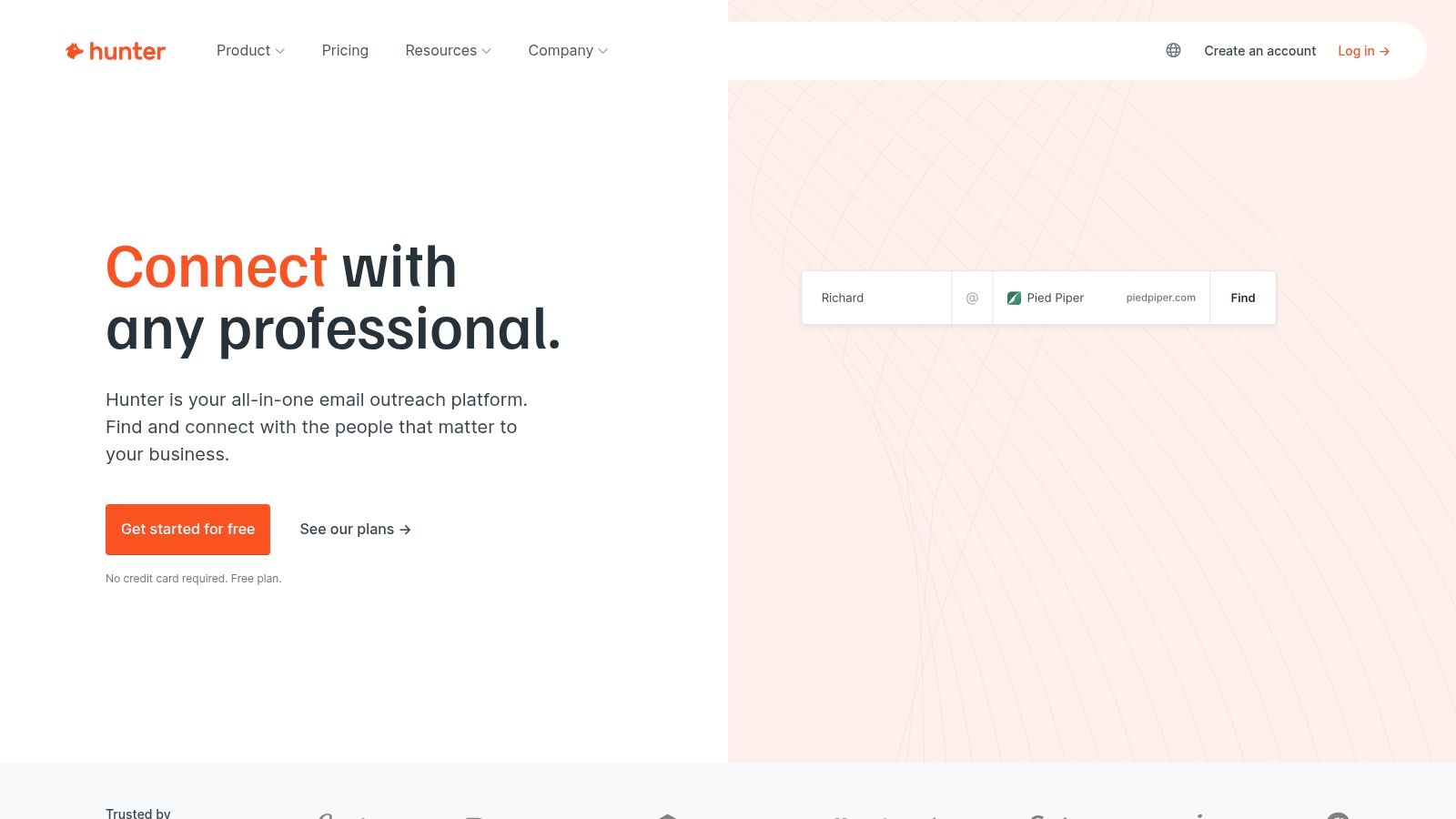
Hunter is one of the easiest tools on this list to understand. It's domain-first, email-centric, and practical for teams that mainly need discovery plus verification rather than an expansive account intelligence platform.
That focus can be a strength. If your workflow starts with a company domain, inbound lead, or short list of named contacts, Hunter's simpler operating model can beat a bigger platform that brings unnecessary overhead.
Where Hunter fits
Hunter is a good fit for SMB and mid-market teams enriching inbound signups, validating domains, and supporting lightweight outbound. The API is straightforward, CSV workflows are accessible, and the product doesn't ask for a major implementation cycle.
Where it falls short is broad contact intelligence. If your team wants strong direct-dial enrichment, deep technographics, or large account-level augmentation, Hunter isn't designed to be that product.
Useful patterns for Hunter include:
- Inbound cleanup: Enrich and verify leads captured through forms.
- Domain-to-email workflows: Support outbound prospecting when domain is the best available input.
- Low-friction testing: Evaluate enrichment impact without a long buying process.
Website: Hunter
8. RocketReach Contact and company enrichment
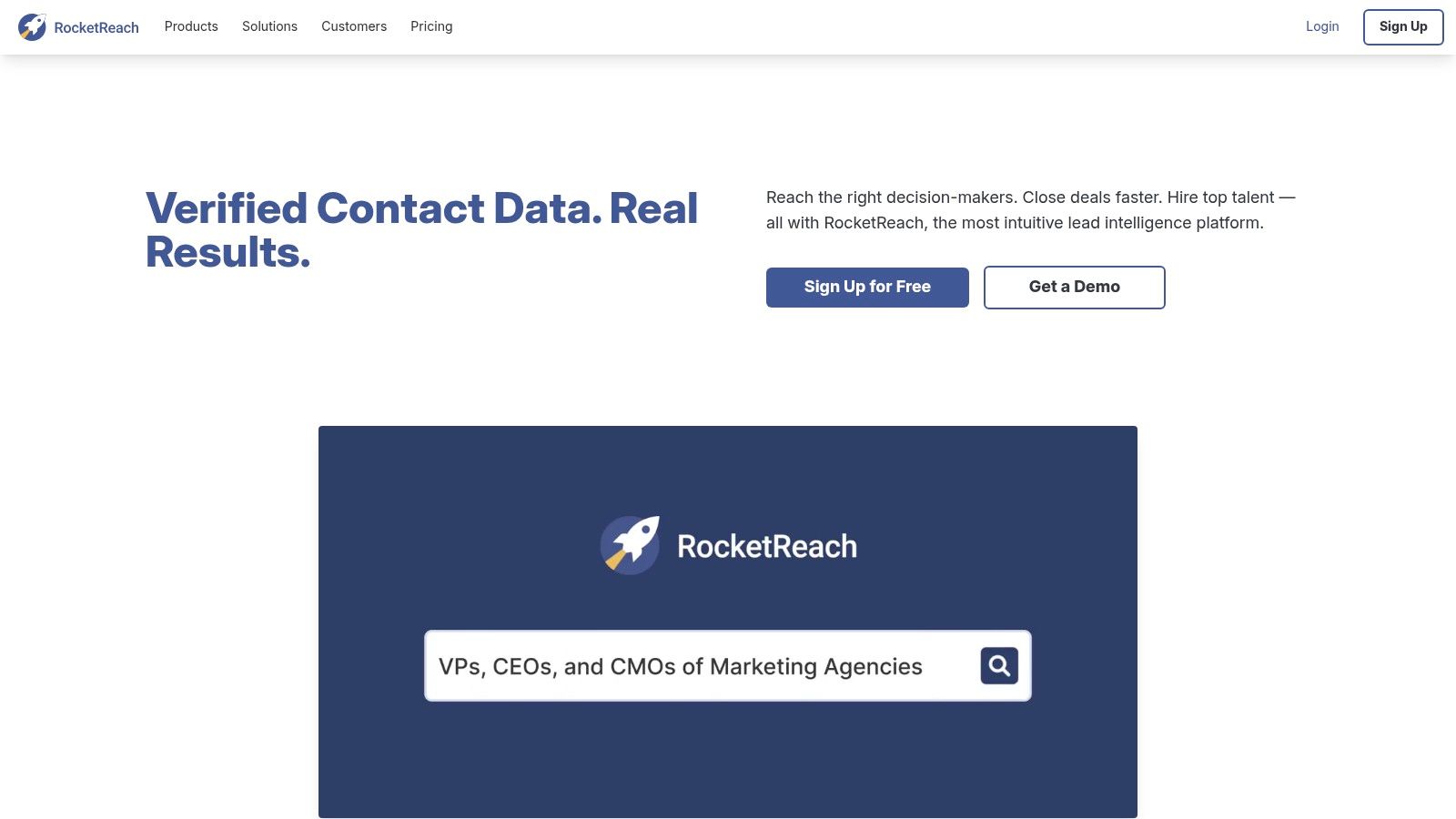
RocketReach is often not the first enrichment tool a team buys. It's the second. That's not a criticism. In many stacks, that's exactly where it adds value.
A lot of ops teams use RocketReach as a supplemental provider inside a broader waterfall or verification workflow. The browser plugins, CSV options, and REST API make it relatively easy to insert as a backup source when the primary vendor misses.
How teams usually use RocketReach
RocketReach is most useful when your team already understands that no single vendor covers your ICP perfectly. Instead of forcing one provider to do everything, you use RocketReach to improve yield on hard-to-match segments or edge cases.
Architectural thinking matters. Recent industry commentary has pointed out that the category is becoming less about one universal dataset and more about combining specialist strengths such as verified emails, phones, technographics, and waterfall coverage in modern enrichment stacks.
RocketReach works in that model because it's easy to add. The trade-off is that costs can rise when API usage and higher-volume needs expand, and support or accuracy feedback is mixed enough that you should test carefully before making it a primary source.
Website: RocketReach
9. FullContact Identity resolution and enrichment APIs
FullContact belongs in this list for a different reason than most of the others. Its core value is identity resolution. If your records are fragmented across multiple identifiers and systems, FullContact can be more useful than a tool that only appends contact fields.
That matters in mature data environments. CRMs, CDPs, data warehouses, and product systems often hold partial versions of the same person or company. Enrichment without resolution can create duplicates faster than it creates clarity.
Why FullContact matters
FullContact is best for engineering-led pipelines that need to unify identifiers first and enrich second. Its Enrich and Resolve APIs support that pattern well, and the API-only model avoids the usual seat-based logic that can become awkward for backend use cases.
The catch is implementation effort. FullContact makes sense when identity graph work is the problem you're solving. It's a poor choice if your real need is “give reps more verified emails inside Salesforce.”
FullContact is the kind of tool that pays off when your data model is the bottleneck. If rep productivity is the bottleneck, a simpler contact enrichment vendor is usually the better buy.
Website: FullContact
10. Clearbit now Breeze Intelligence inside HubSpot
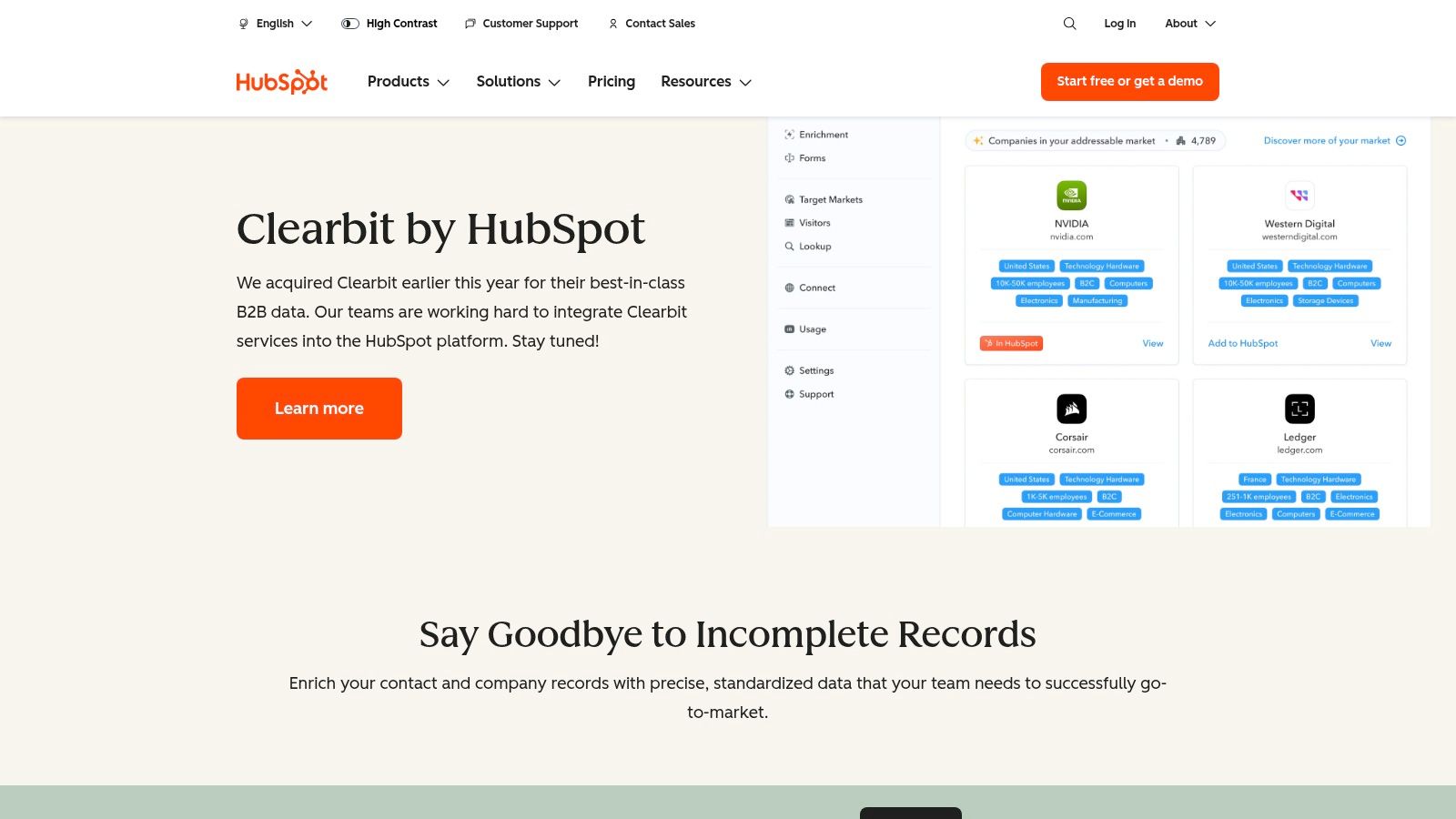
Clearbit is no longer really a standalone buying decision. It now lives inside HubSpot as Breeze Intelligence, which changes how you should evaluate it. You're not just buying data. You're buying convenience inside a HubSpot-centric operating model.
That distinction is important because native integration is often worth more than raw feature count. If your ops team already runs routing, automation, and reporting inside HubSpot, eliminating connectors can matter as much as enrichment depth.
Best use case for Breeze Intelligence
Breeze Intelligence is the best fit for teams that are committed to HubSpot and want company and person enrichment to happen natively in the CRM. Visitor identification and website intelligence are especially useful when marketing ops wants to enrich inbound flows without exporting data between systems.
The downside is lock-in. If you aren't already invested in HubSpot, Breeze Intelligence isn't a flexible independent option. And if your highest priority is strict contact verification for outbound deliverability, you may still want a specialist enrichment layer elsewhere in your stack.
Website: Clearbit inside HubSpot
Top 10 B2B Data Enrichment Tools, Side-by-Side Comparison
| Product | Core features | Accuracy & Deliverability | Target audience | Value & Pricing | Unique selling points |
|---|---|---|---|---|---|
| 🏆 Icypeas | ✨ Email Finder, strict Email Verifier (Google/MS catch-all), Reverse Lookup, People Scraper, 575M ppl / 62M co | ★★★★★, strict, low-bounce validation | 👥 Sales, marketing, product teams & devs | 💰 Flexible credits (never expire), intro 50 free credits; cost-effective | ✨ ISO27001 hosting, GDPR/CCPA audited, 99.9% uptime, dev-first API |
| ZoomInfo – OperationsOS Enrich | Real-time & scheduled enrichment, native SFDC/MAP/CDP connectors, technographics | ★★★★☆, enterprise-grade coverage & deliverability | 👥 RevOps, enterprise GTM teams | 💰 Quote-based (enterprise pricing) | ✨ Deep firmographics/technographics & native integrations |
| Apollo.io – Enrichment + sales intelligence | CRM/list enrichment, waterfall enrichment, API & CSV/CRM updates | ★★★★☆, good match rates with waterfall | 👥 SDRs, growth teams using outbound workflows | 💰 Usage-based tiers; pricing/credits tightened for some | ✨ Integrated outbound tools + cost-managing waterfall enrichment |
| Lusha – Prospecting & enrichment | API, browser extension, CSV enrich, unified credits | ★★★☆☆, strong for US emails/phones | 👥 Outbound reps & CRM users | 💰 Clear credit logic; reports of price increases | ✨ In-CRM workflows & handy browser extension |
| People Data Labs (PDL) | Person/company endpoints, bulk jobs, data licensing, free tier | ★★★★☆, developer-grade, transparent quality | 👥 Engineering/data teams needing scale | 💰 Volume-based, transparent pricing; scalable licensing | ✨ Data feeds & licensing for high-volume blends |
| Cognism – CRM enrichment & DaaS | Continuous/scheduled CRM jobs, Enrich/Redeem APIs, unified credits | ★★★★☆, strong EMEA/GDPR-aligned deliverability | 👥 GDPR/EMEA-focused sales & RevOps teams | 💰 Sales-assisted pricing; can be premium | ✨ Compliance-first controls and EMEA coverage |
| Hunter – Domain & lead enrichment | Domain-based email discovery, email verification, API & CSV | ★★★☆☆, cost-effective but domain-dependent | 👥 SMBs enriching inbound signups | 💰 Affordable for low volumes | ✨ Simple API and domain-to-email workflows |
| RocketReach – Contact & company enrichment | REST API, browser plugin, CSV/batch workflows, team plans | ★★★☆☆, useful as secondary source; mixed feedback | 👥 Teams needing supplemental/backup vendor | 💰 Can escalate for high-volume API use | ✨ Easy to add as secondary vendor with broad integrations |
| FullContact – Identity resolution & enrichment | Enrich & Resolve APIs, SDKs, identity graph, real-time enrichment | ★★★★☆, strong identity resolution for stitching data | 👥 Engineering-led teams, CDPs & data hubs | 💰 API-first; pricing opaque at scale | ✨ Identity graph + dev tooling (SDKs) |
| Clearbit (Breeze in HubSpot) | HubSpot-native enrichment, visitor de-anonymization, company/person appends | ★★★★☆, seamless inside HubSpot workflows | 👥 HubSpot-first GTM teams | 💰 Billed via HubSpot; requires paid HubSpot plan | ✨ Native HubSpot UX & visitor de-anonymization |
How to Choose the Right Enrichment Tool for Your Workflow
The biggest mistake buyers make is asking which platform has the biggest database. That question sounds sensible, but it rarely predicts success in practice. The better question is this: which tool gives your team the highest yield of usable records in the workflow you operate?
For automated CRM enrichment, reliability matters more than novelty. You need stable connectors or an API your team trusts, clear field mapping, and a process for refreshing records without creating duplicates or overwriting better first-party data. Icypeas and ZoomInfo stand out here for different reasons. Icypeas is the tighter specialist option when verification quality and implementation flexibility are the priority. ZoomInfo is stronger when enterprise governance and large-scale account enrichment drive the purchase.
For outbound list building, the trade-off shifts. Coverage matters, but deliverability matters more. Apollo is attractive because it combines enrichment with sales execution in one product, and that convenience is real. Icypeas is stronger when your team wants a focused enrichment engine with stricter verification and less bundle overhead. If your current outbound motion is generating too many bounces, list cleaning should come before any expansion effort.
For cleaning existing lists, specialist verification is usually the smarter investment than broad sales intelligence. Instead, teams often overspend on “platforms” when what they really need is stricter validation, better workflow triggers, and cleaner output before anything hits the sender domain. In my experience, list cleaning projects fail less from lack of data and more from weak verification standards.
For product and internal workflow integrations, API design and operational control decide everything. People Data Labs and FullContact are strong when engineering owns the workflow and wants enrichment as infrastructure. Icypeas also fits well here when the use case needs contact resolution, verification, and clean operational embedding without turning into a full custom data project.
There's also a compliance layer that too many buying guides skip. If you operate across multiple regions, enrichment can't be treated as a simple append exercise. You need to decide what fields you enrich, how long you retain them, how you document source provenance, and how your team handles lawful basis and transparency. That's one reason governance-first tools such as Cognism keep showing up in serious evaluations, especially for teams operating across Europe.
One market signal is worth keeping in mind. Independent benchmark coverage from Amplemarket reported the top score in its 2026 test suite at 219/231 overall, with under-3% email bounce rate in testing and a database of 200M+ contacts in its 2026 enrichment benchmark. I'm not including Amplemarket in the ranked list because this piece is centered on the specified ten tools, but that benchmark reinforces a useful buying principle: low bounce performance is often a better operating KPI than raw record count.
Run a pilot before committing. Use a sample from your CRM, not the vendor's demo list. Measure match rate, verification quality, bounce behavior, API friction, and downstream usefulness in routing or sequencing. Then model cost on usable records, not purchased records.
If you're evaluating adjacent GTM systems too, this same workflow-first thinking applies to competitive intelligence tools. The best tool isn't the one with the longest feature list. It's the one your team can trust in production.
If you want a specialist enrichment engine instead of another bloated sales platform, Icypeas is worth a serious trial. It's especially strong when your priorities are strict email verification, low-bounce list cleaning, real-time CRM enrichment, and developer-friendly API workflows. Test it on a stale CRM segment or pre-send outbound list and compare the usable output, not just the number of records returned.























































.png)


.webp)