.avif)
10 Best SERP API Alternative Tools for 2026


.avif)
You're probably in one of two situations right now. Either your current SERP pipeline is getting expensive as query volume grows, or you've hit the point where a single vendor's parser and pricing model no longer fit the way your product works. That usually happens when a rank tracker becomes a reporting platform, when a growth team starts monitoring local packs and shopping results, or when an internal data workflow turns into a production dependency.
That's why “SERP API alternative” isn't really a pricing search. It's an architecture decision. Some tools are clean, purpose-built SERP APIs with normalized output and predictable request semantics. Others are scraping platforms that can fetch SERPs but leave more parsing and field mapping to you. And some products that appear in adjacent searches, including people-data vendors, solve a different problem entirely.
If your team is also trying to understand how search data fits into AI workflows, Busylike's guide to AI search is worth reading alongside this list. It helps frame where raw search-result collection fits versus content retrieval, enrichment, and answer generation.
I've approached the tools below the way I would for a real evaluation: developer ergonomics first, operational risk second, pricing clarity third. The practical question isn't “which one has the most features.” It's “which one gives you the right result shape, enough reliability, and a cost model you can live with when usage changes.”
Table of Contents
1. DataForSEO, SERP API
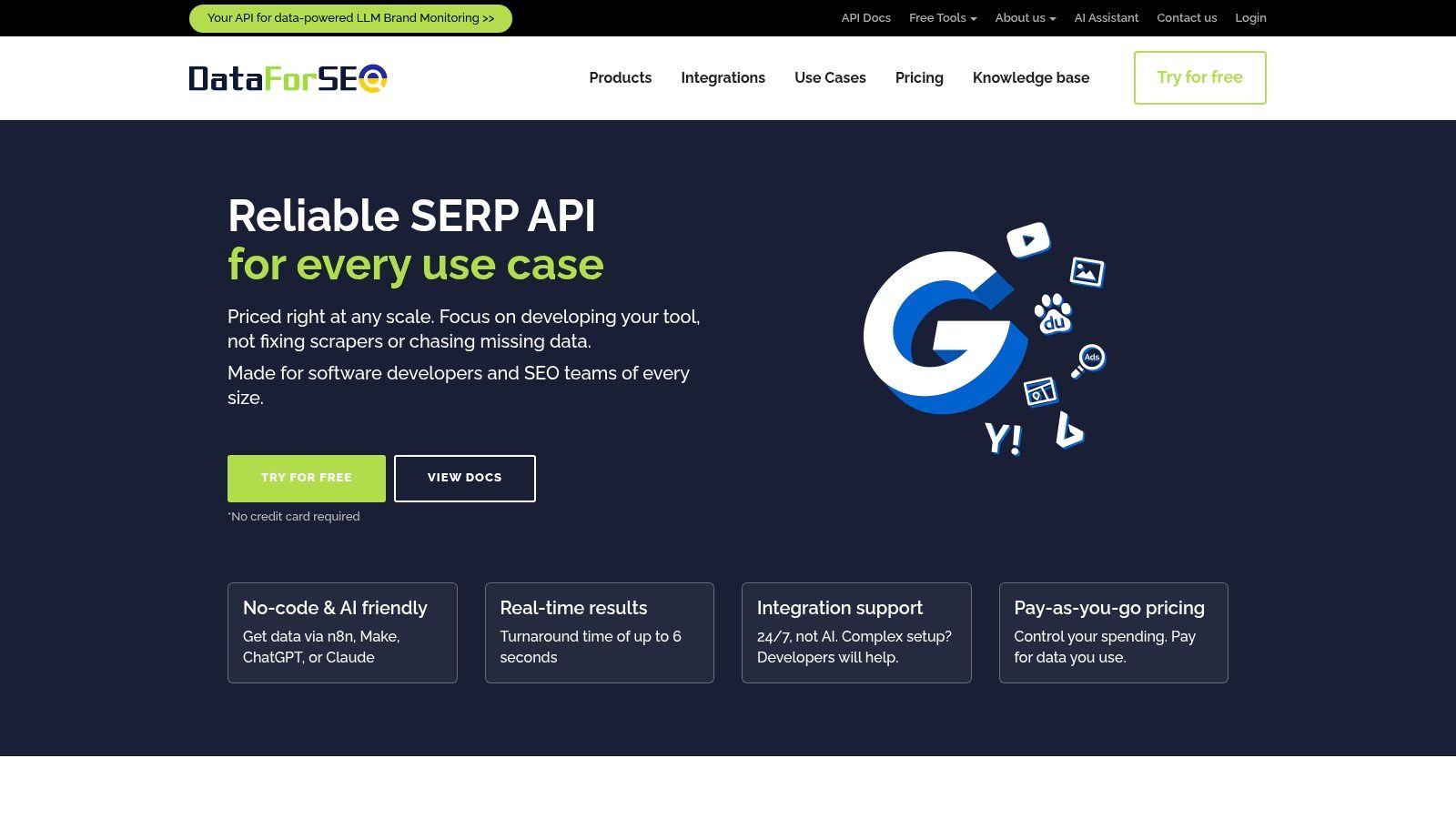
DataForSEO SERP API is the option I'd put in front of a product team that wants control more than hand-holding. It covers major search engines, exposes multiple SERP-related endpoints, and gives you enough knobs to tune latency, depth, and task handling without forcing you into a monolithic SEO suite.
That matters if you're building internal tooling or a customer-facing feature where cost forecasting happens at the request level. DataForSEO's model is closer to an infrastructure component than a polished dashboard product. For many teams, that's a feature, not a drawback.
Why developers tend to like it
The strongest part of DataForSEO is consistency. The output is normalized across engines and result types, which reduces the amount of per-engine cleanup you need in your own code. That's especially useful when your pipeline doesn't stop at rank collection and instead joins SERP data with ads, keywords, or trends.
Its sandbox also changes how you evaluate it. You can validate response shape, error handling, and parser coverage before wiring it into production billing logic. If your team is still deciding how a SERP layer fits into a broader data stack, this overview of what a data API is gives useful context.
Practical rule: Choose DataForSEO if your team is comfortable assembling the workflow itself and wants pricing and data extraction to stay modular.
Trade-offs that matter in production
You do have to think like a builder here. There's a small top-up step, and you won't get the same “few clicks and done” feeling that simpler subscription products offer. But in exchange, you get a mature developer-facing platform with broad task coverage and fewer assumptions about how you should use the data.
If I were comparing pure SERP API alternatives for a SaaS product, DataForSEO would sit near the top when the brief is: multi-engine support, strong docs, predictable request economics, and no need for a bundled UI.
2. Scale SERP by Traject Data
Scale SERP is one of the cleaner choices when the team evaluating it includes non-developers. Public tiers are easy to understand, the trial path is straightforward, and the product's language is built around searches, batches, and webhook delivery instead of forcing you to decode a credit economy.
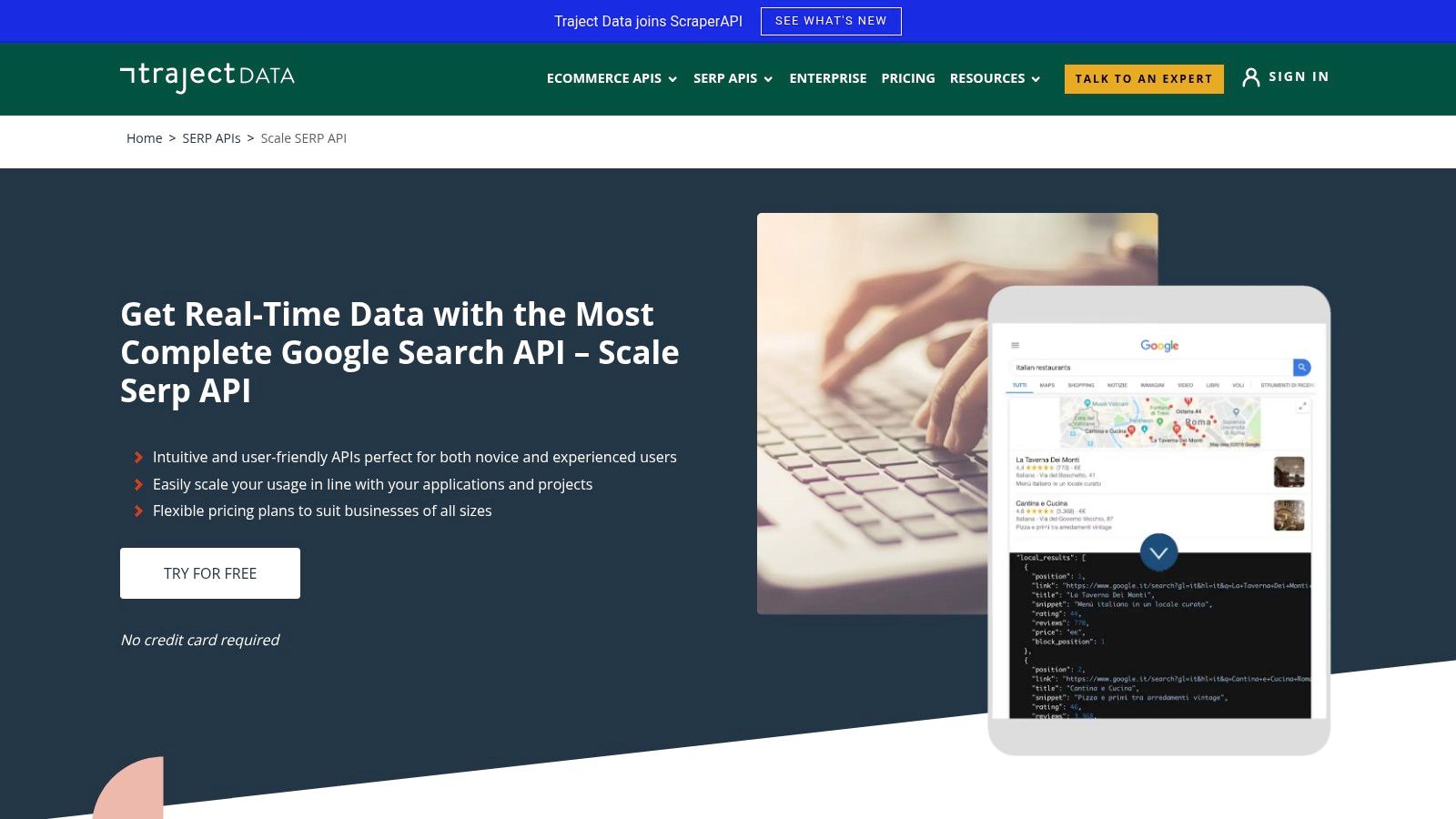
That sounds small, but it changes procurement. When a growth team, analyst, and engineer can all look at the same plan page and understand what they're buying, tools move through review faster.
Where it fits best
Scale SERP is primarily a Google-focused option. If your workload is rank tracking, localized result collection, or scheduled keyword pulls on Google, that focus is usually fine. If you need broader engine diversity as a first-class requirement, you'll likely outgrow it faster than a platform like DataForSEO or Bright Data.
The operational model is practical. Batch jobs and webhooks let you decouple request generation from result consumption, which is useful when you don't want frontend actions blocked on search retrieval. I like that because it nudges teams toward a more reliable queue-based architecture without making the API feel enterprise-heavy.
The real trade-off
Scale SERP's appeal is simplicity. The downside is that simplicity usually comes with narrower scope. It isn't the tool I'd choose if I expected the project to expand from Google search into multiple engines, wider scraping needs, or a more experimental retrieval layer.
If your team wants to test quickly, see clean plan boundaries, and avoid a lot of pricing translation, Scale SERP is one of the easiest swaps to evaluate.
For small and mid-sized products, that can be enough. The main question is whether “easy now” will still work when your use case broadens.
3. Zenserp an APILayer product
Zenserp sits in a useful middle ground. It feels more subscription-oriented than a usage-metered infrastructure API, but it still covers enough SERP surface area to support real product work. If your team wants fast startup time and doesn't want to stitch together multiple vendors for basic search-result collection, Zenserp is a credible option.
Its positioning is Google-first, but it also reaches into other engines and verticals like images, news, shopping, and trends. That breadth is enough for many SEO and monitoring applications without pushing you into a larger scraping platform.
Why it often works for lean teams
Zenserp reduces API sprawl. Add-ons for keyword-related data mean you may not need a separate provider for every adjacent lookup your workflow requires. That's not just convenience. It reduces authentication overhead, billing fragmentation, and failure points in your ETL jobs.
The API also appears designed for stable output over novelty. In practice, that usually matters more than marketing around cutting-edge SERP features. A parser that returns a dependable schema week after week is more valuable than a flashy endpoint that covers everything on paper but needs constant exception handling.
Where to be careful
I'd validate niche SERP blocks before committing. If your product logic depends on a specific Google surface or a less common result type, you want to test those exact queries early. Subscription plans can feel predictable, but they're less forgiving than true pay-as-you-go if your volume swings sharply between quiet months and heavy collection periods.
Zenserp makes the most sense when you want a reasonably broad SERP API alternative, clean onboarding, and a plan structure that finance can understand without reading implementation docs.
4. ValueSERP by Traject Data
ValueSERP does exactly what its name suggests. It's the budget-conscious choice in the Traject Data family, aimed at teams that care more about cost discipline than about having every advanced SERP nuance exposed on day one.
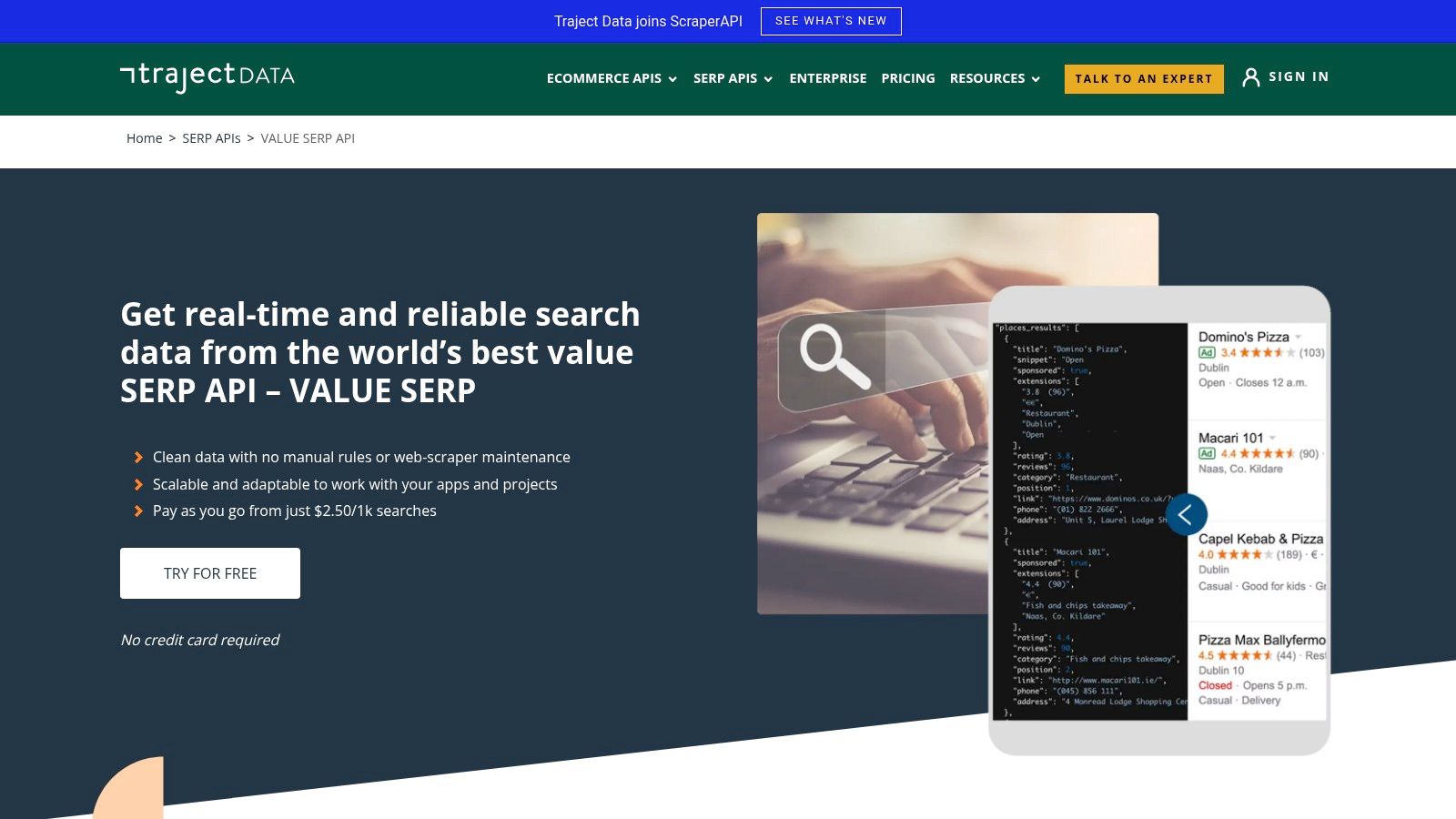
That makes it more interesting than it first appears. A lot of search workflows don't need exhaustive parser depth. They need repeatable Google results, enough rate capacity, and a bill that doesn't surprise anyone.
A sensible pick for stable, repeatable jobs
If I were building a reporting job that runs on a known keyword set every day or every week, ValueSERP would be on the shortlist. Its batch support and familiar Traject-style delivery model make it approachable, especially if your team has already used another product from the same vendor family.
There's also something practical about tools that don't try to be everything. ValueSERP doesn't pretend to be a full scraping infrastructure layer. It tries to make recurring SERP collection affordable and straightforward.
The constraint to keep in mind
The trade-off is parser ambition. Before choosing it, confirm the exact result blocks your downstream logic needs. If you're collecting broad rank signals and standard organic results, that check may pass easily. If you rely on edge SERP features, the “value” positioning can become a limitation.
- Best fit: teams running routine Google-centric monitoring jobs
- Less ideal: teams that expect multi-engine expansion or unusually deep SERP extraction
- Operational upside: similar docs and delivery patterns to sibling Traject products
The reason to pick ValueSERP isn't excitement. It's discipline. Sometimes the right SERP API alternative is the one that keeps a simple workload simple.
5. SerpWow by Traject Data
SerpWow feels like the Traject product for teams that want broader Google surface coverage without jumping straight to an enterprise scraping vendor. It supports multiple Google verticals and gives you several ways to consume results, including API pulls, webhooks, and cloud delivery.
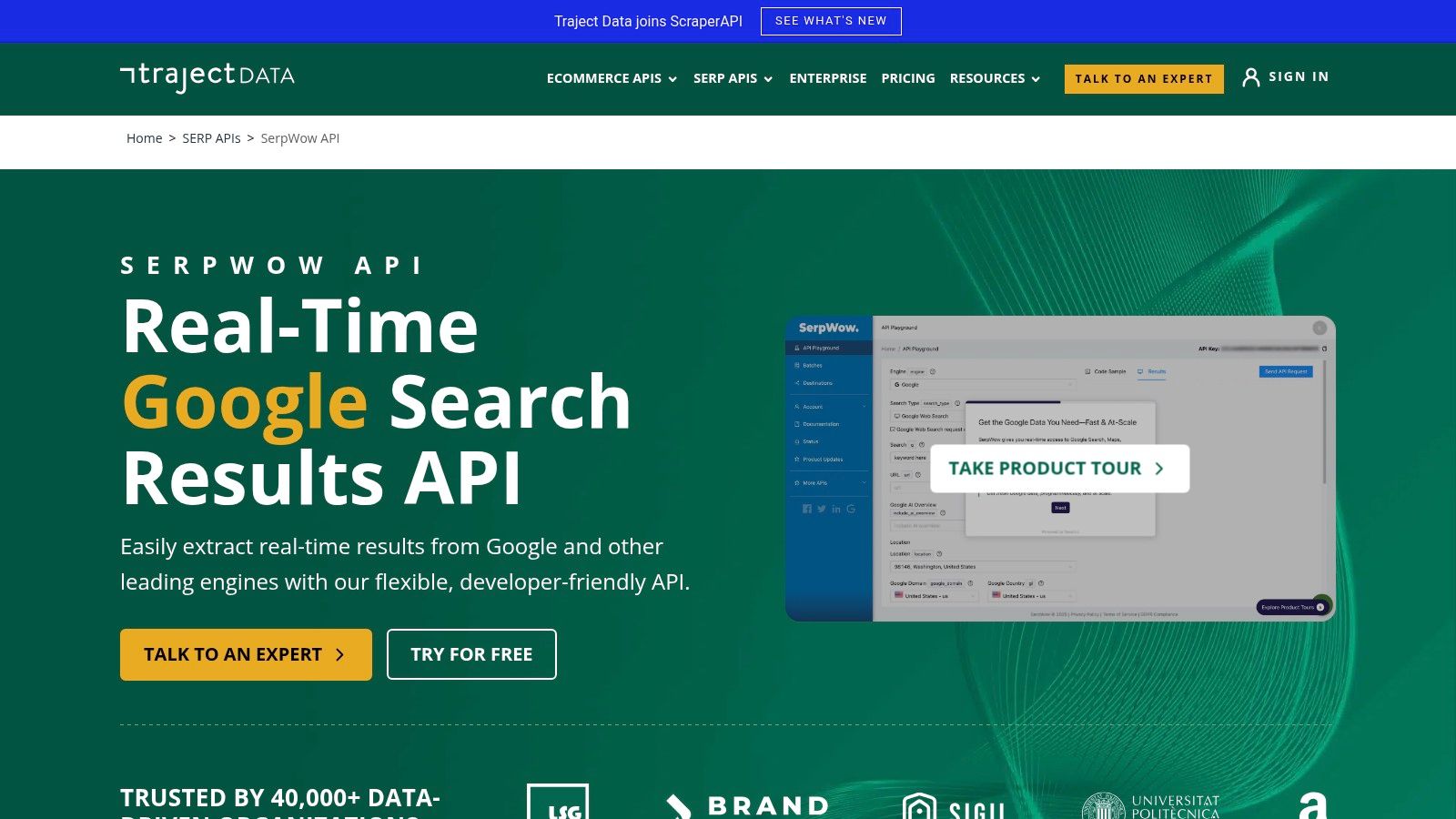
That delivery flexibility matters more than feature lists usually admit. Different teams consume SERP data in different ways. A backend service may want direct API responses. A data engineering workflow may prefer files dropped into storage. SerpWow supports both styles.
Why I'd consider it for experimentation
SerpWow is useful when you're still learning what your search-data product needs. Because it spans search, news, images, videos, scholar, trends, shopping, and maps, you can run experiments across several Google surfaces without re-platforming immediately.
That lowers early product friction. If your PM wants to test whether maps signals or shopping results improve a model or dashboard, you can do it inside one vendor relationship instead of rebuilding the ingestion layer.
“Broad Google support beats theoretical flexibility when you're still validating the product.”
What to verify before rollout
The credit model needs scrutiny. Any time pricing is abstracted into credits, I want a clear mapping between the queries I'll run and the bill I'll receive. That doesn't make SerpWow bad. It just means you should test with your real request mix, not only with example calls.
Also, SerpWow is still mostly a Google answer. If your actual requirement is “search engine diversification,” it won't replace a more multi-engine provider. But if your problem is “we need one API that covers a lot of Google territory and several result delivery patterns,” it's a strong candidate.
6. SearchAPI.io
SearchAPI.io is one of the more developer-friendly options for teams focused on modern Google surfaces. It covers a wide range of result types, including newer interfaces that many older comparisons still ignore, and it makes testing easy with quick-start examples.
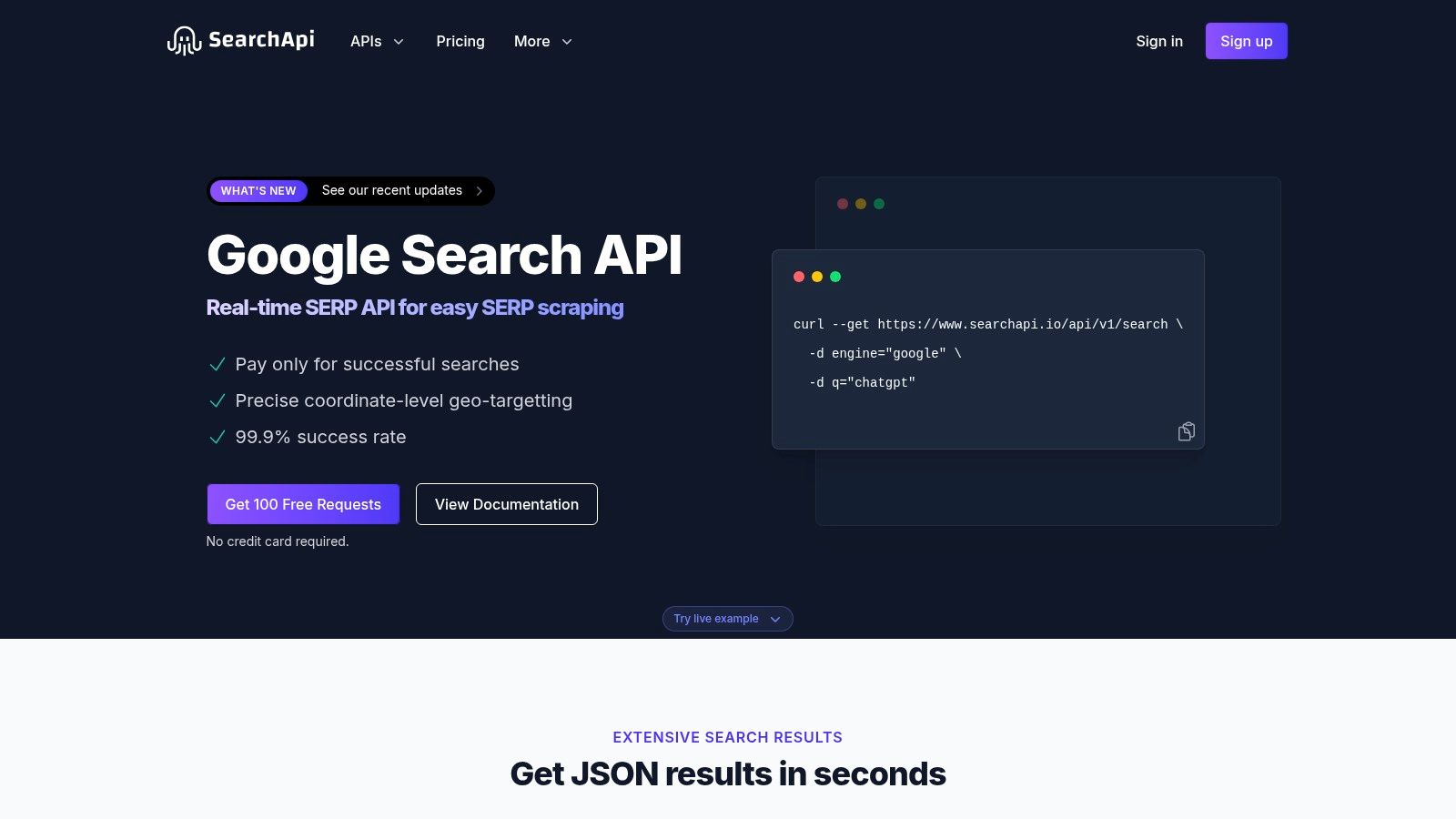
If your project depends on geo precision, SearchAPI.io gets attention fast. Coordinate-level targeting is the kind of detail that matters for local SEO tooling, location-aware monitoring, and any workflow where city-level targeting still feels too coarse.
Where it stands out
Some SERP APIs handle classic web search well but lag when Google introduces new result surfaces. SearchAPI.io appears more willing to expose those newer elements in one place. That's useful for teams doing competitive monitoring, ad analysis, or product research where the “whole page” matters more than organic links alone.
The onboarding path is also practical. Good examples reduce implementation mistakes, and implementation mistakes are often what people later describe as API unreliability. In my experience, docs quality and example quality are underrated parts of operational reliability.
One non-technical factor to consider
There's an active legal dispute involving SerpApi and SearchAPI.io, noted publicly by the companies involved. I'm not making a legal judgment here, but I would factor vendor risk into any long-term procurement decision. If you're building an internal tool, that risk may feel acceptable. If you're building a core dependency for customers, legal uncertainty deserves review by the people who own vendor approval.
- Strong fit: local monitoring, newer Google surfaces, fast proof-of-concept work
- Watch item: legal and procurement risk
- Best evaluation method: test your exact query classes, especially location-sensitive ones
Technically, it's compelling. Strategically, it requires a bit more diligence than the docs alone suggest.
7. Bright Data, SERP API
Bright Data SERP API is for teams that already know they're going to operate at meaningful scale or under heavier anti-bot pressure. It's less “simple SERP API” and more “enterprise retrieval layer with SERP support built on serious unblocking infrastructure.”
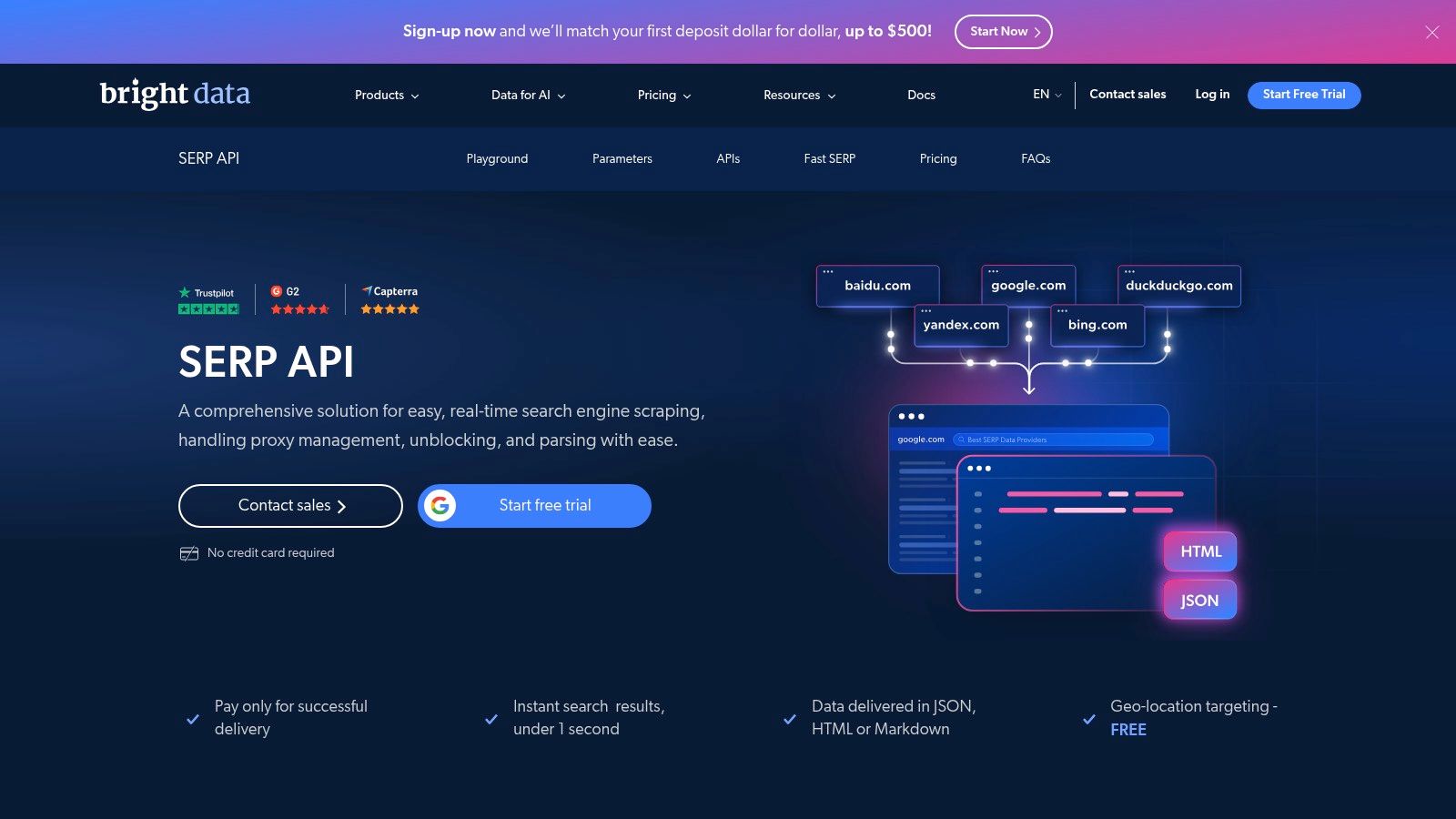
That changes the buying decision. You're not only paying for parsed results. You're paying for resilience, destination delivery options, enterprise controls, and access to a vendor that also handles broader scraping workloads.
Why enterprises pick it
Bright Data has a straightforward strategic advantage. If your company already needs proxy infrastructure, bypass solutions, or non-SERP web extraction, one vendor can simplify the stack. That's often more important than shaving a small amount off nominal per-request cost.
It also fits organizations where compliance review, access control, and support expectations are stricter. Teams comparing it with lighter-weight SERP APIs should be honest about whether they need those capabilities.
For adjacent outbound and enrichment workflows, this overview of B2B data enrichment tools is useful because it highlights a common architecture mistake: mixing search-result collection with contact-data enrichment as if they're interchangeable systems.
Operational note: Bright Data makes more sense when SERP collection is one part of a broader data acquisition platform, not a one-off side project.
Why smaller teams may skip it
If your workload is modest, Bright Data can feel like overbuying. The tooling is powerful, but its power comes with a cost in procurement complexity and product surface area. Smaller teams often move faster with a narrower API, even if Bright Data would be the stronger long-term infrastructure choice.
I'd choose Bright Data when failure is expensive, scale is expected, and the organization is comfortable buying infrastructure, not just an endpoint.
8. Oxylabs, SERP Scraper API
Oxylabs SERP Scraper API competes in a similar tier to Bright Data, but I think of it as the pick for teams that care greatly about extraction reliability under hostile conditions and already understand scraping operations.
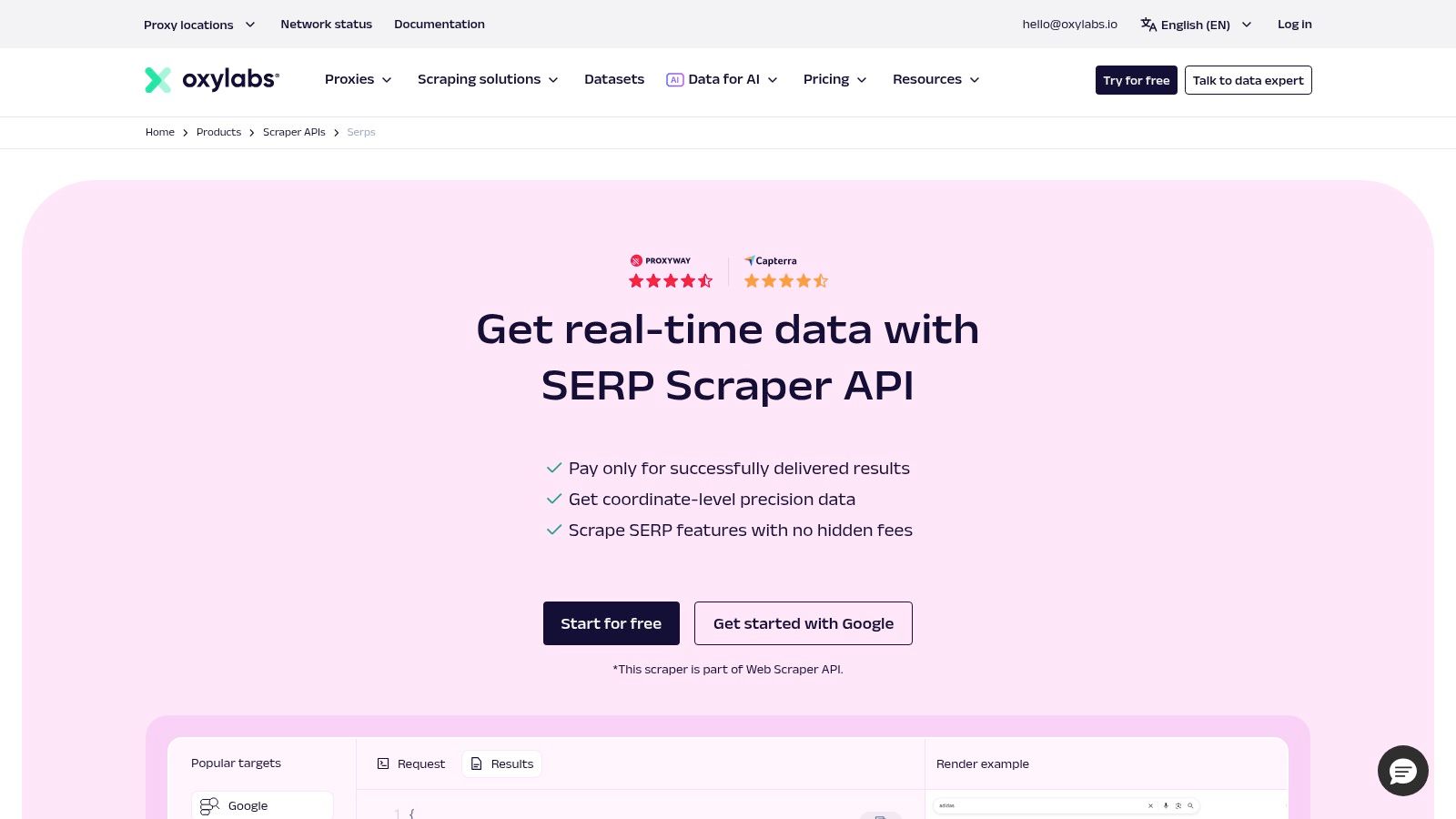
Automated retries, proxy rotation, locale targeting, and dashboard-plus-API workflows all point to the same use case. This isn't just about getting a JSON response. It's about continuing to get one when targets are unstable, localized, or aggressively defended.
Best use cases
Oxylabs is a serious candidate for large-scale monitoring, marketplace intelligence, and any workflow that crosses from “SEO data” into “competitive web data.” That's because the SERP product sits inside a broader scraping and proxy platform. If your team eventually needs both structured search results and direct page extraction, that ecosystem matters.
I also like Oxylabs for organizations where the people evaluating the tool aren't only app developers. The dashboard and code snippets make it easier for analysts, solutions engineers, and platform teams to collaborate during the pilot stage.
Why it isn't for everyone
The downside is familiar. Enterprise scraping vendors often make low-volume economics less attractive. If you only need periodic keyword pulls, you probably won't use enough of Oxylabs' infrastructure strengths to justify the added cost and complexity.
The right way to assess Oxylabs isn't “is it cheap.” It's “what does a failed or blocked request cost our workflow?”
If the answer is “not much,” choose something simpler. If the answer is “a broken data feed or a delayed customer deliverable,” Oxylabs deserves real consideration.
9. Apify, Google Search Scraper API via Actors
Apify's Google Search Scraper Actor API is the fastest route to a working pipeline when your use case extends beyond “fetch a SERP and stop.” That's the key difference. Apify isn't just a SERP API. It's an execution platform where prebuilt Actors can scrape search results, follow links, schedule runs, store outputs, and push datasets into downstream systems.
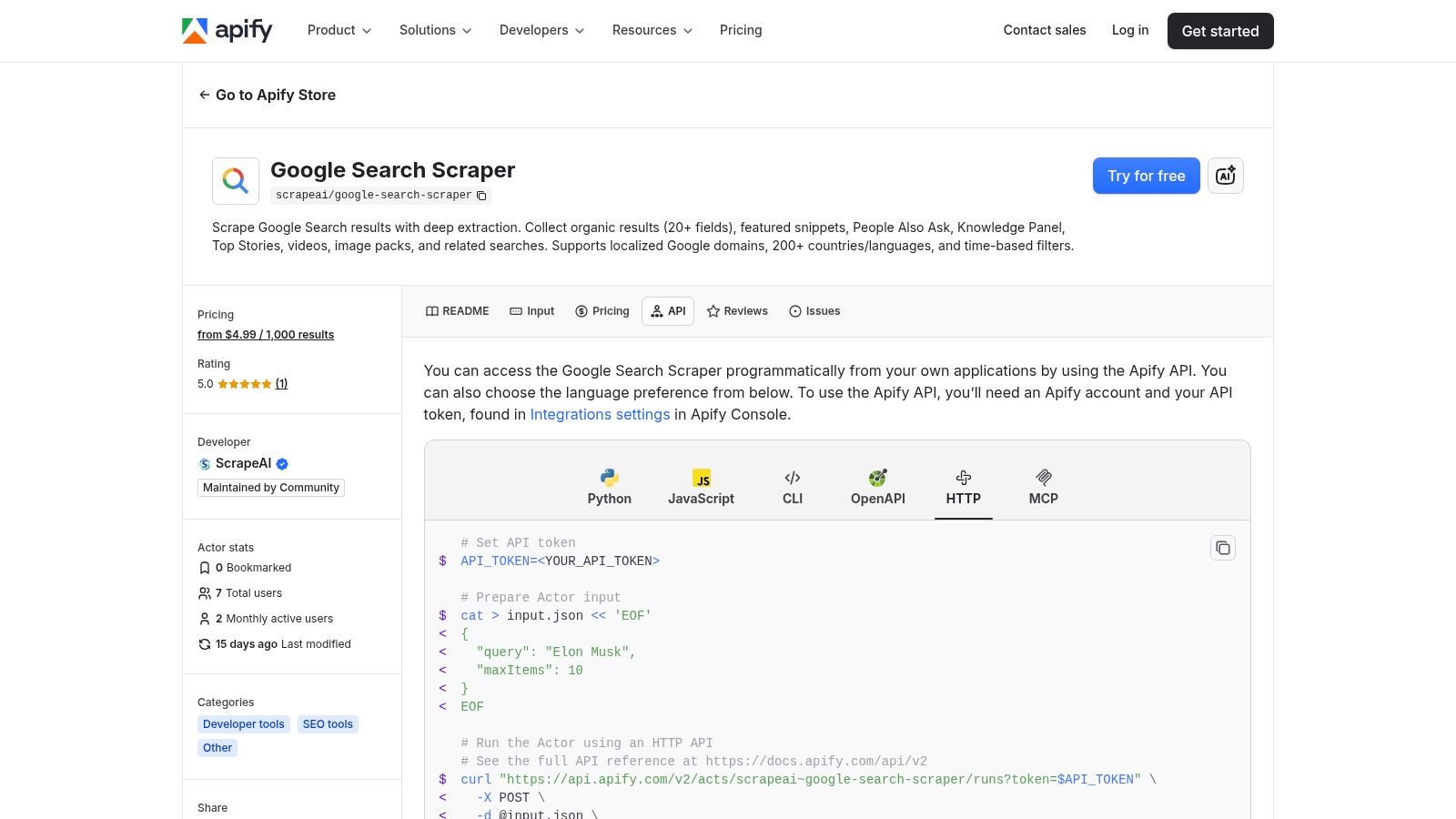
That's why Apify often wins prototypes. You can stand up an end-to-end workflow quickly, especially when the data path includes storage, retries, and orchestration.
Where it's unusually strong
Apify is ideal when you want to combine SERP retrieval with follow-on scraping. For example, collect results for a query set, visit the ranking pages, extract page content, and land everything in a dataset your team can inspect or ship to cloud storage. Doing that with a pure SERP API often means adding multiple services yourself.
The operational layer is mature. Scheduling, monitoring, and webhooks aren't afterthoughts. They're part of the platform's core model, which makes Apify attractive to teams that care about workflow composition as much as they care about raw extraction.
The caution flag
Marketplace quality varies. That's the price of flexibility. Before standardizing on any Actor, I'd review maintenance cadence, user feedback, schema stability, and whether the Actor owner treats it like a product or a side project.
- Choose Apify when: you want a pipeline, not just an endpoint
- Be careful if: you need a highly uniform parser contract across many workloads
- Big advantage: easy storage and orchestration around the scrape itself
For product teams moving quickly, Apify can save a lot of engineering time. You just need stronger vendor and component review discipline.
10. ZenRows, Universal Scraper API
ZenRows is the least pure “SERP API alternative” on this list, and that's exactly why some teams should consider it. It's a universal scraping platform first. You can use it for Google SERPs, but it's more accurate to describe it as a broad scraping layer with anti-bot handling, headless rendering, and concurrency controls.
If your organization collects many kinds of web data and SERPs are only one input, ZenRows can simplify the stack. If your only goal is parsed search results with minimal engineering, a purpose-built SERP API will usually be easier.
Why it's attractive in mixed scraping environments
ZenRows gives teams one commercial relationship for rendered pages, anti-bot management, and general extraction. That matters when the same data pipeline scrapes product pages, directories, marketplaces, and search engines. A single request model across those sources can be easier to operationalize than a patchwork of niche APIs.
For builders experimenting with automation-heavy workflows, this walkthrough on using the Icypeas API with vibe coding is relevant because it shows the opposite side of the stack: structured enrichment APIs are often much simpler to wire than browser-driven extraction systems.
The important distinction
ZenRows may fetch the page well, but you may still need to define your own mapping from raw content into the fields your app expects. That's the core trade-off. You gain flexibility across many scraping targets, and you give up some of the clean, purpose-built SERP parsing you'd get elsewhere.
This is also where people confuse categories. A SERP API gives you search-result data. A people-data platform like Icypeas gives you cached, structured professional and company information for enrichment and outbound workflows. They complement each other, but one doesn't replace the other.
If you need broad web extraction, ZenRows is practical. If you need normalized search-engine result objects with minimal post-processing, it's not the most direct answer.
Top 10 SERP API Alternatives, Quick Comparison
| Provider | Core features ✨ | Performance / Reliability ★ / 🏆 | Best for 👥 | Pricing / Value 💰 |
|---|---|---|---|---|
| DataForSEO, SERP API | Multiple queues, sandbox, normalized JSON, extra endpoints | ★★★★, mature docs & SDKs | 👥 Builders, agencies, product teams | 💰 PAYG per-request; predictable; requires top-up |
| Scale SERP (Traject) | Real-time Google, batch jobs, webhooks, free eval 125/mo | ★★★★, transparent tiers & predictable | 👥 Teams wanting easy trial & per-search billing | 💰 Public tiers; free trial bucket; clear overages |
| Zenserp (APILayer) | Multi-vertical Google + other engines, CPC add‑ons, batch | ★★★★, turnkey, uptime focus | 👥 Fast-start apps & scale-ups | 💰 Subscription tiers up to 1M/month; generous allotments |
| ValueSERP (Traject) | Tiered plans, real-time endpoints, batch support | ★★★, value-focused SLAs | 👥 Cost-sensitive, high-volume users | 💰 Low headline $/1k searches; best at volume |
| SerpWow (Traject) | Broad Google verticals, JSON/CSV/HTML, webhook/cloud delivery | ★★★★, wide Google surface coverage | 👥 Teams needing many Google surfaces & scale | 💰 Credit-based pricing; confirm credits→search mapping |
| SearchAPI.io | Precise geo-targeting, many Google surfaces, success-only billing | ★★★, broad features; legal risk noted | 👥 Geo/locale-focused workflows | 💰 Success-only; free 100 requests eval; verify pricing |
| Bright Data, SERP API | SERP parsers + proxy/unlocker net, enterprise SLAs | ★★★★★🏆, resilient at extreme scale | 👥 Enterprises needing reliability & unblocking | 💰 Premium; enterprise pricing & SLAs |
| Oxylabs, SERP Scraper API | Proxy rotation, retries, locale/device targeting, dashboard | ★★★★★, high success under anti-bot pressure | 👥 Large-scale, hard-to-reach targets | 💰 Enterprise-oriented pricing |
| Apify, Google Search Scraper | Marketplace Actors, storage, scheduling, webhooks | ★★★★, fastest path to a pipeline | 👥 Developers needing prebuilt flows & delivery | 💰 Variable by Actor; pay-per-result or compute fees |
| ZenRows, Universal Scraper API | Headless rendering, anti-bot mgmt, concurrency, pay-per-success | ★★★★, flexible for mixed pipelines | 👥 Data engineers & full‑pipeline scraping | 💰 Pay-per-success; price depends on page class multipliers |
Making the Final Call
The mistake I see most often is choosing a SERP API alternative by homepage messaging instead of by failure mode. Every provider looks good when the test query is simple, the volume is low, and the result only needs to be printed to a console. Actual differences show up later, when your app depends on consistent schemas, batch workflows, geo targeting, or stable costs across changing usage.
Start with the core question. Do you need a purpose-built SERP API, or do you need a broader scraping platform that happens to support SERPs? DataForSEO, Scale SERP, Zenserp, ValueSERP, SerpWow, and SearchAPI.io are closer to the first category. Bright Data, Oxylabs, Apify, and ZenRows lean toward the second, though each does it differently.
That distinction drives implementation cost. Purpose-built SERP APIs usually reduce parsing work and give you a more direct path to normalized search data. Broader scraping platforms often make more sense when your team also needs page rendering, anti-bot tooling, destination delivery, or orchestration around the crawl itself. If search is just one stage in a larger data acquisition workflow, a generalized platform can be the better long-term decision even if it takes more setup.
The second question is operational. How do you want to consume results? If your product issues live, user-triggered queries, latency and predictable request semantics matter more. If you run scheduled collections, batch submission and webhook delivery often matter more than raw response speed. Teams often underestimate that difference and then force a real-time integration onto a workload that should've been queue-based from the start.
The third question is financial. Don't only compare headline pricing models. Compare how billing maps to your exact workload. Credit systems, subscriptions, and usage-based request billing can all be reasonable. The wrong one becomes expensive when your traffic pattern changes or when some query types cost more to collect than others. Before committing, run realistic samples across your expected query set, including local, mobile, shopping, and edge-case searches if those matter to your product.
My own shortlist would look like this. Choose DataForSEO if your team wants developer control, broad endpoint coverage, and clean modularity. Choose Bright Data if resilience, scale, and broader web data infrastructure matter more than keeping the stack lightweight. Choose Apify if you want the fastest route from idea to working pipeline and expect the workflow to include storage, orchestration, or follow-on scraping. Choose Scale SERP or Zenserp if your team values onboarding simplicity and easier plan comprehension. Choose Oxylabs if blocked requests are costly and reliability under pressure is the main requirement.
One last point matters more than most feature grids suggest. A SERP API is not a people-data API. If your workflow needs search-result collection, buy a SERP product. If your workflow needs verified work emails, professional profiles, or company enrichment, use a people-data platform like Icypeas. Many go-to-market and product teams need both, but they solve different layers of the stack.
The right decision usually comes from a short, disciplined trial. Pick two or three finalists, test the exact queries your application depends on, inspect the JSON carefully, measure how much cleanup your team has to write, and then choose the provider whose trade-offs you can live with.
If your workflow doesn't stop at search results and you also need verified professional contact data, company enrichment, or API-friendly lead intelligence, Icypeas fills that gap cleanly. Use a SERP API to collect what search engines show, then use Icypeas to enrich the people and companies behind those results with structured B2B data your sales, marketing, and product teams can act on.




















































































.png)


.webp)