.avif)
What Is a Marketing Data Platform? a Complete 2026 Guide

.avif)
You can usually tell when a team needs a marketing data platform before anyone says it out loud.
Paid media says LinkedIn drove the pipeline. Lifecycle says email created the demand. Sales says half the “qualified” leads were students, vendors, or duplicate contacts. Finance asks for a clean view of spend to revenue, and the room goes quiet because every dashboard uses a different definition.
That's the moment teams typically start shopping for another connector, another dashboard, or another reporting layer. In practice, that rarely fixes the underlying problem. The issue isn't just that data lives in different places. It's that the data coming out of those systems often isn't trustworthy enough to run growth against.
A marketing data platform matters because it gives marketing, ops, and revenue teams one operational layer for collecting, cleaning, governing, and activating data across the stack. If you're mapping the mess before you centralize it, this guide to marketing data sources is a useful companion. And if your team is deciding whether to get outside help, this practical resource on advice for growth teams on analytics agencies is worth reading before you hire.
Table of Contents
Moving Beyond Disconnected Marketing Data
Organizations don't suffer from a lack of data. They suffer from too many systems producing partial truths.
A common setup looks fine on paper. Salesforce or HubSpot holds lead and opportunity data. Google Ads, LinkedIn, and Meta report campaign performance. Marketo, HubSpot, Customer.io, or Klaviyo track email engagement. GA4 or product analytics tools capture site behavior. Then someone exports CSVs into Sheets, Looker Studio, Tableau, or a warehouse model and tries to make the numbers line up.
They usually don't.
One platform counts conversions at the ad level. Another counts form fills. CRM reports opportunities by created date. Finance reports bookings by closed date. Attribution breaks because UTMs are inconsistent, country naming is messy, and “same person” exists as three records across systems.
The backdrop is important. The MarTech market reached $859 billion in 2025 and is projected to exceed $1.03 trillion by 2026, while the number of solutions grew to 15,384, roughly 100x in 14 years according to marketing technology market data compiled by Technology Checker. More tools create more useful signals, but they also create more failure points in definitions, syncs, ownership, and trust.
What fragmentation looks like in practice
A Head of Growth usually sees the symptoms before the root cause:
- Channel disputes: Paid, lifecycle, and sales each defend different reports.
- Slow decisions: Every weekly review starts with data cleanup instead of action.
- Weak handoffs: Good leads arrive without enrichment, routing context, or source confidence.
- Unreliable attribution: Teams can see activity, but not a dependable path from spend to outcome.
The real cost of disconnected data isn't bad reporting. It's delayed decisions and avoidable waste.
The fix isn't “put everything in one dashboard.” Dashboards summarize. A marketing data platform standardizes, governs, and prepares the underlying data so the dashboard has something reliable to show.
Defining the Marketing Data Platform
A Head of Growth usually asks a simple question. "Which campaigns are creating pipeline we can trust?" If the answer still depends on spreadsheet cleanup, hand-checked lead records, and debates about what counts as a qualified account, the stack has a data management problem, not a reporting problem.
A marketing data platform is the layer that collects marketing, customer, and revenue data into one governed environment, then makes that data reliable enough to use for decisions, targeting, routing, and measurement.
An MDP sits between the systems where data is created and the systems where teams act on it. CRM, ad platforms, web analytics, product events, email tools, call tracking, offline conversions, and enrichment sources all produce useful signals. The MDP brings those signals together, standardizes them, applies rules, and keeps definitions consistent so every downstream report or audience is built on the same foundation.
Without that layer, growth teams end up maintaining a chain of one-off integrations. It works until it doesn't. A new field appears in the CRM, campaign naming slips, a form tool changes its schema, or one person exists under multiple IDs. Then reporting slows down, lead routing gets messy, and confidence drops.
What an MDP actually does
At a practical level, the platform needs to ingest data through connectors, APIs, webhooks, CDC, batch syncs, and real-time streams. It then maps fields into a usable schema, resolves identities across systems, applies enrichment and business rules, and prepares clean outputs for reporting tools, activation channels, and operational workflows.
That is the difference between data being present and data being usable.
A warehouse can store records. A dashboard can visualize them. A CDP can help with profile building and audience activation. An MDP focuses on the work growth teams usually discover too late: making the underlying data trustworthy enough that attribution, segmentation, routing, and performance reviews stop changing every time someone pulls a new export.
What an MDP is not
It is not a dashboard layer with prettier charts.
It is not just another database.
It is not a replacement for governance, because governance is part of the job. Ownership, naming rules, field definitions, identity logic, and refresh policies still need to be defined and maintained inside the platform.
Practical rule: If a platform connects tools but still leaves your team debating field definitions, duplicate people, and source-of-truth logic, you do not have a true marketing data platform yet.
Companies buy an MDP because they need marketing data to hold up under operational pressure. That usually means four outcomes:
- Data arrives consistently from the systems growth and revenue teams depend on.
- Records line up across sources because schemas and naming conventions are standardized.
- People and accounts are more accurate because identity resolution and enrichment fill in gaps.
- Teams can act on the output because reporting, audiences, scoring, and routing are built on governed data.
That last point gets missed in a lot of high-level definitions. The value of an MDP is not that it connects tools. Plenty of systems can do that. The value is that it turns scattered, inconsistent inputs into data the business can trust enough to spend against, route from, forecast with, and defend in a board meeting. If the platform does not improve data quality, enrichment, and governance, it is only centralizing the mess.
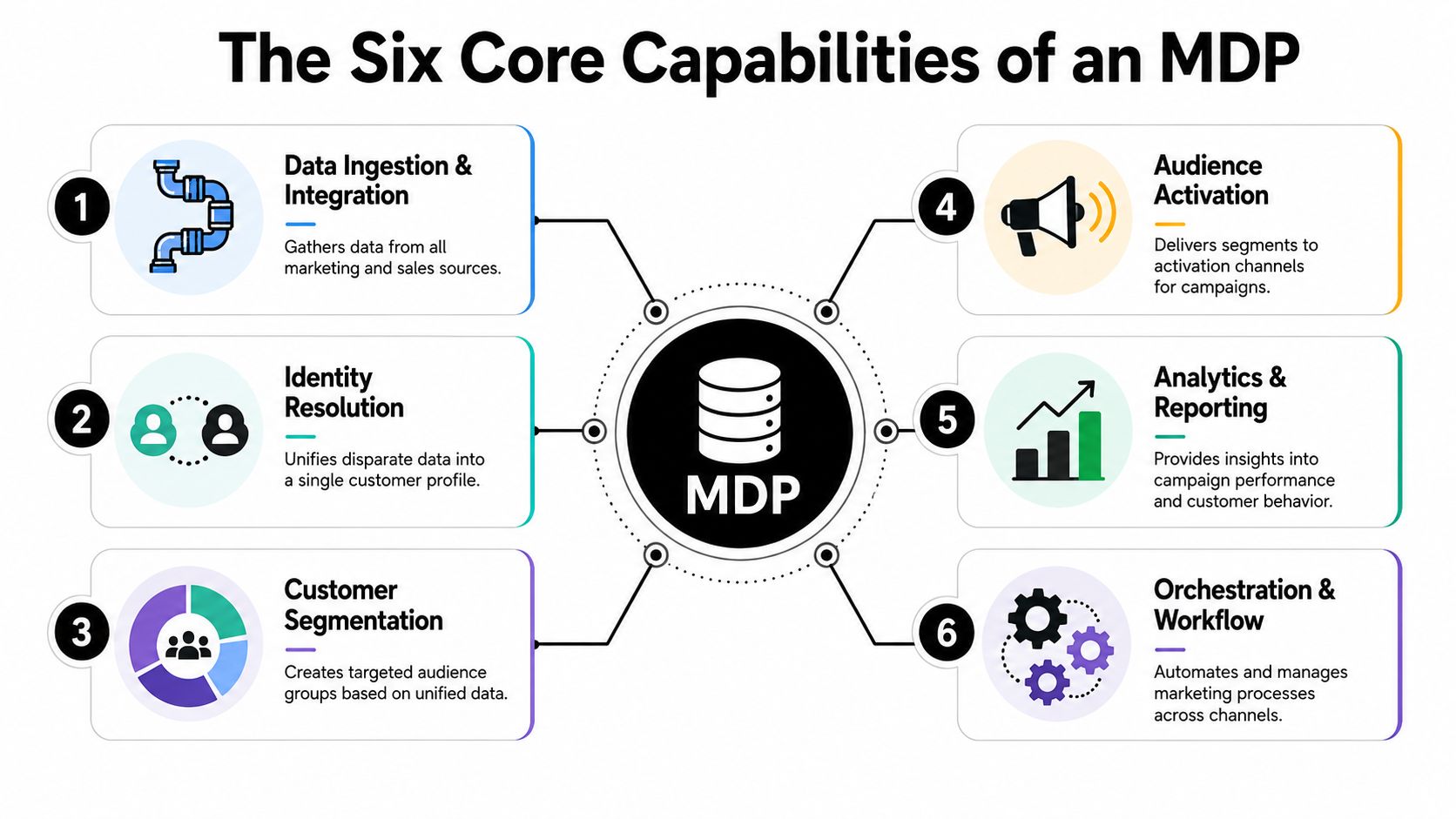
The Six Core Capabilities of an MDP
A Head of Growth usually feels the need for these capabilities in a painful moment, not during vendor research. Paid says a campaign is working. Sales says the leads are junk. Finance has a different CAC number. The problem is rarely that data exists in too few places. The problem is that no system has done the work to make that data consistent enough to trust and useful enough to act on.
That is the standard an MDP has to meet.
What the platform has to do
An MDP earns its budget by doing six jobs well, in the right order. If ingestion works but identity is weak, reporting drifts. If activation works but governance is loose, bad segments spread faster. The value comes from the combination.
1. Data ingestion and integration
The platform has to pull data from ad platforms, CRM, web analytics, product events, email systems, offline sources, and enrichment vendors. It also has to support batch pipelines and real-time event flow.
Those two modes serve different needs. Batch is fine for finance rollups and daily performance reporting. Real time matters when a team needs to suppress an audience quickly, trigger sales routing, or personalize based on current behavior.
2. Identity resolution
Many evaluations get too shallow. One buyer can show up as an anonymous visitor, a webinar registrant, a Salesforce lead, and later an opportunity contact. If those records do not connect correctly, attribution, scoring, and segmentation all break in quieter ways that take months to notice.
Identity resolution works like reconciling multiple versions of the same customer file while preserving the history attached to each record. Good platforms let teams define match rules, confidence thresholds, and survivorship logic instead of forcing a black-box merge.
3. Data enrichment
Raw records are often too thin for decision-making. A work email and company name may be enough to create a lead, but not enough to route it by territory, segment it by market, or judge whether it fits your ICP.
Enrichment adds missing context such as company attributes, job function, firmographic labels, and validated contact details. The trade-off is accuracy versus coverage. Wider enrichment can fill more fields, but weak providers can also introduce stale or conflicting values. That is why enrichment needs validation rules, not blind acceptance.
4. Unified storage and modeling
The platform needs a governed place where campaign data, funnel activity, customer records, and revenue events can live in one structure. This is the layer that standardizes naming, maps fields, aligns timestamps, and defines what terms like MQL, sourced pipeline, or influenced revenue mean.
Without that model, every analysis turns into a one-off cleanup project. Teams that want better marketing data analysis workflows usually find that the analysis itself is not the bottleneck. The bottleneck is inconsistent structure upstream.
5. Audience activation
An MDP should send useful outputs back into execution systems. That includes ad audiences, email segments, suppression lists, lead routing triggers, and sales alerts.
The platform begins to affect pipeline, not just reporting. A growth team might build a high-intent audience from product usage and CRM status, then push it to paid channels or creative tools such as ShortGenius AI ad generator for faster campaign production. But activation only helps if the underlying data is governed. Faster distribution of a bad audience still wastes budget.
6. Governance
Governance is what keeps the other five capabilities from drifting. It covers permissions, lineage, field definitions, PII handling, compliance controls, refresh schedules, and change management.
Teams tend to notice governance only after something breaks. Two dashboards show different conversion rates. A field gets repurposed without warning. An identity rule changes and audience size drops by half. Governance prevents those failures from becoming recurring operating issues.
A marketing data platform must ingest data in batch and real time, standardize schemas, and resolve identities across sources to create a dependable record of customer and campaign activity. That record is what makes attribution, segmentation, and routing credible enough to use in day-to-day decisions.
Why these capabilities fail in the real world
Failures usually start with sequence. Teams buy for connectivity, then postpone the harder work of quality control and governance.
Common patterns show up fast:
- Ingestion without naming discipline: Data lands on schedule, but UTM structure, campaign names, and channel labels vary by team.
- Identity without clear rules: Records merge too aggressively, and one bad match contaminates attribution and lifecycle reporting.
- Enrichment without validation: Extra fields appear, but nobody knows which provider wins when values conflict.
- Activation without review controls: Audiences sync cleanly into paid and email systems, even when the logic behind them is flawed.
An MDP can move bad data very efficiently.
That is why I evaluate these six capabilities less by feature checklist and more by operating reality. Can the team maintain match logic without engineering every week? Can they trace a metric back to source fields? Can they explain why a person entered an audience, and reverse it when needed? If the answer is no, the platform may be connected, but the data is still not trustworthy enough to run growth against.
MDP vs CDP vs DMP How They Compare
The confusion here is understandable. Vendors blur categories because “data platform” sounds broad enough to cover almost anything.
The cleanest way to compare them is by job, not label.
The job each platform is hired to do
A marketing data platform is built to unify, prepare, govern, and operationalize marketing data across multiple systems. It's broad. It usually touches reporting, identity, segmentation, and activation.
A customer data platform focuses more narrowly on customer profiles, audience building, and activation. It often centers on known users and marketing use cases like personalization, suppression, and segmentation. That category is growing fast. One market estimate values the global CDP market at $9.72 billion in 2025 and projects $37.11 billion by 2030, with audience segmentation holding 27.09% share in 2025 according to CDP market research from MarketsandMarkets. That tells you where many buyers still see immediate value.
A DMP historically handled anonymous audience data for advertising and media buying. In practical terms, many teams use the term less now because privacy changes reduced the value of older third-party-cookie-driven workflows.
A data warehouse stores and organizes data for analysis. It can absolutely sit under a modern marketing stack, but by itself it usually doesn't give marketers plug-and-play identity, audience syncs, marketing-friendly schemas, or workflow logic.
A practical comparison table
| Platform | Primary Purpose | Core Data Type | Primary User | Key Use Case |
|---|---|---|---|---|
| MDP | Unify, govern, and operationalize marketing data across systems | Marketing, customer, campaign, and revenue data | Marketing ops, RevOps, analytics, growth | Trusted reporting, segmentation, attribution, activation |
| CDP | Build customer profiles and activate audiences | Mostly first-party customer and behavioral data | Marketing, lifecycle, CRM teams | Personalization, audience segmentation, cross-channel activation |
| DMP | Support ad targeting with largely anonymous audience data | Anonymous audience data | Media and advertising teams | Programmatic targeting and audience buying |
| Data Warehouse | Store and query structured data centrally | Raw and modeled business data | Data teams, analytics, engineering | Central storage, BI, modeling, reporting |
The biggest buying mistake is expecting one category to do another category's job without extra work.
For example, a warehouse can support an MDP design, but it doesn't automatically behave like one. A CDP can activate audiences well, but it may not solve broader reporting governance across finance, CRM, and multi-region paid data. A DMP can help with media use cases, but it won't give sales and lifecycle teams a trustworthy customer record.
If you're a Head of Growth, the practical question is this: where does trust break first in your current stack?
- If the pain is audience activation from known customer behavior, start with CDP-style needs.
- If the pain is cross-system reporting and operational consistency, think MDP first.
- If the pain is storage and modeling flexibility, the warehouse becomes central.
- If the pain is legacy ad audience buying, a DMP may still matter, but usually in a narrower role.
Practical Use Cases for Growth Teams

Where growth teams feel the impact first
The best use cases aren't glamorous. They remove friction from decisions teams make every day.
Inbound lead qualification
A visitor fills out a demo form. Instead of sending a thin record into the CRM and hoping SDRs sort it out later, the MDP enriches the lead, checks company context, standardizes source data, and routes it with the right ownership. If your team is also tightening reporting and segmentation workflows, this guide to marketing data analysis fits well alongside that work.
For enrichment, teams often combine an MDP with tools that verify and complete contact records. For example, ShortGenius AI ad generator belongs on the creative side of the stack for ad production, while data-focused tools serve a different role by improving the records and signals those campaigns rely on.
Account-based segmentation
B2B teams rarely market to one contact. They market to clusters of people inside the same account. An MDP can unify form fills, ad engagement, email activity, and CRM state so growth and sales can build account views instead of isolated lead views.
That changes campaign planning. Instead of “who clicked,” the question becomes “which target accounts show buying behavior across channels.”
What strong teams do differently
Teams that get value from a marketing data platform usually apply it to a small number of operational problems first.
- They clean high-value fields first: Source, campaign, region, lifecycle stage, owner, and account identifiers.
- They enrich where action depends on context: Routing, suppression, prioritization, and personalization.
- They activate only trusted segments: Not every field should trigger a workflow on day one.
Good MDP teams don't centralize everything at once. They make a few important workflows dependable, then expand.
Three common examples show the pattern:
Pipeline-focused paid media
Marketing stops optimizing only to platform conversions and starts building audiences and reports around CRM-aligned stages.Lifecycle suppression and timing
Email and ad teams stop hitting recent customers, open opportunities, or disqualified leads with the wrong message because audience rules finally use shared definitions.Journey analysis that sales trusts
Ops can map meaningful paths from first touch to handoff because event and CRM logic are reconciled before anyone builds the dashboard.
A mature use case isn't “we connected more tools.” It's “we can now act on the data without arguing about whether it's wrong.”
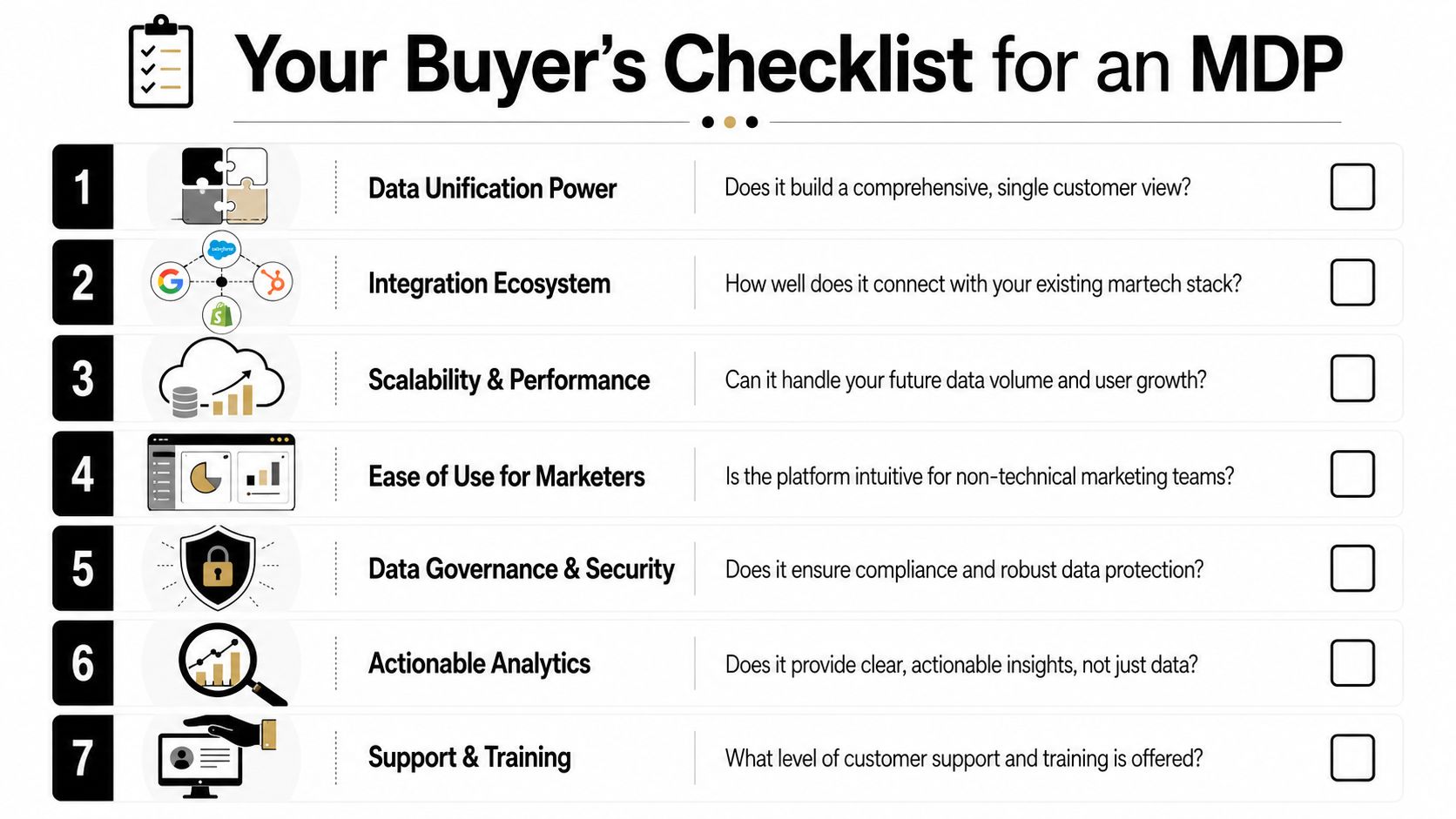
Your Buyer's Checklist for an MDP
Most vendor demos make the same promise. They'll connect your tools, unify your view, and enable better decisions.
That's not enough to buy on.
Questions that expose weak platforms fast
Start with architecture. A critical evaluation point is whether the platform is warehouse-native, which allows it to run on top of an existing warehouse and avoid data duplication and lower operational latency compared with bundled systems that create new silos, as explained in this guide to cloud data platform architecture.
That one design choice affects cost, governance, latency, and long-term flexibility.
Ask vendors these questions directly:
- How does data move and where does it live? If the answer is vague, expect duplication and sync drift.
- What happens when field definitions change? Mature platforms have versioning, lineage, and ownership models.
- Can marketers use it without breaking it? A system that requires engineering for every audience update won't stick.
- How are permissions, masking, and access handled? Governance can't be bolted on later.
- What does implementation require from us? You want honest dependency mapping, not a cheerful fantasy.
If you're comparing tools around enrichment, storage, and operational fit, it also helps to review the wider category of marketing database software so you don't confuse a database tool with a true MDP layer.
What to test before you sign
The best buying process includes a controlled proof, not just a polished demo.
Use a narrow workflow. Good examples are paid-to-CRM source mapping, inbound lead enrichment and routing, or lifecycle suppression across email and ads.
Then test for these seven things:
Integration depth
Don't stop at “yes, we connect to Salesforce.” Ask which objects, fields, sync patterns, and failure handling are supported.Schema control
You need to see how raw source fields become shared business definitions.Identity behavior
Ask what the platform matches automatically, what it won't, and how false merges are prevented.Governance model
Look for lineage, role-based access, auditability, and clear admin controls.Activation reliability
Test whether a clean segment can reach the downstream tool without lag or broken logic.Usability for operators
RevOps and MOPs should be able to maintain key workflows without a backlog of engineering tickets.Total operating cost
Count implementation services, maintenance, modeling work, connector limits, and any extra tooling the vendor assumes you'll buy.
Buy for repeatable operations, not for the best screenshot in the sales deck.
A platform is a good fit when it reduces the number of custom fixes your team has to remember. If it adds another hidden layer of dependency, it may centralize data while making execution slower.
Frequently Asked Questions About MDPs
Should you build or buy
If your team has strong data engineering resources, a stable warehouse foundation, and clear ownership across marketing ops, analytics, and RevOps, you can build parts of an MDP yourself.
Many teams do. They use Snowflake, BigQuery, dbt, Hightouch, Reverse ETL tools, BI, and custom identity or enrichment workflows. That can work well when the company already operates like a product team around data.
Most growth teams shouldn't romanticize this path.
Building your own stack gives flexibility, but it also gives you permanent maintenance. Every API change, field addition, sync issue, and governance gap becomes your problem. Buying a platform usually makes more sense when speed, maintainability, and marketer usability matter more than custom engineering control.
The right question isn't “can we build it?” It's “do we want to own this as an ongoing product?”
What should happen before implementation
The first step isn't choosing a vendor. It's defining what your team must trust.
A key implementation challenge is governance. Teams that succeed focus on aligning data definitions, field mapping, and reporting logic across systems so the platform's output is trustworthy enough for decisions, as noted in Funnel's explanation of what a marketing data hub does.
Start with a working session across marketing ops, RevOps, analytics, and sales ops. Decide:
- Which objects matter first: Lead, contact, account, opportunity, campaign, product event.
- Which fields need shared definitions: Source, medium, lifecycle stage, owner, region, segment.
- Which workflows break today: Routing, suppression, attribution, reporting, handoffs.
If SEO and content are part of your acquisition mix, it also helps to review how teams select the best AI SEO tool, because the same evaluation habit applies here. Tools are easy to buy. Reliable operating logic is harder to build.
A few other common questions come up often:
What does implementation involve?
Usually connector setup, schema mapping, identity rules, governance decisions, and downstream activation setup. The technical work is manageable. The definition work is what slows teams down.
How long does it take?
That depends on scope and data hygiene. A narrow operational use case can move quickly. A multi-region, multi-brand source-of-truth rebuild takes longer because consensus is harder than ingestion.
What's the best first use case?
Pick one with obvious business friction and clear ownership. Inbound lead routing, lifecycle suppression, or paid-to-CRM source alignment are usually better starting points than “full attribution transformation.”
The teams that win with a marketing data platform don't start by asking for a perfect 360 view. They start by making a few important decisions dependable.
Icypeas helps B2B teams enrich and verify professional contact data so records entering the CRM, marketing automation platform, or warehouse are more complete and usable. If you're building a marketing data platform strategy and want cleaner inputs for routing, segmentation, and outreach, Icypeas is worth a look.

























































.png)



.webp)