.avif)
What Is Demographic Data: Examples & Strategic Uses

.avif)
Your team already has account lists, job titles, industries, and company size. The CRM looks full. Outreach still stalls.
That usually means the problem isn't volume. It's context. Sales reps are talking to companies as if every decision-maker inside them thinks the same way, works in the same conditions, and responds to the same message.
That's where demographic data becomes useful. Not as a textbook term, but as a practical layer that helps B2B teams understand the people behind the account, spot underserved markets competitors miss, and turn better targeting into real pipeline.
Table of Contents
- Beyond the Firmographics Your CRM Already Has
- A simple way to classify B2B data
- Where most teams get confused
- Is demographic data the same as firmographic data
- What is demographic data used for in sales
- Should every demographic field go into the CRM
- Can demographic data help with market expansion
- What's the biggest mistake teams make
- How should teams start
Beyond the Firmographics Your CRM Already Has
A common B2B mistake looks like this. Marketing builds a campaign for mid-market software companies. Sales gets a clean account list with industry, employee count, and revenue band. Reps send the same sequence to every VP, director, and manager in those accounts. Response stays weak.
The data isn't wrong. It's incomplete.
Firmographics tell you what the company is. They don't tell you much about the person opening the email, joining the demo, or pushing back in procurement. A director who built a career through technical roles often reacts differently from one who came up through operations. A buyer in one region may care about a different business problem than someone with the same title somewhere else. Education, location, language, occupation history, and family or household context can change how a message lands.
That's why demographic data matters in B2B. It gives your team human context.
Practical rule: If your message only changes by industry and company size, your personalization probably isn't personal enough.
This becomes even more important when teams want growth outside saturated markets. Most competitors cluster around the same visible accounts, same intent signals, and same standard segmentation. They chase the easy list. Demographic data helps you see where the actual demand conditions are forming around people and communities, not just around company records.
Used well, it improves more than copy. It sharpens territory design, event strategy, partner selection, product positioning, and expansion planning. Used poorly, it becomes another pile of fields no rep trusts and no marketer uses.
The difference comes down to one question. Are you collecting demographic data because it sounds impressive, or because it changes who you target, how you talk to them, and where you decide to build pipeline?
What Is Demographic Data Really?
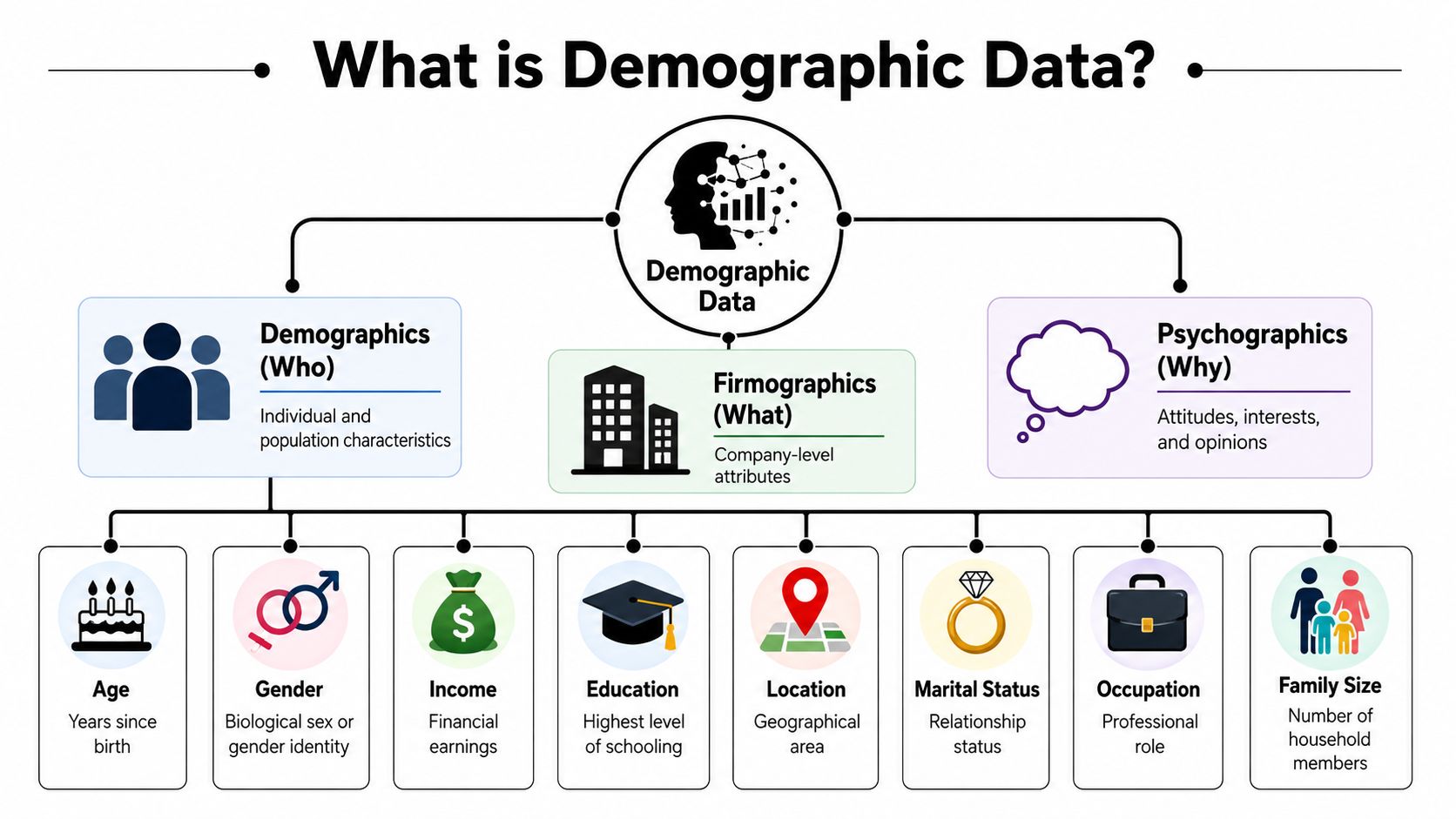
Demographic data is the statistical information that describes people or populations. It commonly includes traits like age, gender, income, education level, and geographic location. In the United States, the U.S. Census Bureau is a primary source, and its data is described as nearly equivalent to currency for policymakers and business leaders because it helps forecast community changes and support decision-making, as noted in this overview of demographic data from ATTOM Data.
For B2B teams, the simplest way to think about it is this:
- Firmographics describe the account
- Demographics describe the person or population
- Psychographics describe motivations, attitudes, and preferences
That distinction matters because teams often dump all three into one targeting bucket and then wonder why campaigns blur together.
A simple way to classify B2B data
If firmographic data is a company business card, demographic data is closer to the buyer's professional profile. It helps answer who this person is, where they operate, and what background may shape their choices.
Here's a practical breakdown.
| Data Type | What It Describes | Example Data Points | Primary Use Case |
|---|---|---|---|
| Demographic | Individual or population characteristics | Age, location, education, occupation, language, income | Personalization, territory planning, audience segmentation |
| Firmographic | Company-level attributes | Industry, employee count, company size, business model, location of HQ | Account selection, ICP design, TAM mapping |
| Psychographic | Attitudes, interests, values, priorities | Risk tolerance, innovation mindset, buying preferences, professional interests | Messaging strategy, positioning, creative direction |
Where most teams get confused
The confusion usually starts when teams assume job title alone is demographic data. It isn't enough on its own. A title tells you role placement. Demographic context helps explain the person behind it.
That's why some teams doing serious market planning also look at specialized resources such as this demographic data definition for banks, especially when they need to connect population traits to regional growth decisions rather than just contact-level outreach.
Demographic data becomes useful when it changes a go-to-market decision. If it doesn't affect segmentation, messaging, prioritization, or expansion planning, it's just storage.
A good working definition of what is demographic data in B2B is this: structured information about people and populations that helps sales and marketing teams understand audience composition, tailor outreach, and identify where commercial opportunity is likely to emerge.
Common Demographic Fields for B2B Targeting
Not every field deserves a place in your CRM. Some improve targeting. Others just make forms longer and records messier.
The fields that actually change go-to-market decisions
Start with the data that can alter messaging, routing, or prioritization.
Geographic location helps with territory design, regional messaging, local compliance review, event planning, and time-zone based sequencing. It also matters when product demand is tied to local economic or community conditions.
Education level and field of study can act as a proxy for technical depth, training background, and how much explanation a buyer may need. A highly technical audience often responds better to specific claims, while a commercially oriented audience may care more about workflow or ROI framing.
Occupation and career path matter because job titles flatten too much nuance. A head of operations who rose through logistics may care about reliability and process control. A peer who came from finance may focus more on reporting, cost containment, and controls.
Employment history is useful when you're running competitor displacement or ecosystem campaigns. If a prospect previously worked at a company that used a certain stack, that can inform your angle and proof points.
Language matters in global outreach and in multilingual domestic markets. The wrong language choice doesn't just reduce engagement. It can signal that your team doesn't understand the buyer at all.
Family status or household context is less commonly used in direct B2B outreach, but it can matter in industries tied to benefits, insurance, banking, healthcare access, or local service delivery.
QuestionPro notes that expert analysis of demographic data often includes socioeconomic factors such as occupation and family status, and that this type of data is collected through methods like focus groups, surveys, and polls that sit under privacy rules governing how personal information can be used in marketing, as described in this QuestionPro guide to demographic data.
How to avoid collecting useless fields
A field earns its place when someone on your team can answer, “What changes if we know this?”
Use that test before adding anything.
A few examples:
- If location changes routing, send the lead to the right rep.
- If education changes copy, build separate messaging tracks.
- If prior employer changes pitch, arm reps with competitive context.
- If language changes conversion odds, localize the outreach and landing page.
What doesn't work is collecting demographic details because they seem advanced. Teams often enrich records with dozens of attributes and then still build one-size-fits-all campaigns. That creates complexity without lift.
The right demographic field should change an action, not just decorate a contact record.
The strongest B2B teams treat demographic fields as operational inputs. If a field can't influence segmentation, personalization, routing, or scoring, leave it out.
How to Collect and Enrich Demographic Data
Teams often don't struggle with the idea of demographic data. They struggle with the workflow. They know what they want to understand, but the data sits in too many places, arrives in uneven formats, and ages fast.
Where raw demographic data comes from
You can collect demographic data directly, source it publicly, or append it from third-party systems.
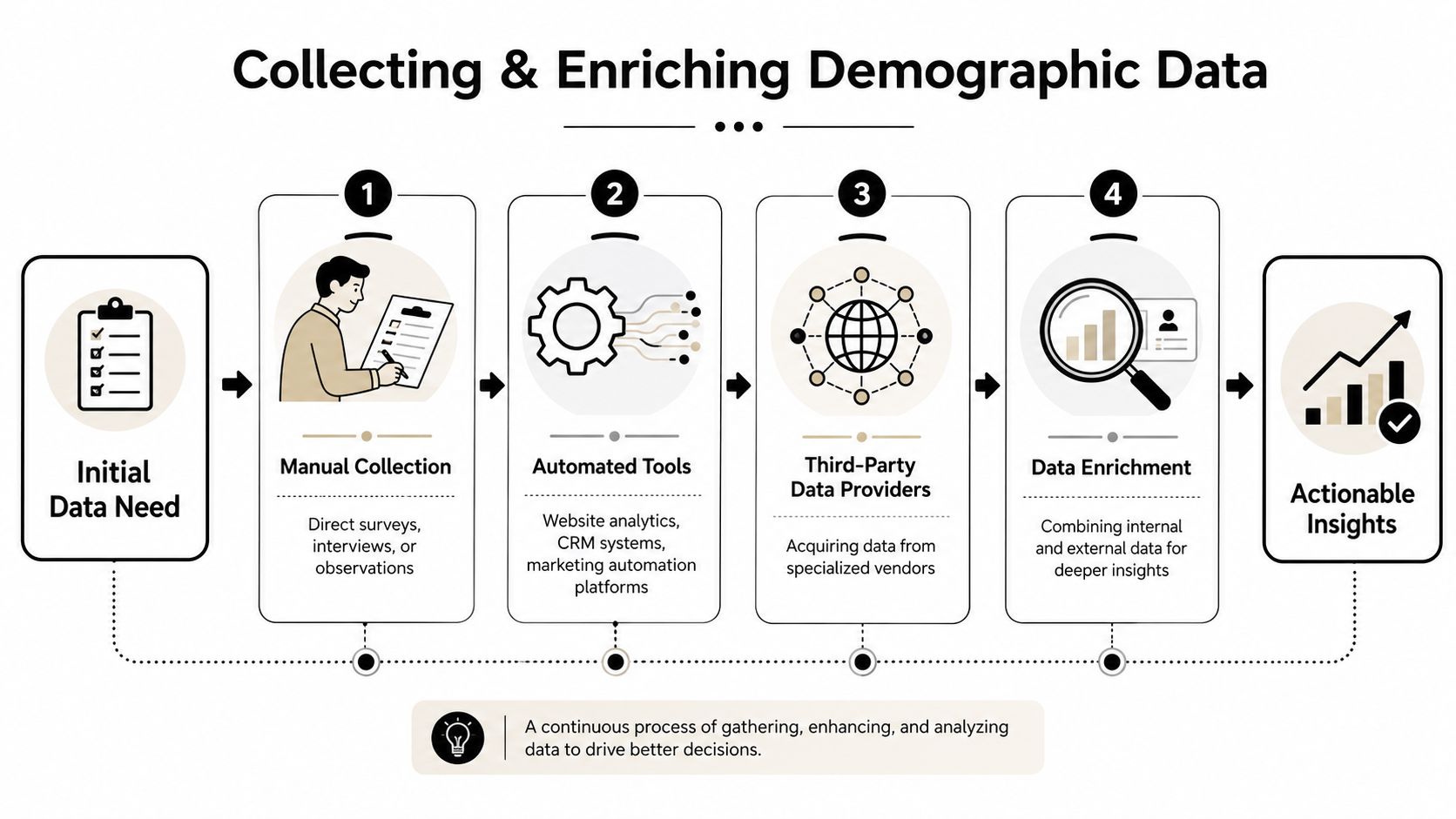
Direct collection usually comes from forms, surveys, onboarding flows, event registration, customer interviews, product usage questionnaires, and sales conversations. It's often more relevant because you control the question design. It's also slower and limited by what prospects are willing to share.
Public datasets are useful for market-level analysis. For global analysis, the United Nations provides free access to over 15 statistical databases with demographic indicators covering 266 world entities, and businesses use details such as homeownership rates, religious affiliation, and spoken language to shape campaigns and user experiences, according to this Tulane library guide on international demographic sources.
Third-party providers help when you need scale, standardization, and faster enrichment. That usually means appending known records with additional fields, validating existing information, and making the data usable inside CRM and outbound workflows.
A practical collection mix often looks like this:
- First-party inputs from forms and enrichment prompts
- Public market data for territory and segment research
- Provider data to fill in missing person and account context
- Internal behavioral data from CRM, product, and campaign systems
How enrichment turns records into working intelligence
Enrichment starts with something you already know. An email address, a name and company, a domain, or a form fill. Then you append relevant attributes that help your team act.
That process works best when you define the operational use first. Don't enrich for the sake of enrichment.
For example:
| Starting record | Added demographic context | Operational result |
|---|---|---|
| New inbound lead | Location, language, occupation history | Better routing and localized follow-up |
| Webinar registrant | Education background, region | Smarter segmentation and event nurture |
| Outbound prospect list | Job progression, geography | More precise messaging and sequencing |
If you're evaluating platforms that support this workflow, compare how they handle appending, verification, and CRM syncs. A useful reference point is this review of B2B data enrichment tools. One option in that category is Icypeas, which provides contact discovery, verification, reverse lookup, and profile enrichment through web tools and API workflows.
Good enrichment narrows choices. Bad enrichment creates more fields than your team can realistically use.
The trade-off is straightforward. Public data gives breadth. First-party data gives relevance. Third-party enrichment gives speed and scale. Strong teams combine all three, then filter aggressively so only decision-driving fields reach sales and marketing.
Putting Demographic Data to Work in B2B
Once demographic data is clean enough to trust, it stops being a research asset and becomes a revenue lever.
A lot of teams use it only for basic segmentation. That's useful, but it leaves a lot on the table.
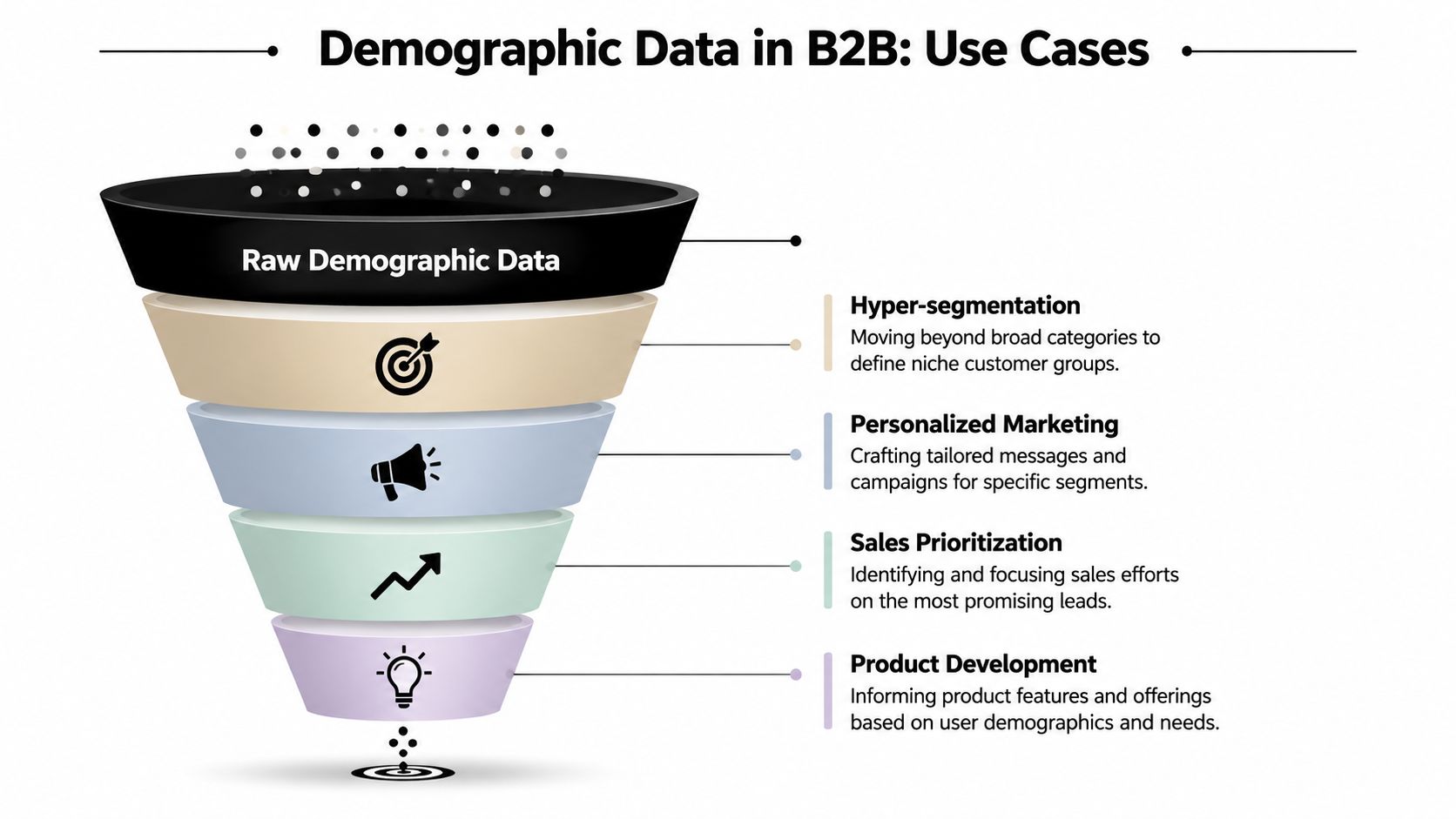
Four revenue uses that matter
The first use is hyper-segmentation. Instead of grouping everyone into one industry bucket, you build smaller audiences around patterns that affect buying behavior. That might mean separating technical buyers from commercial buyers inside the same vertical, or splitting regional audiences where language and local conditions shift the message.
The second is personalized messaging. A generic pitch to “operations leaders” tends to flatten every buyer into the same persona. Demographic context lets your team write copy that sounds informed rather than automated. The point isn't to mention personal details for effect. It's to align the value proposition with the buyer's likely frame of reference.
The third is lead prioritization. Sales teams need a practical answer to “who goes first?” Demographic context can improve scoring when it reflects real fit. Not every director-level contact deserves the same urgency. Tenure, region, role path, and language can help separate a workable opportunity from a low-probability one.
The fourth is product and offer shaping. Product teams and commercial teams often treat market selection as separate from feature planning. Demographic data can connect them. If your buyer base in one region has different education profiles, language needs, or service expectations, your onboarding and packaging may need to change as well.
Later in the evaluation process, supporting content helps too. This overview of marketing data enrichment is a useful example of how teams connect appended data to campaign execution rather than leaving it trapped in a database.
A quick primer on B2B application is worth watching before you build those workflows:
The underserved market play most teams skip
The more interesting use case is market discovery.
Most competitors aim at the obvious accounts in obvious geographies. That's where inboxes get crowded and paid acquisition gets expensive. Demographic overlays can reveal places where commercial demand exists but supplier attention is thin.
FHFA data defines minority census tracts as areas with 30% or more minority population and median income below 100% of AMI, and those underserved-area maps create a useful framework for combining demographic overlays with lead databases to find overlooked B2B opportunity, as described on the FHFA underserved areas data page.
That matters if you sell through local operators, branches, franchise networks, lenders, service providers, or regional channel partners. The play is not “target underserved communities” as a slogan. The play is to identify where unmet need and reachable commercial infrastructure overlap.
For example, a multi-location growth team can layer underserved geography data with branch networks, service availability, and prospect databases to prioritize expansion. Franchise groups can use the same logic when evaluating territory quality and outreach workflows. If that model is part of your motion, this guide to lead generation for franchises is a practical companion because it focuses on how location-driven targeting becomes an actual pipeline system.
The market advantage isn't just better personalization. It's seeing viable pockets of demand before your competitors notice them.
Data Quality Verification and Compliance
Demographic data is only useful if your team trusts it. If sales thinks the fields are stale, they'll ignore them. If legal sees unclear collection practices, they'll block programs late. Both outcomes slow growth.
The three checks that matter most
Treat data quality as three separate checks, not one vague standard.
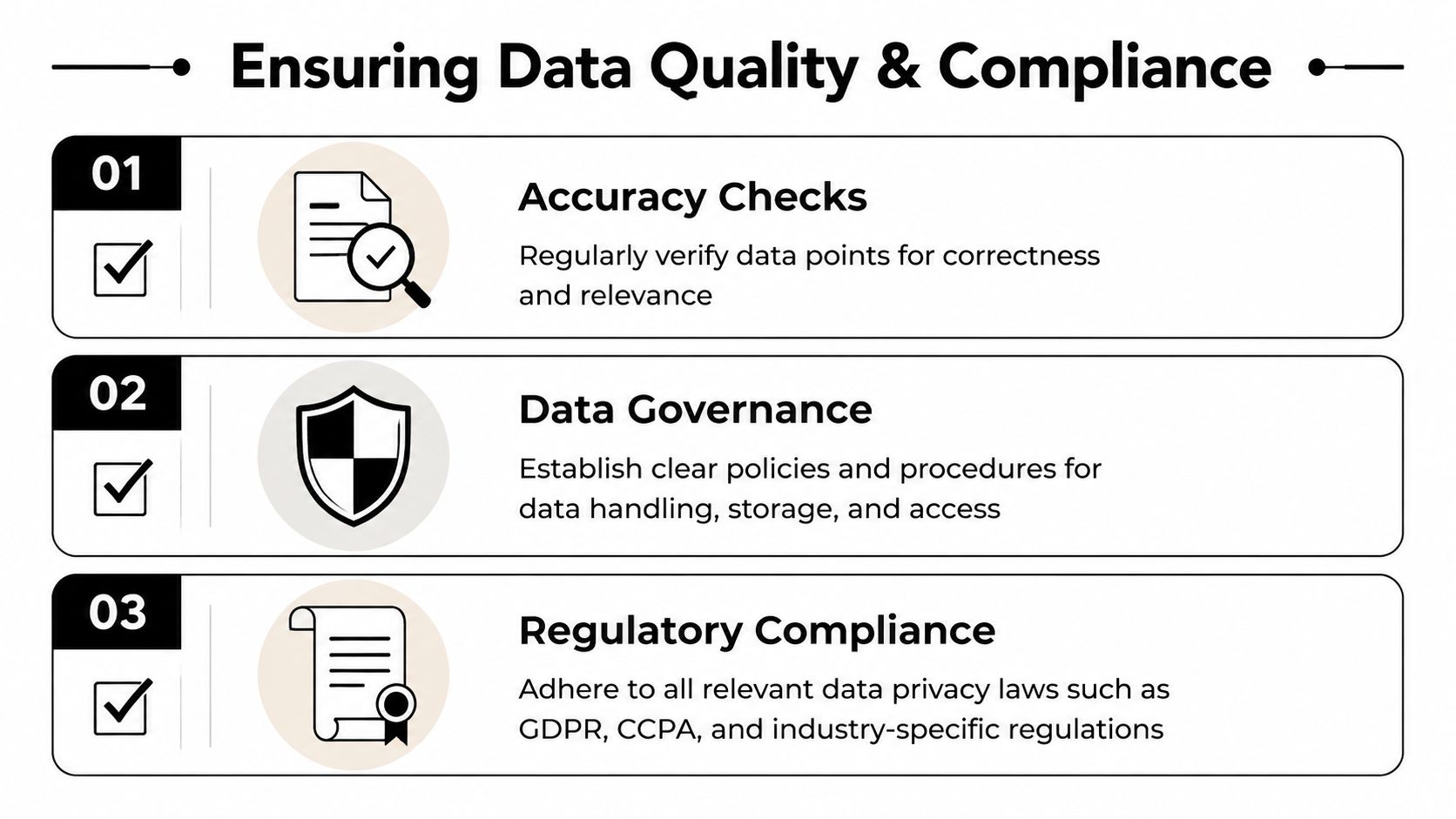
Accuracy asks whether the field is correct right now. Wrong location, outdated role, or misclassified language can break personalization and lead routing.
Freshness asks whether the record still reflects reality. People move, switch companies, change responsibilities, and relocate. A field that was valid months ago may now point your rep in the wrong direction.
Completeness asks whether the minimum usable context is present. A half-filled profile can be worse than a lean but reliable one because it creates false confidence.
This is why cleaning matters before enrichment scale. Teams that keep old CRM records untouched usually spread the problem into every sequence, score, and dashboard. A practical reference for operational cleanup is this guide to CRM data cleaning.
Compliance is a targeting constraint, not a footnote
Privacy review shouldn't happen after a campaign is ready to launch. It needs to shape what data you collect, how long you keep it, who can access it, and what you're allowed to do with it.
QuestionPro notes that demographic data can include sensitive socioeconomic details and that collection methods such as surveys, polls, and focus groups fall under privacy regulations governing how personal information may be used in marketing. That means your process has to match your use case. If a field is sensitive, ask whether you truly need it. If you do need it, define the lawful basis, access controls, retention logic, and usage rules before sales starts acting on it.
Cleaner, better-governed data gives revenue teams a real edge because they can move faster without revisiting the same trust and compliance debates every quarter.
The practical standard is simple. Collect less, validate more, document how it's used, and remove fields that don't support a real commercial decision.
Frequently Asked Questions About Demographic Data
Is demographic data the same as firmographic data
No. Firmographic data describes the company. Demographic data describes the person or population connected to the opportunity. In B2B, you usually need both. Firmographics help you choose accounts. Demographics help you understand who inside those accounts you're trying to persuade.
What is demographic data used for in sales
Sales teams use it to improve segmentation, personalize outreach, route leads, and prioritize follow-up. The best use is practical. If a field doesn't help a rep decide who to contact, how to message them, or whether the lead fits, it won't get used.
Should every demographic field go into the CRM
No. Only keep fields that affect action. Extra fields make records harder to maintain and easier to distrust. A smaller set of reliable fields is more useful than a bloated profile full of low-confidence data.
Can demographic data help with market expansion
Yes. It's especially useful when you're evaluating underserved or under-messaged areas. Demographic overlays can reveal demand conditions that don't show up in a basic account list, especially for regional, multi-location, or partner-led growth models.
What's the biggest mistake teams make
They collect demographic data and stop there. Nothing changes in segmentation, messaging, routing, or scoring. At that point, the data project looks complete, but the go-to-market motion stays generic.
How should teams start
Start with one commercial question. For example: which regions deserve dedicated outreach, which inbound leads need localized follow-up, or which buyer backgrounds correlate with smoother sales cycles. Then collect or enrich only the fields that help answer that question.
If your team wants to turn demographic context into usable contact and account intelligence, Icypeas can support that workflow with contact discovery, verification, reverse lookup, and enrichment that fits sales, marketing, and CRM operations.





































.png)



.webp)