.avif)
Definition of Cadence in Business: A Practical Guide


.avif)
In business, cadence is the regular, predictable rhythm of key activities like meetings, sales outreach, or product releases that drives momentum and alignment. When teams use a stable cadence instead of ad hoc coordination, time-to-decision drops by 30%, and in sales, 4 to 7 touchpoints over a 14-day period can produce a 35% higher response rate than sporadic outreach.
If your team feels busy but progress still slips, cadence is usually the missing piece. Calendars are full, updates happen, people are working hard, yet decisions stall, follow-up gets uneven, and priorities drift. That isn't a work ethic problem. It's a rhythm problem.
The practical definition of cadence in business isn't just "how often we meet." It's the drumbeat that keeps the entire organization in sync. Good cadence tells people when to share information, when to decide, when to escalate, and when to act. Bad cadence leaves those moments to memory, urgency, or whoever shouts first.
Table of Contents
- Build the rhythm before you optimize it
- Why contact data quality determines outreach cadence success
- How remote teams avoid meeting overload
Introduction From Chaos to Rhythm
The symptoms of weak cadence are immediately recognizable. The pipeline review moves because someone is traveling. Product updates arrive late because engineering and go-to-market teams are working on different clocks. Leaders keep calling extra meetings because the normal ones never seem to produce clear decisions.
A strong business runs differently. People know when issues get surfaced, where trade-offs get resolved, and how often priorities are inspected. That doesn't remove pressure, but it does remove a lot of avoidable friction.

The mistake most companies make is treating cadence as administrative meeting frequency. They ask, "Should this be weekly or biweekly?" That's too shallow. Real cadence is strategic execution rhythm. It controls how information moves, how decisions get made, and how often the business corrects course.
That distinction matters. Data from McKinsey's 2025 "Strategy Execution" report shows that organizations treating cadence as a rigid meeting schedule have a 35% lower rate of strategic goal attainment than those using cadence as a dynamic rhythm of decision-making that adapts to market shifts.
Administrative frequency versus execution rhythm
A calendar full of recurring meetings can still produce chaos. If meetings exist only to report status, cadence becomes bureaucracy. If each recurring touchpoint has a job, surface risk, make a call, unblock work, inspect performance, then cadence becomes an operating mechanism.
Practical rule: If a recurring meeting doesn't clearly change decisions, priorities, or next actions, it's frequency without cadence.
This is why the definition of cadence in business needs more precision than most explainers give it. Cadence isn't the invite. It's the repeatable pattern that keeps planning, execution, and review connected.
What Is Business Cadence Really
Business cadence is the regular, predictable frequency and rhythm of scheduled activities that governs information flow and decision latency. That's the technical definition, but in practice it works like a business heartbeat. It sets the pace at which teams share updates, solve problems, and make decisions.
When that rhythm is stable, people don't waste energy coordinating the coordination. They know when to bring issues forward, when leaders will review them, and when actions will be checked. That predictability is what turns a group of busy functions into an operating system.

Cadence is a control system
Cadence is often described too loosely as rhythm. Rhythm is useful as an analogy, but operators need the harder definition. Cadence controls three things:
- Information flow: Who sees what, and when they see it
- Decision timing: How long issues sit before someone resolves them
- Execution follow-through: How often progress is reviewed against intent
The direct payoff is speed without constant urgency. When cadence is inconsistent, the probability of meeting fatigue increases by 40%, leading to a 25% drop in productivity; conversely, a stable cadence reduces time-to-decision by 30% by removing the lag created by ad hoc coordination. Those figures are part of the verified data set provided for this article.
A useful way to think about it is this: speed is how fast one decision gets made. Cadence is how reliably the business makes decisions over time.
Why consistency changes team behavior
Teams don't drift because people are careless. They drift because review points are irregular, priorities aren't revisited on a known rhythm, and escalation depends on personality instead of process.
A workable cadence usually has a hierarchy. Daily stand-ups can handle immediate blockers. Weekly reviews can align execution. Monthly audits can inspect performance and spot drift. The exact intervals vary by complexity, but the principle is the same. More moving parts require tighter inspection, while larger teams need more protection for focus time.
A stable cadence doesn't make work rigid. It makes adjustment easier because teams know when change will be discussed and who needs to be in the room.
For sales teams, this same logic applies outside internal meetings. Outreach works better when touchpoints follow a designed sequence rather than rep memory. If you want a practical example of how repeatable follow-up supports closed revenue, this breakdown of sales motions that help close the deal is a useful complement.
Common Types of Business Cadence Explained
Not every cadence serves the same job. One keeps teams aligned. Another moves prospects through the funnel. A third helps product teams ship without creating cross-functional confusion. Lumping all of these together is one reason people misunderstand the definition of cadence in business.

Meeting cadence
Meeting cadence is the most familiar form. It defines how often teams gather for updates, decisions, problem-solving, and accountability. Done well, it reduces ambiguity. Done poorly, it creates reporting theater.
A good meeting cadence has a clear purpose for each layer:
- Daily operational touchpoints: Clear blockers and assign immediate follow-up
- Weekly execution reviews: Resolve dependencies, inspect progress, and adjust priorities
- Monthly leadership reviews: Evaluate performance trends and make broader calls
The trade-off is straightforward. Too little structure and issues surface late. Too much structure and people spend their week preparing for meetings instead of doing the work those meetings are supposed to support.
Sales and outreach cadence
Sales cadence is more precise because it deals with buyer contact. Here, cadence means the timing and frequency of calls, emails, social touches, and follow-ups designed to maximize engagement while minimizing friction.
The strongest verified guidance is specific: a structured sales cadence with 4 to 7 touchpoints over a 14-day period yields a 35% higher response rate compared to sporadic outreach. That matters because sales teams often mistake intensity for consistency. Sending a burst of messages on one day and then going quiet isn't cadence. It's noise.
A practical sequence might include:
- Day 1: Initial call
- Day 2: Follow-up email
- Day 4: Second call
- Day 7: Personalized video
That pattern works because it is predictable without being robotic. It creates expectation while still leaving room to adapt if the prospect engages early or signals a better path.
The quality of the sequence matters, but the quality of the contact data under it matters just as much. A perfect cadence aimed at the wrong inbox still fails.
Product and feature cadence
Product cadence is different again. Its purpose isn't outreach or status alignment. It's controlled delivery. Teams need a repeatable rhythm for planning, building, reviewing, and releasing changes.
The most effective product cadence balances two competing needs:
| Need | What it requires |
|---|---|
| Coordination | Shared checkpoints between product, engineering, design, and go-to-market |
| Focus | Enough uninterrupted time for building, testing, and refining work |
In this context, leaders often overcorrect. If teams check in too often, they fragment deep work. If reviews are too sparse, launch readiness gets discovered too late.
The appropriate solution isn't copying another company's release calendar. It's designing a rhythm that fits complexity, dependencies, and risk. A mature cadence protects both movement and quality.
Sample Cadence Templates for Your Team
Organizations typically don't require a blank sheet. They need a starting point that is structured enough to use and flexible enough to adjust. These templates are best treated as operating drafts, not rules carved in stone.
Templates you can adapt immediately
| Cadence Type | Objective | Example Sequence / Schedule |
|---|---|---|
| SDR outreach cadence | Create consistent prospect engagement | Day 1 initial call, Day 2 follow-up email, Day 4 second call, Day 7 personalized video, then continue the remaining touches within a 14-day window |
| Engineering sprint cadence | Maintain delivery rhythm and visibility | Weekly planning checkpoint, mid-cycle async progress update, end-of-cycle review, retrospective, next-cycle prioritization |
| Leadership operating cadence | Keep strategy and execution aligned | Weekly business review, monthly performance audit, quarterly strategic review |
| Customer success cadence | Protect retention and expansion opportunities | Onboarding kickoff, scheduled health review, regular adoption checkpoint, renewal planning review |
| Marketing campaign cadence | Coordinate launch and follow-up work | Pre-launch alignment, launch-day monitoring, weekly performance review, post-campaign analysis |
The SDR example is the easiest to picture because it maps directly to buyer interactions. If you're rewriting your outreach process, this guide on how to write the best cold email is a practical companion to cadence design.
How to tailor a template without breaking it
The mistake isn't changing a template. The mistake is changing it randomly.
Adjust cadence based on actual operating conditions:
- If work is complex: Increase inspection points, but keep them short and decision-oriented.
- If the team is large: Use a hierarchy instead of putting everyone into every review.
- If buyers are unresponsive: Change message relevance or channel mix before assuming the cadence itself is wrong.
- If meetings feel heavy: Remove status reporting from live sessions and push it into written updates.
A template works when people can anticipate the next action without checking five calendars, three Slack threads, and a project board. It fails when every exception becomes a redesign.
Good cadence templates create clarity first. Optimization comes later.
How to Implement and Measure Your Cadence
Designing cadence is operational work. It requires judgment, trade-offs, and a willingness to remove rituals that don't earn their place. Teams usually fail here in one of two ways. They either over-engineer the system before it exists, or they launch a loose routine and never measure whether it improves execution.
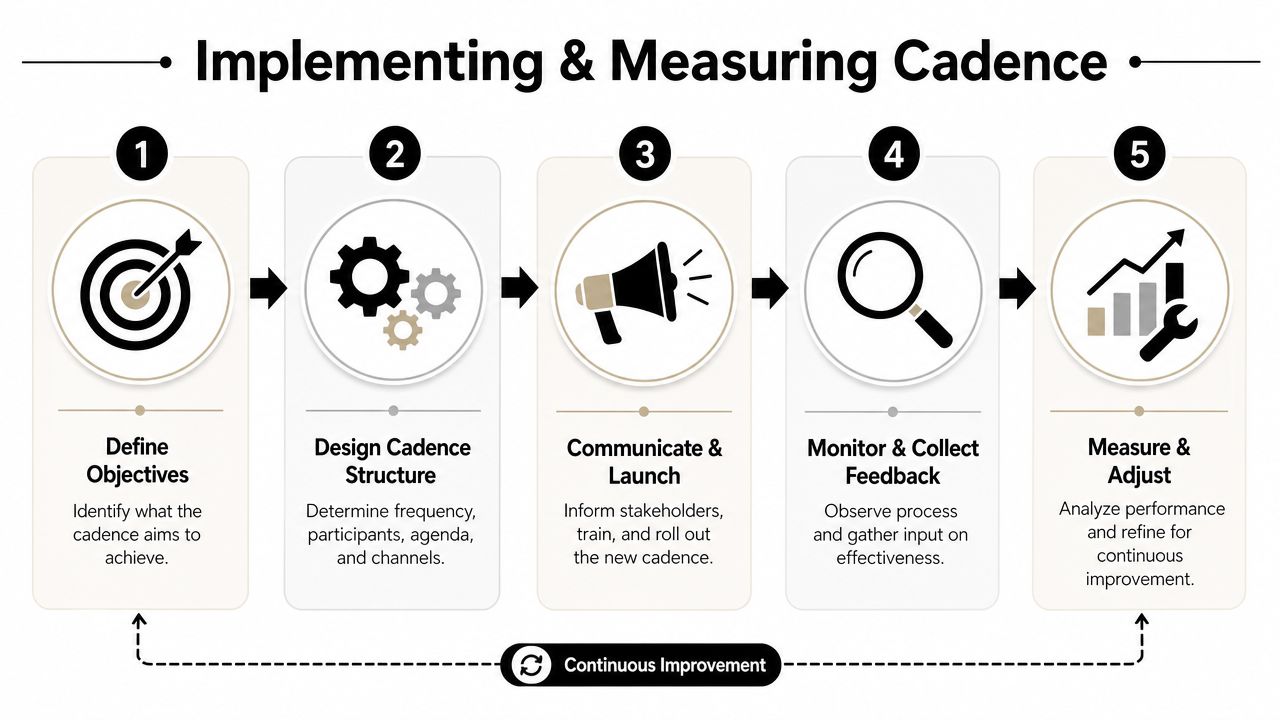
Build the rhythm before you optimize it
Start with five practical steps:
Define the objective
Pick one outcome. Faster decisions, better forecast inspection, more consistent prospect follow-up, cleaner release coordination. Cadence without a target turns into ritual.Design the minimum viable rhythm
Set frequency, participants, channels, and expected outputs. Keep each recurring touchpoint tied to a job.Communicate the rules of use
People need to know what belongs in the cadence and what doesn't. That includes escalation paths and decision ownership.Launch and observe
Watch where the rhythm creates friction. Don't rewrite the system in week one because one meeting felt awkward.Measure and adjust
Review whether the cadence is improving the objective you chose.
If your team is struggling with overloaded recurring meetings, this practical resource on fixing your meeting cadence is worth reading because it focuses on purpose and decision design rather than just trimming the calendar.
A data-informed review also matters. Teams that already track activity and outcomes can use patterns from their broader marketing data analytics workflow to see whether cadence changes are influencing response, conversion, or execution reliability.
A short walkthrough can help anchor the implementation mindset:
Why contact data quality determines outreach cadence success
Sales leaders often blame cadence when the deeper problem is data quality. The sequence is sound. The rep follows the schedule. The personalization framework is reasonable. But emails bounce, job titles are outdated, the account routing is wrong, or the contact left the company.
That breaks the entire system.
An outreach cadence depends on accurate inputs:
- Verified email addresses: So the sequence reaches a real inbox
- Current role and company data: So messaging matches the buyer's context
- Enriched profiles: So reps can personalize without wasting time on manual research
- Clean CRM records: So follow-up timing isn't distorted by bad history
When the underlying data is weak, teams misread the result. They think the cadence is too short, too long, too aggressive, or too passive. In reality, the rhythm wasn't the issue. The target quality was.
How remote teams avoid meeting overload
Remote and distributed teams face a different cadence problem. Leaders often add more live meetings to compensate for less hallway communication, then wonder why execution slows down.
The better model is async cadence. In verified data for this article, the async cadence model is defined as a rhythmic sequence of automated data updates, AI-generated insights, and weekly pulse checks. According to a 2025 Salesforce study, this model shows a 40% increase in lead response time for remote teams while reducing meeting hours by 30%.
That doesn't mean "no meetings." It means using live time for judgment, exceptions, and decisions, while moving status collection and routine updates into systems.
A practical remote cadence usually includes:
- Automated updates: Pipeline, delivery, or campaign data pushed on a known schedule
- Weekly pulse reviews: Short synchronous sessions focused on exceptions and decisions
- AI-assisted summaries: Condensed context before people meet
- Clear ownership: One person accountable for each metric, issue, or next step
Here, cadence becomes resilient. The business doesn't rely on everyone being online at once. It relies on a repeatable flow of information and a predictable rhythm for action.
Conclusion From Schedule to Strategic Advantage
The best definition of cadence in business is simple and demanding at the same time. It's the predictable rhythm that turns strategy into repeated action. Not the calendar invite. Not the ritual itself. The rhythm behind how teams share information, make decisions, and maintain momentum.
That distinction changes how leaders build systems. If cadence is only administrative frequency, the answer is usually more scheduling. If cadence is strategic execution rhythm, the answer is better design. Fewer ad hoc interruptions. Clearer decision forums. More intentional review points. Stronger follow-through.
Sales teams feel this especially clearly. A thoughtful outreach cadence can improve response, but only when the contact data underneath it is accurate enough to support real delivery and real personalization. Meeting cadence works the same way. Product cadence does too. The rhythm only works when the inputs are trustworthy and the purpose of each touchpoint is clear.
Good cadence doesn't make an organization rigid. It gives people a stable operating environment so they can adapt without chaos. That's why it becomes a competitive advantage. Teams with strong cadence waste less motion, lose less context, and recover faster when conditions change.
If your team is trying to build a reliable outreach cadence, accurate contact data matters as much as timing. Icypeas helps sales, marketing, and RevOps teams find, verify, and enrich professional contact data so sequences reach the right people, personalization is grounded in current information, and your cadence performs the way it was designed to.

























.png)



.webp)