.avif)
10 Best Lead Enrichment Tools for Sales Teams in 2026


.avif)
When buying lead enrichment tools, teams often ask the wrong question. They ask, “Which database is biggest?” The better question is, “What job do we need this tool to do every day without breaking our workflows, budget, or compliance standards?”
That distinction matters because enrichment isn't just about adding missing fields. Contact data decays fast. Industry studies consistently report annual data decay of about 22.5%, which means a CRM can get stale long before anyone notices the damage in bounce rates, routing errors, and weak personalization. The fix isn't a one-time append. It's a system for finding, verifying, refreshing, and governing data continuously.
That's why the best lead enrichment tools serve different teams in different ways. SDRs need speed and deliverability. RevOps needs match logic, refresh cadence, and workflow control. Developers need APIs that don't fight them. If your team still treats enrichment like a spreadsheet cleanup project, it may be time to rethink the stack, the process, and even your basic Google Contacts CRM assumptions.
This guide gets to the point. These are the 10 lead enrichment tools worth considering in 2026, with the practical trade-offs that matter when you're the one responsible for pipeline quality.
Table of Contents
1. Icypeas
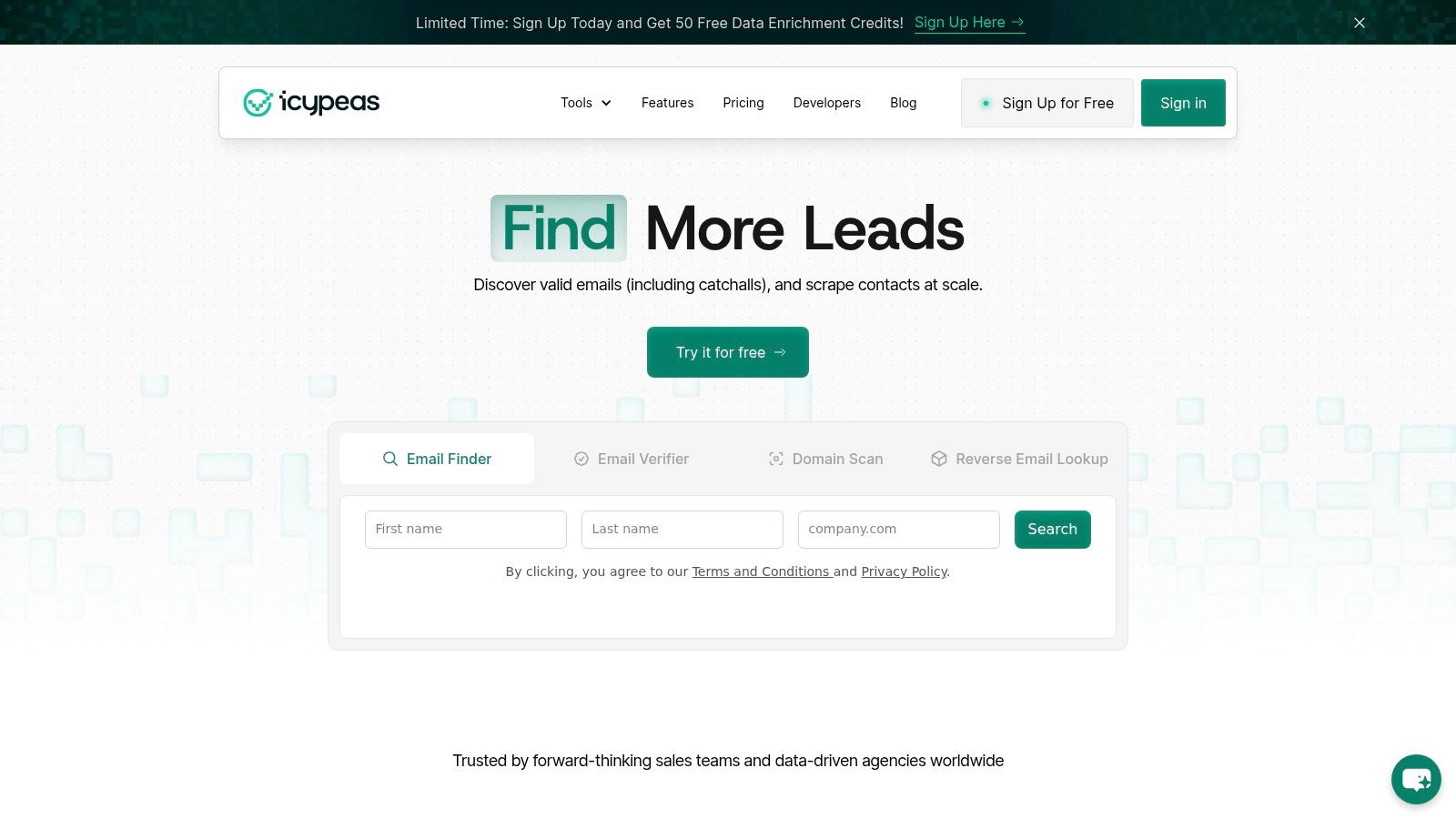
Icypeas is the specialist pick on this list. If your actual job is finding work emails, verifying them hard enough to protect deliverability, enriching records, and keeping CRM data usable, it does that without forcing you into a bigger sales suite.
That specialist positioning matters more than most buyers think. A lot of platforms sell “all-in-one” convenience, but operationally the hard part is still data quality. Independent benchmark-style coverage of enrichment platforms has highlighted how buyers increasingly care about freshness, match logic, and validation quality, including signals like under 3% bounce rates and 70M+ weekly refreshes, plus a separate 95% accuracy guarantee from another provider category example. That's the lens I'd use to evaluate Icypeas too. Not database bragging. Operational trust.
Why Icypeas stands out
Icypeas combines an Email Finder, strict Email Verifier, Reverse Email Lookup, Domain Scan, and People Scraper in one focused workflow. The standout capability is catch-all verification for Google and Microsoft environments, which is one of the places weaker tools create hidden risk. A vendor that looks cheap on paper gets expensive fast when SDRs send to bad addresses and your domain reputation takes the hit.
It also takes a compliance-forward approach. The platform emphasizes cached public-source profile enrichment instead of live scraping, plus GDPR and CCPA alignment, annual legal audit, and ISO 27001-certified hosting. If you care about compliant enrichment workflows, that's closer to what modern buyers should ask for in regulated markets, especially as teams push enriched data into automation and AI systems. Icypeas also publishes useful context on B2B data enrichment tools.
Practical rule: If email verification quality is a top requirement, buy the specialist first, then layer outreach or CRM around it. Don't do the reverse.
Best fit by team
For SDRs, Icypeas is strongest when the team needs reliable email discovery and low-bounce verification without extra workflow clutter. For RevOps, it's useful when CRM hygiene and ongoing lead refresh matter more than having one vendor for everything. For developers, the API, rate limits, credit rollover, and uptime focus make it viable to embed enrichment inside product or internal tooling.
A few trade-offs are worth being honest about:
- Best for deliverability-sensitive teams: If your outbound engine lives or dies on inbox placement, strict verification is more valuable than broad feature sprawl.
- Best for cost-conscious operators: Icypeas positions itself as cheaper than larger suites, but you'll still want to model credit use against your workflows.
- Not your sequencer or CRM: You'll need another system for campaign orchestration, pipeline management, or sales engagement.
The short version is simple. If your job-to-be-done is accurate email discovery, verification, and scalable enrichment, Icypeas deserves serious consideration.
2. ZoomInfo
What are you buying when you choose ZoomInfo. Better data, or a control system for a large revenue team?
That distinction matters. ZoomInfo fits companies that need one vendor to support SDR prospecting, account research, enrichment, intent inputs, routing, and admin governance across a big GTM org. The value is not just record volume. It is the ability to standardize how data gets used across sales, marketing, and operations.
For RevOps, that usually means fewer point solutions to manage and fewer integration decisions to revisit every quarter. For SDR leaders, it means reps can prospect inside a familiar system with broad company and contact coverage. For developers, the question is different. They need to examine API access, workflow flexibility, and whether the platform is worth the overhead if the job is merely enriching records inside a product or internal app.
Where ZoomInfo earns its place
ZoomInfo tends to win when process complexity is the main problem. Large territory models, role-based access, lead routing rules, enrichment at multiple lifecycle stages, and cross-functional reporting are all easier to govern when one platform sits in the middle.
That convenience comes with trade-offs.
Enterprise pricing can be hard to model upfront. Credit rules can create friction between leadership and frontline users. Data quality also gets judged more harshly at this price point, because a single bad record does not just waste a rep's time. It affects routing, scoring, sequencing, and reporting downstream.
A practical buyer's checklist helps here:
- SDR job-to-be-done: Do reps need broad account and contact coverage in one place, or mostly verified emails and direct dials?
- RevOps job-to-be-done: Is the bigger issue tool sprawl and governance, or field-level data accuracy and cost control?
- Developer job-to-be-done: Do you need flexible enrichment infrastructure, or a packaged sales data environment with admin controls?
- Commercial model: Can you predict credit consumption by workflow, team size, and refresh frequency before signing?
- Geographic fit: Does your team sell mainly in North America, or do you need stronger international consistency?
If your team is still defining those requirements, this guide to marketing data enrichment strategy and tooling choices is a useful planning reference.
I usually recommend ZoomInfo to mature GTM teams that can justify consolidation, procurement overhead, and strict process design. I would not put it first on the list for a lean startup, an agency, or a team whose main requirement is verified contact data at a lower cost. In those cases, a specialist or lighter-weight platform often maps better to the actual job.
Visit ZoomInfo
3. Apollo.io
Apollo.io is what many smaller teams buy when they say they want lead enrichment tools. It bundles prospecting data, sequencing, basic CRM functionality, and enrichment into one self-serve platform that doesn't require an enterprise rollout.
That combination is why it keeps winning with startups, agencies, and smaller outbound teams. You can stand up a rep quickly, test segments, enrich records, and run outreach from the same environment. For a team with limited headcount, reducing tool sprawl often matters more than getting the single best database in every category.
Why smaller GTM teams like it
Apollo fits the SDR manager who wants productivity now, not after a six-month systems project. It also fits teams that want to enrich list uploads, score accounts lightly, and push data into outbound motion without buying a separate sequencing platform.
The trade-off is what happens at scale. Credits, exports, and fair-use mechanics become more noticeable when you have multiple reps, high-volume workflows, or a RevOps team trying to standardize process across business units. If you need more context on where enrichment fits inside a broader growth stack, this piece on marketing data enrichment is relevant.
A good way to think about Apollo is this:
- Best for SMB efficiency: One tool can cover prospecting, light enrichment, and outreach.
- Less ideal for deep specialization: Verification quality, governance, and provider orchestration won't match a dedicated stack.
- Watch the usage model: Credit systems are manageable at small scale and more restrictive when your process matures.
Apollo is often the right first purchase. It just isn't always the right long-term architecture.
4. Lusha
Lusha is built for speed. If a rep needs to pull up a contact, grab an email or phone number, and move on, its workflow feels lighter than the heavier platforms.
That simplicity is why a lot of SDR teams like it. Browser extension, CSV enrichment, API access, and manageable team controls cover the core use case without a lot of setup. It's a practical tool for self-serve contact discovery, especially when you want reps to adopt the tool without much training.
The practical trade-off
Lusha is rarely the most strategic choice for a mature RevOps team. It's more often the tactical choice for rep-level productivity. That distinction matters because self-serve ease can become a limitation once you care more about central governance, waterfall enrichment, and record refresh policy.
Phone accuracy and credit consumption can also vary depending on your segment. In some markets it works well enough as a primary source. In others, it's better as a quick-access layer for reps with a more robust enrichment process behind it.
A tool that reps love can still be the wrong system of record for RevOps.
Buy Lusha if your main job-to-be-done is fast prospect lookup with low friction. Don't buy it expecting it to become the backbone of a complex data operation.
Visit Lusha
5. Cognism
Cognism is the tool I'd put on the shortlist first for teams selling into Europe. Its positioning around GDPR-conscious processes and strong EMEA coverage gives it a different buyer profile from US-centric databases.
That matters because compliance-safe enrichment is still underexplained in most software comparisons. The better guidance isn't just “make sure the vendor says GDPR.” The key question is whether the sourcing, storage, and validation model works for the regions you target. Broader industry discussion around lead-enrichment tools and privacy expectations points in that direction, even if most vendors still stay too high level.
Where Cognism makes sense
Cognism works best when legal, regional coverage, and phone data quality all matter at once. If your team sells across the UK and Europe and wants a vendor that takes compliance positioning seriously, it's a credible option.
The main trade-off is familiar. Pricing is quote-based, and if most of your pipeline is in the US, you may find stronger value elsewhere. For global teams, though, a compliance-forward provider can save headaches that don't show up in a feature matrix.
I'd sum it up this way:
- Choose Cognism for EMEA-heavy motion: It's a more natural fit when Europe is central to the pipeline plan.
- Choose it when compliance review is real: Procurement and legal teams often care about more than contact volume.
- Don't assume one provider is enough forever: Many teams eventually pair a primary source with another vendor for gap-filling and freshness.
6. Clearbit (Breeze Intelligence within HubSpot)
Clearbit is no longer really a standalone decision for most buyers. It's now Breeze Intelligence within HubSpot, and that changes how I'd evaluate it. You're not just buying enrichment. You're deciding whether HubSpot should be the center of the go-to-market system.
For teams already standardized on HubSpot, that can be a strong answer. Native enrichment inside the CRM reduces field-mapping issues, supports routing rules, and keeps workflows in one place. If operations discipline matters more than vendor optionality, that's a real advantage.
Best when HubSpot is the center of gravity
Breeze Intelligence makes the most sense for marketing ops and RevOps teams that want enrichment to feed forms, scoring, routing, and lifecycle automation inside HubSpot. If your website, CRM, workflows, and reporting already live there, keeping data enrichment native is often cleaner than stitching in an outside tool.
The catch is total cost. Pricing is tied to HubSpot packaging and credits, so what looks simple at the architecture level can become expensive at the budget level. This overview of HubSpot Sales Intelligence features is helpful if you're mapping the wider HubSpot ecosystem, not just enrichment.
For buyers outside HubSpot, I usually wouldn't start here. For buyers inside HubSpot, it's one of the easiest choices to justify operationally.
7. People Data Labs (PDL)
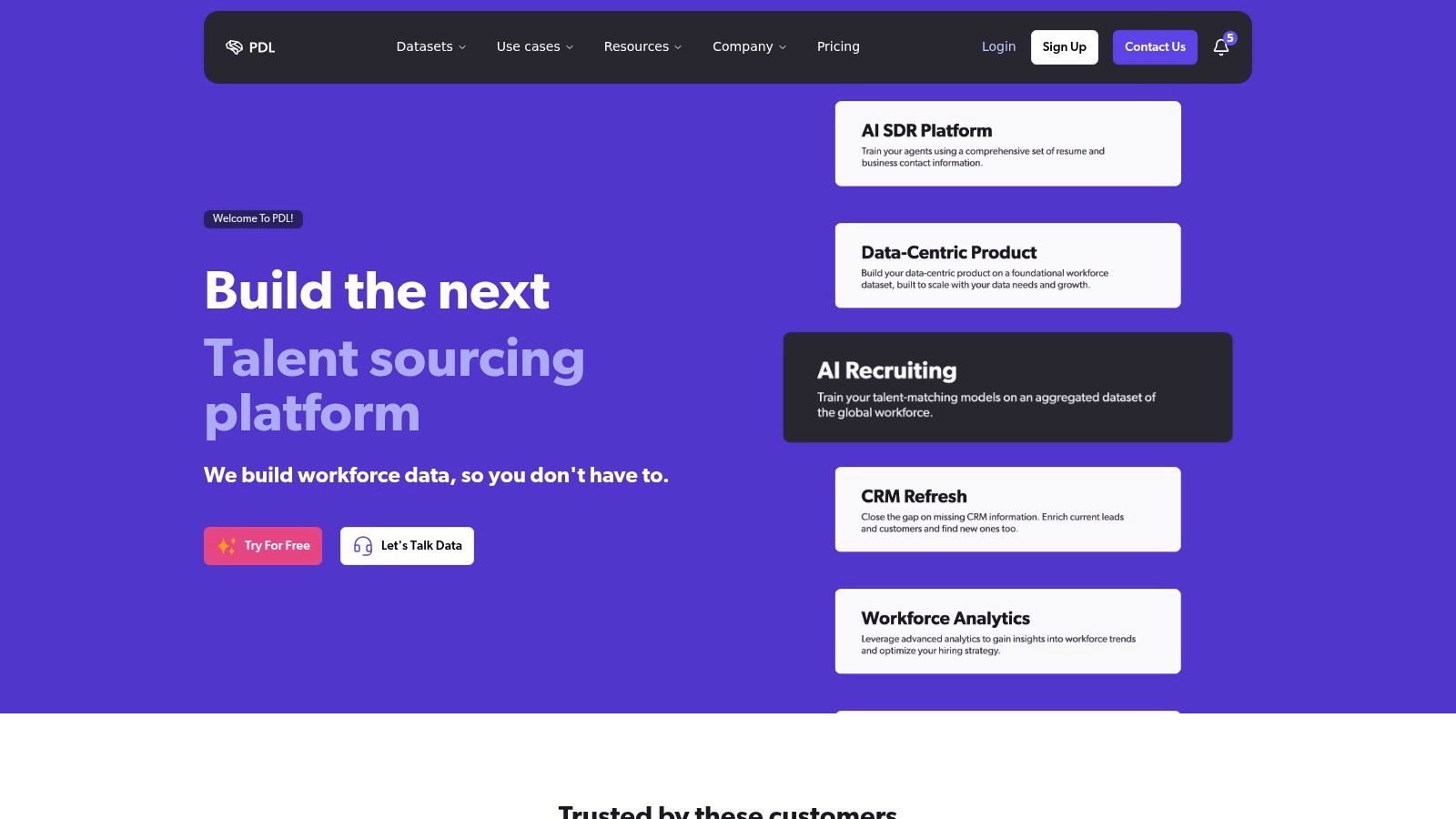
People Data Labs is not trying to win the SDR beauty contest. That's why it's useful. It's built for developers, product teams, and data engineering groups that want people and company data programmatically.
If your team is enriching sign-ups inside the product, scoring accounts in a warehouse, or building internal tools around person and company identity, PDL fits better than sales-first platforms. The API-first model is the point. You're buying flexibility and access, not rep workflow polish.
Built for developers, not reps
PDL is a strong option when the job-to-be-done is embedding enrichment into a product or internal pipeline. Developers usually care about documentation, endpoint consistency, bulk access, and licensing options more than browser extensions or sequence builders.
That makes it a poor fit for teams who expect a rep-ready prospecting experience out of the box. It also means RevOps and engineering need to be aligned before buying. Otherwise you end up with a powerful data source that no one operationalizes.
The right buyer for PDL already knows where the data will flow before procurement starts.
If you need a UI for reps, look elsewhere. If you need an API layer you can build on, PDL is one of the more practical options in the market.
8. Hunter
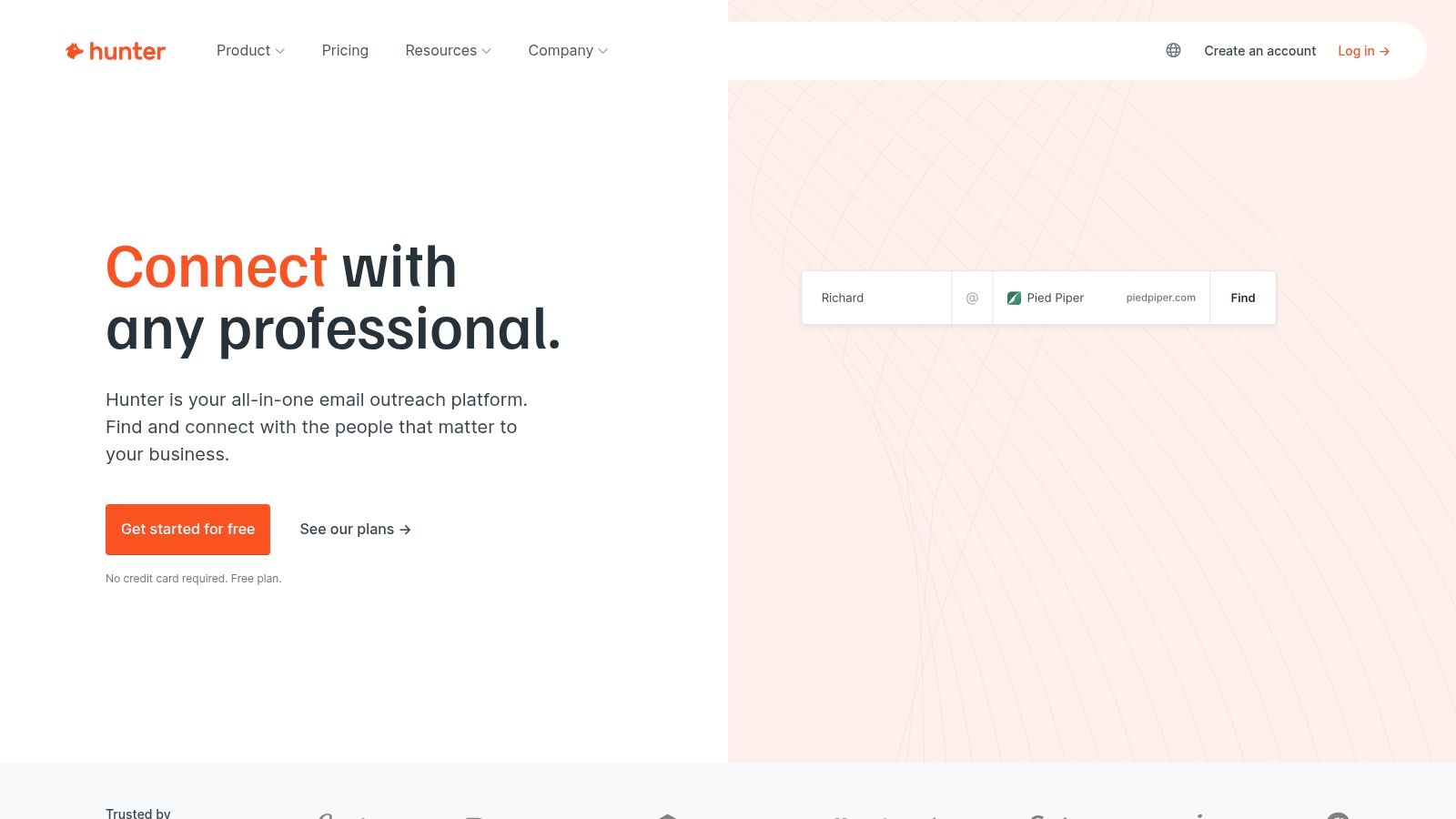
Hunter stays relevant because it does one core job cleanly. Find emails, verify them, run bulk checks, and support lightweight outreach if needed. Not every team needs a bigger data platform than that.
This is a good reminder that lead enrichment tools don't all need to be broad. Some of the best buying decisions come from narrowing the job-to-be-done. If your team is email-first, works from domains and names, and wants transparent self-serve access, Hunter is easy to trial and easy to explain internally.
Best for email-first workflows
Hunter is a sensible pick for freelancers, small sales teams, recruiters, and agencies that care more about email workflows than full account intelligence. The UI is simple, the API is straightforward, and the credit pool model is usually easier to manage than more complex seat-based setups.
Its limitations are also clear. No real phone-data strength, lighter enrichment depth than larger providers, and less value for teams that want broader account intelligence or complex orchestration. That's fine. A focused tool can still be the right tool.
I'd choose Hunter when the workflow is straightforward and the team values clarity over feature breadth.
9. Snov.io
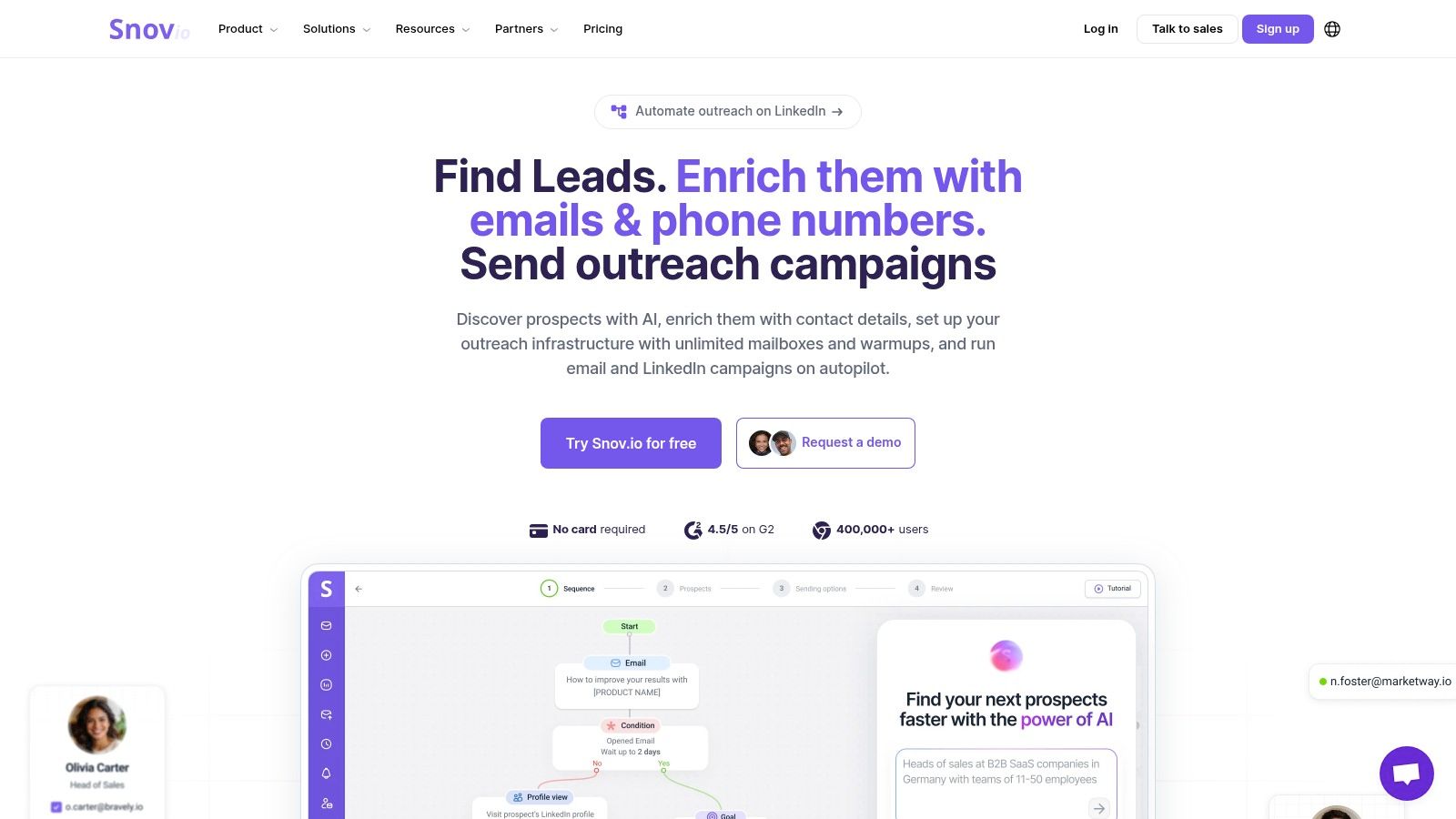
Snov.io sits in a practical middle ground. It combines email discovery, verification, enrichment, and sequencing in a package that's approachable for SMBs and agencies.
That bundled approach is attractive when the alternative is buying separate tools for every step of cold outreach. For teams that aren't ready for a complex GTM stack, Snov.io can reduce overhead and give reps one place to work.
Who should choose Snov.io
Snov.io is best when your process is email-centric and your team values simplicity over depth. Agencies, early-stage startups, and lean outbound teams often fit that profile.
The main caution is the same one that applies to many bundled tools. When one platform tries to do many jobs, not every part is category-leading. If phone coverage, compliance nuance, or advanced ops governance matter a lot, you'll probably outgrow it.
A practical buying lens:
- Good first system: Useful when you're still building process.
- Good for bundled convenience: Discovery, verification, and outreach live together.
- Less ideal for mature data teams: Specialized needs usually push teams into a more modular stack.
10. RocketReach
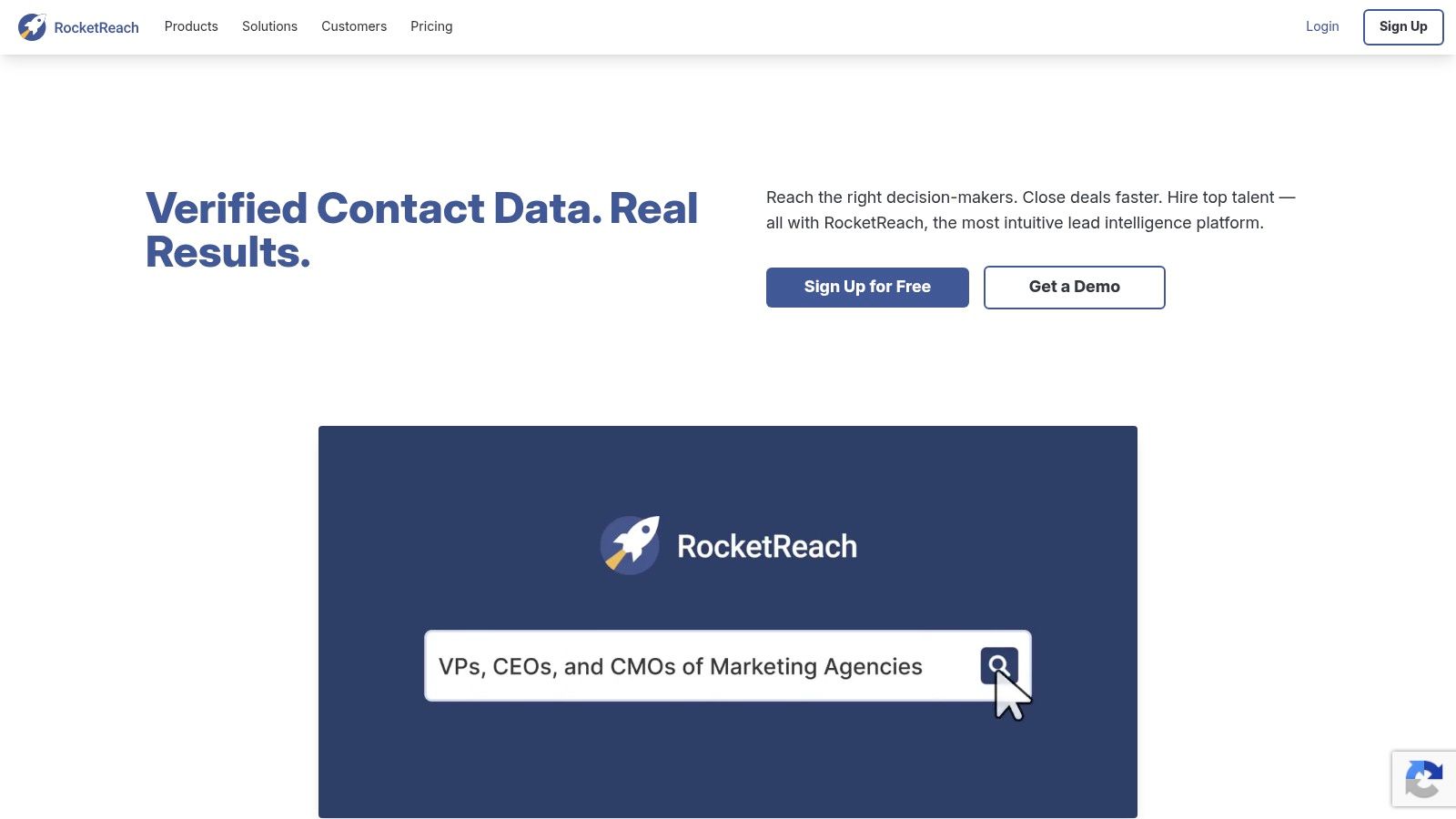
RocketReach is one of those tools that often works best as a second source. It's easy to spin up, useful for quick lookups, and common in workflows where teams want another data point before sending or importing records.
That role is more important than it sounds. Modern enrichment has shifted toward orchestration across providers, not reliance on one static database. ZoomInfo's own explanation of waterfall enrichment and continuous refresh reflects that change well. The strongest teams don't just append once. They query multiple sources, validate per field, and keep refreshing records as contacts and companies change.
Best used as a complementary source
RocketReach fits well when you need coverage checks, secondary validation, or another source for fast contact lookup. It's especially practical for teams that already know a single provider won't cover every segment cleanly.
The caution is contractual and operational. Pricing structures and renewals can be confusing, so buyers should confirm terms in writing before scaling usage. It's a useful tool. It's just not usually the tool I'd want as my sole enrichment backbone.
Top 10 Lead Enrichment Tools Comparison
| Product | Core capabilities | Quality & deliverability | Value & pricing | Best for / Audience | Standout / Unique |
|---|---|---|---|---|---|
| 🏆 Icypeas | Email Finder, ultra‑strict Verifier, Reverse Lookup, People Scraper, 575M people / 62M companies | ★★★★★ ultra‑low bounce; 99.9% uptime | 💰 pay‑as‑you‑go credits (never expire); cost‑effective (claimed 3–10x cheaper) | 👥 B2B SDRs, lead‑gen agencies, revops, developers | ✨ Google/MS catch‑all verify; monthly refreshed dataset; ISO27001 + GDPR/CCPA |
| ZoomInfo | Large contact DB, firmographics, technographics, intent, workflows | ★★★★ strong NA coverage; mixed accuracy feedback | 💰 opaque, contract quotes; enterprise pricing | 👥 Large US‑focused GTM teams & enterprises | ✨ intent signals & mature admin/governance |
| Apollo.io | Contact + account DB, sequencing, light CRM, AI assistant | ★★★★ reliable for SMB use | 💰 transparent self‑serve pricing + free tier | 👥 SMBs, agencies, sales teams wanting all‑in‑one | ✨ bundled outreach + data; clear free tier |
| Lusha | Person/company lookup, Chrome extension, CSV bulk, API | ★★★ straightforward UX; variable phone accuracy | 💰 self‑serve plans; monthly roll‑over caps | 👥 SDRs and individual reps | ✨ popular browser extension; easy quick lookups |
| Cognism | Prospecting platform, EMEA mobile/phone coverage, GDPR focus | ★★★★ strong EMEA mobile/phone reliability | 💰 custom/quote pricing (enterprise) | 👥 Teams targeting EMEA or needing compliance rigor | ✨ GDPR‑first processes & Do‑Not‑Call coverage |
| Clearbit (Breeze in HubSpot) | HubSpot‑native company/contact enrichment, reveal, routing | ★★★★ integrated deliverability within HubSpot | 💰 tied to HubSpot subscriptions/credits (quote) | 👥 HubSpot‑standardized teams | ✨ native HubSpot routing & reveal capabilities |
| People Data Labs (PDL) | API & bulk feeds for person/company data, licensing options | ★★★★ API‑first reliability for devs | 💰 public API tiers; flexible licensing | 👥 Product teams, data engineers, devs | ✨ bulk feeds + API licensing for embedding data |
| Hunter | Domain Search, Email Finder, Verifier, sequences, API | ★★★★ good email focus; no phone data | 💰 transparent self‑serve pricing + free tier | 👥 Email‑centric outbound teams | ✨ simple UI; unlimited users share credits |
| Snov.io | Email discovery, verification, enrichment, sequencing | ★★★ useful for SMB outreach; data varies by region | 💰 self‑serve bundles with public pricing | 👥 SMBs & agencies wanting integrated sending | ✨ marketplace add‑ons; integrated outreach stack |
| RocketReach | Fast person/company lookups, extension, bulk/CSV, API | ★★★ quick coverage; used as secondary source | 💰 varied plans; credit/renewal terms can be confusing | 👥 Researchers, teams filling data gaps | ✨ fast lookups across industries; complementary source |
Enrich Your Data, Accelerate Your Pipeline
What are you buying when you buy a lead enrichment tool. More contacts, or fewer workflow failures?
The market keeps expanding, but vendor growth has made selection harder, not simpler. More products now cover some mix of contact discovery, verification, firmographic enrichment, routing, and outbound workflow. The practical result is more overlap, more packaging confusion, and more ways to pay for data your team will not use.
The better way to choose is by job-to-be-done.
For SDR teams, the question is speed and contactability. Can reps find the right person fast, get usable email or phone data, and trust the record enough to send without hurting deliverability? For RevOps, the bar is different. Match rates, refresh logic, CRM sync behavior, governance controls, and territory routing matter more than a large top-of-funnel database. For developers and product teams, the decision usually comes down to API reliability, schema coverage, rate limits, licensing terms, and whether the data can be embedded into an internal workflow or customer-facing product.
That distinction matters because the right tool for one team can be the wrong purchase for another. A broad platform can make sense if your main problem is vendor sprawl, admin overhead, or cross-functional standardization. A specialist tool can be the better choice if one failure point is driving lost revenue, such as bounced emails, missing mobile numbers, or weak verification on net-new contacts.
I usually push teams to examine stale data before they compare feature grids. Bad refresh policies create quiet operational problems. Routing rules break. Personalization gets weaker. Reps work accounts with outdated contact ownership. Deliverability declines because old records stay in sequence pools too long. A one-time append solves missing fields for a moment. It does not solve data decay.
A practical buying process should cover these questions:
- Primary job: Is the tool for SDR prospecting, CRM cleanup, inbound enrichment, compliance-sensitive outreach, or an API use case?
- Usable data quality: How often is data refreshed? How is it verified? How does the vendor handle match confidence and duplicates?
- Real cost structure: Do credits, seats, exports, minimum contracts, and enrichment volume make the tool more expensive than it looks?
- Workflow fit: Does it work inside your CRM, sales engagement platform, browser workflow, or internal product stack without extra operational drag?
- Coverage by region and field type: Email-only products can work well for some teams. Others need direct dials, mobile numbers, technographics, or stronger EMEA compliance coverage.
- Future operating model: Will this tool still fit if you later add waterfall enrichment, automated refresh, or stricter governance?
If revenue teams start with the biggest operational pain, the decision usually gets clearer. Teams struggling with bounced outreach and weak contact verification often get faster payback from a specialist. Teams struggling with fragmented systems and inconsistent governance may accept lower point accuracy in exchange for one standardized platform.
That trade-off is normal.
Done well, enrichment supports three different outcomes at once. SDRs spend less time hunting for contacts. RevOps keeps routing and segmentation cleaner over time. Developers get a data layer they can build on. That is why adjacent tooling still matters. Better data only helps pipeline if records are usable and outbound reaches the inbox, which is where an email spam checker can still play a role.
If your team needs a specialist tool for finding, verifying, and enriching B2B contact data without paying for a full sales suite, Icypeas is worth testing first. It fits SDR teams that care about deliverability, RevOps teams that need cleaner CRM data, and developers who want an API they can build around.




































































.png)


.webp)