.avif)
Learn: What Is First Party Data for B2B in 2026

.avif)
Your SDRs are working hard, but the list quality keeps sabotaging them. Half the contacts are stale, job titles don't match reality, routing rules fire on weak signals, and the CRM fills up with records nobody trusts. Marketing says attribution is blurry. Sales says lead scoring is broken. Engineering says the event data exists, but nobody agreed on the schema.
That's usually the moment teams start asking a better question than “where can we buy more data?” They start asking what is first party data, what qualifies as it, and how it should flow through a B2B stack so SDRs, RevOps, and developers can all use the same customer truth.
Table of Contents
- How the three main data types compare
- Zero-party data is not the same thing
- Does enrichment turn data into first-party data
- How do you start if your data is messy
- Is enriched data still first-party data
- What should you measure first
Why First-Party Data Matters More Than Ever
An SDR sends a solid sequence to the wrong people. The company fit looked right on paper, but the contacts changed roles months ago. The engagement history is missing. The hand-raisers from your website never made it into the same view as the outbound records. So reps personalize against guesswork, not behavior.
That's the true cost of weak data. It doesn't just lower reply rates. It creates bad routing, bad prioritization, and bad trust in every downstream report.

Why bought or inferred data stops being enough
Purchased records can still be useful for coverage and enrichment, but they don't tell you what people did with your brand. They rarely capture the sequence that matters in B2B. Which page they viewed, which webinar they registered for, whether they opened onboarding emails, whether support tickets suggest expansion or churn risk.
That's why first-party data moved from “nice to have” to operating requirement. Privacy rules changed. Platforms reduced reliance on third-party cookies. And in a 2022 Statista survey on customer data used for personalization, brands worldwide reported using exclusively first-party data to personalize customer experiences, showing that it had become a mainstream marketing input by 2021–2022.
Practical rule: If your GTM team can't explain where a field came from and how it was collected, they shouldn't build critical workflows on top of it.
Why this is a B2B opportunity, not just a constraint
For B2B teams, first-party data is the most stable signal set you have because it comes from touchpoints you control. Website visits, form fills, product usage, CRM activity, email engagement, support interactions, and transaction history are all operationally useful because they tie to known accounts and known workflows.
It also changes how teams work day to day:
- SDRs prioritize real intent instead of static list criteria.
- RevOps scores and routes leads using direct behavioral evidence.
- Marketing suppresses noise instead of pushing every record into campaign flow.
- Engineering builds cleaner integrations because the source systems are known.
A lot of teams think they need huge scale before first-party data becomes useful. In practice, they usually need cleaner capture, tighter identity resolution, and fewer disconnected tools.
Defining First-Party Data From the Ground Up
The easiest way to understand first-party data is to compare it to a direct conversation. If a prospect tells you what they need on a demo call, you trust that more than a rumor from five people away. If a buyer visits your pricing page, downloads a security brief, and replies to a nurture email, those are direct signals from your own relationship with that buyer.
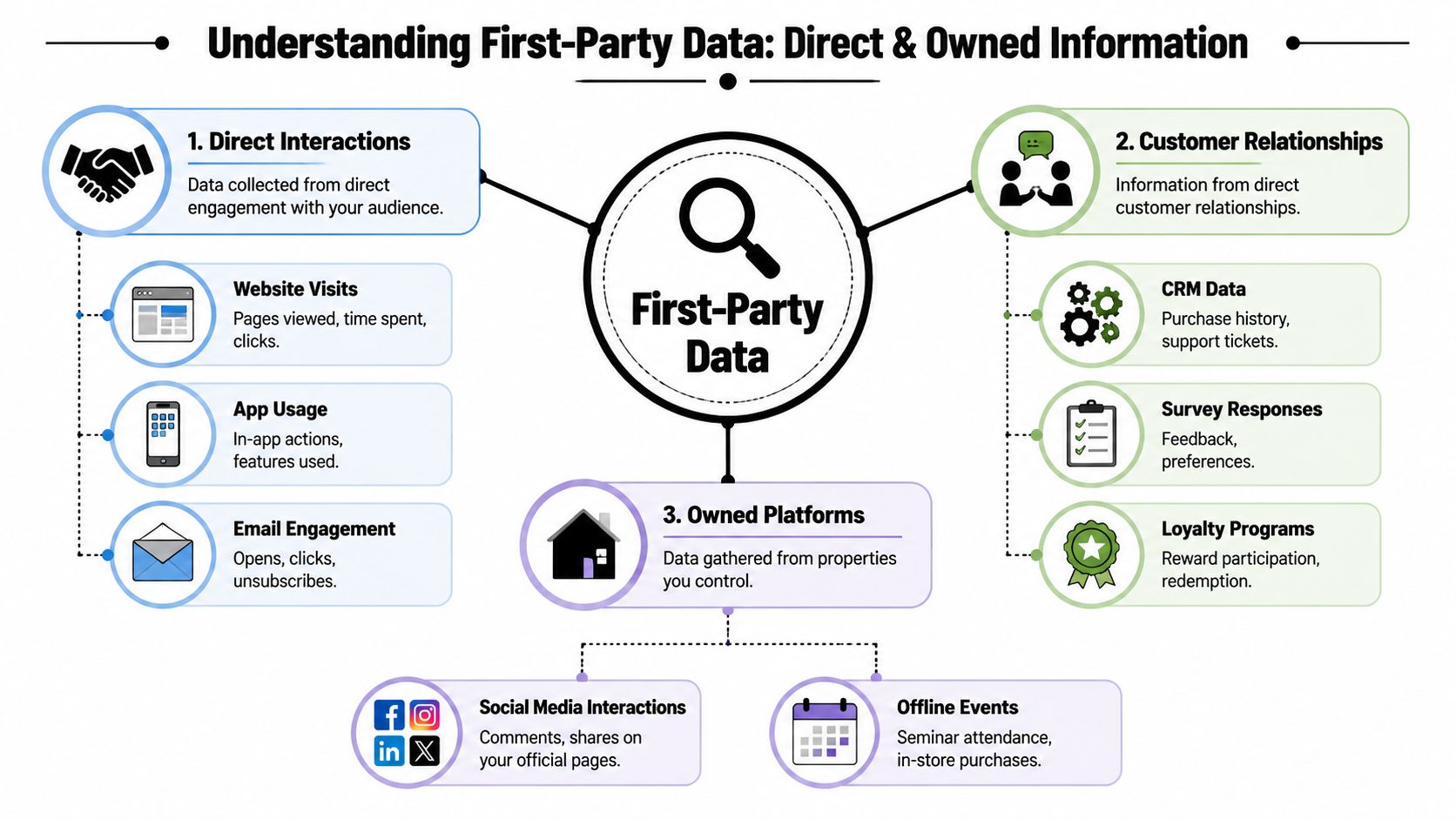
That's the intuition behind what first-party data is. It's information you collect from your own audience through touchpoints you own or operate.
A simple way to think about it
If your company observed it directly, stored it from its own systems, and can tie it to an account or person in a consented way, it's likely first-party data.
That includes signals from places like:
- Web and app activity such as page views, clicks, feature usage, and session patterns
- CRM history such as lifecycle stage changes, owner assignments, meeting outcomes, and opportunity context
- Email engagement including opens, clicks, replies, and unsubscribes
- Support and success systems such as ticket themes, onboarding milestones, and renewal conversations
- Transactions and forms like purchases, trial starts, demo requests, surveys, and registrations
If you want a broader breakdown of where these signals sit inside a modern stack, this overview of marketing data sources is a useful companion.
The technical definition that matters in operations
The marketing definition is fine, but ops and engineering teams need a stricter one. According to Amplitude's explanation of first-party data, first-party data is the data model an organization can directly observe and store from its own owned surfaces such as web, app, CRM, email, support, or transaction systems, so the same user can be resolved across event data and entity data inside a single customer profile.
That distinction matters because B2B systems usually split data into two buckets:
Event data
Things a person did. Viewed a page, clicked an email, attended a webinar, created a project, invited a teammate.Entity data
Things that describe the person or account. Role, company, segment, preferences, lifecycle status, contract tier.
Here's a quick visual walkthrough before going deeper:
When teams miss this model, they create fragmented records. Web analytics knows one version of the lead. CRM knows another. Product analytics knows a user ID with no account context. Sales engagement tools keep their own activity history. Nobody can answer basic questions quickly.
First-party data isn't a spreadsheet. It's a connected record of direct interactions that multiple teams can act on.
A Clear Guide to Data Types
Teams get into trouble when they use “data” as one bucket. It isn't. Source and collection method matter because they affect trust, compliance, activation, and maintenance.
How the three main data types compare
| Attribute | First-Party Data | Second-Party Data | Third-Party Data |
|---|---|---|---|
| Source | Collected directly from your own audience | Another company's first-party data shared with you | Aggregated by an outside collector |
| Collection relationship | Direct | Indirect but partner-based | Indirect and external |
| Control | Highest | Moderate | Lowest |
| Typical accuracy for your workflows | Usually strongest because it reflects direct interactions | Can be useful if the partner and mapping are reliable | More variable, often weaker for account-level action |
| Best use | Scoring, routing, personalization, suppression, measurement | Partner campaigns, audience expansion, shared programs | Coverage, enrichment, broad targeting, modeling |
| Main limitation | Scope depends on your audience and systems | Requires trust and careful matching | Harder to validate and operationalize cleanly |
The practical rule comes from Clearbit's guide to data types: the key test is how the data was collected. First-party data is what a company collects directly from its own audience. Second-party data is another organization's first-party data. That distinction matters even more as cookie-based tracking gives way to identifiers such as hashed email.
Zero-party data is not the same thing
A lot of teams lump zero-party and first-party together. They're related, but not identical.
According to Piwik PRO's explanation of first-party and zero-party data, zero-party data is information customers proactively share, such as preferences or intentions. First-party data is observed behavior on owned channels, such as page views or purchases.
That means:
- A prospect selecting “interested in enterprise pricing” on a form is zero-party data
- That same prospect visiting your pricing page three times is first-party data
Both are valuable, but they answer different questions. Zero-party tells you what the buyer says they want. First-party shows what they do.
Does enrichment turn data into first-party data
No. Enrichment improves a profile, but it doesn't change the origin of the added fields.
If you capture an inbound sign-up on your website, the sign-up itself is first-party data. If you append company details, job title normalization, or contact information from an outside provider, those appended attributes are not suddenly first-party. They remain external data attached to a first-party profile.
That's a healthy way to think about stack design:
- Keep origin clear
- Store source metadata
- Separate observed signals from appended attributes
- Don't let enrichment overwrite direct user-provided values without rules
This boundary case matters most in B2B because enrichment is common. Teams often need broader account context, but they still need to know which fields came from direct interaction and which came from outside sources.
Practical Methods for Collecting Quality Data
Most B2B companies already generate useful first-party data. The problem isn't absence. It's poor capture discipline, inconsistent identifiers, and weak handoff between systems.
Owned touchpoints that produce usable signals
The strongest collection points are the ones tied to clear buyer actions across owned channels.
Website forms and conversion paths
Demo requests, newsletter sign-ups, gated assets, pricing requests, and trial starts are obvious examples. The form submission matters, but the surrounding behavior matters too. Which page led to conversion, what content they viewed before submitting, and whether the session came from brand search, outbound, or partner traffic.Product and app events
For product-led or hybrid motions, feature usage is often the cleanest intent signal in the business. Logins, setup completion, team invites, admin actions, and repeated use of core workflows tell you far more than a static lead source field.CRM activity entered by humans
Sales notes, call outcomes, disqualification reasons, and buying committee mapping are first-party data when your team collects them directly. This is one reason CRM hygiene matters so much. Bad picklists create bad operating truth.Email and lifecycle automation
Engagement with owned email programs gives you direct signal about relevance and timing. Replies are especially useful because they often contain explicit intent that should feed routing and segmentation.
For teams that also append or verify records after collection, this guide to marketing data enrichment helps frame where enrichment supports, but does not replace, direct collection.
What teams often collect badly
The source systems aren't usually the issue. The collection design is.
Common failures include:
Over-collecting fields nobody uses
Long forms lower quality because users guess, skip, or enter junk.Under-defining event names
If one team logs “signup_complete” and another logs “registration_done,” downstream analysis gets messy fast.Treating free text as a strategy
“Other” fields and open comments are helpful, but core routing fields need structure.Losing history on overwrite
If your CRM only stores latest value and not change history, you lose signal about progression.
Ask for the minimum needed to move the next workflow forward, then collect more through behavior and follow-up.
A practical collection model uses both kinds of direct input. Zero-party data captures what the buyer tells you. First-party behavioral data captures what the buyer does. The combination is what makes segmentation usable instead of theoretical.
The Business Case for First-Party Data in B2B
Organizations don't need another philosophical argument for cleaner data. They need proof that it changes revenue outcomes, acquisition efficiency, and workflow quality.
Why commercial teams care
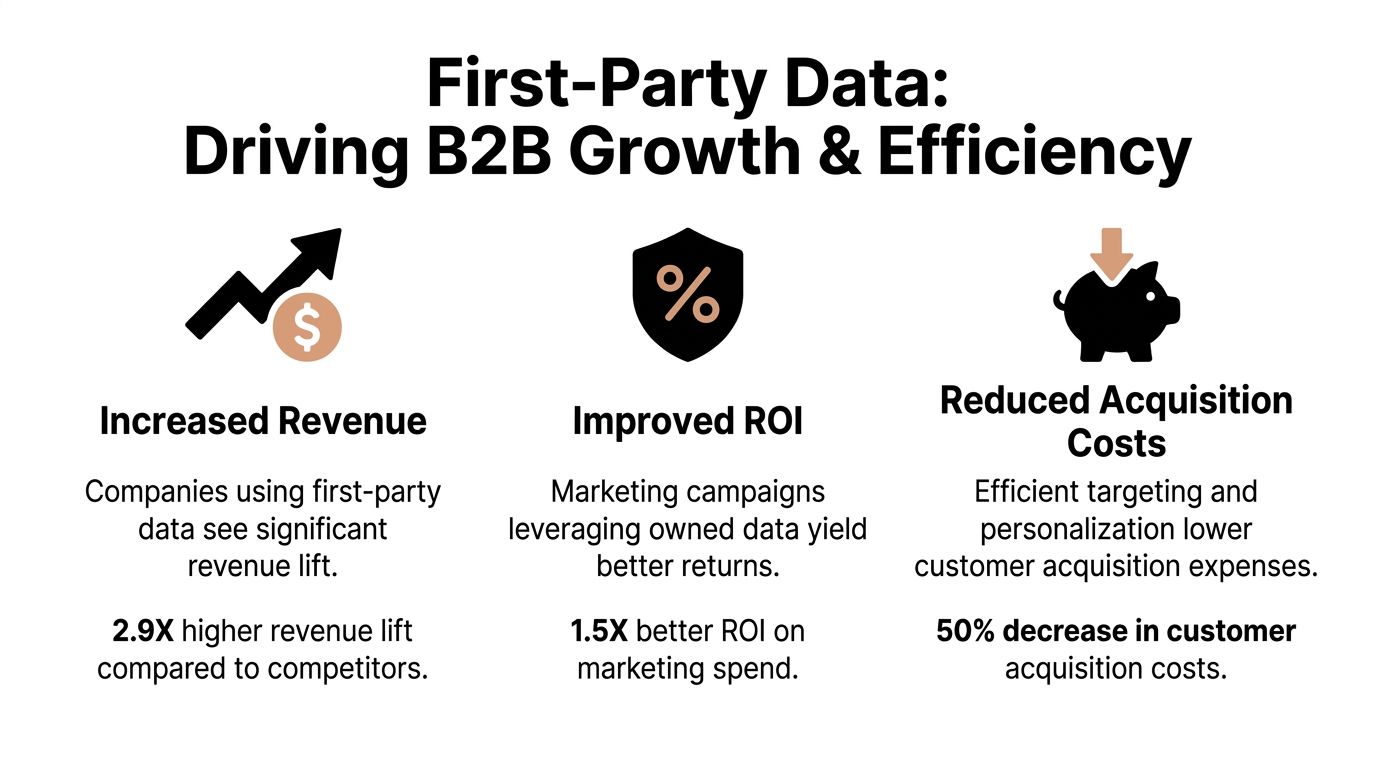
A widely cited benchmark reported that brands using first-party data for marketing saw a 2.9x revenue lift and a 1.5x increase in cost savings, while another benchmark cited an 8x ROI and more than 25% lower CPA, according to the Digital Marketing Institute's summary of first-party data benchmarks.
Those numbers are often quoted in marketing contexts, but the B2B implication is broader. First-party data improves the parts of the funnel where teams usually waste effort: poor-fit outreach, weak scoring, duplicate records, and generic follow-up.
What improves inside a B2B engine
The gains usually show up in operational areas first.
Outbound gets more relevant
SDRs stop opening with generic company facts and start using actual engagement context. “Saw your team downloaded the integration guide” beats “noticed your company is growing.”Lead scoring gets less fictional
A score based on direct behavior and lifecycle events is easier to defend than one built mostly on guessed firmographics.Suppression gets smarter
Teams can exclude bounced contacts, disengaged segments, existing customers, open opportunities, or unqualified records without relying on stale spreadsheets.Deliverability improves indirectly
Better targeting and cleaner lists reduce unnecessary volume and lower the odds that you keep hammering the wrong contacts.
There's also a content strategy angle. If your team is investing in executive visibility and social distribution, a practical resource on how to grow on LinkedIn fits nicely with a first-party model because social engagement on your owned profiles can become another high-value signal for segmentation and follow-up.
The best commercial use of first-party data isn't “more personalization.” It's better decisions about who should get what, from whom, and when.
Activating Data Across Your GTM Stack
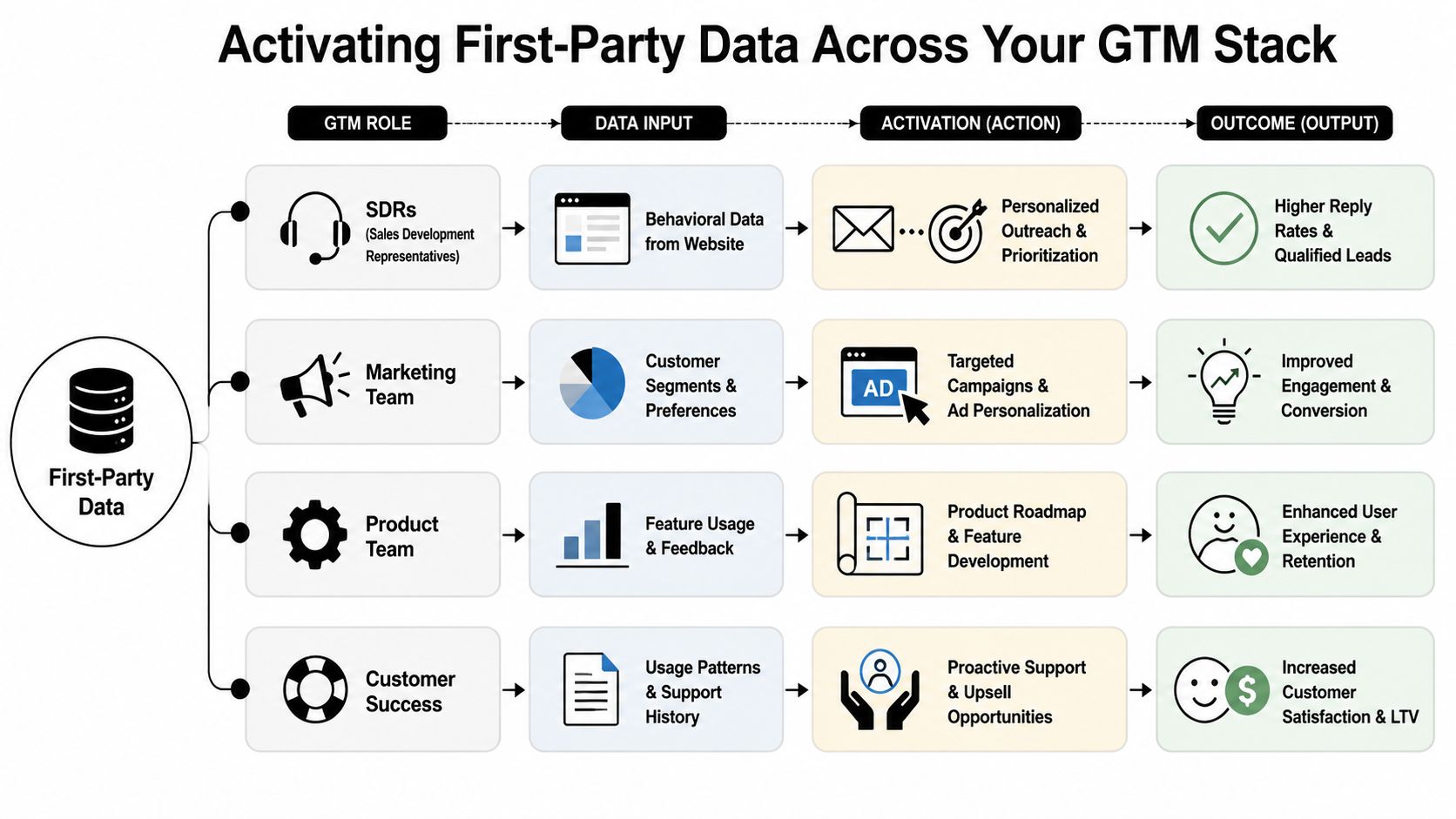
Data only becomes valuable when the profile is unified, accessible, and tied to action. That's why teams centralize first-party records in a CRM or CDP. As explained in CDP.com's overview of first-party data activation, organizations typically centralize it to standardize records, de-duplicate identities, and create a persistent profile that can drive targeting and predictive analytics.
One lead profile across multiple teams
Take a common flow. A prospect visits your site from a paid campaign, reads a product comparison page, registers for a webinar, and later starts a free trial using a work email.
At that point, multiple systems know something:
- the web analytics tool has anonymous and then known session history
- marketing automation has registration and email engagement
- the product database has activation events
- the CRM has lead and account ownership
- support may soon have onboarding questions
If those systems stay disconnected, each team acts on partial truth. If they resolve into one profile, the handoff becomes much cleaner.
An SDR can see the account's latest behaviors before sending outreach. RevOps can route based on account ownership plus product activity. Customer success can prioritize onboarding based on adoption milestones instead of waiting for a complaint.
If your current tooling is fragmented, this overview of a marketing data platform helps frame what a unification layer is supposed to do operationally.
What RevOps automates
RevOps usually owns the workflows that make first-party data useful at scale.
Typical automations include:
Identity and deduplication
Match leads to accounts, merge obvious duplicates, and preserve source history.Lead routing
Send product-qualified or demo-qualified records to the right owner based on territory, segment, account status, or named-account rules.Lifecycle progression
Move records between inquiry, MQL, SAL, SQL, opportunity, customer, and re-engagement states based on direct signals.Suppression logic
Prevent conflicting outreach to active opportunities, current customers, or recently disqualified leads.
Attribution also gets better once these rules are in place because events and ownership can be connected more reliably. If your team is cleaning up measurement logic, this guide for B2B pipeline attribution is a useful reference for thinking through multi-touch models without oversimplifying the journey.
What developers need to build
Developers usually touch the least glamorous but most important layer. Event capture, schema governance, identity stitching, sync reliability, and API activation.
The build priorities are usually straightforward:
Define event names and properties once
Product, web, and marketing teams should not invent separate vocabularies for the same action.Create a durable identifier strategy
Anonymous IDs, user IDs, account IDs, and email-based matching need clear rules.Write data back into operating systems
If a valuable event stays trapped in a warehouse, SDRs and CSMs won't use it.Append external context carefully
Tools like Clearbit, ZoomInfo, Apollo, or Icypeas can enrich first-party records with professional contact or company data. That's useful when a sign-up arrives with limited context, but the appended fields should remain tagged as external enrichment rather than treated as native first-party observation.
The teams that do this well build one persistent profile and let every function read from it differently. Sales sees priority and context. Marketing sees segments and exclusions. Product sees adoption patterns. Support sees account history.
Your First-Party Data Strategy FAQ
How do you start if your data is messy
Start smaller than you think. Pick one core journey such as demo requests, trial starts, or inbound contact forms. Standardize the fields, define the events around that journey, map them into the CRM, and make sure ownership and lifecycle rules work. Don't start with a giant data program. Start with one motion the business already cares about.
Is enriched data still first-party data
No. The direct interaction remains first-party. The appended details remain external data attached to that profile. That doesn't make enrichment bad. It just means source lineage should stay visible so ops teams know what came from the buyer and what came from a provider.
What should you measure first
Measure operational trust before chasing advanced models. Look at whether records match correctly, whether routing works, whether duplicates fall, whether SDRs use the signals, and whether suppression rules prevent obvious mistakes. If teams don't trust the profile, they won't act on it.
First-party data works best when collection is transparent, fields have clear ownership, and every important workflow can answer one basic question: what did this person or account do directly with us?
If your team is collecting solid first-party signals but missing usable contact and company context, Icypeas can help enrich inbound records, verify professional emails, and support CRM or API-driven workflows without replacing the importance of your own direct data.





























































.png)



.webp)