.avif)
High Ticket Sales Meaning: A Guide for B2B Teams

.avif)
In B2B, high ticket sales meaning usually starts at $10,000 or more, but the definition is the complexity of the deal, not just the price. It's a consultative, multi-stakeholder sale of a high-value solution, not a quick transaction and not a glorified checkout flow.
That matters because a lot of the advice people find online about “high ticket sales” has very little to do with actual enterprise selling. The popular version is often built around one-call closes, scripted objections, and coaching offers sold through social media. Serious B2B teams operate in a different environment entirely. They sell products and services that affect budgets, workflows, risk, procurement, and executive priorities.
If you're an SDR, AE, outbound lead, or RevOps operator, getting this definition right changes how you prospect, qualify, message, and forecast. It also keeps you from copying tactics that look aggressive on social media but collapse in front of a real buying committee.
Table of Contents
More Than Just a Price Tag
Most bad advice on high-ticket selling starts with the wrong assumption. It treats “high ticket” as shorthand for “expensive” and then jumps straight to persuasion tactics.
That's not how real B2B deals work. According to Apollo's breakdown of high-ticket sales, data from 2025 shows that 68% of “high ticket closer” job postings on social media are affiliated with influencer-led course schemes selling $3,000–$10,000 masterclasses, whereas genuine B2B high-ticket deals typically run from $10,000 to $500,000+ and involve multi-stakeholder committees and 6–18-month cycles. Those are two different worlds wearing the same label.
One world is optimized for speed, scripts, and pre-qualified interest. The other is built around internal alignment, perceived risk, and proof that the solution deserves operational trust.
Why the confusion hurts real sales teams
When reps import remote-closer logic into enterprise sales, three things usually go wrong:
- Qualification gets sloppy. Reps mistake curiosity for intent and a polite stakeholder for a decision-maker.
- Discovery stays shallow. They look for pain they can dramatize instead of business problems they can map to a buying process.
- Follow-up becomes pushy. They press for a decision before the customer has internal consensus.
That confusion also shows up in data strategy. Teams that don't know whether they're running a volume motion or a committee sale often build the wrong targeting rules, track the wrong signals, and personalize too late. That's one reason understanding concepts like first-party data in B2B go-to-market systems matters so much.
The fastest way to lose credibility in a serious deal is to sell it like a seminar package.
A real high-ticket B2B motion starts with one sober assumption. The buyer isn't just spending money. They're taking on professional risk. Once you see that clearly, the rest of the process makes more sense.
What Is High-Ticket Sales in a B2B Context
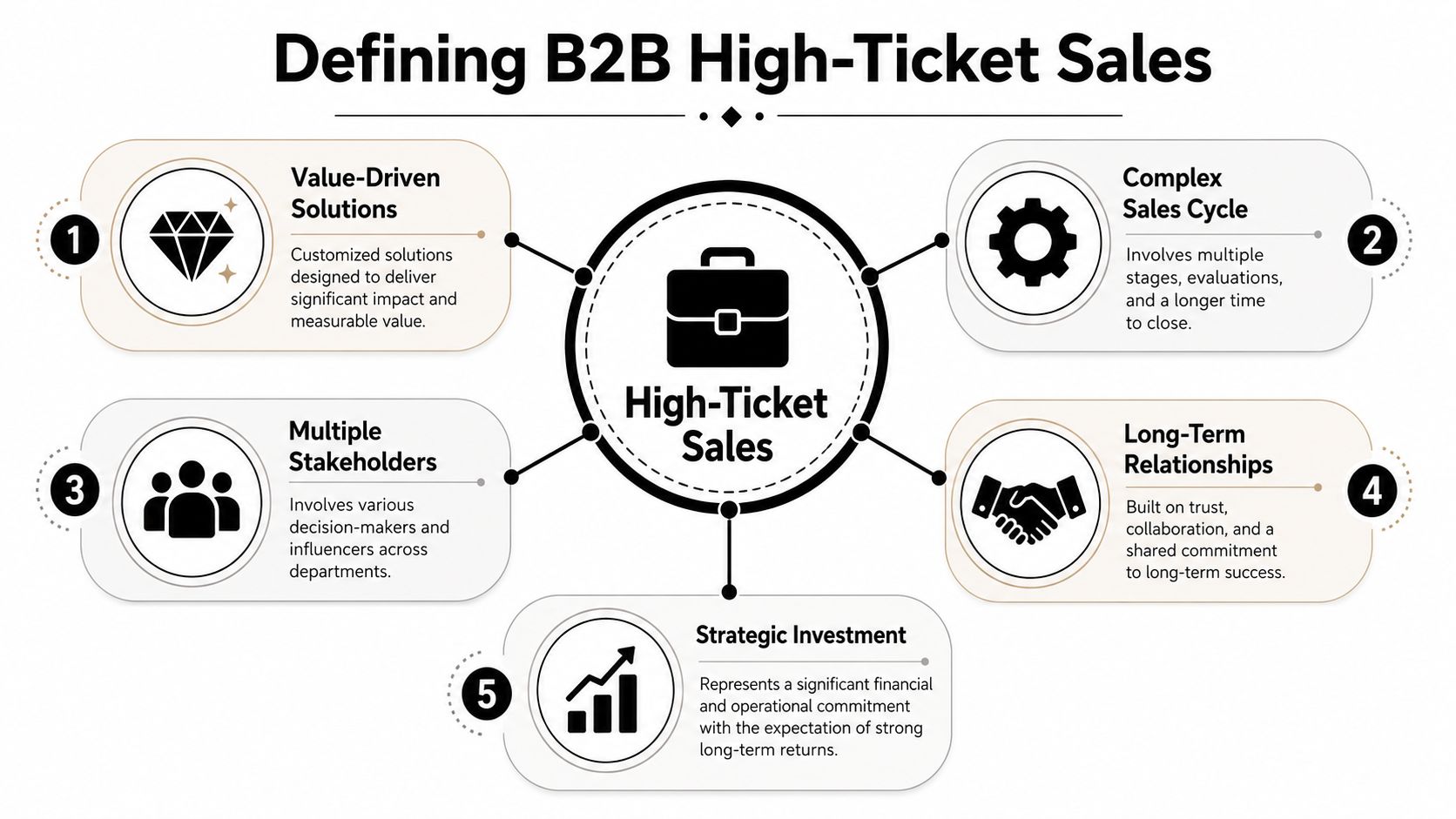
In a B2B setting, Martal's definition of high-ticket sales is the cleanest one to work from: high-ticket sales refers to selling high-value products or services with a typical price floor of $10,000 or more, and enterprise deals frequently average over $100,000 and can reach six or seven figures. The same source makes the critical point that the definition is distinguished by the complexity of the buying process rather than the price alone.
That second part is the one commonly missed.
The real threshold is organizational risk
A purchase becomes high ticket in B2B when the decision triggers formal scrutiny. The buyer has to think about budget approval, implementation effort, stakeholder buy-in, legal review, vendor risk, and expected business impact.
That's why a deal can feel “high ticket” even when the price alone doesn't tell the full story. The buyer may be purchasing software, a services engagement, or a broader operational change. What they're really evaluating is whether your solution is worth the cost, the effort, and the internal exposure that comes with choosing a vendor.
A practical way to consider this:
| Buying pattern | Transactional purchase | High-ticket B2B purchase |
|---|---|---|
| Decision style | One person decides | Several people weigh in |
| Main concern | Price and convenience | Risk, fit, and expected outcome |
| Sales role | Answer questions | Orchestrate consensus |
| Proof needed | Product info | Business case, trust, and specificity |
A better analogy than luxury retail
People often compare high-ticket sales to selling luxury goods. That's not wrong, but it's incomplete.
A better analogy is the difference between buying coffee and commissioning a house renovation. Coffee is simple. If you don't like it, the downside is small. A renovation affects your budget, your timeline, your daily life, and your confidence in the people doing the work. You ask more questions because the consequences are bigger.
High-ticket B2B works the same way. Buyers don't want a polished pitch. They want confidence that the vendor understands the business problem, the internal constraints, and what success has to look like after purchase.
Later in the process, a conversation like this can help frame the concept visually:
Practical rule: If the buyer needs internal approval, cross-functional support, and a credible implementation path, you're in high-ticket territory whether or not the internet thinks the number sounds impressive.
High-Ticket Sales vs Transactional Selling
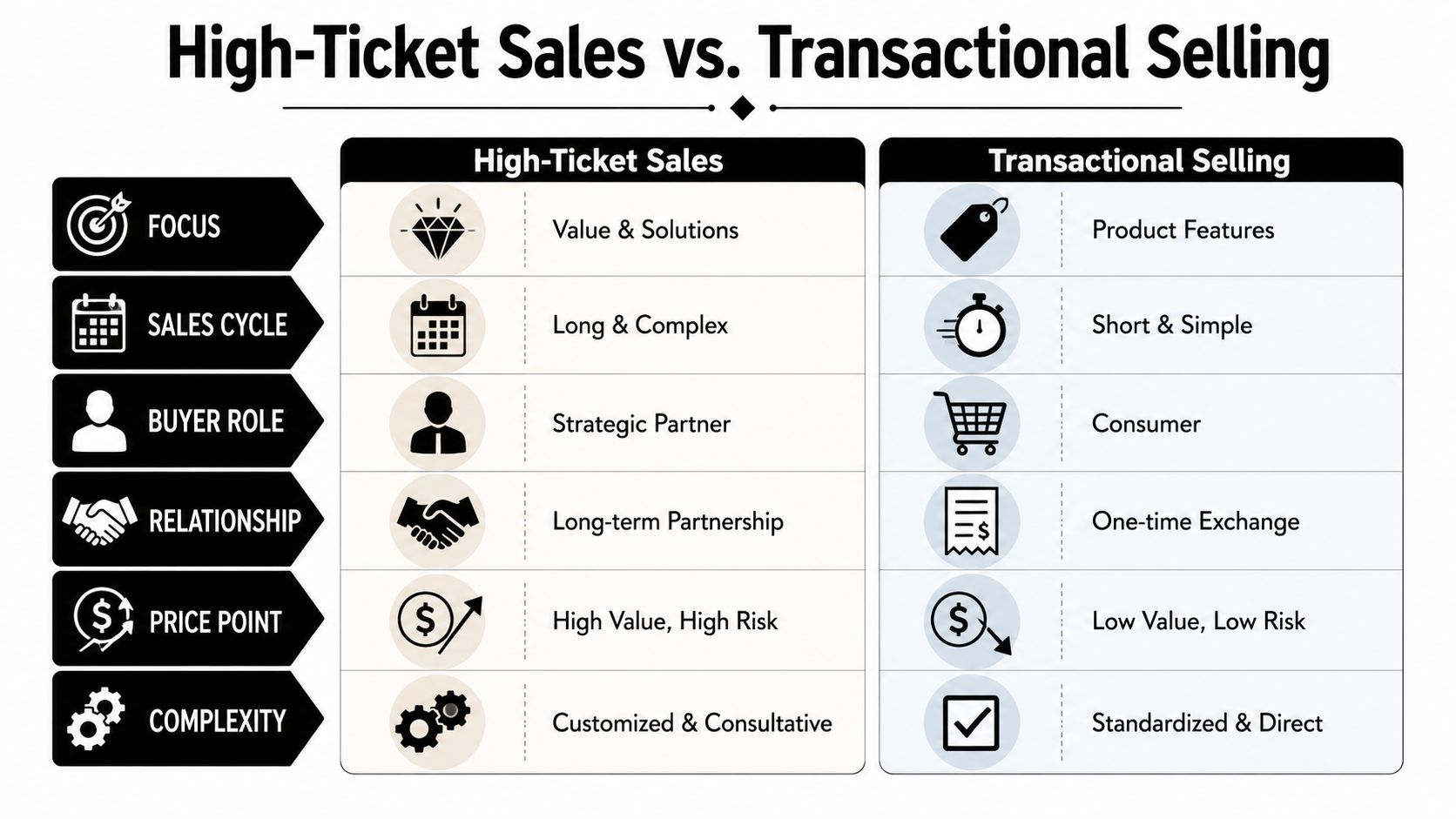
The easiest way to understand high ticket sales meaning is to compare it with the opposite model. Transactional selling is about reducing friction so a buyer can make a quick decision. High-ticket selling is about reducing risk so a buyer can make a defensible decision.
RepSelect's explanation of high ticket sales captures the heart of it well. High ticket sales is the process of selling high-priced offers predominantly through one-on-one conversations, where the buyer pays for an outcome rather than a physical product. The same source notes that the sale happens through conversation, trust, and the buyer's belief that the outcome is worth the price, with no checkout page involved.
The difference in plain terms
Here's the practical contrast:
| Dimension | High-ticket sales | Transactional selling |
|---|---|---|
| Buyer motivation | Solve a costly problem | Buy something useful quickly |
| Sales conversation | Diagnostic and consultative | Informational and direct |
| Value discussion | Outcome, ROI, risk reduction | Features, price, availability |
| Relationship | Ongoing partnership | Often a one-time exchange |
| Rep behavior | Guides decisions | Removes friction |
In transactional sales, a strong rep is fast, clear, and responsive. In high-ticket sales, a strong rep is also politically aware. They know who can block the deal, who owns the pain, who controls budget, and who needs a different version of the story.
What breaks when teams use the wrong model
A lot of stalled pipelines come from forcing a transactional playbook onto a consultative sale.
- Feature dumping instead of diagnosis. Teams rush into demos before they've uncovered the cost of the status quo.
- Single-threaded outreach. One champion says the right things, then procurement or IT kills momentum later.
- Premature proposals. Reps send pricing before the buyer has agreed internally on scope, urgency, or ownership.
- Activity over progress. Lots of calls happen, but nothing advances because no one is driving a decision process.
In high-ticket selling, the rep isn't there to “convince.” The rep's job is to help the customer make a sound decision and help the internal champion sell that decision inside their company.
That shift changes everything. Your emails get sharper. Your discovery gets deeper. Your forecasting gets more honest. And your win rate improves because you stop treating serious purchases like impulse buys.
The Anatomy of a High-Ticket Sales Motion
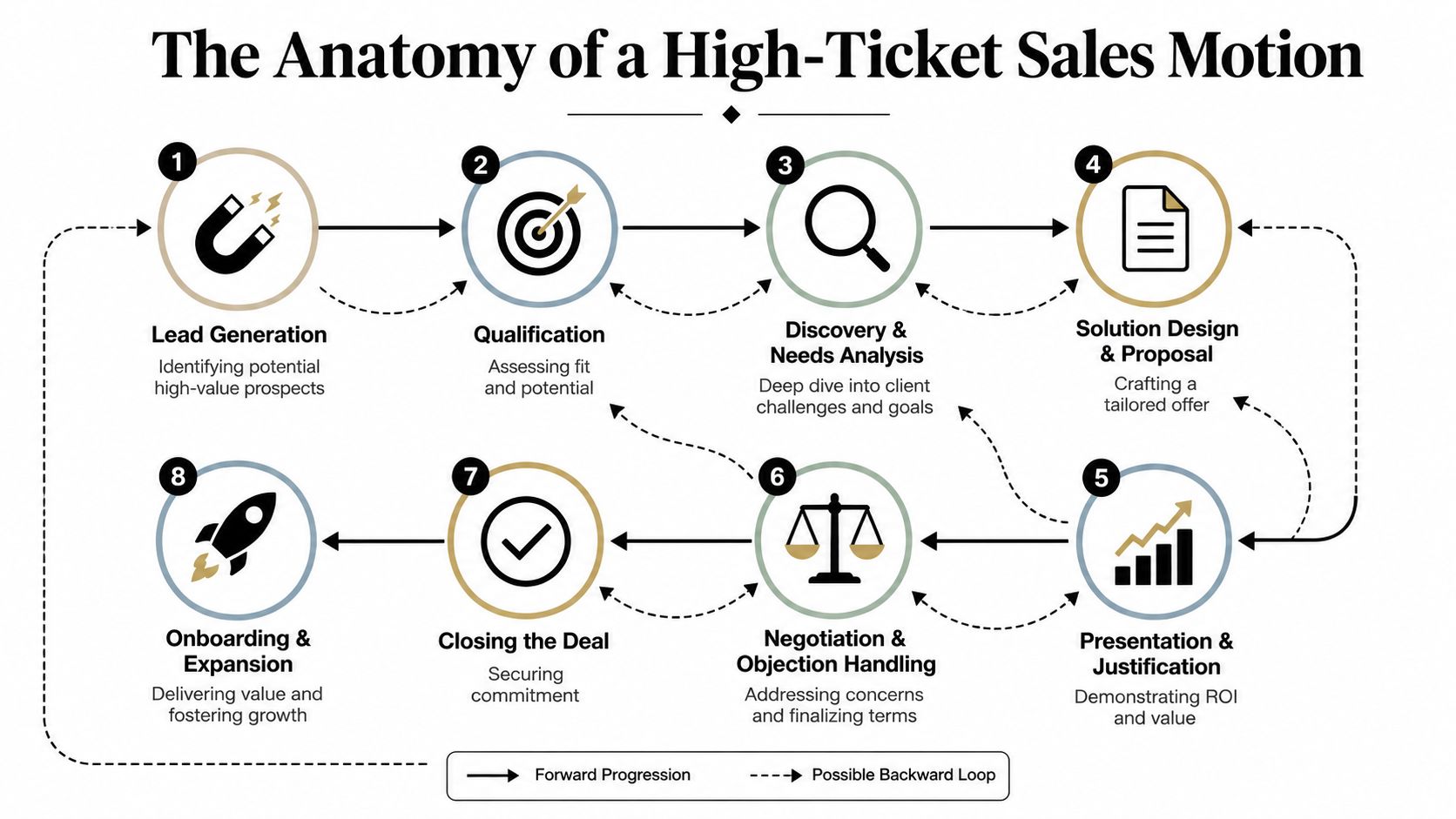
A high-ticket deal rarely moves in a straight line. It behaves more like a campaign with loops, side conversations, internal delays, and moments when the buyer appears to go cold even though the deal is still alive.
Sendtrumpet's analysis of high-ticket sales cycles notes that high-ticket sales cycles run between 60 and 180 days on average, and that this duration is driven by multiple decision-makers including VPs and C-level executives. That lines up with what most B2B teams see. The deal doesn't just need a “yes.” It needs enough aligned yeses from the right people.
How the motion actually unfolds
A solid high-ticket motion usually includes these stages:
Targeting the right accounts
Good reps don't just hunt for interest. They hunt for relevance. The account has to have a problem your team can solve and enough organizational maturity to buy.Qualification beyond surface fit
Basic fit isn't enough. You need to know who feels the pain, who owns budget, what other projects compete for attention, and what happens if nothing changes.Deep discovery
Discovery should uncover business consequences, not just feature requests. If the buyer can't explain the operational or financial impact of the problem, the deal is still soft.Solution design
In solution design, high-ticket sales departs sharply from transactional selling. The offer often needs to be positioned around the buyer's environment, priorities, rollout path, and stakeholder concerns.Committee communication
A strong champion can open the door. They usually can't close the deal alone. Reps need material that helps technical evaluators, financial reviewers, and executive sponsors each answer their own version of “why this vendor?”
For teams building process around this, resources on building converting sales funnels can be useful when adapted to a long-cycle B2B context. The key is to think in stages of trust and internal alignment, not just lead capture.
Where deals usually stall
Deals often slow down in familiar places:
- After the first good meeting. The rep thinks momentum exists. The buyer thinks research has just started.
- During internal handoff. Your champion likes the solution but hasn't equipped peers to support it.
- At procurement and legal. These teams aren't trying to sabotage the deal. They're doing their job, and weak preparation shows up fast.
- At executive review. Senior leaders want strategic fit, not a replay of the feature demo.
A mature rep plans for those stalls early. They don't wait for objections to appear. They identify likely friction before it becomes delay.
The best enterprise reps don't just manage their pipeline. They manage the customer's buying process better than the customer can.
Common Challenges and Real-World Examples
The hardest part of high-ticket sales isn't hearing “that's expensive.” It's understanding what that statement means in context.
Sometimes it means the buyer doesn't see enough value. Sometimes it means they see the value but can't defend the purchase internally. Sometimes it means your champion agrees with you and still doesn't have the political capital to move the deal.
Objections that signal risk, not rejection
A few common objections show up repeatedly in high-value deals:
“We don't have budget.”
This often means “we don't have approved budget for this problem right now” or “this isn't ranked high enough yet.” The move isn't to argue. It's to understand prioritization and whether the problem is painful enough to displace something else.“We need to think about it.”
Usually, they don't need more time alone. They need more clarity, more internal alignment, or fewer unanswered risks.“Send me a proposal.”
Early in the cycle, that can be a brush-off. In a real opportunity, a proposal should formalize an already-shaped decision, not substitute for discovery.“This looks great, but it's a big change.”
That's often the most honest objection in the room. Buyers may like the outcome and still fear implementation disruption.
The right response is rarely a script. It's a better diagnosis of what's blocking conviction.
Three B2B examples that feel like real deals
Example one: cybersecurity platform replacement
A mid-market company had too many fragmented tools and too many internal owners. The security lead wanted consolidation, but finance worried about total spend and IT worried about migration risk. The winning sales motion focused less on “better features” and more on reducing operational complexity, giving each stakeholder a reason to support the change.
Example two: logistics software rollout
An operations team wanted better visibility across carriers, but frontline managers feared process disruption. The rep who won didn't force urgency through pressure. They mapped rollout concerns, adjusted the implementation narrative, and helped the buyer frame the project as controlled improvement rather than a risky overhaul.
Example three: strategic consulting engagement
The client didn't struggle to understand the service. They struggled to trust that the consulting team would drive action instead of producing a slide deck. The deal moved when the seller shifted from methodology talk to a concrete operating cadence, executive sponsorship model, and clear ownership after kickoff.
A pattern runs through all three. The deal didn't move because someone “handled objections.” It moved because someone lowered perceived risk and made the purchase easier to defend.
Fueling Your Pipeline with Accurate Prospect Data
In high-ticket sales, bad targeting is expensive. If a rep spends months nurturing the wrong account, the cost isn't just time. It's lost pipeline capacity, distorted forecasts, and missed opportunities with buyers who fit.
That's why prospect data matters more in long-cycle B2B than many teams admit. You can survive imperfect data in a high-volume motion for a while. In a complex sale, weak data poisons the process early. You target the wrong function, email the wrong level, miss the internal champion, or personalize around a problem the company doesn't own.
Bad data is expensive in long-cycle sales
The best outbound teams treat data quality as a strategic advantage, not an admin problem.
They care about whether the contact still works there, whether the title reflects actual influence, whether the company profile is current, and whether the account has enough signs of fit to justify a serious pursuit. That standard becomes even more important in segments like public sector or regulated industries, where teams may also monitor structured sources such as a government RFP database to find buying signals that generic prospect lists won't catch.
A mature pipeline also depends on enrichment. If your CRM only stores a name, email, and company, reps are forced to improvise. If your system includes role context, company details, and cleaner segmentation inputs, outreach gets tighter and account plans get better.
What useful prospect data actually helps you do
Good prospect data supports three practical outcomes:
Find the buying group
Not just one contact. You need economic influence, operational ownership, technical evaluation, and often an internal champion.Improve message relevance
Personalization works when it reflects the buyer's environment, not when it recites generic industry pain.Protect deliverability and workflow quality
Long-cycle selling depends on consistent communication. Clean data keeps reps from wasting touchpoints on dead inboxes and stale records.
If your team is tightening this part of the stack, guides on B2B data enrichment tools for prospecting and CRM quality can help clarify what belongs in enrichment versus verification versus ongoing database maintenance.
The point isn't to collect more data. It's to create enough accurate context that your reps start in the right place and stay in the right accounts.
From Meaning to Mastery in High-Ticket Sales
High ticket sales meaning has very little to do with internet hype. In serious B2B work, it means selling a meaningful solution into a meaningful decision process.
That requires a different identity from the rep. You can't act like an order-taker waiting for a yes, and you can't act like a pressure closer chasing emotional momentum. You have to operate like a guide who understands business pain, internal politics, buying friction, and the proof each stakeholder needs before the deal can move.
The career shift behind the skill
The reps who become strong at high-ticket sales usually make three shifts:
From pitching to diagnosing
They ask better questions and spend less time trying to impress people early.From single-threading to account orchestration
They stop depending on one enthusiastic contact and build support across the account.From activity tracking to decision tracking
They don't confuse meetings with progress. They watch for signs that the buyer is moving toward internal commitment.
That's why high-ticket selling becomes a career-defining skill. It forces you to think beyond quotas and scripts. You learn how businesses make decisions, how executives weigh risk, and how to position your solution as something worth backing.
If you want to keep improving that part of the craft, practical advice on how to close the deal in B2B sales is worth studying, especially when it focuses on commitment and consensus rather than pressure.
High-ticket sales mastery isn't about sounding more confident on a call. It's about becoming the kind of seller buyers trust with expensive, visible, business-critical decisions.
If your team needs cleaner contact data, stronger enrichment, and more reliable prospecting inputs for complex B2B sales, Icypeas is built for that job. It helps sales and RevOps teams find, verify, and enrich professional contact data at scale so reps can reach the right stakeholders, personalize with real context, and spend more time advancing qualified deals instead of cleaning lists.



















.png)



.webp)