.avif)
Requesting for Appointment: A Guide to Booking More Meetings

.avif)
Most reps think requesting for appointment is about the message. It isn't. The advantage lies in timing, relevance, and follow-up discipline. The teams that consistently book meetings don't rely on clever one-liners. They identify the right account, find the right person, show they've done the homework, and ask for a specific next step.
That matters because B2B teams still underinvest in the part of the process that turns interest into pipeline. While 90% of marketers agree appointment setting drives tangible sales results, only 21% actively prioritize it according to Martal's appointment setting research. That gap explains why average outreach feels noisy and why disciplined reps still have room to outperform.
Table of Contents
- The Untapped Goldmine in Your Sales Process
- Start with a narrower ICP than feels comfortable
- Research the account like you'll have to defend the outreach live
- Build relevance from data, not guesses
- Email when context matters
- Phone when speed matters
- LinkedIn when familiarity helps
- The channel mix that usually works
- The anatomy of a strong request
- Cold appointment request example
- Warm inbound follow-up example
- Referral-based request example
- When the prospect says not interested
- When they ask for more information
- When they go quiet after showing intent
The Untapped Goldmine in Your Sales Process
Appointment setting decides whether expensive demand generation turns into pipeline or stalls in the inbox.
Teams spend heavily to get attention. A significant miss comes later, when a qualified prospect shows some level of interest and the outreach still fails to earn calendar time. I have seen outbound programs with solid targeting, strong reply rates, and weak meeting volume because reps treated the request itself like a formality instead of a conversion event.
That gap shows up in day-to-day execution. A rep gets a reply, sends a generic “would you be open to a quick call?” note, and loses the thread. Another rep uses enriched account and contact data, references a live initiative, names the problem clearly, and asks for a specific next step tied to that prospect's role. Same account list. Very different meeting rate.
This is why appointment requests deserve the same operating discipline as pipeline reviews and territory planning.
The quality of the ask depends on the quality of the data behind it. If the CRM is full of duplicates, stale ownership, and missing activity history, reps cannot tell who has already been contacted, which message angle was used, or what changed at the account since the last touch. That is why clean records improve conversion, not just reporting. If your team is dealing with messy records, fix the foundation with a practical process for CRM data cleaning.
Data enrichment is the main advantage here. Generic personalization rarely books meetings anymore. What works is relevance with proof. Tools like Icypeas help reps find the details that make an appointment request feel earned: recent funding, hiring patterns, tech stack changes, role scope, team structure, and direct contact data that is current enough to use. Those inputs change the message from “Can we connect?” to “You are hiring three SDR managers in EMEA, which usually means ramp pressure and uneven handoff quality. Worth comparing notes for 20 minutes next week?”
That approach also changes how reps think about the meeting. The request is not the close. It is the next logical step after showing that you understand the account well enough to have a useful conversation.
The pattern shows up outside SaaS too. In service businesses, local operators still win appointments through better follow-up, sharper qualification, and stronger objection handling. Practical resources on tactics to increase gym sign-ups are useful for that reason. The market changes, but the conversion mechanics stay familiar. Interest fades fast, and bookings go to the team that guides the decision with context.
Laying the Groundwork Before You Ask
Great appointment requests are usually won before the first message goes out.
Reps get ignored for predictable reasons. They target the wrong accounts, contact the wrong people, and open with a message that proves they didn't do the homework. That's not just a style problem. 82% of B2B decision-makers find sales representatives unprepared, primarily due to insufficient research on their company, industry, and role, according to VanillaSoft's guidance on appointment setting calls.
Start with a narrower ICP than feels comfortable
Most reps build an ICP that's too broad to be useful. “B2B SaaS companies with a sales team” isn't an ICP. It's a category.
A usable ICP gives you disqualifiers, not just qualifiers. It should tell the rep who not to contact.
Use a simple filter set:
- Company fit: Industry, business model, region, and size of team.
- Operational signal: Hiring pattern, product motion, go-to-market model, or visible expansion.
- Role fit: The person who owns the problem, not the person who merely touches it.
- Urgency clue: A reason this account should care now, not someday.
When requesting for appointment, narrow beats broad because it sharpens every line that follows. Subject lines improve. Openers feel less generic. Calls sound informed instead of hopeful.
Research the account like you'll have to defend the outreach live
A good standard is this: if the prospect replies, “Why are you reaching out to me specifically?”, your rep should be able to answer in one sentence without scrambling.
That means checking the basics before outreach:
- Company website: What do they sell, to whom, and what language do they use?
- LinkedIn profile: Does the contact own the function you're targeting?
- Recent context: Hiring, product launches, market focus, partnerships, or messaging shifts.
- Team structure: Is this likely a builder, a manager, or the final approver?
Don't ask for a meeting until you can explain why this person, at this company, should spend time with you now.
This is also where list quality matters. If reps spend half their day guessing email formats or chasing bad contact records, preparation collapses. Clean contact discovery helps, especially when you need a repeatable way to find business email addresses without turning prospecting into manual detective work.
Build relevance from data, not guesses
Personalization gets overhyped because it is often confused with shallow familiarity. Mentioning a recent post isn't enough. Real personalization connects a visible business reality to a plausible pain point.
That usually comes from enriched professional context such as:
| Input | What it tells you | How it changes the ask |
|---|---|---|
| Job title | Scope and decision rights | You frame the meeting around the right priority |
| Company segment | Likely process complexity | You adjust examples and language |
| Team size | Scale of the problem | You avoid over- or under-selling |
| Stated product focus | Strategic direction | You align the request with current initiatives |
If you know the prospect leads RevOps at a sales-led SaaS company with an expanding SDR team, your request can be direct. If you know they're a founder at a lean services firm, your request should be shorter, more practical, and less jargon-heavy.
That's the difference between “Would love to connect” and a message that earns a reply.
Choosing the Right Channel for Your Request
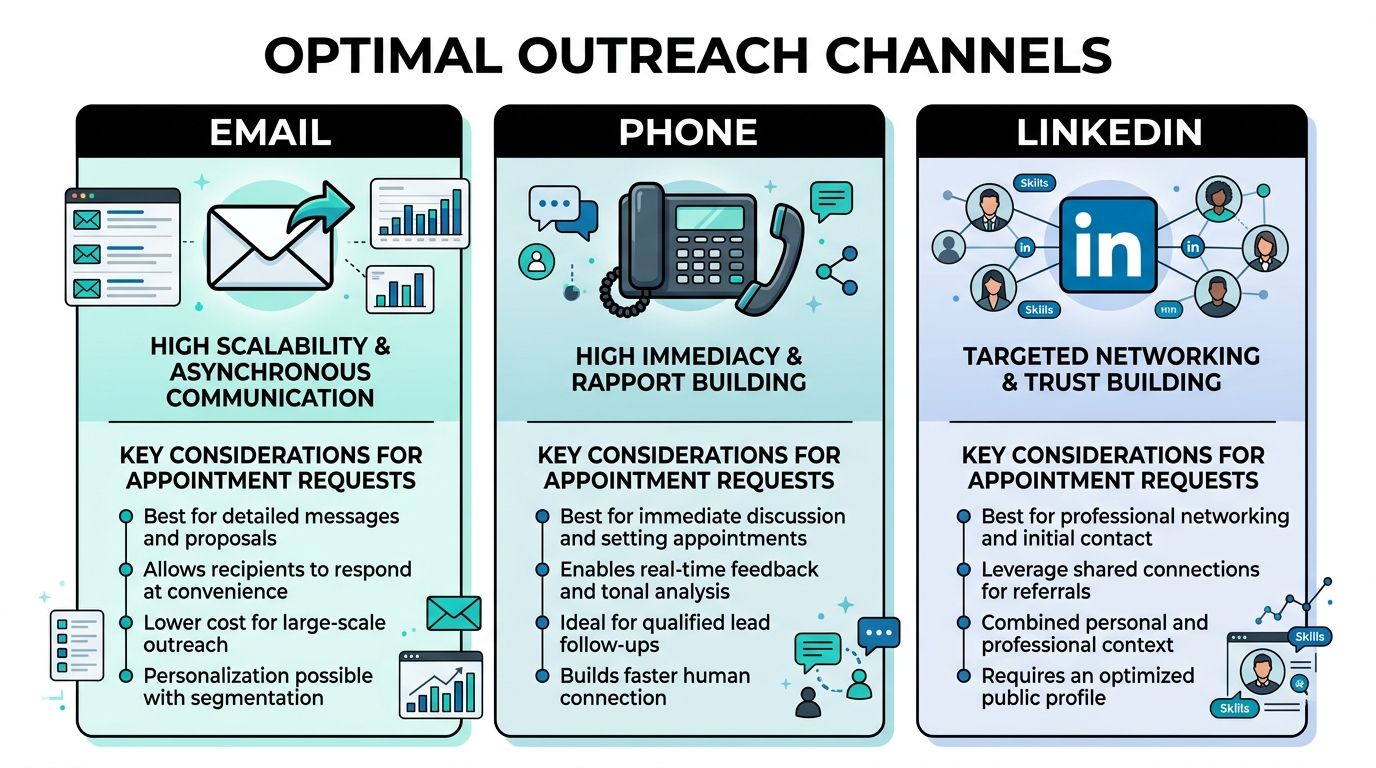
No single channel wins every time. Email, phone, and LinkedIn each do different jobs. Strong reps don't argue about which one is best in the abstract. They pick the one that fits the buying context, then combine channels so each touchpoint helps the next one land.
Email when context matters
Email is best when your request needs setup. It gives you room to frame the problem, show relevance, and make the next step feel easy.
Use email when:
- The offer needs explanation: Complex products and nuanced pain points need context.
- The buyer is senior: Executives often prefer to assess relevance asynchronously.
- You have a strong account insight: A sharp observation reads well in writing.
Email fails when reps write too much, lead with their company, or hide the ask at the bottom. If your message needs three scrolls and still doesn't tell me why we should meet, it's not thoughtful. It's lazy.
Phone when speed matters
Calls still matter because they compress time. A live conversation lets you test positioning, handle objections, and secure a slot before attention drifts.
Phone works best when:
- The problem is easy to state clearly
- The prospect's team works in a fast-moving environment
- You already have enough context to sound credible immediately
The trade-off is obvious. A call exposes weak preparation faster than email does. If the rep hasn't done the research, the prospect hears it in the first ten seconds.
LinkedIn when familiarity helps
LinkedIn is rarely the best place to close the meeting by itself. It is, however, excellent for warming the path.
Use it to:
- Validate role and recent activity
- Create name recognition before a call or email
- Reference shared context such as events, posts, or mutual contacts
What doesn't work is treating LinkedIn like a dumping ground for mini cold emails. If the first line sounds automated, the message will be read like one.
The channel should match how the buyer processes trust. Some buyers want written context. Others want a sharp conversation. Most respond best when they see both.
The channel mix that usually works
The most reliable approach is multi-channel, but not random. Each touch should do one job.
Here's a simple way:
| Channel | Best use | Weakness |
|---|---|---|
| Detailed relevance and clear CTA | Easy to ignore | |
| Phone | Fast qualification and direct booking | Punishes poor prep |
| Familiarity and light warming | Weak as a standalone close |
For most outbound motions, start with an email that carries the core thesis, use LinkedIn to add familiarity, and call when there's enough context to have a real conversation. That sequence respects how buyers respond. They often need recognition before they grant time.
How to Write an Appointment Request That Gets a Yes
Most appointment requests fail because they ask for too much trust too early. The prospect doesn't yet know why this conversation deserves calendar space, so a vague “open to chatting?” lands as work.
Your job is to reduce uncertainty. A strong request tells the prospect why you reached out, why them, why now, and what happens in the meeting. Then it asks for a specific slot.
As noted earlier, the strongest calls to action are specific. A direct scheduling option converts better than a soft, open-ended question. That principle is simple and easy to miss.
The anatomy of a strong request
A useful request usually has five parts:
Relevant opener
Show you know who they are and what they likely care about.Problem framing
Name the issue in operational terms, not marketing fluff.Credible reason to talk
Give them a practical reason a meeting would be worth it.Low-friction ask
Keep the meeting short and clear in purpose.Specific CTA
Offer a concrete time instead of asking them to do all the work.
Here's the difference in practice.
Weak:
Would you be interested in a quick chat sometime next week?
Better:
I think there's a worthwhile conversation around how your team qualifies inbound demos before handoff. Does Thursday at 10 AM work for a short call?
That specificity matters because it reduces decision fatigue. It also signals confidence.
If you want a deeper breakdown of outreach structure, this guide on how to write the best cold email is a solid reference for tightening the ask without sounding stiff.
Cold appointment request example
Cold outreach has one job. Earn enough trust for a reply.
Example
Subject: Quick idea for your SDR workflow
Hi Sarah,
I noticed your team is hiring across sales development and account executive roles. That usually means qualification consistency becomes harder fast.
I'm reaching out because teams in that stage often struggle with one specific issue: reps are active, but meetings don't convert cleanly because context gets lost between first touch and handoff.
If that's relevant on your side, I'd suggest a short conversation focused on where those breakdowns usually happen and what to tighten first.
Does Wednesday at 11 AM work for a brief call?
Best,
[Name]
Why this works:
- It starts with an observable signal.
- It names a plausible operational pain.
- It avoids hype.
- It asks for one clear next step.
Warm inbound follow-up example
Warm leads should not get the same script as cold leads. They already raised a hand. Your request should pick up their context and move quickly.
Example
Subject: Following up on your demo request
Hi Daniel,
Thanks for reaching out. Based on the details you shared, it sounds like your team is evaluating ways to improve lead routing and contact quality before reps engage.
The fastest next step is a short working session so we can look at your current process and see whether there's a fit.
Would Friday at 2 PM work? If that's tight, I'm happy to send a booking link so you can choose a better time.
For teams that want to remove back-and-forth completely, tools that book lessons without back-and-forth emails show the same principle well. Friction kills conversion, whether you're scheduling classes or sales meetings.
Best,
[Name]
The important part here is speed and clarity. Don't force warm prospects through an unnecessary nurture loop if they're already open to a conversation.
Referral-based request example
Referrals are warmer, but they still need structure. Many reps waste referrals by assuming the introduction does all the work.
Example
Subject: Reaching out via Priya
Hi Marcus,
Priya suggested I contact you because your team is reviewing how outbound and inbound qualification fit together. She thought the timing might be relevant.
From what I can tell, you're balancing growth with tighter process control, which usually creates pressure around contact quality, rep focus, and handoff consistency.
I'd be glad to compare notes and keep it practical. Does Tuesday at 9:30 AM work for a brief conversation?
Best,
[Name]
A referral message should still explain why the meeting matters. Name the topic. Name the context. Then make the decision easy.
The Persistent Art of the Follow-Up Cadence
Most reps stop just before the point where meetings get booked.
That isn't opinion. 80% of all B2B appointments are set only after the fifth specific contact with a prospect, yet 92% of salespeople give up before that point, according to Automatic Appointments on follow-up calls in B2B sales.
That one number should change how you think about requesting for appointment. A single touch rarely tells you much beyond whether the timing was perfect. Most of the time, it wasn't.
Why most cadences fail
Bad follow-up usually looks like one of these:
- Repetition without progress: Every email says the same thing in slightly different words.
- No channel variation: The rep sends email after email and never calls.
- No new angle: The prospect gets another nudge but no fresh reason to care.
- Weak final ask: The cadence never confidently asks for time.
Follow-up isn't about reminding people that you exist. It's about making the meeting easier to justify each time you reappear.
A lot of reps avoid persistence because they don't want to seem annoying. That fear is understandable, but it's usually covering for a weaker problem. The message lacks relevance, so the rep knows another touch will feel empty.
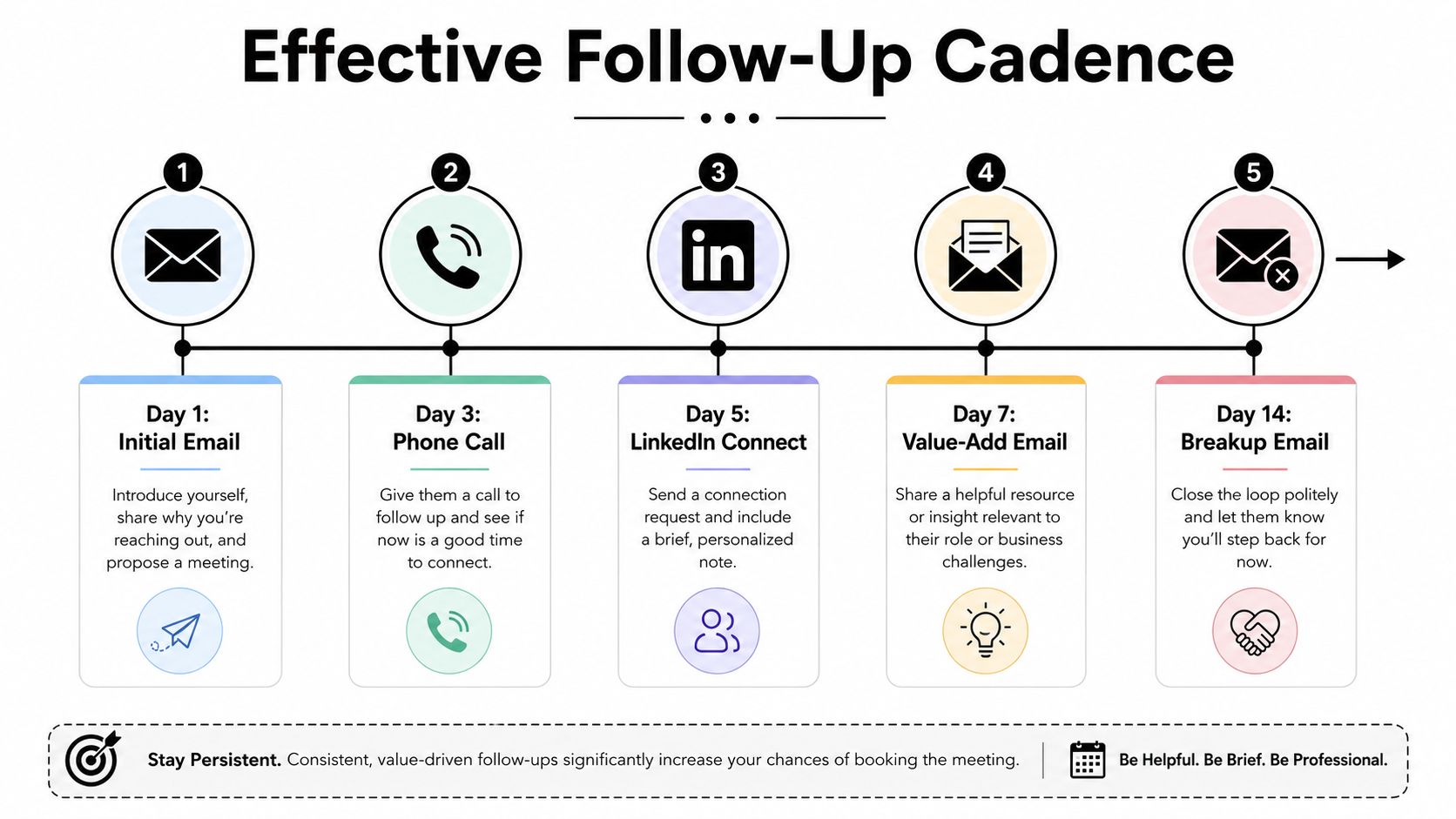
A practical multi-touch sequence
Use a sequence with variety. Here's a simple example:
| Day | Channel | Purpose |
|---|---|---|
| Day 1 | Establish relevance and ask for a meeting | |
| Day 3 | Create familiarity and validate role | |
| Day 5 | Call | Test live interest and handle objections |
| Day 7 | Add a new angle, example, or observation | |
| Day 10 | Call or email | Direct close or respectful breakup |
The embedded walkthrough below is a useful visual primer on cadence pacing and contact sequencing.
This sequence works because each step has a different job. The first email introduces the thesis. LinkedIn makes the name familiar. The call turns passive awareness into an actual conversation. Later touches sharpen the ask instead of just repeating it.
What to change from touch to touch
Don't send “just bubbling this up” five times.
Instead, vary the follow-up:
- Touch two: Clarify why you chose them specifically.
- Touch three: Mention the operational issue you suspect they're dealing with.
- Touch four: Offer a narrower meeting purpose.
- Touch five: Close with a direct choice. Meet now, later, or not at all.
That last point is important. Strong reps don't beg for attention. They make it easy to say yes, but they also make it easy to decline. That honesty often gets more replies than endless nudging.
Turning Objections into Opportunities
A large share of meeting objections are not final decisions. They are requests for proof, clarity, or lower commitment. Good reps treat them that way.
The job is simple. Identify what is missing, answer that specific gap, and give the prospect an easy next step. That works far better than pushing harder or dropping into a canned rebuttal.
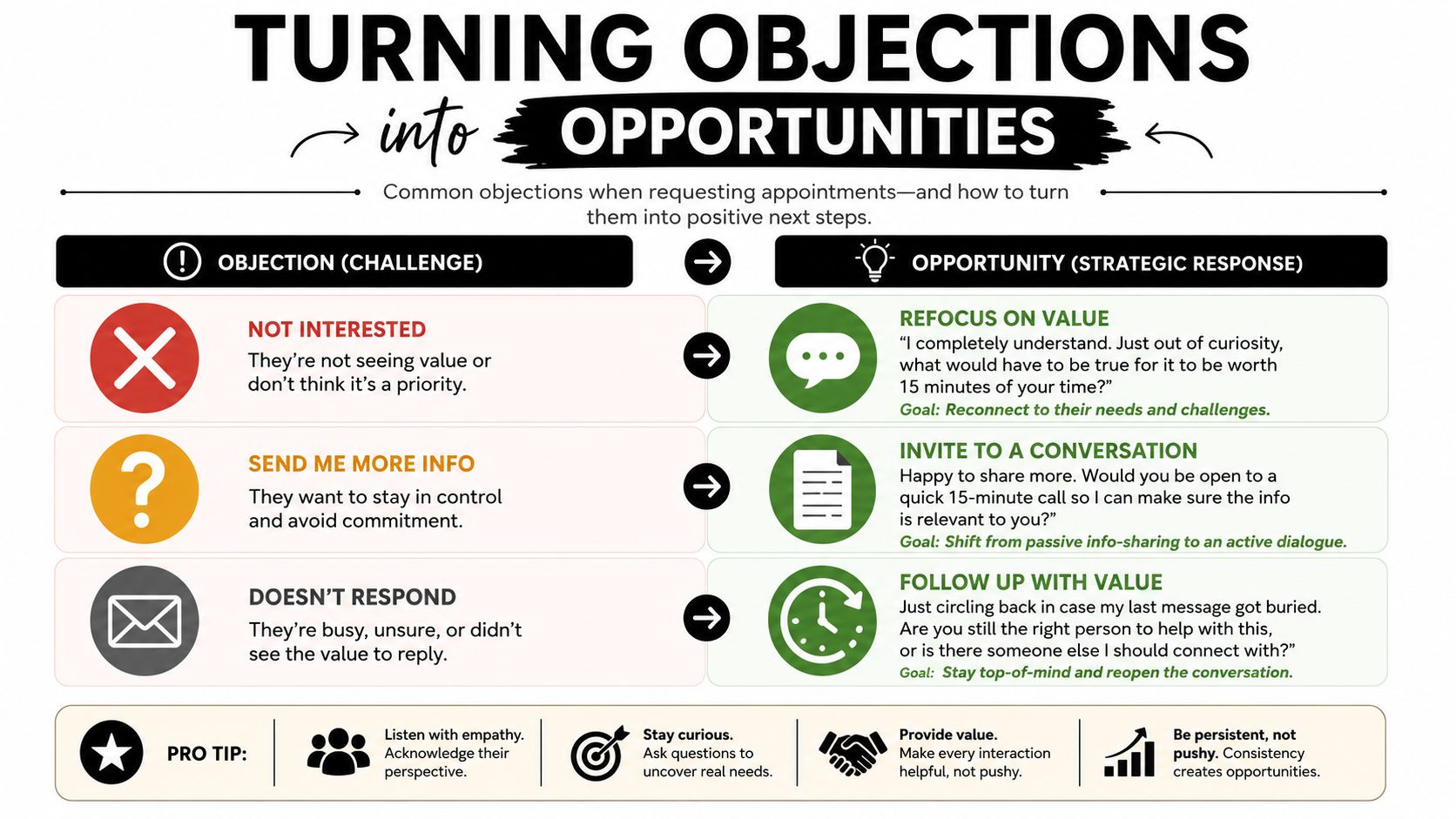
When the prospect says not interested
Start by checking whether the objection is about priority, timing, or fit. Those are different problems, and they need different responses.
Try:
Understood. Is the issue that this is not a priority right now, or that it does not map closely enough to what your team is working on?
That question does two useful things. It lowers pressure, and it gives you information you can use. If timing is the blocker, ask for permission to return with a tighter reason to meet. If fit is the blocker, use the account data you have already enriched. Mention a recent hiring push, territory change, tech stack detail, or handoff gap that makes the request relevant to their world.
When they ask for more information
Treat this as a test. Some prospects want to screen you out. Others want to see whether you understand their situation well enough to earn a conversation.
A stronger reply sounds like this:
Happy to send something. To make it useful, should I tailor it around how your team handles qualification, routing, and handoff today?
Now the prospect has to choose. If they give context, you have a path to a real conversation. If they only want collateral, send a short note, keep it specific, and include one optional next step. Generic PDFs rarely book meetings. A brief summary tied to their role, team structure, or current tools performs better because it shows you did the homework.
This is one place where enrichment matters. If Icypeas helps you confirm the buyer's function, reporting line, location, and company changes before you reply, your "more information" follow-up stops sounding like a brochure request and starts sounding like informed guidance.
When they go quiet after showing intent
Silence after initial interest usually points to friction. The meeting link was easy to ignore. The purpose was too broad. Internal priorities changed. Sometimes they intended to reply and never did.
Handle that by reducing effort. Send a short confirmation with a clear agenda, the meeting link, and the expected outcome. Once a meeting is booked, a strategic reminder cadence helps reduce no-shows, including a 24-hour reminder with an agenda, a 1-hour “See you soon” message, and a 5-minute “Hopping on now” notification, based on Belkins' appointment setting playbook.
Use this checklist:
- Send a useful confirmation: Include the agenda, platform link, and expected outcome.
- Offer a guilt-free reschedule option: Make it easy to move the meeting instead of ghosting it.
- Keep reminders short: Confirm the purpose, not your enthusiasm.
- Make attendance easy: Remove uncertainty about who's joining and what will be discussed.
The best objection handling sounds like useful clarification. It helps the buyer make a smaller, safer decision.
Strong objection handling starts before the objection appears. If your targeting is accurate and your request reflects enriched B2B context, your response feels less like a tactic and more like a helpful next step. That is how cold outreach turns into booked conversations.
Icypeas helps sales and RevOps teams find, verify, and enrich professional contact data so reps can stop guessing and start requesting meetings with real context. If you want cleaner prospect records, stronger personalization inputs, and faster list building, explore Icypeas.























.png)


.webp)