.avif)
10 Best Marketing Data Tools for Growth in 2026

.avif)
Your GTM strategy breaks faster than teams expect when the data underneath it is weak. A campaign goes live with good positioning and polished creative, then execution starts to fail. Emails bounce. Reps hit disconnected numbers. Lead routing sends accounts to the wrong owner. Personalization tokens pull the wrong company name or no company data at all because the record was never verified.
That is not a messaging problem. It is a data operations problem.
I see the same pattern across growth teams. They keep adding tools, but the solution is a modular marketing data stack where each product handles a specific job, and the handoff between tools is deliberate. One tool might enrich a lead, another might verify contact data, another might add intent signals, and your CRM or automation platform should only receive records that pass those checks. That is how teams protect campaign performance and improve ROI without paying for a bloated all-in-one platform.
The market keeps expanding as companies put more budget into analytics, enrichment, and workflow automation. The global marketing analytics and intelligence tool market is projected to reach $34.7 billion in 2026, with 18% year over year growth in analytics tool spending. More options does not automatically produce better data quality.
The practical decision is tool fit. A stack built around specialist products such as Icypeas for enrichment and verification, paired with the right source for prospecting, intent, or CRM activation, usually outperforms a single platform that claims to do everything but underdelivers in the places that matter most. Clean inputs, clear workflow ownership, and realistic trade-offs matter more than feature volume.
Table of Contents
- Understanding the Marketing Data Tool Landscape
- Why Icypeas belongs at the front of the stack
- Best fit and trade-offs
Understanding the Marketing Data Tool Landscape
Organizations don't typically need one giant platform. They need coverage across a few distinct jobs, and they need each tool to hand off cleanly to the next one. That's the difference between a modular stack that performs well and an expensive subscription bundle that creates new cleanup work.
The core categories are straightforward:
- Lead databases: Tools for finding net-new contacts and companies by industry, title, geography, size, and other filters.
- Data enrichment and verification: Tools that append missing fields and validate emails before outreach or CRM sync.
- Intent data providers: Platforms that help identify which accounts are actively researching a category.
- CRM enrichment and hygiene: Products that standardize, update, deduplicate, and maintain records after they enter your system.
- All-in-one platforms: Suites that combine several of these functions, usually with trade-offs in accuracy, flexibility, or cost.
The part many lists miss is source quality. A lot of articles focus on dashboards and reporting tools while skipping the quality of the contact data flowing into them. That's a real gap because 60% of digital marketing data suffers from accuracy issues due to unverified contact sources. If the upstream record is wrong, your attribution, lead scoring, routing, and outreach metrics all get distorted.
Practical rule: Verify and enrich before you analyze. Cleaning records after they hit your CRM is slower, more expensive, and usually incomplete.
1. Icypeas
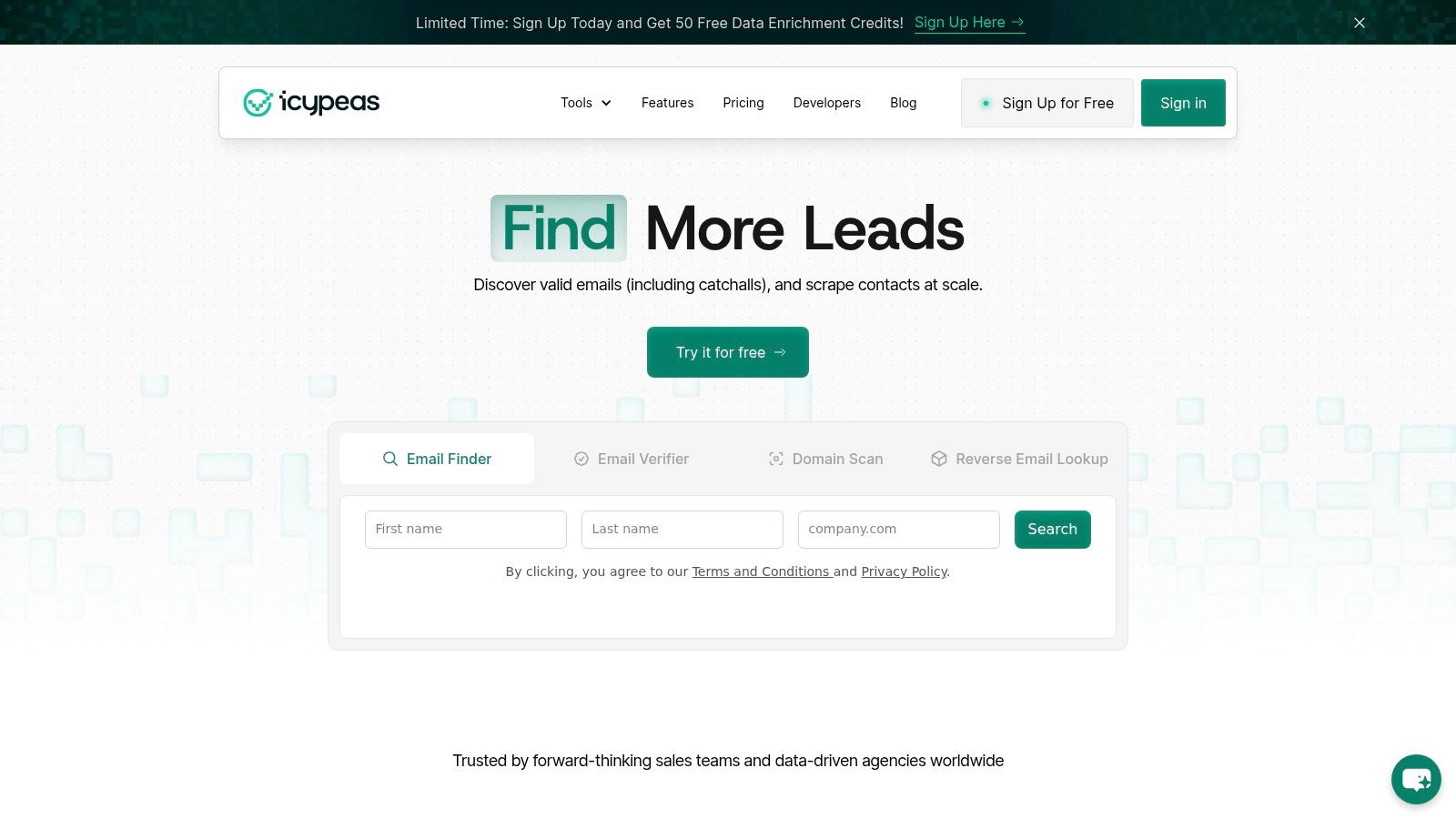
Icypeas is the specialist I'd put closest to the top of a modern marketing data stack. It doesn't try to be your CRM, your sequencer, your dialer, and your intent platform at the same time. It focuses on what usually breaks first in outbound and inbound data workflows: finding professional contact data, verifying it strictly, and enriching records so the rest of the stack works better.
That matters because bad source data compounds fast. If you feed weak records into your CRM, marketing automation, and reporting layers, every system inherits the problem. Icypeas is built to stop that at ingestion.
Why Icypeas belongs at the front of the stack
Icypeas combines an Email Finder, Email Verifier, Reverse Email Lookup, Domain Scan, and People Scraper. For teams that run outbound at scale or enrich inbound sign-ups in real time, that mix is practical. You can find a work email, verify whether it's safe to send to, resolve an existing email into a fuller profile, and add title or company context for routing and personalization.
The database footprint is one of the strongest reasons to use it. Icypeas provides access to 575M people profiles and 62M company profiles, refreshed monthly. That monthly refresh cadence also fits a broader compliance and freshness conversation that too many teams ignore. In a market where 72% of B2B marketers face data decay within 45 days, cached multi-source data updated monthly maintains 95% accuracy and supports ISO 27001 security, a cached public-source model can be a better operating choice than aggressive live scraping.
Cached public-source data is often the more practical answer when your team cares about both accuracy and compliance.
Icypeas also stands out for strict verification, especially around catchall mailboxes on Google and Microsoft environments. That's the kind of detail operators care about because sender reputation gets damaged by edge cases, not just obvious invalid addresses. Add the API, flexible credits that don't expire, and compliance posture around open-source intelligence, GDPR, and CCPA, and you get a specialist tool that slots well into both sales-led and developer-led workflows.
Best fit and trade-offs
Icypeas is best when you need precision at the front of the stack. That includes list cleaning before a campaign, CRM enrichment jobs, inbound lead qualification, and API-driven product workflows.
The trade-off is simple. It's not an all-in-one GTM suite. You'll likely pair it with a lead database, CRM, sequencer, and possibly intent data.
- Best for: Teams that care about deliverability, accurate enrichment, and modular workflows
- Watch out for: Very recent role changes may lag because the model uses cached public-source data rather than live LinkedIn scraping
- Website: Icypeas
2. HubSpot Clearbit
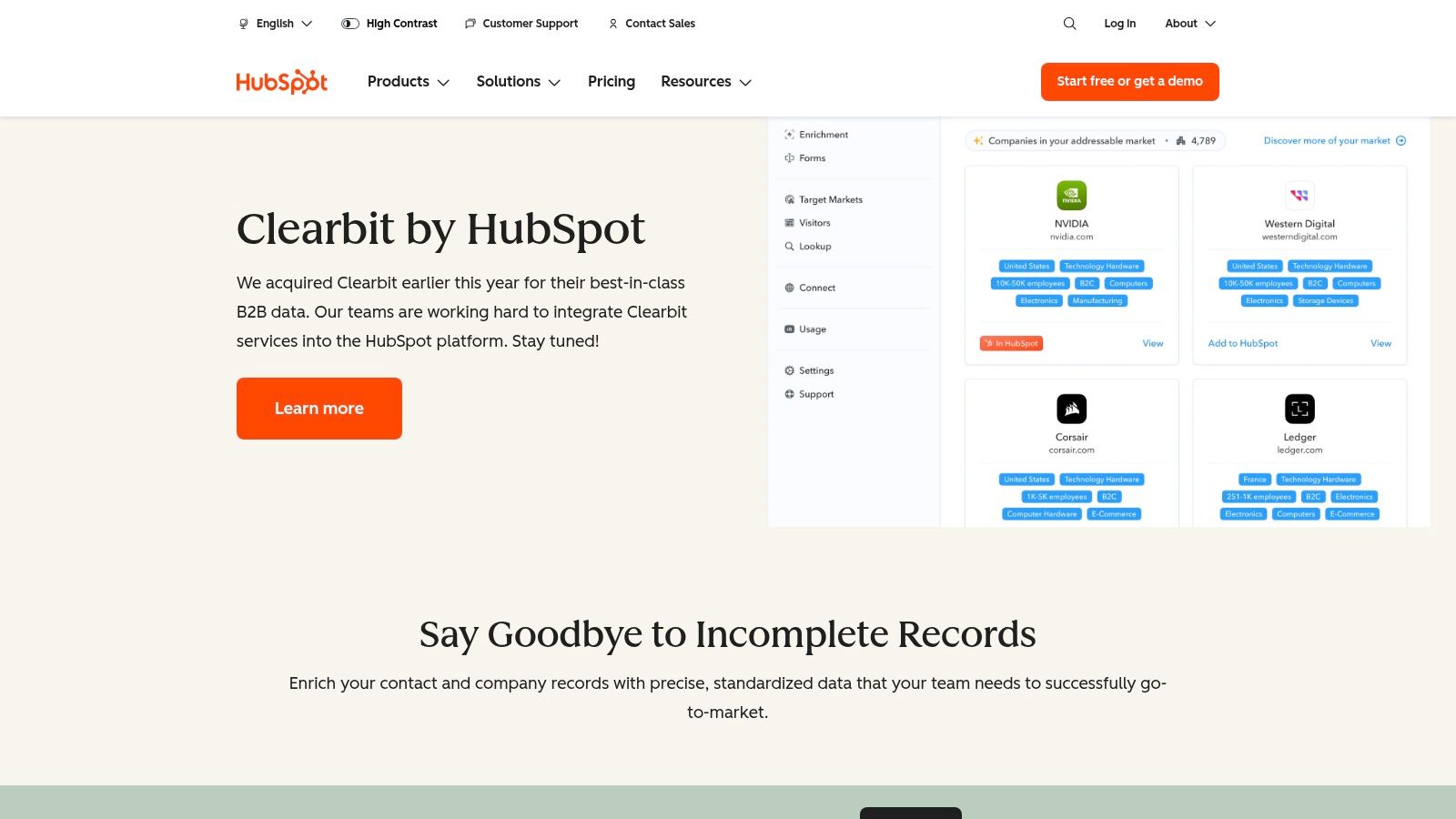
HubSpot Clearbit makes the most sense when HubSpot is already your operational center. In that setup, its value isn't just enrichment. It's the fact that enrichment, website visitor identification, scoring, routing, and activation can all happen inside the same environment without constant middleware work.
That native alignment changes the buying decision. If your forms, CRM, automation, and reporting already live in HubSpot, Clearbit can reduce friction more than a technically stronger standalone provider that creates sync overhead.
Where it works best
Clearbit is strongest on firmographic and technographic enrichment, plus IP-based website visitor identification. It helps fill company and contact fields, standardize records, and trigger workflows based on what HubSpot already knows. For marketing ops teams, that usually means faster segmentation, cleaner lead routing, and better account-level context for ABM motions.
The downside is lock-in. Outside a HubSpot-centric stack, the appeal drops quickly. You're paying for native convenience, not just data quality.
If you're comparing enrichment vendors specifically, it helps to review how specialist tools differ from embedded enrichment layers. This roundup of B2B data enrichment tools is a useful reference point for that decision.
- Best for: HubSpot-first marketing and RevOps teams
- Less ideal for: Teams using Salesforce, custom data pipelines, or multiple MAP and CRM systems
- Website: HubSpot Clearbit
3. ZoomInfo SalesOS
ZoomInfo SalesOS is what many larger organizations buy when they want breadth, procurement support, and an enterprise vendor that can cover multiple departments. It's a broad GTM platform with contact data, company data, workflows, and add-on modules for adjacent use cases.
That breadth is useful, but it changes the evaluation criteria. You're not just choosing data quality. You're choosing packaging, contract structure, admin complexity, and how much of your stack you want under one commercial relationship.
What you're really buying
SalesOS is often strongest for teams that need large-scale account and contact discovery, especially in US-heavy outbound motions. It also appeals to operations teams that want mature integrations and one vendor with multiple modules for sales, marketing, and operations.
The trade-off is that these broad platforms can encourage over-reliance on a single source. In practice, many teams still need specialist verification and enrichment to improve accuracy before records hit outreach systems. If you're weighing broad platforms against narrower alternatives, this list of ZoomInfo competitors helps frame where specialists can outperform suites.
For teams considering external collection methods, it's also worth reviewing the practical limits of using web scraping for lead enrichment. Scraping can help in narrow workflows, but it rarely replaces a maintained data stack with verification and governance.
- Best for: Enterprise teams that want broad coverage and mature integrations
- Main drawback: Opaque pricing and more complex procurement than self-serve tools
- Website: ZoomInfo
4. Apollo.io
Apollo.io is the tool I see most often in SMB and mid-market stacks that need to move quickly without buying five separate products on day one. It combines a large prospecting database with enrichment, sequencing, dialing, and AI-assisted workflow support.
That combination is the appeal. Apollo lowers the operational burden of stitching together a database, basic enrichment layer, and engagement platform when the team is still small.
Why SMB teams like it
Apollo is practical because the value proposition is obvious. One subscription can cover list building, contact lookup, sequence execution, and lightweight CRM syncing. That's often good enough for teams that care more about speed and cost control than absolute specialization.
There are still trade-offs. Once a team's outbound volume grows, the weaknesses of all-in-one systems show up faster. Data quality can vary by segment, and heavy dialing motions can make credit consumption less predictable than it looks at first glance.
If your team is still proving outbound, Apollo can replace multiple tools. Once you're scaling, pair it with a stricter verifier rather than trusting every contact record by default.
Apollo works best as the top-of-funnel sourcing layer in a modular stack. Pull target accounts and contacts there, then pass the records through a specialist verifier before reps start sending.
- Best for: Startups and mid-market teams that want one platform for sourcing and engagement
- Less ideal for: Teams with strict deliverability standards or complex RevOps governance
- Website: Apollo.io
5. Lusha
Lusha stays popular because it's easy to understand. Reps can start quickly, use the browser extension, pull direct contact details, and build lists without much training. That simplicity matters more than people admit, especially for frontline teams that won't tolerate a complicated sourcing process.
It's not the deepest platform in this category, but that isn't always the point. Lusha is often a speed tool, not a stack anchor.
Best use case
Lusha fits teams that need lightweight prospecting and quick lookups. SDRs can use it directly from browser workflows, and smaller teams can test data acquisition without negotiating an enterprise contract first.
The limitation is cost efficiency for phone-heavy teams. Once your motion depends heavily on calling, credit burn becomes more noticeable. For many orgs, Lusha works better as a tactical rep tool than as the main system for enrichment and verification.
If you're comparing it with specialist alternatives, this page on the Icypeas alternative to Lusha is useful because it highlights the difference between quick access tools and stricter data verification workflows.
- Best for: SDR teams that want fast list building with minimal setup
- Main drawback: Less attractive for large-scale calling motions and deeper enrichment workflows
- Website: Lusha
6. People Data Labs PDL
People Data Labs is a different kind of buy. It's not built primarily for reps clicking around a browser extension. It's built for teams that want person, company, and IP data delivered through APIs and data products they can embed into applications and internal workflows.
That makes it especially relevant for product teams, RevOps, and technical founders who want control over how enrichment happens.
Builder-first strength
PDL is useful when you need programmatic enrichment, identity resolution, or custom matching logic inside your own systems. If you want to enrich inbound sign-ups, score product users, or build internal prospecting utilities, PDL is easier to reason about than a sales-led platform with hidden packaging.
The challenge is operational discipline. Developer-first pricing models are flexible, but they can become expensive if no one monitors usage carefully. Teams that buy PDL without a clear enrichment logic often spend time building pipelines they could have solved faster with a more opinionated tool.
A practical pattern is to use PDL when the workflow is the product. If the workflow is just outbound list prep, a simpler operator-facing stack usually wins.
- Best for: Builders, RevOps engineers, and SaaS teams embedding enrichment into apps
- Watch out for: Cost planning and over-engineering
- Website: People Data Labs
7. Cognism
Cognism earns its place on this list because it approaches the category from a compliance-first angle. That's especially relevant for teams operating in Europe, where outreach rules, data sourcing questions, and phone coverage quality matter a lot more than generic “more contacts” positioning.
If your outbound team works across EMEA, Cognism usually shows up early in the shortlist.
Why compliance-focused teams shortlist it
Its strongest differentiator is the combination of sales intelligence with compliance workflows and phone-focused data. The Diamond Data positioning around human-verified mobile numbers is particularly relevant for teams that still rely on calling as a serious channel.
That doesn't make Cognism the universal answer. US-centric teams looking for the broadest possible database may prefer other providers, and the custom pricing model means it's less convenient for smaller companies that want to test before involving procurement.
Still, compliance posture isn't a side issue anymore. Adoption of AI and data tools has accelerated, with 87% of marketers using Generative AI in at least one recurring workflow and 88% reporting daily AI tool use. As more workflows depend on automated data handling, compliance and source governance become more important, not less.
- Best for: EMEA outbound teams and compliance-conscious operators
- Main drawback: Quote-based buying process and less appeal for self-serve teams
- Website: Cognism
8. SalesIntel
SalesIntel is a strong option for teams that want more assurance around contact freshness and don't mind a more managed buying process. Its positioning blends AI with ongoing human verification, which appeals to operators who've already been burned by stale records inside fully automated platforms.
This is the kind of tool RevOps teams often appreciate more than individual reps do. The value shows up in hygiene, not just in list size.
Where the human verification angle matters
SalesIntel combines contact and company data with enrichment workflows and buying signals. That makes it useful when you want one system that supports both discovery and ongoing record maintenance. It's also relevant for teams that care about enrichment cadence and scheduled refresh jobs, not just one-time prospecting exports.
The friction is predictable. Pricing isn't public, and some of the deeper functionality requires a sales process and onboarding. That's acceptable for mature teams, but less attractive for companies still experimenting with their stack.
Human verification matters most when your CRM is already polluted. If you're still early, prevention usually beats cleanup.
- Best for: RevOps-led teams focused on ongoing data hygiene
- Main drawback: Less transparent buying experience than self-serve alternatives
- Website: SalesIntel
9. UpLead
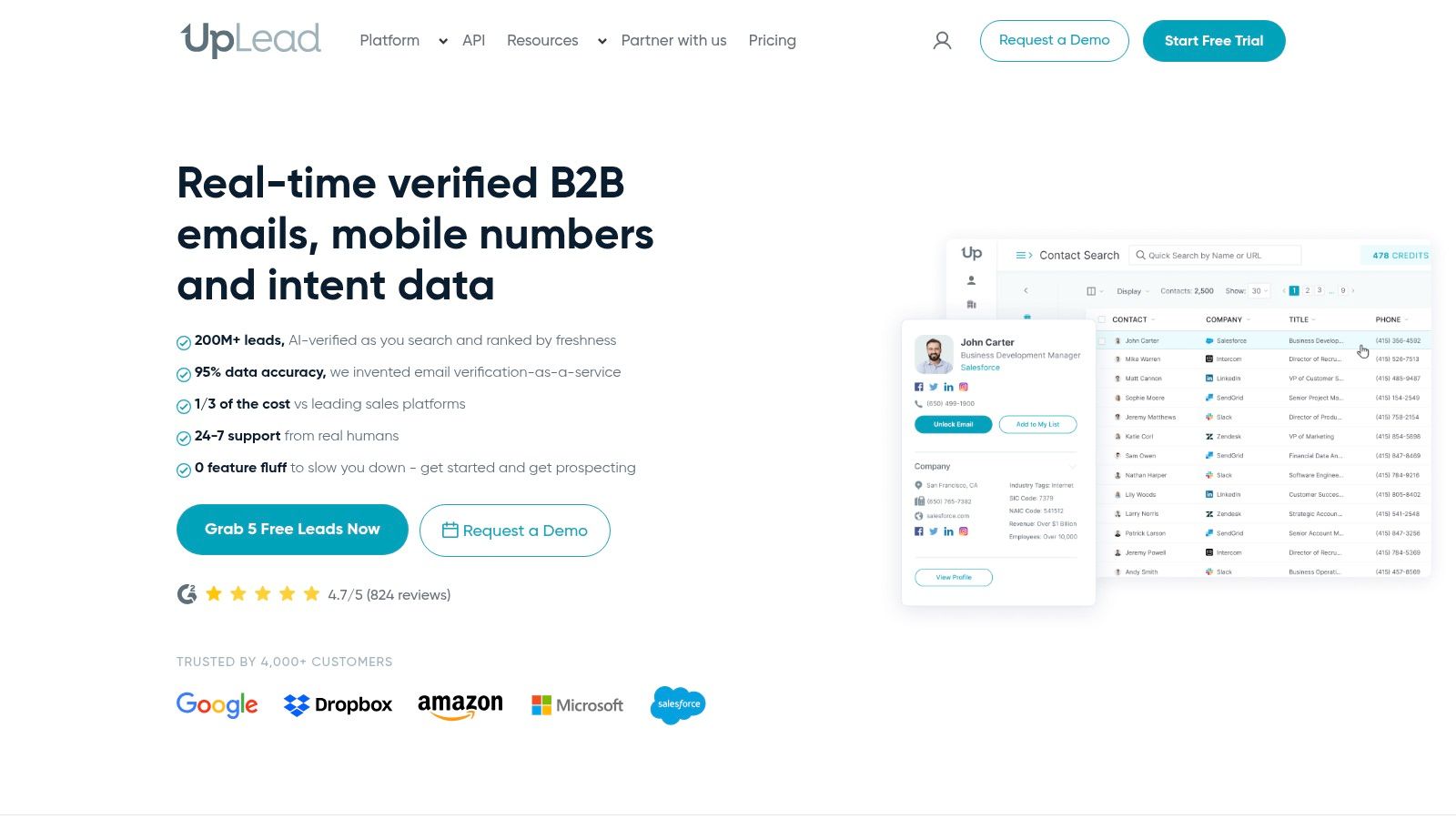
UpLead is one of the cleaner choices for teams that want a straightforward prospecting and enrichment platform without enterprise sprawl. It doesn't try to overwhelm buyers with adjacent modules. The pitch is simpler: usable B2B contact data, real-time email verification, and predictable credit-based access.
That simplicity is a strength when your team values clean records over feature expansion.
Clean data over platform sprawl
UpLead tends to fit SMB and mid-market teams that want self-serve access, decent API support, CSV enrichment, and a pricing model they can understand without a lengthy sales cycle. For ops teams, the attraction is predictability. You can model usage more easily than on platforms where every workflow seems to consume a different bucket of credits.
The limitation is coverage depth compared with some enterprise incumbents, especially if your motion depends heavily on broad phone data across many segments. For many teams, that's a reasonable trade-off. Better to work with a smaller set of cleaner records than flood the CRM with questionable ones.
- Best for: SMB and mid-market teams that want predictable prospecting and enrichment
- Main drawback: Less breadth than some larger enterprise databases
- Website: UpLead
10. Bombora Company Surge intent data
Bombora isn't a replacement for contact data tools. It's a prioritization layer. That distinction matters because teams often buy intent and then expect it to solve sourcing, enrichment, and activation by itself.
It won't. Intent tells you where attention may be building. You still need clean contacts, routing rules, and an activation plan.
Intent is a prioritization layer, not a contact database
Bombora's Company Surge is widely used because it integrates well into ABM and advertising workflows. It can help marketing and sales teams focus on accounts showing relevant research behavior, especially when the list of possible targets is already too large to work manually.
The common mistake is treating intent topics as self-explanatory. They aren't. Topic selection, score thresholds, timing, and follow-up rules all need tuning. Without that, intent becomes another noisy feed.
Bombora works best when it sits on top of a clean base. Use a lead database to define the account universe, apply intent to prioritize, then enrich and verify the specific contacts before activation.
- Best for: ABM teams prioritizing in-market accounts
- Main drawback: Requires orchestration with other tools to become useful
- Website: Bombora
Top 10 Marketing Data Tools: Features & Data Quality
| Product | Core features | Quality & deliverability (★) | Value & pricing (💰) | Target audience (👥) | Unique selling point (✨) |
|---|---|---|---|---|---|
| Icypeas 🏆 | Email Finder, strict Email Verifier (Google/MS catchall), Reverse Lookup, People Scraper, 575M ppl / 62M companies | ★★★★★ low-bounce, catchall checks, 99.9% uptime | 💰 Credit-based PAYG, credits never expire, often 3–10x cheaper | 👥 Sales/Marketing/Product, Devs, RevOps (SMB→Enterprise) | ✨ Strictest verifier (catchall), monthly-refreshes, ISO27001 & GDPR/CCPA |
| HubSpot Clearbit | 100+ company/contact attrs, IP visitor ID, native HubSpot activation | ★★★★ strong enrichment inside HubSpot | 💰 Best value if on HubSpot; pricing tied to HubSpot | 👥 HubSpot-centric marketing & ABM teams | ✨ Native HubSpot workflows & visitor intent |
| ZoomInfo SalesOS | Large contacts & dials, firmographics, modular OS add-ons | ★★★★ broad US coverage & integrations | 💰 Enterprise/quote pricing; multi-seat contracts | 👥 Large enterprises, US outbound teams | ✨ Deep ecosystem, modular Sales/Marketing/Ops OS |
| Apollo.io | Contact DB + enrichment, sequencer, dialer, AI assistant | ★★★★ good deliverability for SMBs | 💰 Published tiers + free plan; cost-effective for SMBs | 👥 SMB / mid-market SDRs & growth teams | ✨ All-in-one prospecting + engagement stack |
| Lusha | Contact/enrichment, Chrome extension, simple credit model | ★★★ quick lookups, variable phone accuracy | 💰 Free tier + monthly credits; per-phone cost higher | 👥 SDRs & frontline reps needing fast lists | ✨ Browser extension + easy credit rules |
| People Data Labs (PDL) | Person/Company/IP enrichment APIs, search, data licenses | ★★★★ transparent API quality, dev-focused | 💰 Usage-based with clear tiers & free testing | 👥 Developers, product teams, RevOps | ✨ Developer-first APIs & licensing options |
| Cognism | Phone-verified mobile numbers (Diamond), GDPR ops, intent | ★★★★ strong callable mobile accuracy (EMEA) | 💰 Quote-based enterprise pricing | 👥 EMEA outbound teams & compliance-sensitive orgs | ✨ Human-verified mobile numbers + compliance workflows |
| SalesIntel | Human-verified contacts, 90-day re-verification, signals | ★★★★ human-in-loop reduces stale data | 💰 Custom pricing; sales-led contracts | 👥 RevOps, teams needing verified contacts & signals | ✨ 90-day re-verification + behavioral signals |
| UpLead | People & company enrichment, real-time email verify, API | ★★★★ 95% accuracy guarantee, real-time checks | 💰 Published per-credit pricing; predictable costs | 👥 SMB / mid-market data-focused teams & developers | ✨ 95% accuracy guarantee & pay-for-results model |
| Bombora (Company Surge) | Company Surge intent signals from data co-op, integrations | ★★★★ proven intent signals for ABM | 💰 Non-public pricing; best paired with contact data | 👥 Marketing, ABM & demand gen teams | ✨ Large publisher co-op delivering Company Surge intent |
From Tools to Strategy Building Your Data Stack
Monday morning, the team pulls three versions of the same prospect from three different tools. One record has the right company. Another has the right title. The third has an email that bounces. That is not a sourcing problem alone. It is a stack design problem.
The practical fix is to assign a clear job to each layer. Use one tool for discovery, one for verification and enrichment, one CRM as the source of truth, and one reporting layer that reads from cleaned data instead of raw imports. Teams that skip this design step usually pay for duplicate coverage, argue over which record is correct, and send campaigns against data they do not trust.
A modern stack works better when it is modular. ZoomInfo, Apollo, Lusha, UpLead, or SalesIntel can handle list building, depending on your market and budget. Icypeas fits later in the flow, where records need to be checked, corrected, enriched, or rejected before they hit the CRM or sequencer. HubSpot Clearbit can support inbound routing and firmographic context inside the CRM. Bombora belongs on top of a working foundation, not underneath it, because intent data only helps if the account, contact, and routing logic are already clean.
That order matters.
Teams often start with the most expensive platform and expect broad coverage to solve accuracy. In practice, all-in-one systems trade depth in one area for convenience in another. A vendor may be strong for account discovery but weaker on callable numbers, weaker on verification, or too rigid for product-led enrichment workflows. The opposite mistake is buying five specialist tools without defining handoffs, ownership, or deduplication rules. Then every sync creates another version of the same contact.
The better approach is opinionated and boring in the right places. Pick a primary prospecting source. Define verification rules before records can move downstream. Set field-level ownership in the CRM. Decide which tool is allowed to overwrite title, company, phone, or lifecycle fields. If no one can answer those questions, the stack is still a collection of subscriptions, not a data system.
This matters more as the market gets more crowded, not less. As noted earlier, the martech category keeps expanding. More choice is useful, but it also increases the cost of poor tool fit. The highest-ROI stacks usually are not the biggest. They are the ones where each tool has a narrow role, the data moves in a predictable order, and verification happens before outreach, scoring, and reporting.
Putting It All Together Sample Data Workflows
Here's a practical way to combine these marketing data tools without overcomplicating the stack.
- High-precision outbound prospecting: Build your target account list in Apollo.io or ZoomInfo SalesOS. Pull the contacts you want, then run them through Icypeas before any sequence starts. Verify deliverability, enrich titles and company details, push only approved records into your CRM, then sync to your sequencer. This keeps bad records from contaminating outreach metrics and sender reputation.
- Automated inbound lead enrichment: A new demo request or signup triggers a webhook. Icypeas Reverse Email Lookup resolves the work email into a fuller professional profile, then HubSpot Clearbit or your CRM automation layer uses those fields for routing, scoring, and segmentation. Sales gets context immediately instead of waiting for manual research.
- Intent-led account prioritization: Start with Bombora to identify accounts showing relevant research activity. Match those accounts against your ICP in HubSpot or your CRM, source the right contacts with Apollo or ZoomInfo, then verify and enrich with Icypeas before outreach begins.
- Product-led enrichment workflow: Use People Data Labs when enrichment needs to live inside your app or backend workflow. If the record is going to sales outreach after product qualification, add Icypeas as the verification checkpoint before it reaches the outbound queue.
Clean records should move forward automatically. Uncertain records should pause for review. Bad records should never enter the CRM.
How to Choose the Right Tools An Evaluation Checklist
Selection gets easier when you stop asking which tool is best overall and start asking which tool is best for each layer.
- Data accuracy and freshness: Check how the vendor handles refresh cycles, verification, and stale records. If the platform can't explain its data sourcing and hygiene logic clearly, expect cleanup work later.
- Coverage and compliance: Match the tool to your operating region. US-heavy teams and EMEA-heavy teams often need different strengths. If compliance risk is a board-level issue for your company, give that more weight than raw database size.
- Integration model: Native CRM and MAP integrations matter, but API quality matters too. Many of the best workflows involve routing records between specialist tools rather than staying in one interface.
- Pricing logic: Seat-based, credit-based, and custom enterprise pricing each create different behaviors. The important question isn't what looks cheapest on a pricing page. It's whether usage stays predictable once the workflow scales.
- Role fit: Some tools are built for reps, some for RevOps, some for developers. A technically strong tool still fails if the people using it every day don't adopt it.
One more filter helps. Ask where your current process breaks first. If the answer is bounced emails, bad lead routing, or dirty CRM data, start with verification and enrichment. If the answer is account prioritization, add intent later. Don't buy an advanced analysis layer before the source records are trustworthy.
Conclusion Build a Data Foundation for Smarter Growth
The best marketing data tools in 2026 don't win because they promise everything. They win because they solve a specific part of the stack well and connect cleanly with the rest of your systems.
That's why modular stacks usually outperform all-in-one buying logic over time. A broad platform can still play a useful role. Apollo.io can be a strong sourcing and engagement layer for smaller teams. HubSpot Clearbit can be the right answer when HubSpot already runs your GTM operations. ZoomInfo, Cognism, SalesIntel, UpLead, People Data Labs, and Bombora all have clear use cases. But none of them should be evaluated in isolation from the workflow they'll sit inside.
The practical stack pattern is simple. Start with a lead source that matches your market and team size. Add a specialist verification and enrichment layer to protect deliverability and improve routing. Use your CRM as the system of record. Add intent where account prioritization needs more signal. Then build reporting and analysis on top of that cleaner foundation.
This matters even more as teams increase their use of AI and automation. The more workflows you automate, the faster bad records spread. That's why I'd rather see a company invest early in cleaner source data than spend later trying to explain weak attribution, broken personalization, and poor outbound performance. If you're exploring adjacent analysis workflows too, this guide to top AI data analysis tools for 2026 is a useful complement once your upstream data is under control.
Start by auditing what's entering your CRM today. Check how many records are incomplete, how many should never have been contacted, and how many downstream workflows depend on fields that are often wrong. Then build from the front of the stack outward. In most cases, the most impactful improvement isn't another dashboard. It's stopping inaccurate contact data before it spreads.
If you want a practical place to start, use Icypeas as the verification and enrichment layer in your marketing data stack. It's one of the cleanest ways to improve deliverability, enrich inbound and outbound records, and keep bad data from polluting the rest of your GTM systems.




















































.png)


.webp)