.avif)
What Is Competitive Intelligence: 2026 Guide for Business

.avif)
Competitive intelligence is the ethical process of turning public information into a strategic business advantage, and 90% of Fortune 500 companies use it. If your team keeps getting surprised by competitor pricing changes, launches, or hiring moves, what you're missing isn't more data. It's a way to turn signals into decisions.
A familiar pattern plays out in B2B teams every quarter. Sales loses a deal and hears, too late, that a competitor changed packaging, offered a new pricing model, or staffed a specialist team for the account. Marketing launches a campaign, then watches a rival dominate the conversation with sharper positioning and better timing. Product builds based on customer requests, only to find that another vendor reframed the category first.
That isn't bad luck. It's a visibility problem.
Companies often already collect fragments of competitive information. Reps hear objections on calls. Marketers track competitor pages. Product managers read reviews and launch notes. The issue is that these inputs stay scattered. Nobody turns them into a shared operating picture.
That's where competitive intelligence matters. Done well, it isn't a heavyweight corporate ritual reserved for strategy teams. It's a repeatable discipline that helps operators make better choices before the market forces their hand.
Table of Contents
- Sales teams need signals they can act on today
- Marketing teams need positioning context
- Product teams need pattern recognition not feature envy
Introduction The High Cost of Flying Blind
A sales leader reviews a lost enterprise deal and hears the same line again: “Your competitor seemed more prepared for our rollout.” The rep had a solid relationship. The demo was strong. Procurement didn't kill the deal. The rival showed up with better context, knew which capability mattered, and anticipated objections before they surfaced.
Marketing teams face the same problem in a different form. They build a campaign around one message, then a competitor launches a sharper narrative that makes their work look generic overnight. Product teams feel it when buyers start asking for features that weren't on the roadmap last month, because another vendor changed expectations in the market.
These misses rarely happen because teams are lazy or uninformed. They happen because information sits in silos until it becomes useless.
Competitive intelligence gives teams a way to stop reacting late. It means collecting public signals, analyzing what they mean, and using that understanding to guide decisions in sales, marketing, product, and leadership. It turns “we heard something on a call” into “we know how to respond.”
That discipline isn't fringe. 90% of Fortune 500 companies currently use competitive intelligence to gain a strategic competitive advantage, according to competitive intelligence statistics compiled by Evalueserve. That tells you something important. The biggest companies in the world don't treat CI as a nice-to-have research habit. They treat it as standard operating infrastructure.
The real cost isn't missing information
Teams usually don't fail because data is unavailable. They fail because nobody defined what to watch, who owns it, or how it gets used.
A few common symptoms show up fast:
- Sales works from memory: Reps rely on old battlecards, scattered Slack notes, and half-remembered objections.
- Marketing watches outputs only: Teams see campaigns and launches, but miss the strategic shift behind them.
- Product responds superficially: PMs chase competitor features without understanding why buyers care.
Practical rule: If your team only notices a competitor move after it affects pipeline, pricing pressure, or roadmap debates, you don't have competitive intelligence yet. You have delayed awareness.
Why this matters to growth teams
For a growth team, flying blind creates operational drag. Outreach gets less relevant. Positioning gets softer. Roadmaps get noisier. Teams debate opinions instead of comparing evidence.
The point of CI isn't to obsess over rivals. It's to reduce uncertainty where decisions are expensive. Done properly, it helps a rep prepare for a call, a marketer sharpen a message, and a product leader see where the market is moving.
Defining Competitive Intelligence Beyond the Buzzwords
A good way to think about what is competitive intelligence is this: it's the business version of studying game film. A strong team doesn't just watch highlights. It studies formations, substitutions, tendencies, and weak spots. Then it changes how it plays.
Competitive intelligence works the same way. You gather public information about competitors, customers, and the market. Then you analyze it until it becomes useful enough to change a decision.
What intelligence actually means
Raw data isn't intelligence. A pricing page update is data. A new VP hire is data. A cluster of job posts is data.
It becomes intelligence when someone connects the dots. For example:
- A pricing page changes: That may suggest a packaging shift aimed at mid-market buyers.
- New implementation roles appear: That may signal expansion into more complex accounts.
- A webinar theme changes: That may reflect a new positioning strategy or target segment.
This is why casual monitoring isn't enough. If all you do is browse competitor sites or skim LinkedIn, you'll collect activity without learning much from it. Teams that want a sharper framework for this kind of analysis can also gain competitor insights for X growth through examples that connect monitoring to action.
Later in the buying process, this distinction matters a lot. Sales doesn't need a folder of screenshots. It needs an answer to “How should I position against this competitor in this deal?”
A short explainer helps illustrate the shift from observation to action:
What competitive intelligence is not
CI gets misunderstood in two predictable ways.
First, some people hear the term and think of corporate espionage. That's wrong. Ethical CI uses public, legally accessible information. It doesn't involve private systems, deception, or stolen materials.
Second, teams often mistake collection for intelligence. Monitoring competitor blogs, newsletters, job boards, or review sites is useful. But without interpretation, it's just a pile of inputs.
Competitive intelligence starts with observation, but it earns its value in analysis and application.
Here's the simplest test:
| Activity | What it is |
|---|---|
| Saving competitor screenshots | Collection |
| Logging launch dates and messaging shifts | Organized information |
| Explaining how those shifts change your pitch, campaign, or roadmap | Intelligence |
If your team wants to answer the question “what is competitive intelligence” in plain terms, that's the cleanest answer: public signals, interpreted well enough to drive better decisions.
Strategic vs Tactical CI Understanding the Difference
A lot of confusion comes from treating competitive intelligence as one thing. It isn't. Organizations frequently require two different modes of CI, and these serve different people.
Two time horizons two operating styles
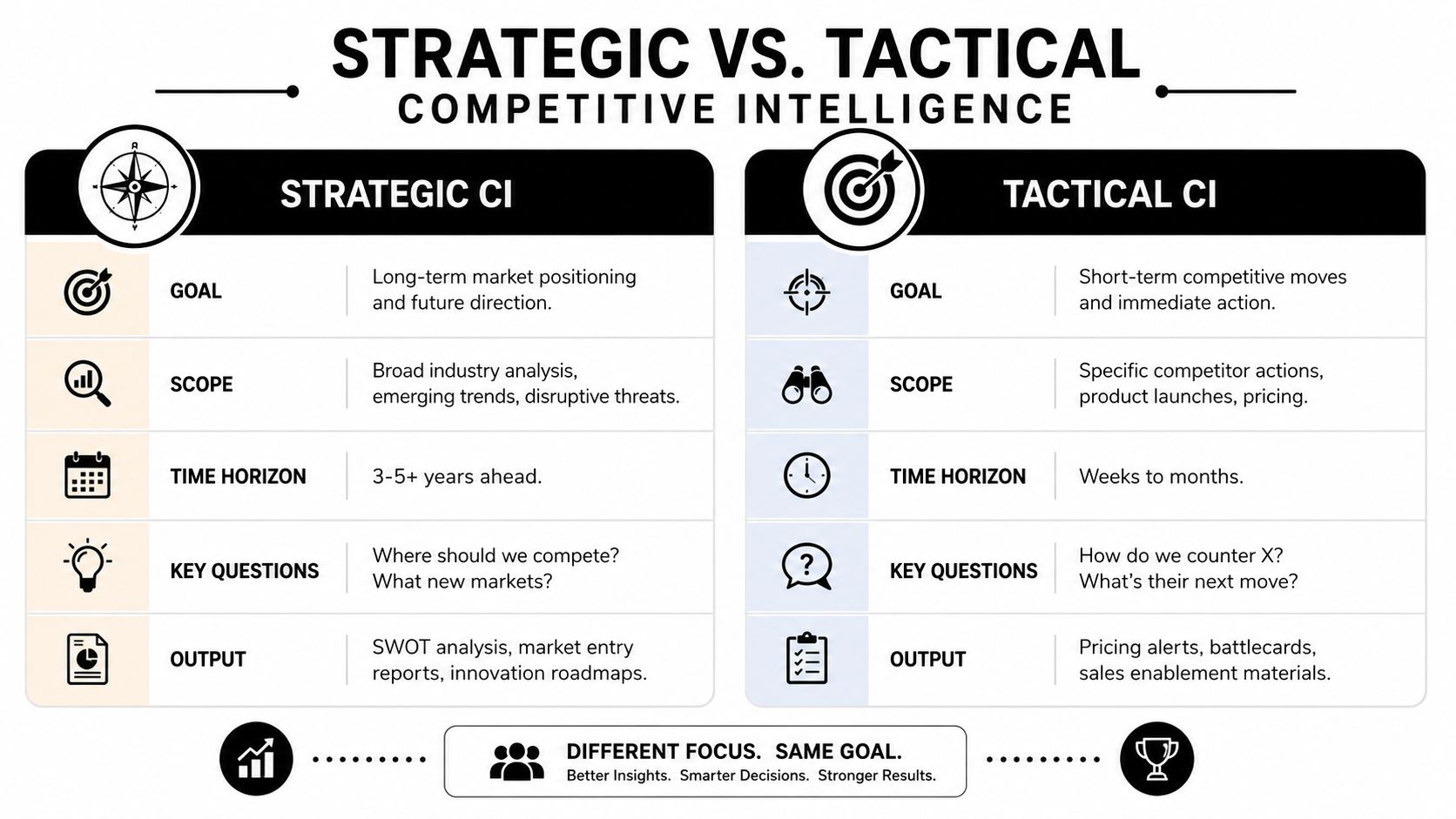
Strategic CI supports long-range decisions. Leadership teams use it to evaluate market direction, category threats, new segments, or investment priorities. It helps answer questions like: Are we entering the right market? Is a new competitor changing the structure of the category? Are customer expectations shifting in a way that should change our positioning?
Tactical CI supports immediate action. Sales, marketing, and product teams use it to respond to competitor moves that affect current execution. It helps answer questions like: How should a rep handle this objection? Why did a competitor suddenly change pricing language? Which launch themes are showing up repeatedly across campaigns?
A practical side by side view
The difference becomes clearer when you compare how each type behaves inside an organization.
| Dimension | Strategic CI | Tactical CI |
|---|---|---|
| Primary users | Executives, strategy, senior product leaders | Sales, marketing, PMs, RevOps |
| Time horizon | Longer-term | Immediate to near-term |
| Typical inputs | Industry shifts, regulatory moves, market narratives | Pricing updates, campaign changes, hiring, launches |
| Output | Direction, prioritization, market choices | Battlecards, messaging changes, outreach triggers |
Both matter. But most B2B teams underinvest in the tactical side because it feels less formal. That creates a strange gap. Leaders talk about market dynamics while operators still work from stale assumptions.
The fix isn't building a giant CI department. It's giving each function the right version of intelligence.
- Sales needs live competitive context: account movement, objection patterns, pricing cues.
- Marketing needs message-level visibility: claims, channel emphasis, content angles.
- Product needs structured evidence: where competitors are investing and what customers are reacting to.
Field note: Strategic CI tells you where the game is going. Tactical CI tells you how to win the next possession.
When teams blend the two, they stop treating competitor awareness as occasional research and start using it as a daily operating input.
The Four-Step Competitive Intelligence Cycle
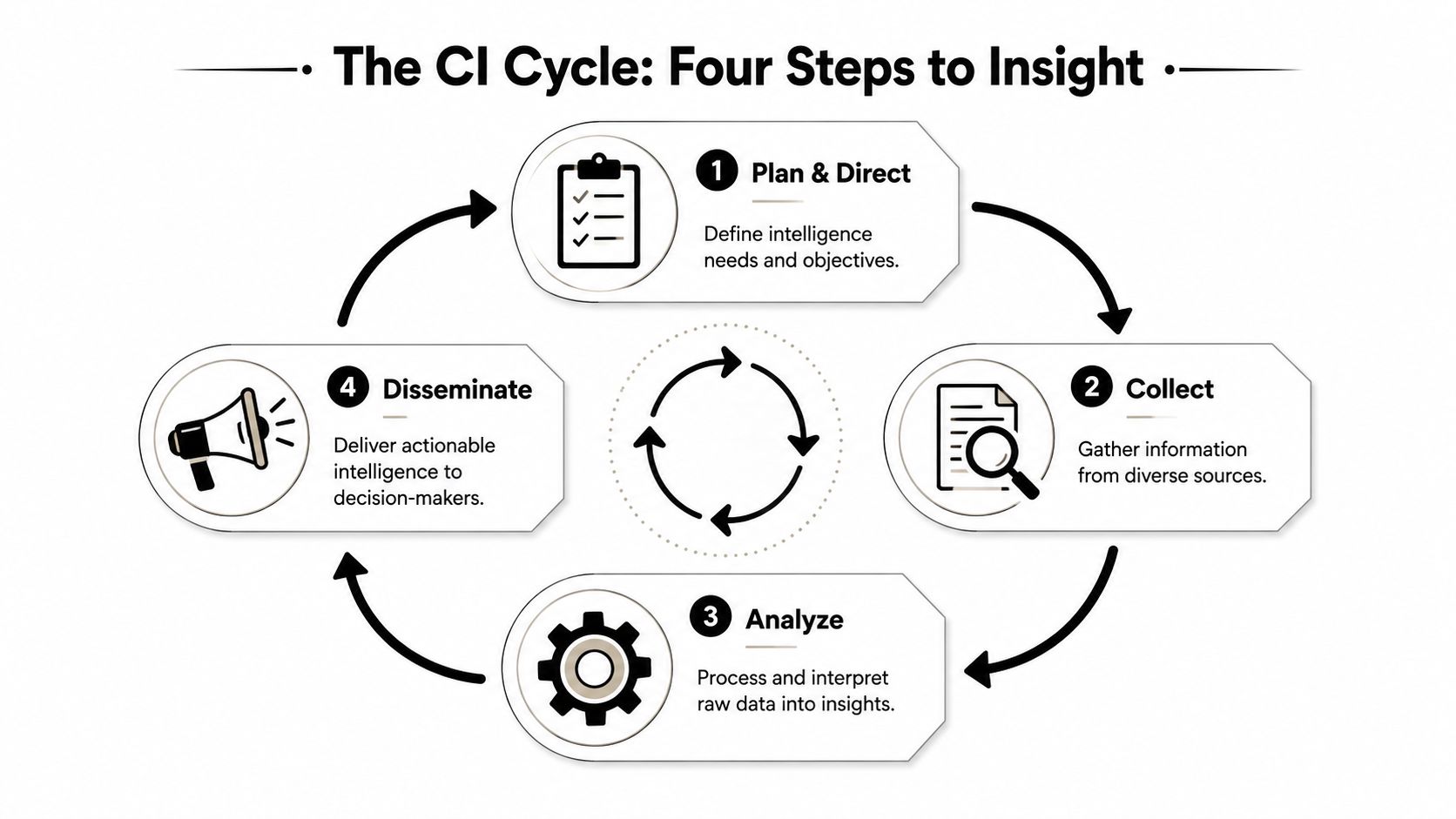
The most useful CI programs are boring in the best sense. They run on a repeatable process. Without that, teams gather too much, analyze too little, and distribute insights too late.

Step one and two decide what matters then collect it
The first step is planning and direction. At this stage, most wasted effort starts or stops. If your team doesn't define the question, it will drown in updates.
Good CI questions are narrow enough to guide collection. Examples include:
- Sales question: Which competitor is changing enterprise packaging in active deals?
- Marketing question: What narrative is a rival pushing across homepage, ads, and webinars?
- Product question: Which workflow are competitors making easier, and how are buyers responding?
Once the question is clear, move to collection. Use a mix of sources: company websites, pricing pages, help docs, launch posts, review platforms, webinars, job listings, sales call feedback, and public-facing profiles. The key is consistency, not volume.
If you need a broader view of where reliable business data can come from, this guide to marketing data sources for modern teams is useful background.
Step three and four interpret then distribute
The third step is analysis. Analysis makes the work valuable. Instead of logging isolated events, compare them over time and ask what changed.
A simple analysis pattern works well:
- Observe the signal: A competitor adds implementation language to several pages.
- Compare context: Similar wording appears in hiring, demos, and customer stories.
- Interpret meaning: They may be moving upmarket or selling more complex deployments.
- Recommend action: Update sales talk tracks and revisit onboarding proof points.
The final step is dissemination and feedback. Intelligence that sits in a Notion page isn't doing much. It needs to reach the people who can use it, in a form they can act on.
That usually means different outputs for different teams:
- For sales: short battlecards, objection handlers, account alerts
- For marketing: messaging summaries, campaign reviews, content gap notes
- For product: launch pattern briefs, review synthesis, packaging comparisons
Send less, but make it usable. A one-page brief that changes a live opportunity is worth more than a long report nobody reads.
The best CI loops also include feedback. Reps should say whether a battlecard helped. Marketers should note whether a messaging shift improved clarity. Product should confirm whether a signal turned out to matter. That closes the loop and sharpens the next cycle.
Putting CI to Work Use Cases for Your Team
The fastest way to understand competitive intelligence is to watch how it changes daily work. The concept sounds strategic, but the ultimate payoff shows up in execution.
One important reality check stands out here. 73% of sales teams fail to integrate CI into daily workflows because existing guides lack step-by-step protocols for integrating CI into CRM enrichment or automated outreach, according to SafeGraph's guide to competitive intelligence. That's exactly why many teams say they “do CI” while reps still prospect blind.
Sales teams need signals they can act on today
A rep preparing for outreach doesn't need a broad market overview memo. They need specific context. Has the competitor assigned a new sales leader in the region? Are they pushing a new pricing frame? Did an implementation complaint show up across recent reviews?
Useful sales CI often looks like this:
- Account prioritization: Spot which target accounts are interacting with competitor narratives or entering buying windows.
- Outreach personalization: Reference business changes that make your alternative more relevant.
- Deal defense: Prepare for likely objections based on the rival's current pitch.
A practical sales workflow is simple. Capture recurring competitor mentions from calls, compare them against recent external signals, then update talk tracks fast. If that update takes weeks, it won't help pipeline.
Marketing teams need positioning context
Marketers often watch competitors at the surface level. They notice campaigns, creative, and content volume. That's useful, but incomplete.
Strong marketing CI asks sharper questions. What promise is the competitor making repeatedly? Which audience are they trying to own? Where are they simplifying or reframing the category?
That changes execution in real ways:
- Message testing gets tighter: You can avoid copycat language and sharpen differentiation.
- Content planning improves: You can fill gaps instead of publishing into crowded themes.
- Launch timing gets smarter: You can decide when to confront a narrative and when to sidestep it.
A competitor's campaign is not just creative output. It's a statement about who they want to win and how they want buyers to think.
Product teams need pattern recognition not feature envy
Product teams get dragged into reactive decisions when CI is handled poorly. A rival launches something visible, sales starts hearing about it, and pressure builds to match the feature.
That usually leads to noise.
Good product CI separates isolated launches from meaningful patterns. It looks at feature changes alongside onboarding language, pricing structure, reviews, and support friction. That tells you whether a launch is strategic, experimental, or just cosmetic.
A product manager can use CI to:
| Signal | Better question |
|---|---|
| New feature launch | What job is this trying to make easier? |
| Pricing change | Which segment are they optimizing for? |
| Review trend | Is this exposing a weakness in their product or ours? |
Used this way, CI helps product teams avoid building from panic. It gives them a clearer read on where customer expectations are moving and where not to overreact.
The Modern CI Toolkit Tools Data and AI
Modern competitive intelligence runs on a stack, not a single platform. Competitive intelligence teams need tools that do three separate jobs well: monitor changes, enrich context, and help interpret what matters.
The stack has three jobs
First, you need monitoring tools. These surface changes across websites, news, reviews, social channels, product pages, and public company activity. Their job isn't to tell you what to do. Their job is to make sure you don't miss meaningful movement.
Second, you need data and enrichment tools. These add operational detail that broad monitoring often misses. For B2B teams, that can include company profile changes, role movement, contact verification, and other signals that help sales and marketing act on competitor activity instead of just observing it.
Third, you need analysis workflows, comprising notebooks, dashboards, AI assistants, and internal briefs. The best setup is the one your team routinely uses. A lightweight workflow with disciplined owners beats an ambitious stack that nobody trusts.
For teams building workflows around profile resolution, enrichment, or verification, it also helps to understand what a data API does in practice, because a lot of CI value now comes from how data moves between systems.
Where AI helps and where it still needs a human
AI is changing CI fast. Recent data reveals a 76% year-over-year increase in AI adoption within competitive intelligence teams, with 60% of these teams now using AI tools daily to process market data, according to the Competitive Intelligence Alliance's CI trends report.
That rise makes sense. AI is good at tedious work that used to consume analyst time:
- Summarizing inputs: launch notes, reviews, transcripts, support pages
- Classifying patterns: repeated claims, pricing language, persona targeting
- Reducing noise: filtering minor updates from more important changes
But AI still has limits. It doesn't own the commercial judgment. It can show that a rival changed messaging across several channels. It can't reliably tell your sales leader whether to challenge that head-on or reposition around a different buying criterion.
Adjacent disciplines also matter. Teams that combine CI with stronger customer understanding usually make better use of the data. If you want to strengthen that side of the equation, these user research methods are worth reviewing because competitor signals are more useful when you can map them against actual buyer needs.
Use AI to compress inputs. Use people to decide significance.
That's the practical split. Let software scan, summarize, and organize. Let operators decide what changes pitch, positioning, or roadmap.
How to Launch Your CI Program Legally and Ethically
You don't need a formal strategy department to start doing CI well. You need a narrow scope, clear ownership, and clean rules.
A simple launch plan
Start small and make it repeatable:
- Pick one or two intelligence questions. Focus on issues with immediate business value, such as pricing pressure in deals or a rival's messaging shift.
- Choose a small competitor set. Track direct competitors first. Too broad and the effort collapses under noise.
- Assign owners by function. Sales can report objections. Marketing can track messaging. Product can monitor launches and reviews.
- Define one distribution format. A weekly brief, shared board, or battlecard update is enough if people use it.
- Review and refine. If an input never affects a decision, stop collecting it.
The compliance line matters
Legal and ethical boundaries aren't a side note. They shape which data is usable and trustworthy.
68% of B2B firms now rely on cached public data, not live scraping, for CI to comply with GDPR and CCPA, according to Valona Intelligence's overview of competitive intelligence types. That distinction matters. Publicly available information can support legitimate CI. Prohibited harvesting and invasive collection methods create risk fast.
A clean operating standard looks like this:
- Use public sources: websites, filings, reviews, job posts, webinars, public profiles, and customer-facing materials
- Avoid prohibited access: private systems, deception, credential abuse, or scraping that violates terms and privacy expectations
- Validate before acting: check whether a signal is current, consistent across sources, and relevant to the decision
- Document your method: teams work better when everyone knows what counts as acceptable collection
If you need a practical grounding in the public-data side of this, a clear primer on open source intelligence in business workflows is a useful starting point.
Competitive intelligence should make your team sharper, not riskier. If a collection method feels questionable, it probably is. Strong CI programs win because they're disciplined, not because they're aggressive.
If your team wants to turn public data into usable sales and market context, Icypeas helps you find, verify, and enrich professional data through compliant open-source intelligence workflows. It's a practical fit for growth teams that need cleaner prospect data, stronger CRM records, and better inputs for competitive monitoring without crossing legal or ethical lines.


























.png)


.webp)