.avif)
Security Compliance Associates: Skills, Path & Vetting

.avif)
You usually know it's time to hire a security compliance associate when growth starts creating friction. Sales wants a bigger enterprise deal. Procurement sends over a security questionnaire. A customer asks for SOC 2 controls, GDPR answers, deletion timelines, and proof that your vendor review process is real. Engineering says they can support the audit, but only if someone tells them exactly what evidence matters and why.
That's the moment many teams discover they don't have a policy problem. They have a translation problem. The business has commitments. The engineers have systems. The auditors have criteria. Someone has to connect all three without slowing the company down.
That's the core job of security compliance associates. They don't just maintain documents. They turn abstract requirements into operating routines, technical controls, audit evidence, and vendor decisions that hold up under scrutiny.
Table of Contents
- Audit work is coordination under pressure
- Policy work only matters when people can use it
- Risk assessment is a prioritization function
- Training is operational reinforcement
- The skill mix that actually matters
- Key compliance frameworks at a glance
- Why unified control mapping changes the job
- Where paper controls fail
- What continuous compliance looks like in practice
- How associates work with engineers without becoming blockers
- The first question is how the data is sourced
- The vendor review questions that matter
- What weak vendor answers look like
Why Your Business Suddenly Needs a Security Compliance Associate
A lot of companies wait too long to add this role. They assume legal can handle the policy language, security can handle the controls, and engineering can pull evidence when an auditor asks. That works right up until it doesn't.
The breaking point usually comes from outside the company. A prospect wants assurance before signing. A regulator's rules apply now, not later. A board member asks who owns risk acceptance, disclosure timing, or deletion requests. The work is no longer occasional. It becomes operational.
That's why security compliance associates have become far more valuable than their title sometimes suggests. In the broader market, the median annual wage for compliance officers reached $78,420 in May 2024, and employment is projected to grow 3% from 2024 to 2034, with about 33,300 annual openings over the decade, according to the U.S. Bureau of Labor Statistics on compliance officers. In the security-specific market, ZipRecruiter data cited in that same source set places Security Compliance Specialists at an average annual salary of $81,143, with most earning between $60,500 and $100,000 annually.
Those numbers matter because they reflect a shift in how companies treat the role. This isn't admin support for an audit season. It's a business function that protects revenue, speeds reviews, and keeps product, legal, security, and engineering aligned.
Growth creates obligations faster than teams expect
Once a company handles customer data, employee data, payment data, healthcare data, or regulated B2B records, the control environment gets more demanding. Someone has to know when GDPR applies, what evidence supports a control, how to respond to customer due diligence, and where internal gaps sit before an external party finds them. A clear grounding in what the GDPR requires in practice becomes part of normal business, not a specialist side topic.
Practical rule: If your team is answering the same security questionnaire differently depending on who replies, you already need a dedicated compliance operator.
The role is a bridge, not a buffer
Good security compliance associates reduce confusion. They don't sit between teams and slow everything down. They make sure sales promises match actual controls, engineering changes produce evidence, and management understands the true risk of exceptions.
Hiring managers often ask whether they need a senior compliance leader first. Usually, they need someone who can own the daily mechanics. Evidence requests. Policy refreshes. Control mapping. Vendor follow-up. Audit schedules. Remediation tracking. Those tasks sound tactical, but they directly affect trust and deal velocity.
The Core Responsibilities of a Compliance Associate
The day-to-day job is less glamorous than most job descriptions suggest. It's a mix of coordination, technical interpretation, documentation discipline, and follow-through. The cleanest way to understand it is through four working pillars.
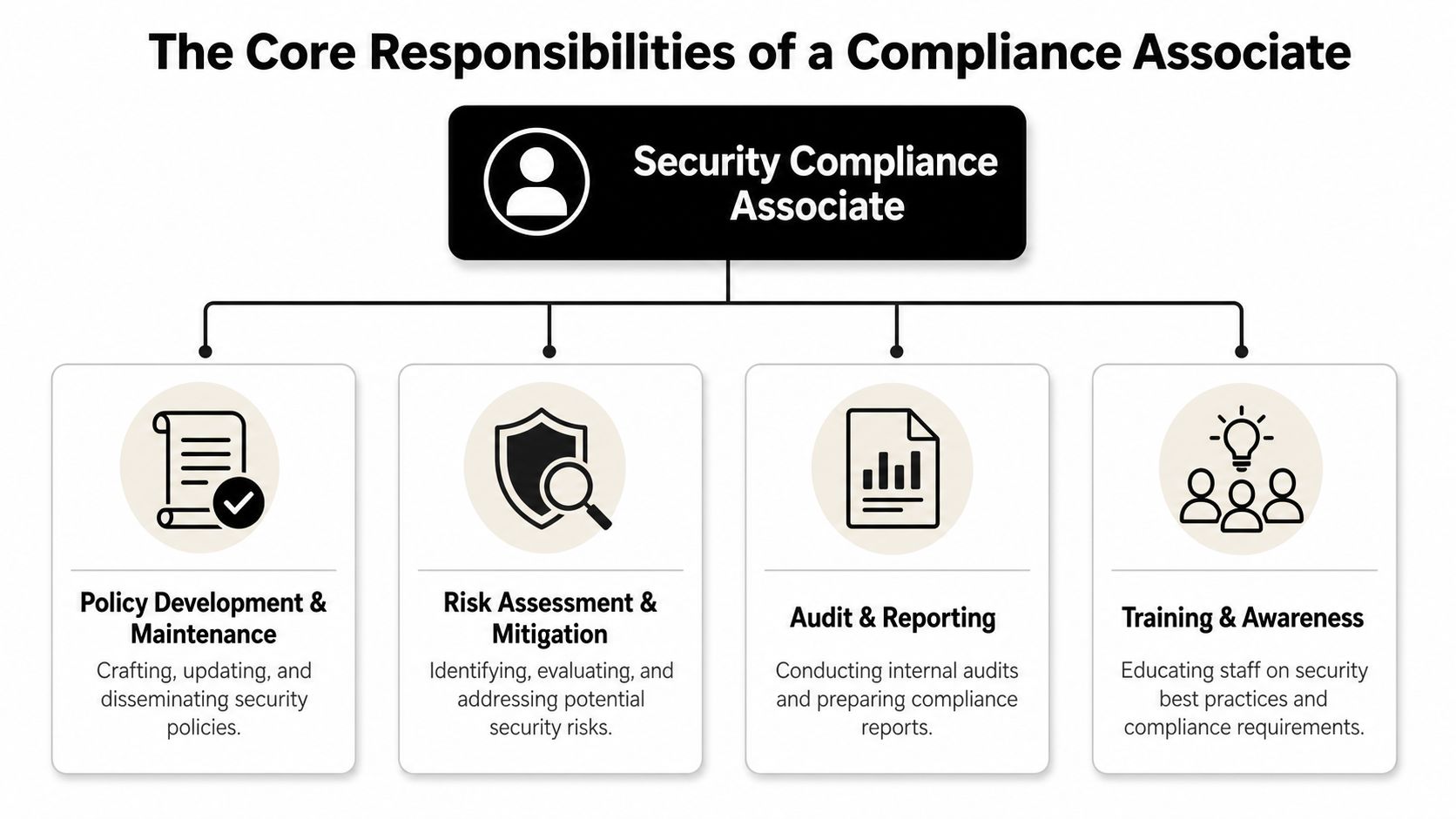
Security compliance associates are often the people enforcing mandatory disclosure protocols and audit standards, including coordination for annual SOX and SSAE 16 audits. The role also has clear market weight outside the U.S. In the UK, the median salary for a Security Compliance Analyst was £55,000 per year based on vacancies posted in the six months leading to October 5, 2025, as described in the University of Tulsa overview of what a security compliance analyst does.
Audit work is coordination under pressure
Audit management sounds simple until evidence starts arriving in ten different formats from six different teams.
A strong associate does three things well here:
- Sets scope early: They confirm what framework applies, which systems are in scope, who owns each control, and what evidence will satisfy the reviewer.
- Normalizes evidence: They convert screenshots, exports, tickets, and logs into something an auditor can follow without extra interpretation.
- Tracks remediation: They don't just log findings. They assign owners, due dates, proof requirements, and retest expectations.
When teams struggle with evidence-heavy environments, adjacent documentation disciplines help. A good example is ClaimKit's guide to R&D documentation for ATO compliance, which shows the same core principle: if records aren't structured as work happens, proving compliance later becomes messy and expensive.
Policy work only matters when people can use it
Weak compliance programs produce polished policies no one follows. Strong ones produce short, usable standards tied to actual systems and behavior.
A compliance associate usually owns the maintenance cycle for documents such as access control policies, data handling rules, retention schedules, vendor review procedures, and incident response support materials. But the hard part isn't writing them. It's forcing precision.
A policy that says “access is reviewed regularly” is weak. A usable standard identifies who reviews access, what system records the review, what exceptions look like, and how evidence is stored.
Policies should read like operating instructions for control owners, not like marketing copy for auditors.
Risk assessment is a prioritization function
This pillar is where the role starts looking less administrative and more strategic.
Associates collect signals from vulnerability reviews, access reviews, exceptions, third-party findings, and control failures. Then they translate them into a risk register or remediation queue leadership can act on. They help answer questions like these:
- Which gaps are audit issues versus real exposure
- Which exceptions are temporary and documented versus unmanaged
- Which risks require engineering work, legal review, or executive sign-off
The best associates don't escalate everything. They rank issues by business impact, framework exposure, and control maturity. That keeps the program credible.
Training is operational reinforcement
Training gets dismissed because many companies reduce it to a yearly slideshow. That's a mistake.
Compliance training works when it's tied to moments that matter. New manager onboarding. Privileged access approval. Secure data handling for support teams. Vendor onboarding for procurement. Change control for engineering leads.
A practical training cadence usually includes:
- Role-based guidance: Finance, engineering, support, and HR don't need the same examples.
- Control-linked refreshers: If access review quality is weak, training should focus there.
- Proof of completion: Attendance, acknowledgment, and version control need to be tracked.
The point isn't awareness for its own sake. It's creating repeatable behavior that holds up when an audit, incident review, or customer due diligence exercise exposes how the company operates.
Essential Skills and Key Compliance Frameworks
If you're hiring for this role, don't over-index on pure policy credentials. You need someone who can understand systems well enough to ask useful questions and business context well enough to judge what matters.
The skill mix that actually matters
The strongest security compliance associates usually combine technical literacy with operational judgment.
On the technical side, they should be comfortable reading cloud architecture diagrams, understanding access models, interpreting vulnerability results, and following how changes move through a deployment process. They don't need to be the engineer writing Terraform or pipeline logic, but they do need to know what good evidence looks like and where control failure often hides.
Soft skills matter just as much:
- Translation: They must explain technical risk to legal, finance, procurement, and leadership without flattening the meaning.
- Negotiation: Control owners don't always agree on scope, priority, or deadlines.
- Persistence: Evidence collection and remediation follow-up are repetitive. The job punishes people who hate disciplined chasing.
- Judgment: Some gaps need escalation. Others need clarification. The role depends on knowing the difference.
A useful adjacent benchmark appears in this data quality manager overview. It highlights a related truth: operational quality roles succeed when they connect standards to workflows, not when they sit in isolation.
Key compliance frameworks at a glance
Different frameworks push on different risks, but daily work often overlaps.
| Framework | Primary Focus | Industry/Region | Example Control |
|---|---|---|---|
| SOC 2 | Trust services controls around security and related operational safeguards | Common in SaaS and B2B buyer reviews | User access review with documented approvals |
| ISO 27001 | Information security management system and control governance | Global, cross-industry | Formal asset management and access control processes |
| HIPAA | Protection of healthcare-related information | U.S. healthcare and health-adjacent organizations | Access restrictions and handling procedures for sensitive records |
| GDPR and CCPA | Privacy, lawful use, deletion, and rights management | EU and privacy-regulated markets | Data retention and deletion workflow with clear ownership |
For teams preparing for SOC 2 specifically, CEFCore's SOC 2 compliance checklist is a practical reference because it helps non-auditors understand how control expectations map to evidence requests.
Why unified control mapping changes the job
Experienced associates save real time.
In B2B data environments, security compliance associates often need to align SOC 2, ISO 27001, and GDPR at the same time. When they map overlapping requirements into a single control set, they can reduce audit effort by 30 to 40 percent through control overlap identification, as outlined in the DevOpsSchool blueprint for associate compliance analysts.
That matters because frameworks frequently ask for the same outcome in different language. Access control is the classic example. One framework may emphasize least privilege, another may emphasize role-based access and review, and privacy rules may emphasize limiting exposure to personal data. A smart associate doesn't build three separate processes. They design one control, one evidence path, and one owner model that can satisfy multiple obligations.
The fastest way to burn out a compliance team is to treat every framework as a separate universe.
What “fluency in ISO 27001” really means isn't memorizing clause names. It means knowing how to convert a control objective into ownership, technical implementation, and repeatable proof.
Integrating Compliance into Engineering Workflows
The most common compliance failure isn't missing policy. It's assuming policy will somehow become technical reality on its own.
Where paper controls fail
A company can have approved policies, signed standards, and a clean control matrix while engineering still ships changes that create compliance problems. That disconnect shows up in user access reviews, change management segregation of duties, incomplete logging, weak deletion handling, and undocumented exceptions.
Security compliance associates close that gap by sitting closer to how software is built. They ask questions like:
- What requirement has to be validated before deployment
- What system generates proof that the control operated
- What happens when a control check fails
- Who owns the exception if release pressure overrides the standard
That work is less about theory and more about workflow design.
What continuous compliance looks like in practice
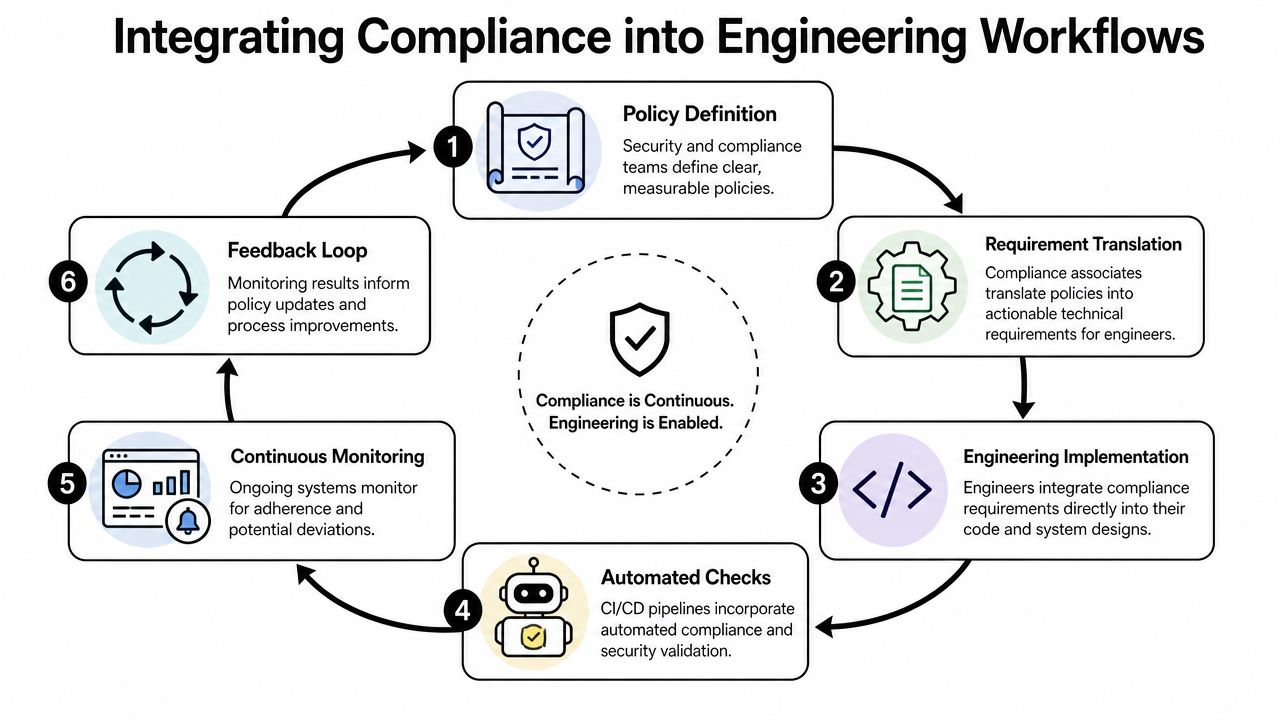
A modern associate doesn't wait for quarter-end to discover whether a control operated. They push for evidence collection inside normal delivery processes.
Associates who enforce automated evidence collection in CI/CD workflows can help teams shift from periodic to continuous compliance monitoring. In the benchmark cited from a Twilio job description analysis, this approach can reduce audit preparation time from 60 to 90 days to under 15 days while maintaining 99.9% audit readiness, as noted in this Security Compliance Associate Analyst reference.
That benchmark matters because it captures what the job has become. The associate is no longer just collecting evidence after the fact. They're shaping how evidence is produced.
A useful visual example sits below.
In practice, this often means embedding compliance expectations into pull request templates, change approval steps, ticket fields, infrastructure templates, and deployment gates. If a privacy-sensitive feature is introduced, the associate may require confirmation of data minimization, access restrictions, retention handling, and deletion workflow support before release.
How associates work with engineers without becoming blockers
Weaker hires often struggle here. They show up with generic requirements and create friction because they can't express what engineering should do.
Better associates frame compliance in engineering terms:
| Engineering moment | What the associate contributes | What doesn't work |
|---|---|---|
| New feature design | Required control outcomes, data handling constraints, evidence expectations | Sending a policy PDF and asking engineering to “be compliant” |
| Pull request or change review | Checklist items tied to logging, access, approvals, and records | Manual one-off approvals with no system trail |
| Infrastructure changes | Standardized requirements in templates and review criteria | Ad hoc exceptions buried in chat threads |
| Audit preparation | Pulling evidence from existing systems of record | Screenshot hunts two days before fieldwork |
If engineers can't tell you where a compliance requirement lives in their workflow, the control probably isn't real.
The right trade-off is clarity over volume. Fewer, well-implemented controls beat a bloated control library that nobody can operate consistently. Security compliance associates who understand that usually become trusted partners to engineering rather than an afterthought attached to release meetings.
How Associates Scrutinize Data Enrichment Vendors
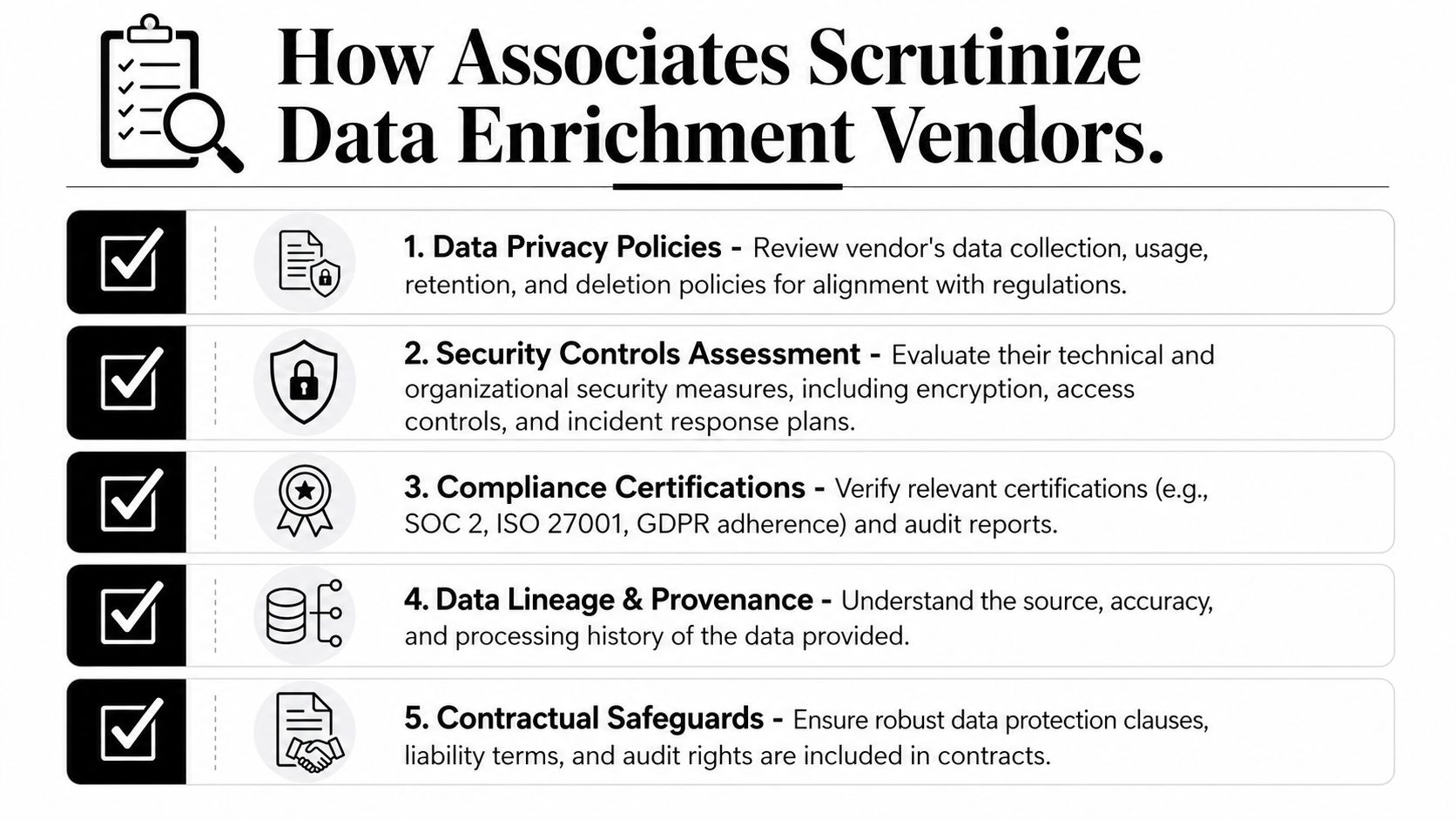
Third-party review becomes much harder when the vendor touches personal or professional data at scale. Generic vendor questionnaires aren't enough. A data enrichment provider can say all the right words and still expose your company if its sourcing model, retention practices, or deletion process don't hold up.
The first question is how the data is sourced
In this category, “Are you compliant?” is a weak question. The answer is always yes.
The stronger question is whether the vendor can prove its data comes from non-invasive, open-source intelligence and cached public data rather than live scraping. That distinction now matters much more in vendor assessment. As noted in the LBMC discussion of SOC 2 gap assessment issues, the market is moving toward stricter validation where vendors must prove they are ISO 27001 certified and align with GDPR and CCPA using non-invasive, open-source intelligence from cached public data, not live scraping.
If your team is evaluating providers in this category, compare product claims carefully against the broader array of B2B data enrichment tools. The important differentiator isn't just coverage. It's whether the sourcing and control model is defensible.
The vendor review questions that matter
A useful review doesn't stop at certificates. It probes the operating model.
Ask questions like these:
- Data provenance: Where does the vendor obtain records, and can they describe the difference between cached public data and live scraping in operational terms?
- Retention and deletion: How long is data kept, how are updates handled, and what happens when a deletion request arrives?
- Security controls: What encryption, access control, logging, and incident response measures protect the dataset and supporting systems?
- Subprocessor visibility: Which downstream providers host, process, or store the data?
- Auditability: Can the vendor provide current reports, policy artifacts, and contract terms that match what sales says in the procurement process?
A mature vendor answers clearly and consistently across sales, legal, security, and technical review. If those answers drift depending on who's in the meeting, treat that as a warning.
What weak vendor answers look like
Most risky vendors don't fail because they have no documentation. They fail because the documentation is vague, outdated, or disconnected from operations.
Watch for these patterns:
- Broad compliance language: “We follow industry best practices” is not a control statement.
- No sourcing specificity: If a vendor won't explain how data is collected, assume the method may not survive scrutiny.
- Unclear deletion mechanics: “We handle requests manually” can be acceptable in small contexts, but only if ownership and timing are defined.
- Certification confusion: A vendor may reference security generally while avoiding direct answers about certified hosting, audited controls, or privacy obligations.
The associate's job here isn't to eliminate all vendor risk. It's to identify which risks are understood, documented, contractually covered, and operationally manageable. That's a much higher bar than completing a checkbox questionnaire.
Hiring and Growing Your First Security Compliance Associate
If you're making the first hire, hire for execution range. You want someone who can manage evidence, work across teams, understand frameworks, and stay comfortable in technical conversations without pretending to be an engineer.
What to hire for first
A practical job description usually includes these expectations:
- Control ownership support: Maintain control inventories, evidence requests, and remediation tracking.
- Audit coordination: Prepare internal teams for audits and organize artifacts for external review.
- Policy maintenance: Update standards and procedures so they reflect real systems and workflows.
- Vendor review participation: Assess third-party security and privacy documentation with procurement, legal, and security.
- Engineering collaboration: Translate policy requirements into operational controls and evidence points.
Good screening questions are concrete. Ask candidates how they'd validate an access review, how they'd handle conflicting answers from a vendor, or how they'd prove a control operated over time.
A practical scorecard for the role
Early on, keep the KPI set small and observable.
Use a scorecard that tracks:
- Audit readiness quality: Are evidence requests answered cleanly and on time
- Remediation follow-through: Do open findings move, or do they stall after assignment
- Policy usability: Can control owners understand and follow the documented process
- Cross-functional trust: Do engineering, legal, procurement, and security work with this person
- Training completion and acknowledgment: Are key groups completing required activities and records being retained
Don't overcomplicate the measurement model in year one. The role succeeds when the program becomes easier to operate, easier to defend, and less dependent on heroics.
How the role usually grows
This role can develop in several directions. Some associates become framework specialists in SOC 2, ISO 27001, privacy, or third-party risk. Others move into compliance management, GRC leadership, security operations partnership roles, or broader security leadership tracks.
The best growth path combines deeper framework fluency with stronger technical judgment. A candidate who can own daily operations today and eventually shape control design tomorrow is far more valuable than someone who only knows how to maintain spreadsheets.
If your team is buying or integrating enrichment data, the compliance review shouldn't be an afterthought. Icypeas gives security, legal, and revenue teams a clear operating model to evaluate, including open-source intelligence sourcing, cached public data rather than live scraping, GDPR and CCPA alignment, and ISO 27001 certified hosting. That makes vendor diligence faster for compliance associates and safer for the business.































.png)


.webp)