.avif)
Sales Process Optimization: A Practical B2B Playbook

.avif)
Your pipeline looks healthy in the CRM. The forecast says the quarter is on track. Then the month ends, a cluster of “late-stage” deals slips, and managers realize each rep has been using a different definition of qualified, proposal-ready, and commit. That's the moment many organizations realize they need sales process optimization.
The problem usually isn't effort. It's structure. Reps are busy, managers are coaching, marketing is generating leads, and customer success is waiting for cleaner handoffs. But when stage definitions are fuzzy, follow-up timing is inconsistent, and account data is incomplete, the process starts leaking revenue long before anyone notices.
This playbook is how to fix it without turning the sales floor into a change-management project that stalls for months. It starts with an honest audit, moves into bottleneck analysis, then plugs automation and enrichment into the exact points where reps lose time or momentum. The last step is a 90-day rollout that keeps the team selling while the system improves underneath them.
Table of Contents
- Why Your Sales Process Is Leaking Revenue
- Start with buyer progression, not rep activity
- Build a stage audit your managers can inspect
- Build stage criteria that survive pressure
- Where enrichment changes the outcome
- Build automation around real decisions
- Use one documented process across teams
- Days 1 to 30 foundation and adherence
- Days 31 to 60 tooling and delivery
- Days 61 to 90 optimization and scale
Why Your Sales Process Is Leaking Revenue
Most revenue leaks don't come from one dramatic failure. They come from small, repeated breakdowns. A lead sits unworked because routing was manual. An AE advances a deal after a polite demo, even though the buyer never confirmed urgency. A manager forecasts off stage names that mean something different to every rep.
That's why sales process optimization matters. It gives the team a shared operating system. When organizations implement standardized exit criteria and automate repetitive tasks, they reduce average sales cycle length by 20% to 30%, and companies that map their process and align stages with the modern customer journey report a 15% to 25% increase in win rates by segment, according to Heimdall's sales process optimization analysis.
Those gains don't come from motivational speeches or a new dashboard alone. They come from removing ambiguity. If “qualified” means budget confirmed for one rep, strong interest for another, and booked demo for a third, the pipeline is unreliable before forecasting even starts.
Practical rule: If a manager can't inspect a stage with objective criteria, that stage is a label, not a process.
A working process does three things at once:
- It guides rep behavior: The next action is obvious, not left to memory.
- It improves manager judgment: Coaching happens on evidence, not anecdotes.
- It protects handoffs: Marketing, SDRs, AEs, and customer success all work from the same definitions.
Poor processes hide waste because activity still looks high. Reps send emails, hold calls, and update fields. But without clean stage movement, those actions don't compound into predictable revenue. A strong process turns motion into progression. That's the difference between a busy team and a controllable one.
The Blueprint Audit Mapping What Really Happens
Most audits fail because leaders review the CRM stage list and assume they've mapped reality. They haven't. What matters is what buyers committed to, what reps did, and whether the data reflects both clearly enough to inspect.
Start with buyer progression, not rep activity
A common breakdown in sales process optimization is the gap between rep-perceived stages and buyer-actual stages. In many pipelines, 60% to 70% of stages are rep activity labels rather than buyer progression proofs, and 45% of sales leaders fail to define clear buyer actions proving progression for each stage, which correlates with 23% longer sales cycles, according to Prospeo's sales optimization analysis.
That shows up in stage names like:
- Demo Done: Internal activity. It says the rep presented.
- Proposal Sent: Internal activity. It says a document left the building.
- Follow-Up: Not a stage. It's a task.
A buyer-centric stage sounds different:
- Problem confirmed by buyer
- Buyer validated solution fit
- Economic path identified
- Decision process confirmed
These are inspectable. A manager can ask for proof. The rep either has it or doesn't.
If your stage can be reached without a buyer doing or confirming something material, it's too weak to forecast from.
Build a stage audit your managers can inspect
Start with a raw export of open and recently closed deals. Pull stage history, time-in-stage, conversion to next stage, loss reasons, lead source, owner, and key account fields. Then review call notes, emails, and a sample of recordings from top performers, average performers, and new reps. The goal isn't to catch mistakes. It's to find the difference between the documented process and the one people execute.
Use a simple audit table like this:
| Stage Name | Buyer Action (Exit Criteria) | Key Rep Activities | Average Time in Stage | Conversion Rate to Next Stage |
|---|---|---|---|---|
| Qualification | Buyer confirms problem, priority, and reason to evaluate | Discovery call, account research, stakeholder mapping | [fill from CRM] | [fill from CRM] |
| Solution Fit | Buyer confirms the solution addresses the use case | Demo, technical validation, objection handling | [fill from CRM] | [fill from CRM] |
| Business Case | Buyer sees value and internal relevance | ROI framing, use-case alignment, stakeholder outreach | [fill from CRM] | [fill from CRM] |
| Decision Process | Buyer shares approval path and decision criteria | Mutual action plan, procurement prep, next-step scheduling | [fill from CRM] | [fill from CRM] |
That table forces discipline. It exposes where stage names are vague and where reps are advancing deals based on hope.
A few operating habits make the audit more useful:
- Shadow real deal reviews: Listen to how managers ask questions and how reps justify stage movement.
- Compare top reps against the median: Top performers often follow a process the CRM never captured.
- Inspect data quality before trusting funnel math: Missing titles, duplicate contacts, stale company records, and bad ownership fields distort the entire audit.
If your CRM is messy, fix that before redesigning the process. A practical starting point is tightening field standards and deduplication using a CRM data cleaning workflow.
Build stage criteria that survive pressure
The best exit criteria are binary enough to hold up at quarter end. “Strong interest” fails that test. “Buyer confirmed evaluation team and next meeting date” survives it.
Write criteria that answer three questions:
- What did the buyer confirm
- What evidence must be captured in the CRM
- What should happen next if the deal is real
Managers should be able to reject a stage advancement in less than a minute. If they need a long debate, the criterion is too subjective.
Pinpointing Your Process Bottlenecks and Leaks
Once the audit is done, the next mistake is trying to fix everything. Don't. Usually, there are two or three choke points that create most of the drag. The job is to find them, name them clearly, and separate the symptom from the cause.

Read the funnel like an operator
Start with three views of the same pipeline.
First, look at conversion by stage. Where do deals stop progressing relative to the rest of the funnel? A drop after qualification often points to weak ICP control or poor discovery. A drop after proposal usually means the rep sent pricing before the buyer built internal consensus.
Second, look at time in stage. Long duration tells a different story than low conversion. If a stage converts eventually but takes too long, the team may be waiting on internal approvals, missing next-step discipline, or failing to multi-thread into the account.
Third, compare by segment, source, and rep. A process flaw affects everyone. A skill problem tends to cluster around certain reps or certain deal types.
A bottleneck is only worth fixing if you can tie it to a repeated pattern in the data and a repeated behavior in the field.
A few patterns show up often:
- Qualification stalls: Reps are accepting meetings outside the ICP, or inbound forms don't collect enough context to route well.
- Demo-to-next-step drop-off: The presentation happened, but the buyer never confirmed fit, urgency, or stakeholder alignment.
- Proposal purgatory: Pricing goes out before decision criteria, legal path, or procurement process are understood.
- Late-stage slippage: Forecast categories are based on rep confidence instead of buyer commitments.
Separate root causes before you prescribe fixes
The same symptom can come from very different issues. A slow qualification stage might reflect poor rep execution, but it might also come from weak enrichment, bad routing logic, or missing firmographic data.
Use this decision lens:
| Symptom | Likely Process Cause | Common Tool Cause | Coaching Signal |
|---|---|---|---|
| Too many low-fit meetings | ICP not enforced at intake | Incomplete lead data | Reps accept anything that books |
| Deals stall after demo | Exit criteria too vague | No shared recap workflow | Reps pitch well but don't secure commitment |
| Handoffs feel messy | Stages and SLAs unclear | CRM fields inconsistent | Teams argue over ownership |
| Forecast misses late | Stages don't reflect buyer proof | Poor dashboard visibility | Reps over-advance deals |
Managers require restraint. Avoid prescribing training when the underlying issue is workflow design. Don't buy software when the team lacks clear criteria. Don't rebuild stages when the handoff fields are incomplete.
A practical prioritization method is to score each bottleneck on three factors:
- Revenue exposure: How much pipeline touches this point.
- Fixability: Whether the team can change it quickly.
- Inspectability: Whether you can measure improvement inside one quarter.
That usually produces a short list. For most B2B teams, it's some version of lead qualification quality, stage progression clarity, and handoff consistency. Fix those first. Cosmetic changes to naming conventions can wait.
Powering Your Process with Automation and Data Enrichment
Once you know where the process breaks, technology becomes useful. Before that, it's mostly noise. Automation should remove repetitive work and enforce standards. Enrichment should give reps and routing systems enough context to make better decisions early.
Where enrichment changes the outcome
The biggest gains usually happen near the top of the funnel and at handoff points.
If inbound leads arrive with only a name and email, SDRs waste time researching basics before they can even decide whether to call. If outbound lists lack verified titles, company context, or current role data, personalization becomes shallow and routing gets sloppy. That's where enrichment belongs.
For practical evaluation of vendors, this roundup of tools for improving B2B data quality is useful because it frames the decision around workflow fit, not just database size.
A working enrichment workflow looks like this:
- Inbound forms: Append company, title, team, and account attributes before scoring or routing.
- Outbound account building: Filter target accounts, then enrich contacts so reps don't prospect blind.
- Pre-call prep: Pull role and company context into the CRM or sequencing tool so discovery starts with relevance.
- CRM hygiene: Refresh stale records, flag incomplete fields, and suppress bad contacts before sequences launch.
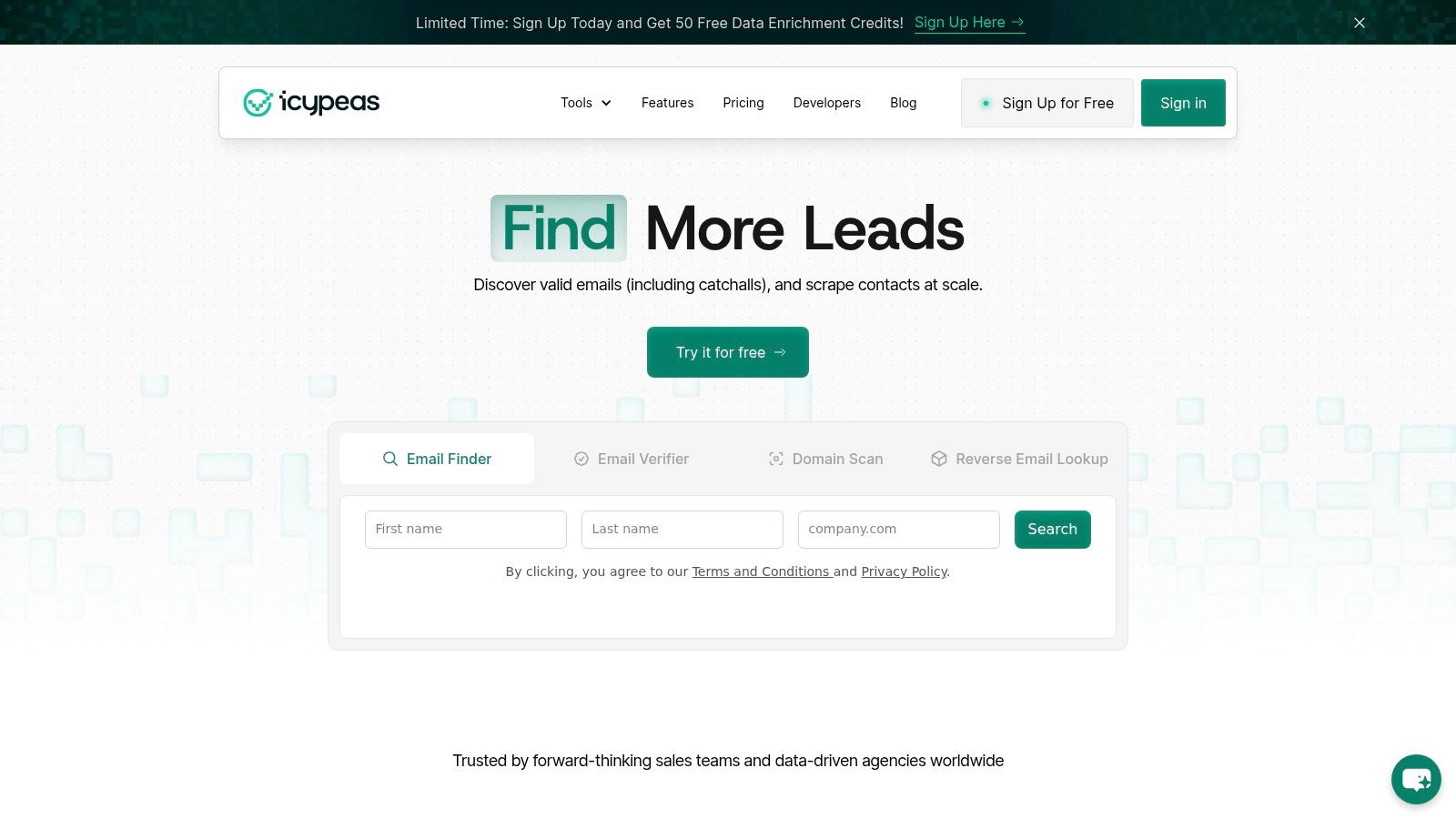
One option teams use for this is B2B data enrichment tools from Icypeas. In practice, that means using verified professional contact data, email finding, reverse lookup, and API-based enrichment to fill in missing account and contact context before the rep touches the lead.
Build automation around real decisions
Automation works when it is tied to a rule a manager would enforce manually.
A few examples:
Lead routing based on fit
If a lead matches your ICP and has the required fields, route it immediately to the right owner. If not, send it to a queue for enrichment or disqualification review.Same-day follow-up enforcement
Trigger tasks and alerts when a qualified inbound lead sits untouched. Fast response matters, but only when routing quality is high enough to trust the handoff.Stage advancement checks
Require fields or buyer-proof notes before a deal can move forward. This reduces the habit of pushing deals ahead because a rep “has a good feeling.”Recap and next-step workflows
After demos or technical calls, generate a standard follow-up task list so the rep confirms stakeholders, decision process, and timing while the conversation is still fresh.
Implementation of AI-powered lead scoring has been shown to increase lead-to-opportunity conversion rates by 25% to 35%, and when sales, marketing, and customer success align around one documented process with explicit exit criteria, pipeline leaks decrease by 30% while SDR-to-AE handoffs become 40% more efficient, according to Monday.com's sales optimization benchmarks.
That result makes sense operationally. Better scoring only works if the process around it is documented. Otherwise, you just prioritize leads into another messy workflow.
Use one documented process across teams
Most automation rollouts fail when sales wants speed. Marketing wants attribution. Customer success wants cleaner implementation notes. Each team adds fields and workflows until the system becomes a patchwork.
The fix is one documented process with a small number of critical controls:
- Shared definitions: Marketing-qualified, sales-accepted, qualified opportunity, and implementation-ready should each have one definition.
- Shared dashboards: Every team should be able to inspect conversion, routing quality, and handoff aging in the same place.
- Shared ownership rules: Someone owns every step. “The team” owns nothing.
Here's a useful test. If a lead or opportunity changes hands, can the receiving team act without digging through call transcripts, Slack threads, and five custom fields? If not, your automation added motion, not clarity.
A short demo helps teams visualize this kind of workflow in practice:
The best tooling setups don't replace process discipline. They enforce it in the background, while reps spend more of their time on live opportunities instead of list building, record cleanup, and status chasing.
Your 90-Day Sales Process Implementation Roadmap
A process overhaul needs sequencing. If you redesign stages, buy tools, retrain reps, and rebuild dashboards all at once, nobody knows which change produced the result. A tighter approach is to roll out in three phases: adherence first, delivery second, optimization third.
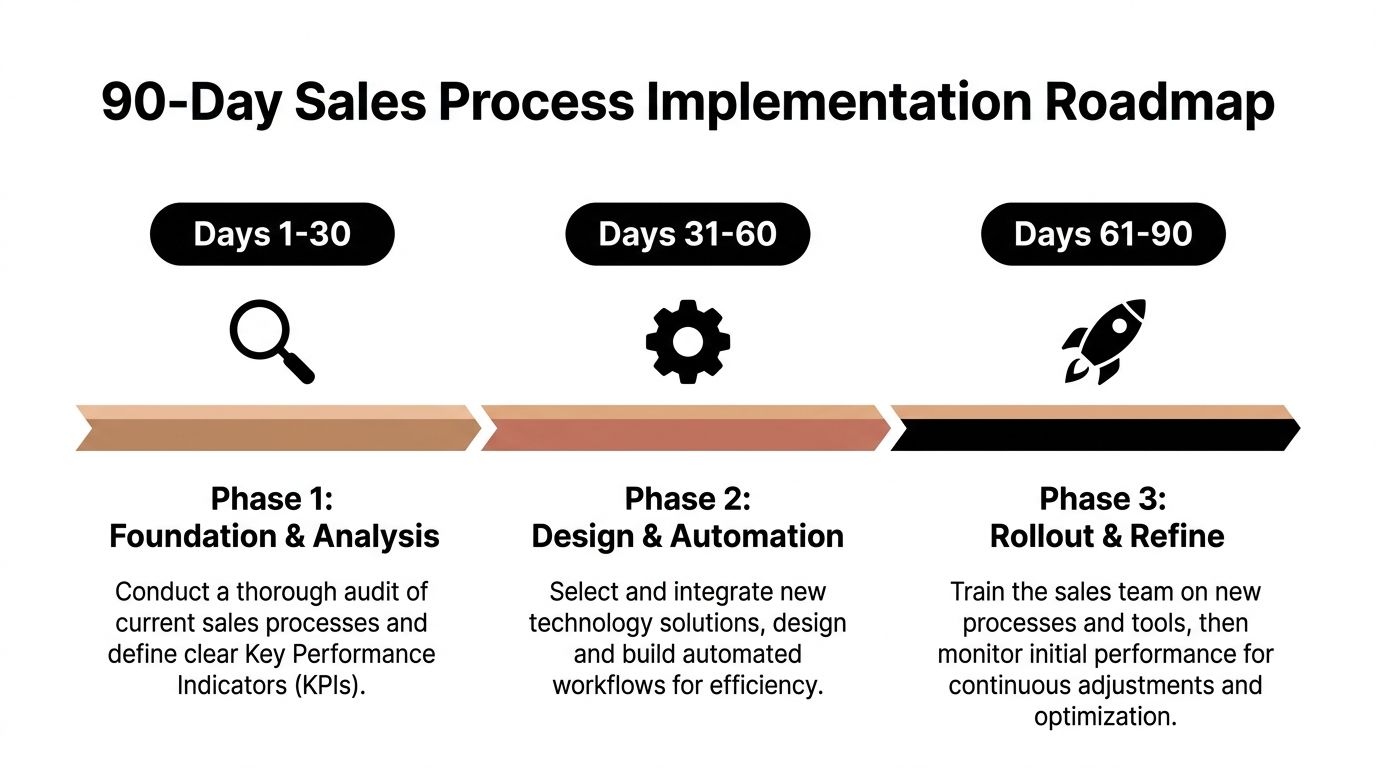
A rigorous optimization methodology follows exactly that order: measure adherence, fix delivery, then run optimization using stage-conversion math, and by Day 90 of a pilot, teams should target a 10 percentage point improvement in forecast accuracy and a 20% reduction in stalled deals, based on Supered's sales process optimization framework.
Days 1 to 30 foundation and adherence
The first month is about making the current process inspectable.
Document the stages, required fields, buyer-based exit criteria, and ownership rules. Keep it practical. Reps don't need a fifty-page manual. They need stage definitions that hold up in deal reviews and a CRM that won't let obvious gaps slip through.
Use manager one-on-ones and pipeline reviews to audit adherence deal by deal. Don't rely on self-report. Inspect open opportunities and mark whether each one meets the defined criteria.
Focus the team on a short list:
- Stage discipline: No advancement without evidence.
- Field discipline: Required data must be captured in the flow of work.
- Follow-up discipline: Next steps are scheduled before a call ends whenever possible.
The first win is not better conversion. It's better truth. Once the data reflects reality, improvement becomes possible.
Days 31 to 60 tooling and delivery
The second month is where tooling earns its keep. By now you know what information is missing, where handoffs fail, and which tasks keep dragging reps into admin work.
Build only the workflows that support the new rules. Good examples include lead enrichment before scoring, routing based on fit and territory, mandatory handoff fields, and alerts for neglected inbound leads or stalled opportunities.
A practical manager checklist for this phase:
| Area | What to implement | What to avoid |
|---|---|---|
| Routing | Rules based on fit, ownership, and completeness | Manual reassignment in Slack |
| CRM fields | Required fields tied to stage movement | Optional fields no one uses |
| Handoffs | Shared summaries and next actions | “See notes” as a handoff method |
| Dashboards | Conversion, time-in-stage, adherence | Vanity activity reporting |
This phase also needs training, but not generic training. Run short sessions inside existing meetings. Show reps the exact criteria, the exact workflow, and the exact reason a deal gets blocked or routed.
Days 61 to 90 optimization and scale
Only after adherence is visible and tooling is in place should you optimize conversion and velocity. At this stage, the numbers mean more because the process is being followed.
Review stage conversion, stalled deal counts, forecast quality, and handoff execution. Compare by segment and rep, then isolate one or two changes worth scaling. That might be rewriting qualification standards, tightening proposal-entry rules, or adding buyer-proof requirements for late-stage commits.
Keep the pilot contained if you can. One team, one region, or one motion is easier to inspect than a global rollout.
Common failure points in this final phase are predictable:
- Too many simultaneous edits: Teams can't tell what worked.
- No baseline: Improvement becomes impossible to prove.
- Soft manager enforcement: Reps revert to old habits quickly.
- Process drift: Exceptions become the actual process if leaders allow them.
The point of a 90-day roadmap isn't speed for its own sake. It's to create a measured path where behavior, systems, and reporting change in the same order a strong operator would debug them.
Measuring Success and Driving Continuous Improvement
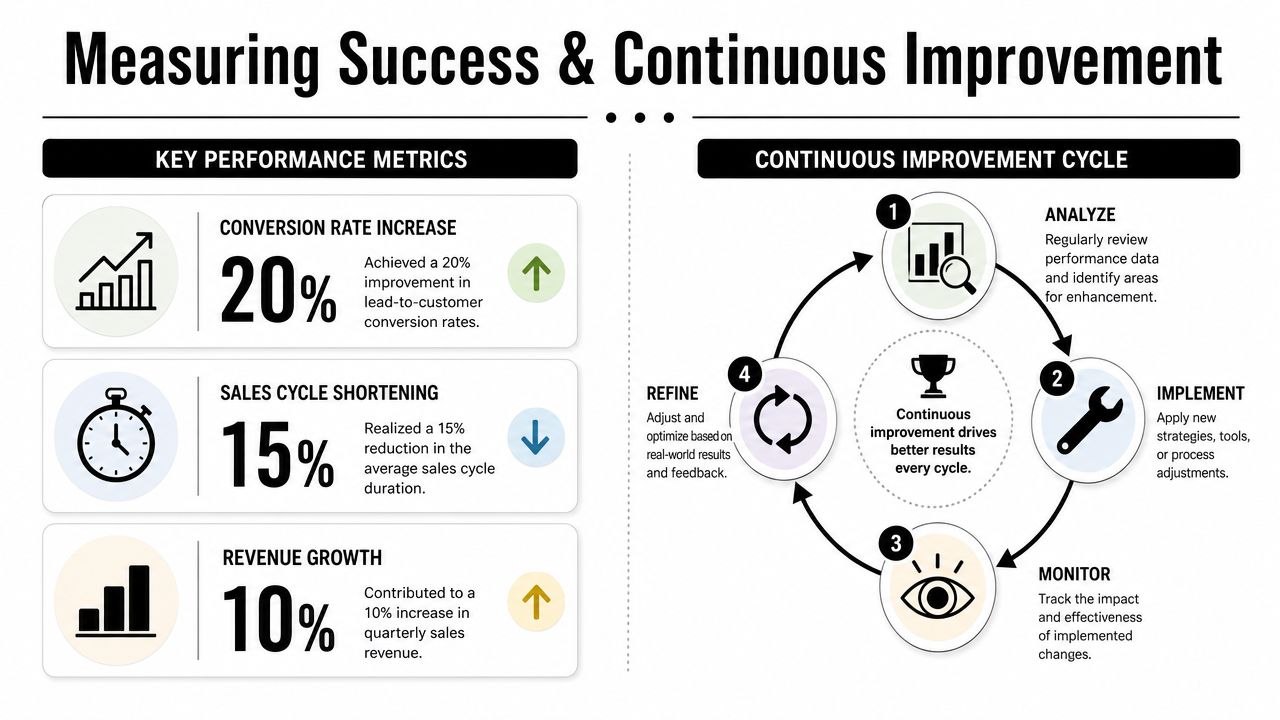
Once the new process is live, the job shifts from implementation to operating rhythm. Sales process optimization isn't finished when the CRM fields are in place. It's finished when managers can see whether the process is being followed, whether buyers are moving more cleanly through it, and where the next friction point is emerging.
Track the metrics that prove process quality
Start with a dashboard that balances leading and lagging indicators.
Lagging indicators include win rate, sales cycle length, and revenue outcomes. They matter, but they tell you what already happened. Leading indicators tell you whether the team is creating the conditions for those results. Useful examples include stage adherence, handoff completeness, stalled deal counts, buyer-confirmed next steps, and account coverage depth.
For managers building scorecards, these performance scorecard templates are a solid reference for turning process expectations into something inspectable each week.
A useful review rhythm looks like this:
- Weekly manager review: Stage hygiene, stalled deals, missing fields, and handoff issues.
- Biweekly funnel review: Conversion and time-in-stage by segment, source, and rep.
- Quarterly process review: Stage definitions, routing logic, qualification standards, and automation rules.
Turn reviews into a repeatable operating rhythm
The best teams treat the sales process like a product. They ship a version, measure real usage, inspect failure points, and refine. They don't confuse rollout with adoption.
That means listening to the floor as well as the dashboard. If multiple reps keep getting blocked at the same stage, the answer might be better coaching. It might also mean the criterion is unrealistic, the field is hard to capture in the workflow, or the buyer path changed and the stage definition didn't.
A process stays healthy when feedback changes the system, not when reps are told to work around it.
Continuous improvement works when each review asks four questions:
- Are reps following the process as designed?
- Are buyers moving through stages in a way the process captures?
- Which bottleneck is costing the most right now?
- What single adjustment is worth testing next quarter?
That loop keeps optimization grounded. It prevents the familiar pattern where a company launches a process redesign, celebrates the documentation, then drifts back into inconsistent forecasting and rep-by-rep improvisation.
A clean process needs clean data behind it. If your team is tightening routing, qualification, handoffs, or CRM hygiene, Icypeas can support the enrichment layer by helping sales and RevOps teams find, verify, and enrich professional contact data inside the workflows they already use.



































.png)



.webp)