.avif)
What Is Identity Resolution: Key Methods for B2B Teams In

.avif)
Identity resolution connects fragmented data points, email addresses, device IDs, CRM records, and web events, into a single persistent profile. In practice, U.S. spending on identity resolution reached $10.4 billion by the end of 2023 and brands, publishers, and agencies spent an average of $433,000 on these solutions in 2022, which tells you this is infrastructure, not a side project (Okta's 2023 analysis).
If you've ever watched a prospect show up in your CRM three different ways, one record from a demo form, one from a webinar, and one from a rep's manual import, you already know the operational problem. B2B teams need identity resolution because lead stitching and CRM enrichment depend on matching the same person, and sometimes the same account, across messy systems, incomplete forms, and different buying signals.
Table of Contents
- Start with the identifiers you can trust
- Tune the system before you automate everything
- Make maintenance part of the operating rhythm
The Problem Identity Resolution Solves for B2B Teams
A prospect fills out a demo request with a personal email, attends a webinar with a work email, and later opens a support ticket under yet another address. Without identity resolution, those signals land in three places and look like three different people, even though they're one buyer moving through the funnel.
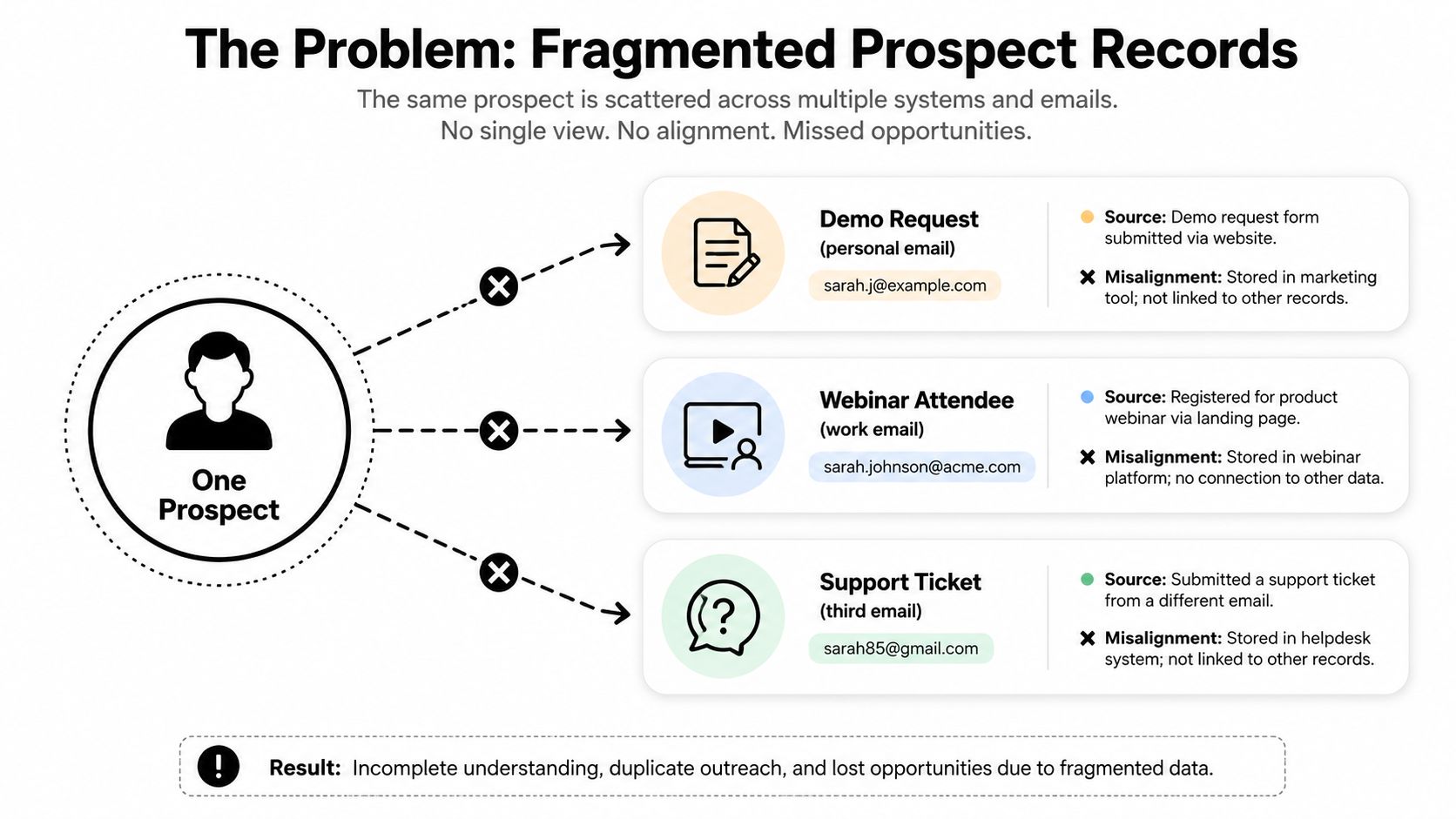
At a basic level, identity resolution is the process of connecting and matching multiple data points into a single persistent profile. In B2B, that profile needs to support both person-level and account-level matching, because a contact record by itself doesn't tell you which company owns the opportunity, and a company record by itself doesn't tell you which person engaged.
Practical rule: if a rep has to ask “is this the same lead?” more than once a day, your identity layer is already costing pipeline time.
A lot of explainers get too consumer-centric. B2B teams aren't just trying to unify clicks and cookies, they're trying to reconcile contacts, buying committees, accounts, and systems of record. That's why identity resolution sits closer to revenue infrastructure than to a one-off data cleanup task, and why cleanup alone never fixes the problem without a matching strategy like the one described in our CRM data cleaning guide.
The distinction from identity verification matters too. Verification proves that a contact detail is valid or belongs to a real person, while identity resolution decides whether that signal belongs to an existing profile, a new profile, or a duplicate. The broader discipline of entity resolution goes beyond people and includes organizations, products, and locations, which matters in B2B because many workflows need both contact stitching and account stitching.
Duplicate records waste SDR time, distort routing, and make personalization look lazy. When a rep sees an old form fill, an active webinar attendee, and a support case as separate people, the next touchpoint feels irrelevant instead of coordinated. Identity resolution fixes that by making one prospect look like one prospect, even when the data arrives in pieces.
The same logic applies when teams are trying to understand the limits of public-contact tools. A practical guide to Spokeo limits is useful for seeing where consumer-style lookup falls short compared with B2B record stitching, especially once you care about work identity, account context, and CRM hygiene.
How Deterministic and Probabilistic Matching Methods Compare
Most production stacks don't choose one identity method and stop there. They combine deterministic matching, probabilistic matching, graph logic, and sometimes machine learning, because each method solves a different part of the same problem.
The trade-off that matters
Deterministic matching is the safest starting point. It links records using verified identifiers like work email, phone number, or login token, which gives you the highest precision but leaves obvious gaps when the identifier is missing or hidden. Probabilistic matching fills some of those gaps by inferring linkage from patterns like shared IPs, shared Wi‑Fi, or similar browsing behavior, but it accepts more ambiguity.
Graph-based systems are useful because they don't treat identity as a single match event. They build an identity graph that links stable and unstable identifiers together, then let the graph absorb new data over time. Machine learning usually sits on top of that foundation, helping score match confidence and reduce noisy merges as more records flow in.
A system that only trusts exact matches will miss too much. A system that leans too hard on inference will merge the wrong people.
| Method | Precision | Coverage | Best B2B Use Case |
|---|---|---|---|
| Deterministic | High | Lower when identifiers are missing | Deduping known contacts, login-based stitching, verified email matching |
| Probabilistic | Moderate | Broader across anonymous or partial records | Pre-routing anonymous engagement, filling gaps before form completion |
| Graph-based | High when maintained well | Strong across many sources | Multi-touch B2B profiles across CRM, events, and enrichment |
| Machine learning | Varies by model quality | Improves with more data | Confidence scoring and ongoing merge tuning |
For most RevOps teams, the decision isn't “which method wins?” It's “which method can we trust at the point of activation?” If you need a rep to call the right person today, deterministic logic should carry the weight. If you're building audience segments or enriching a weak inbound record, broader linking can help, as long as humans can audit it.
That's also why merge discipline matters. Our merge duplicate contacts guide is a useful companion if your team is already battling duplicate records in Salesforce or HubSpot, because identity matching and duplicate handling usually fail at the same time.
The Identity Resolution Pipeline in Production
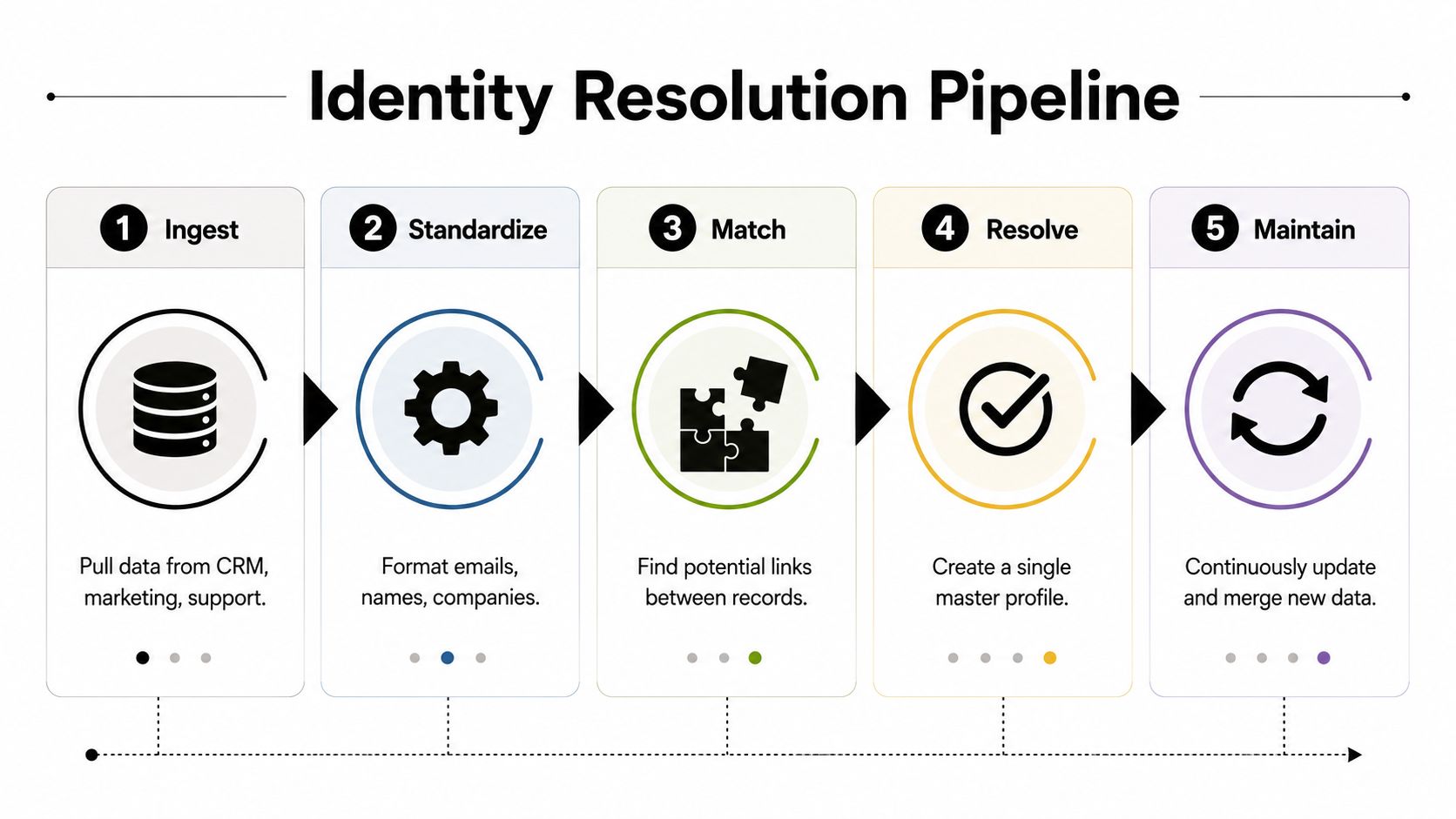
Production identity resolution is not a single lookup. It's a continuous pipeline that takes in new data, normalizes it, evaluates match confidence, writes a stable profile, and keeps that profile current as fresh signals arrive.
What each stage does
Ingest pulls records from CRMs, web forms, event registrations, support tools, and third-party enrichment APIs. Standardize makes the fields usable, which means consistent email formatting, company naming, and field mapping before any matching starts.
Match compares incoming data against known profiles and searches for likely links. Resolve assigns a persistent key when the system is confident enough, so downstream tools stop treating the same buyer as a new person every time they interact.
Maintain is where many teams lose control. If profiles don't get updated as new signals come in, the system starts fragmenting into duplicates or drifting onto the wrong entity, especially when people change jobs, domains, or contact details. That's why identity resolution is really a lifecycle, not a one-time merge.
Maintenance is the part vendors under-sell and operators regret skipping.
The strongest implementations treat each new data source as another input to the same graph, not as a separate list to sync later. A CRM update, a webinar registration, and a reverse-email result should all land in the same profile logic, or your “single customer view” will become three different versions of the truth.
If you're wiring this into your stack, the data pipeline automation guide is relevant because identity resolution falls apart fast when ingestion and refresh rules are manual.
Real B2B Workflows That Depend on Identity Resolution
Identity resolution shows its value in the workflows RevOps teams touch every day. The best test is simple. If the merged profile doesn't change a rep's action, routing decision, or personalization step, it's not doing enough.
Three workflows where the payoff is visible
CRM enrichment fills missing fields from a verified work email or other trusted identifier. That means a rep can see title, company, and profile context before reaching out, which reduces generic outreach and makes segmentation usable instead of aspirational. For teams evaluating enrichment for GTM teams, the key question is whether the enrichment output can reliably attach to an existing contact instead of creating another messy record.
Lead deduplication prevents the same person from being called, emailed, and scored multiple times under different entries. In practice, this is one of the fastest ways to clean up SDR workflows because duplicates distort queues, suppress trust in the CRM, and make handoffs harder between marketing and sales.
Account-based lead stitching links individual contacts to their parent company, which matters when buying intent lives at the account level but engagement happens at the contact level. If a webinar attendee belongs to a target account, the system should route and score that signal differently than it would for an isolated lead with no account context.
If you work in a B2B stack long enough, you eventually see the same pattern. The enrichment layer finds a work email, the identity layer attaches the rest of the profile, and the routing layer decides what happens next. That chain only works if each step trusts the one before it.
At the tactical level, a tool like Icypeas fits for B2B teams. Its reverse email lookup can resolve work emails to professional profiles, which gives sales and marketing teams a deterministic identifier to anchor around when the rest of the record is thin. It's one option among several, but the important part is the function, not the branding, because the workflow needs a trustworthy key before anything else can be stitched correctly.
Privacy Regulations and Signal Loss Are Changing the Game
A lot of identity stacks were built when third-party signals were easier to capture and easier to trust. That environment is weaker now, and explainers that still assume abundant cookies and mobile identifiers are leaving operators with outdated playbooks.
What still works when easy signals disappear
The durable path is deterministic identifiers collected with consent, especially verified work emails, login events, and first-party form fills. Those signals are stronger because they come directly from the buyer or from systems you already control, which makes them more usable when browser and platform tracking get stripped away.
Recent industry coverage also points to a shift toward hashing, tokenization, privacy preferences, and referential identity graphs, because compliance now shapes architecture rather than sitting on the side of it (Martech coverage on privacy changes). For global B2B teams, that means the matching logic has to respect opt-outs, data freshness, and jurisdiction-specific handling, not just accuracy.
If your identity system only works when tracking is easy, it won't survive the next privacy change.
A practical guide for 2026 is useful here because data residency and storage decisions now affect how confidently teams can move identity data across regions. That's no longer a legal side note, it's part of how you design the workflow.
For B2B teams, the priority should be clear. Use stable professional identifiers first, keep consent visible, and make sure the system can degrade gracefully when browser-based signals disappear. Probabilistic modeling can still help, but it should support the deterministic core, not replace it.
Step-by-Step Implementation Checklist for B2B Teams
Start with the identifiers you can trust
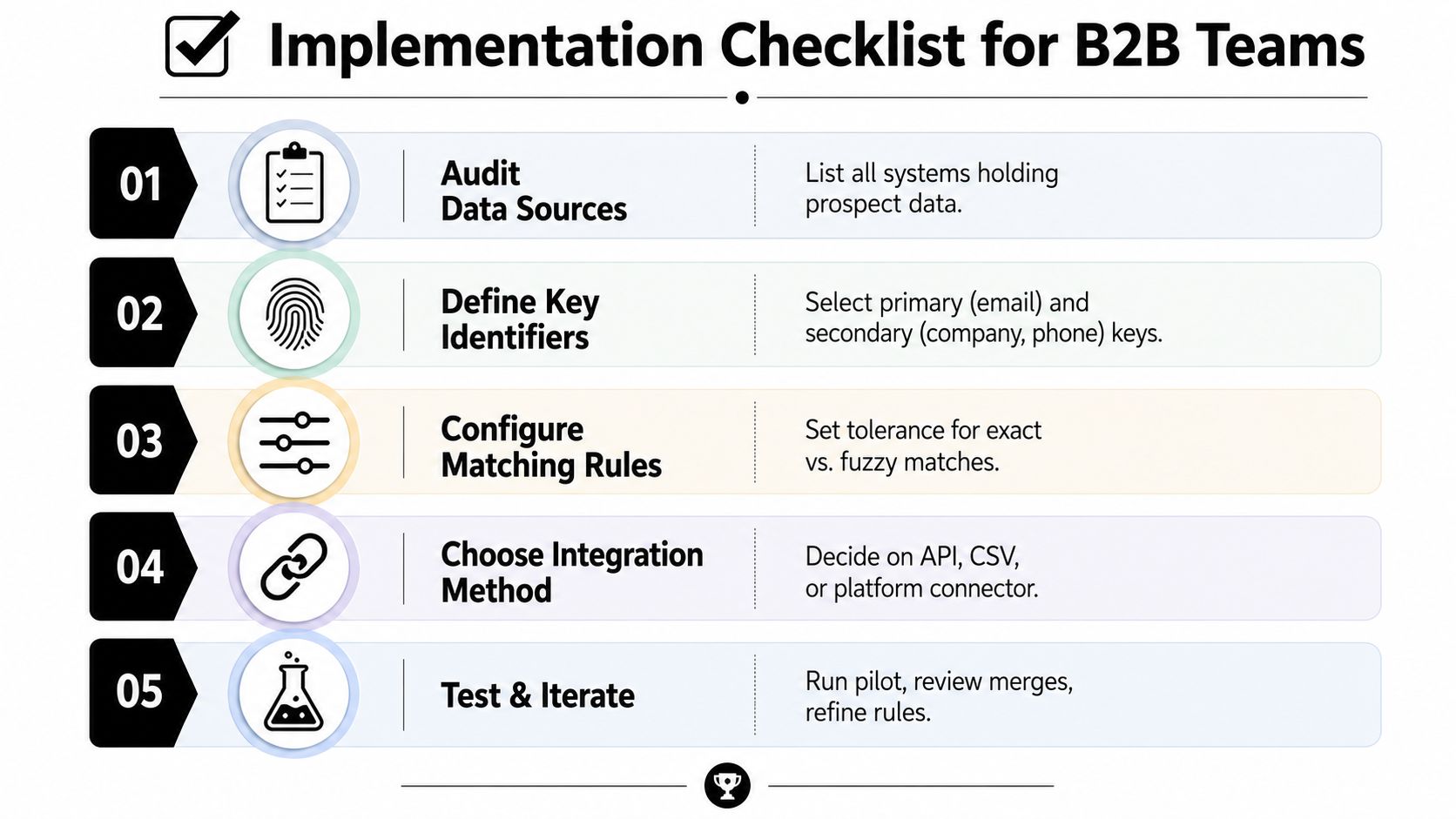
Audit every system that holds prospect data, CRM, marketing automation, webinar tools, support platforms, and enrichment vendors. Then define the primary keys you'll trust first, usually work email, and the secondary keys that help with confirmation, such as company and phone.
That's the point where enrichment APIs matter. If a new inbound lead arrives with only a work email, reverse lookup can fill the profile without forcing your team to wait for manual research. Icypeas also maintains a 575M people-profile lead database that is updated monthly, which gives teams a deterministic source of professional identifiers when probabilistic methods would be too loose for routing or deduplication.
Tune the system before you automate everything
Configure matching rules before you let the workflow run unattended. Exact matches should be the default for high-confidence merges, while fuzzier logic should stay in a narrower lane until the team has reviewed how often it creates false joins.
Practical rule: pilot deterministic matching first, then expand only where the downstream process can tolerate a little ambiguity.
Make maintenance part of the operating rhythm
Set a recurring review for profile merges, exception handling, and stale records. The maintenance step is what keeps identity resolution from turning into a pile of old assumptions, especially when titles change, companies rename themselves, or new records enter from an event or list import.
A clean implementation usually follows this order:
- Audit sources first: map where identities enter, change, and break.
- Choose identifiers deliberately: favor trusted work emails before broader signals.
- Test merges on a small slice: review real records before scaling logic.
- Connect enrichment to the pipeline: use lookup or verification where missing fields block routing.
- Automate cleanup carefully: set dedupe rules only after validation.
If you want a practical way to reduce manual cleanup while preserving control, a platform with verification and enrichment can sit between capture and CRM sync. That's where teams usually get the fastest operational win, because the profile gets better before the rep ever sees it.
Metrics to Track and Common Pitfalls to Avoid
Identity resolution should improve the quality of your revenue system, not just the tidiness of your database. If the numbers don't move the right way, the setup is either too loose, too brittle, or too stale.
The signals worth watching
Track match rate, duplicate rate, profile completeness, and the effect on downstream pipeline work. You want fewer duplicate outreach attempts, better routing, cleaner segmentation, and more believable forecasting, because those are the operational outcomes that matter to sales leadership.
The most common mistakes are predictable. Teams over-trust probabilistic matches without a review loop, they forget that maintenance is part of the system, and they let stale data sit long enough that the profiles stop reflecting real buyers.
Another mistake is treating identity resolution like a one-time migration. It isn't. New records arrive, old signals decay, people change jobs, and accounts evolve, so the pipeline has to keep reconciling fresh data instead of assuming yesterday's match is still true.
Clean identity data doesn't just reduce noise, it changes how fast reps can act and how confidently leaders can forecast.
The business payoff is straightforward. Better identity data means fewer bounces, faster prospecting, tighter personalization, and more accurate pipeline reporting. If those outcomes aren't visible, the identity layer is probably doing too little or merging too aggressively.
If you're building identity resolution into a B2B stack, Icypeas can help with the deterministic side of the workflow, from work-email lookup to profile enrichment and verification. Visit Icypeas to see how its enrichment and reverse lookup tools can fit into CRM cleanup, lead stitching, and operational deduplication.






























































.png)



.webp)