.avif)
How to Build Email Lists That Actually Convert in 2026


.avif)
Many teams don't start by “building a list.” They inherit one.
Monday opens, the SDR dashboard is full of contacts nobody trusts, bounce rates are creeping up, and no one can say which webinar, form, or outbound sequence produced half the names in CRM. That's usually the moment people realize how to build email lists isn't a tactic problem, it's an operations problem. The list is either a usable asset or a pile of addresses, and the difference comes from the process behind it.
Table of Contents
- Authentication comes first
- Reputation is built by behavior, not intention
- Four lanes that deliver consistent results
- Clean before scale, always
What Email List Building Really Means for B2B Teams
An SDR inheriting 40,000 contacts with 18% bouncing, half the records stale, and no source history is not looking at a marketing list. They're looking at technical debt. The first job is to turn raw contacts into an operational asset by treating the list as a pipeline with five stages, acquisition, verification, enrichment, segmentation, and retention.
The list is a system, not a spreadsheet
Permission has to be the foundation. Modern guidance still defines an email list as people who opted in, and vendors recommend explicit permissions, regular cleanup, and segmentation because list quality and deliverability are tied together. Opt-in lists usually perform better because they reduce complaint risk and keep engagement higher, while invalid or inactive addresses drag sender reputation down. Salesforce's guidance on permission-based email lists makes that point clearly.
Practical rule: if a contact can't be traced back to a consent moment, treat the record as suspect until it's verified and documented.
That operational view changes the way teams think about growth. A signup form is just the first gate. After that, every new address should be tagged by source, checked for validity, enriched with useful context, and then routed into the right segment. If you skip those steps, list size rises while usable reach falls.
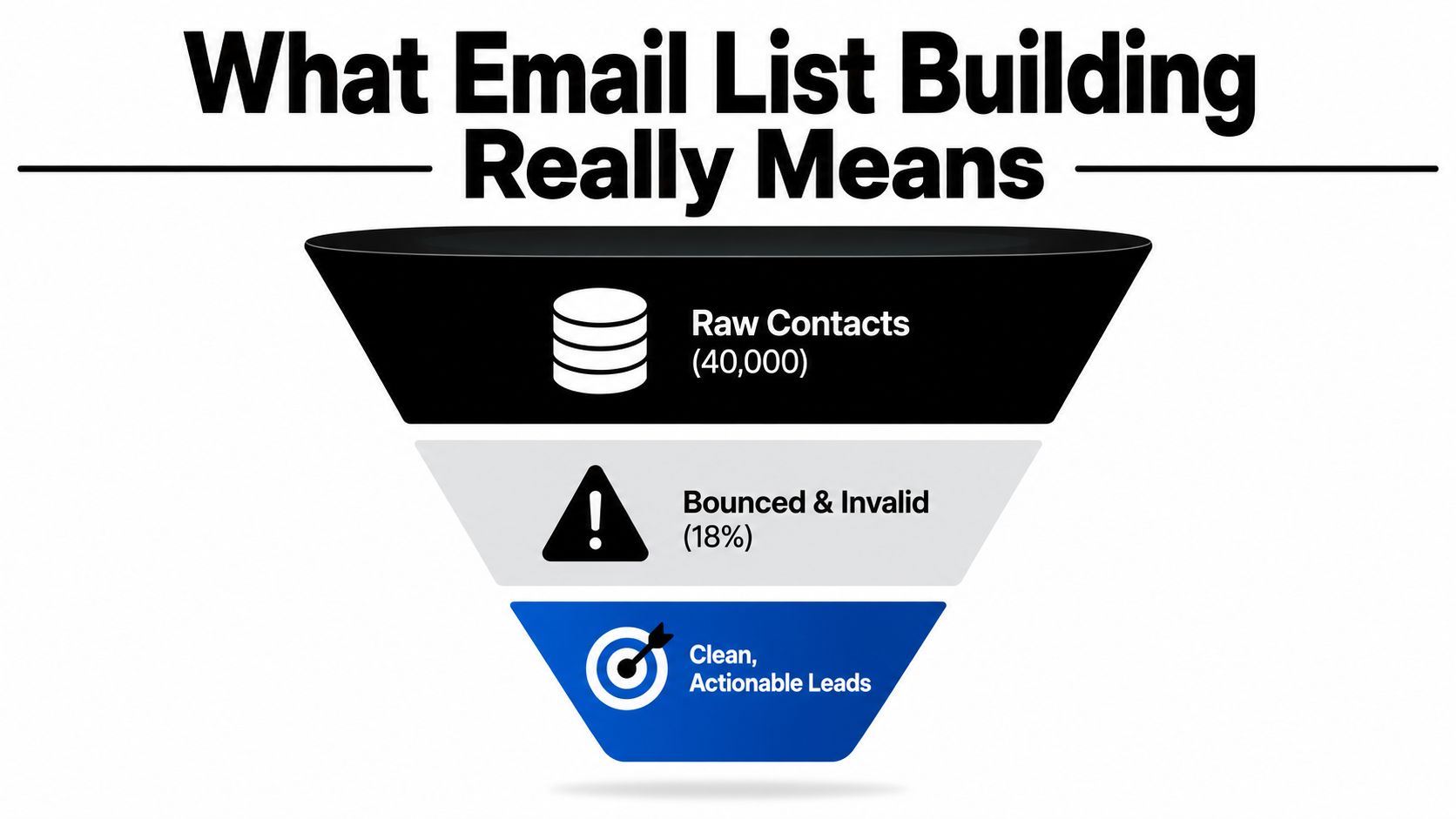
What separates raw signups from usable contacts
The raw signup only becomes useful after the record can answer basic questions. Where did it come from, what role does the person hold, and is the address safe to send to?
That's why the strongest list programs don't celebrate “more names.” They celebrate lower bounce risk, cleaner source attribution, and better routing. If a contact is unverified, unsegmented, and impossible to personalize, it's not really helping growth. It's just inflating the database.
High-ROI Acquisition Sources for B2B Lists
B2B list growth gets messy fast when teams chase every possible channel at once. The better pattern is to pick a few acquisition lanes that match the buying cycle, then run them like separate supply lines. The goal is not just more addresses, it is better intent per address and a predictable path to healthy monthly growth from always-on signup sources, as outlined in the email list building strategies summary.
Four lanes that actually pull their weight
Lead magnets on dedicated landing pages are still the cleanest opt-in path when the offer matches a real pain point. Unbounce-style landing pages, paired with a focused resource, usually beat vague newsletter prompts because the exchange is obvious and the next step feels clear. If you want a practical breakdown of offer framing, the guide on how to build a Kickstarter email list is useful even outside Kickstarter, because it shows how a clear value exchange drives opt-ins.
Webinars and events usually trade volume for intent. A smaller attendee pool can produce better fit than a larger content download list because the topic already filtered for interest. That is why event captures often justify more manual follow-up and tighter segmentation.
Product-led signups work when the product itself gives someone a reason to share an email. Trial flows, gated templates, and account creation pages can all become capture points if the value is obvious and the form stays short. The upside is strong intent, since the person is already interacting with the product.
Outbound-prospected contacts sit in a different bucket. They are not list growth in the classic opt-in sense, but they matter in B2B because teams can verify and enrich records before sending from a separate outbound motion, often with tools and data workflows covered in this marketing data sources overview. The key is to keep consent boundaries clear and never mix acquisition logic that belongs in different systems.
Measure each lane separately. If you cannot tell whether a form, webinar, or product flow created the best contacts, you are optimizing blind.
Where the math changes
The conversion benchmark matters because small improvements compound. A popup converting at 2.1% on 100,000 monthly visitors yields about 2,100 new subscribers in the cited strategy benchmark. That does not mean popups are always the answer. It means placement and offer quality have real financial impact.
For B2B teams, a simple decision rule works better than chasing every tactic. Pick two or three lanes. One should be an always-on opt-in source, one should capture high-intent moments, and one can be a selective outbound or product-led channel. If a lane cannot be tagged, measured, and improved, it does not deserve budget.
Verification and Enrichment Before Anything Goes to Your CRM
Most list-building guides stop at capture. That's where teams get into trouble. A record should pass through verification before it ever touches your sending infrastructure, because a bad address doesn't just fail once, it keeps depressing performance every time you mail it. Klaviyo recommends double opt-in to confirm real subscribers and also points to cleaning inactive addresses after 6–12 months of no engagement to protect sender reputation Klaviyo's list-building guidance.
Verification is a staged workflow
Start with syntax checks. If the address format is wrong, there's no reason to continue.
Then run domain-level validation. MX presence and basic domain hygiene tell you whether the mailbox domain is set up to receive email. After that, move into catch-all and role-based detection. Catch-all domains need stricter handling because they can hide risky or low-confidence addresses behind a permissive server response, and role-based addresses like info@ or sales@ often need separate treatment depending on the use case.
Enrichment makes the contact usable
A verified email still isn't enough for a rep. If the SDR can't tell whether the contact is a manager, a founder, or a junior operator, personalization stays shallow and routing gets sloppy. Enrichment adds the context that lets your team act on the record instead of just storing it.
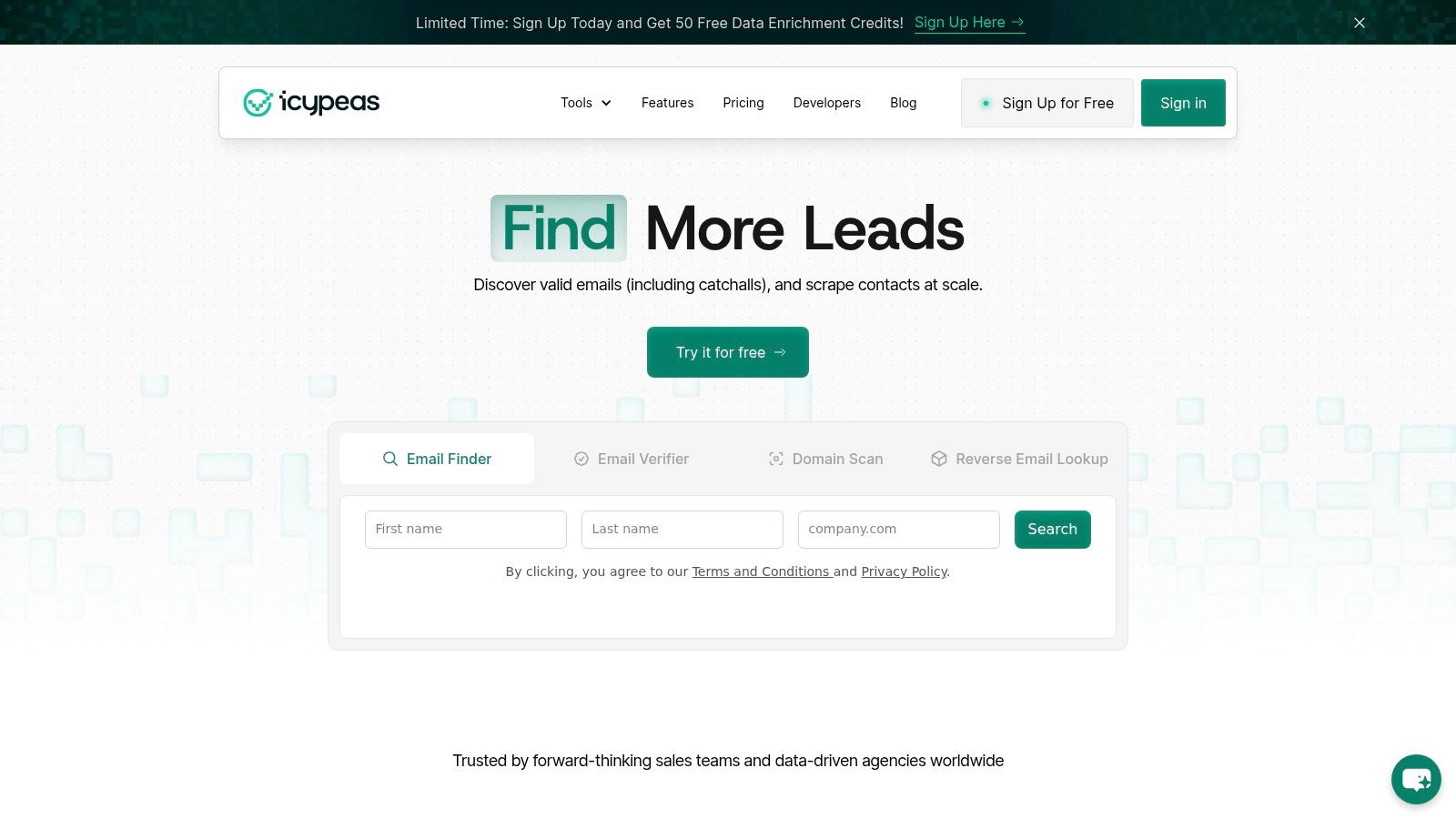
That's where tools in the enrichment stage fit. Icypeas is one option in that workflow, with an Email Finder for missing addresses, an Email Verifier for strict catch-all validation, a Reverse Email Lookup for resolving an address to a profile, and a Lead Database refreshed monthly from open-source intelligence. It also offers a People Scraper for titles and company context, which is useful when your outreach depends on role-aware segmentation. Use it, or any similar system, after consent capture and before CRM import, not after the list is already in circulation.
Clean before scale, always
The mistake is to bulk-import first and verify later. That turns your CRM into a garbage sink and makes every future report harder to trust. A clean list also makes source comparison meaningful, because you can see whether one form or channel produces more valid and engaged contacts than another.
Use this guide to B2B data enrichment tools when you want to compare enrichment functions by stage instead of by feature list.
Deliverability Foundations Every B2B Sender Needs
A clean list can still underperform if the sender setup is broken. Email authentication and reputation sit underneath every campaign, and when that plumbing leaks, acquisition work gets wasted. Deliverability depends on consent, relevance, and regular cleanup, not just on having more contacts.
Authentication comes first
SPF tells receiving servers which senders are allowed to send on behalf of your domain. DKIM signs the message so the recipient can confirm it was not altered in transit. DMARC tells inbox providers how to handle messages that fail those checks, which gives you policy control and visibility.
That order matters. Teams often try to fix engagement before fixing authentication, but the smarter move is to get domain identity stable first. If the identity layer is shaky, list quality improvements will not show up where they should.

Reputation is built by behavior, not intention
Inbox providers watch engagement signals, complaint patterns, and sending consistency. That means the list, the content, and the cadence all shape reputation together. A new domain blasting a cold list carries a very different risk profile from a warmed subdomain sending to a verified opt-in audience.
Warm-up should be deliberate. Keep outbound and marketing mail on separate sending identities when possible, so one stream's behavior does not contaminate the other. New infrastructure should start conservatively, then expand only after the list shows it can sustain healthy engagement.
A sender that grows faster than its reputation can support usually pays for that growth with inbox placement.
Four lanes that deliver consistent results
The operational view matters here. B2B teams get better results when they treat list building as collect, verify, enrich, segment, then send, instead of piling names into a CRM and hoping the mailbox providers sort it out. A good rule is to build the path from capture to inbox before you scale volume, because every weak handoff creates avoidable bounce and complaint risk.
That is where verification and enrichment tools fit. Icypeas is one option in that workflow, with an Email Finder for missing addresses, an Email Verifier for strict catch-all validation, a Reverse Email Lookup for resolving an address to a profile, and a Lead Database refreshed monthly from open-source intelligence. It also offers a People Scraper for titles and company context, which helps when outreach depends on role-aware segmentation. Use it, or a similar system, after consent capture and before CRM import, not after the list is already in circulation.
Clean before scale, always
The mistake is to bulk-import first and verify later. That turns your CRM into a garbage sink and makes every future report harder to trust. A clean list also makes source comparison meaningful, because you can see whether one form or channel produces more valid and engaged contacts than another.
Use this guide to B2B data enrichment tools when you want to compare enrichment functions by stage instead of by feature list.
For a broader checklist, this deliverability best-practices guide is useful when you are auditing sender setup before scaling volume, and website privacy policy requirements matters once you connect capture, consent, and source records into the same workflow.
GDPR and CCPA Compliance Without the Legal Headache
Compliance feels abstract until a contact asks where you got their email. Then the process either holds up or falls apart. The simplest model is to build consent and source documentation into capture, so the legal side is part of list building rather than a cleanup exercise later. For practical website-level framing, these privacy policy requirements for websites are a helpful reference.
Keep the form honest
For EU audiences, the practical split is between consent and legitimate interest. For list growth forms, consent is usually the cleaner operating assumption because it fits opt-in capture and avoids confusion about the relationship. The signup form should make the value exchange obvious, explain what the subscriber is getting, and point to the privacy policy in plain language.
For US teams handling CCPA-related obligations, the form and footer workflows should make opt-out and disclosure straightforward. The point isn't legal theater, it's making the data flow visible to the user. If a person wants to unsubscribe or ask for deletion, your internal process should make that request easy to route and honor.
Avoid the shortcuts that create risk
Purchased lists and scraped lists are the fastest way to create a compliance and deliverability problem at the same time. They also make source documentation impossible, which means you can't confidently explain where the data came from or whether the user opted in. Open-source intelligence plus explicit opt-in is a safer operating model because it keeps provenance visible.
That's also why compliance and enrichment shouldn't be treated as opposing goals. You can enrich a record after consent capture without weakening the permission basis. The rule is simple, build the record from traceable sources, and keep the user's expectation aligned with the way you plan to use the address.
If your team can't explain a contact's origin in one sentence, the process needs work.
Segmentation and Automation Workflows That Turn Subscribers Into Pipeline
A SaaS team runs a webinar and gets 200 signups. If everyone goes into one generic nurture stream, the follow-up burns intent. If the list is segmented by source, role, and behavior, the same signups can move into different paths, and that is where pipeline starts to show up.
Source tags change the whole conversation
The first automation step is straightforward, tag every subscriber by entry source. Webinar registrant, blog form, product signup, outbound prospect. Those tags tell you what the person agreed to, what problem they probably care about, and what follow-up message fits.
Behavioral signals matter too. A demo request should trigger a different path than a pricing-page visit. Demographic filters, such as industry or headcount, help tighten the route, but behavior usually gives a clearer read on urgency.
The handoff should be boring
The best CRM-connected workflows feel almost dull. Marketing-qualified leads go to SDRs with the source tag, role data, and recent activity already attached. Product-qualified leads can route to customer success or lifecycle nurture without a manual export. The rep should not have to ask where the lead came from or what campaign pulled it in.
A simple welcome sequence can do a lot of work:
- Email one, confirm value. The open rate matters most here.
- Email two, deliver the promised asset. Track click-through to the resource.
- Email three, add a relevant use case. Watch engagement by source.
- Email four, invite a soft conversion. Measure reply or demo interest.
- Email five, branch based on behavior. The signal here is whether the lead keeps engaging or drops off.
If you need a clean way to map source tags back to reporting, the Icypeas marketing data sources overview helps organize the upstream inputs before they hit your CRM.
Metrics, Optimization, and Scaling Your List Program
The common mistake is measuring the list by size alone. That creates vanity growth, not a pipeline that works. The metrics worth watching are list growth rate, bounce rate, engagement rate, and pipeline attributable to email.
| Metric | Definition | Healthy Range |
|---|---|---|
| List growth rate | New subscribers added over time from always-on sources | Healthy growth comes from acquisition systems that keep adding qualified contacts |
| Bounce rate | Share of sends that fail because the address is invalid or unreachable | Lower is better, and invalid addresses should be removed before sending |
| Engagement rate | Opens and clicks measured over a rolling 90-day window | Higher engagement is healthier than flat list size |
| Pipeline attributable to email | Opportunities or revenue tied back to email journeys | Should trend with source quality and segmentation depth |
Run the same operating rhythm every month
Start with source quality. If one channel keeps adding contacts that do not engage, fix the source or stop it. Then prune unengaged contacts after the 6–12 month inactivity window noted earlier, because stale records distort reporting and hurt deliverability.
Test one form, one offer, or one placement at a time. If three variables change together, you lose the ability to tell what worked. Re-verify any list segment before a major send, especially when the source is old or the list has been sitting outside your active sending flow.
Scaling comes last. Add new acquisition lanes only after the current ones are clean, measured, and repeatable. If sending volume is growing faster than reputation, add infrastructure carefully and separate marketing mail from outbound where possible.
For teams that want a tighter list-building pipeline, Icypeas covers the verification and enrichment layers that keep bad records out of your CRM and usable records moving toward pipeline. Visit Icypeas if you want to compare address finding, verification, reverse lookup, and enrichment in one workflow and see how it fits into your own list-building system.








































.png)



.webp)