.avif)
Sales vs Business Development: Roles, KPIs, and Playbooks

.avif)
You can feel the split before anyone says it out loud. A founder asks for growth, recruiting sends one salesperson, one BDR, and one business development manager, and suddenly the core question is not who looks strongest on paper, it's what work the team needs done this quarter.
In most B2B teams, that decision gets muddied by titles. Some companies use sales and business development interchangeably, others stretch one person across prospecting, partnerships, demos, and closing, and then wonder why pipeline is inconsistent or follow-up feels chaotic. The practical answer sits in three places, time horizon, pipeline stage, and team maturity.
| Criteria | Sales | Business Development |
|---|---|---|
| Core job | Convert existing demand into revenue | Create new demand and pipeline |
| Primary focus | Discovery, demos, negotiation, closing | Prospecting, partnerships, market expansion |
| Time horizon | Short-cycle execution | Longer-cycle growth building |
| Main KPIs | Revenue, conversion, closed-won deals | Pipeline created, partnerships, new-market growth |
| Typical handoff point | Takes over after qualification | Works upstream before the deal is ready |
Table of Contents
The Question Most B2B Teams Get Wrong
The wrong question is, “Should we hire sales or business development?” The better question is, “What part of the revenue motion is broken right now?”
A lean startup that still needs someone to prospect, run discovery, and close may need a salesperson who can carry the whole motion. A growth-stage team with decent close rates but a thin pipeline usually needs more upstream demand creation, not another closer. A mature B2B business with partner motion, channel opportunities, or new-market expansion has a different problem again, because now the company needs someone thinking beyond immediate bookings.
Start with the work, not the title
That's why this topic is really a team-design problem. Sales and business development are separate functions because they live on different time horizons and solve different bottlenecks, not because one title sounds more senior than the other. The useful lens is simple, does the team need someone to create opportunities that do not exist yet, or someone to convert existing opportunities into revenue?
Practical rule: if the pipeline is thin, fix the upstream motion first. If pipeline exists but deals stall, fix the closing motion.
In smaller teams, the line blurs fast. One person might prospect in the morning, run demos in the afternoon, and manage CRM hygiene after dinner. That's normal, but it doesn't change the underlying split, it only hides it.
If you want a structured way to think about the seller side of the market, the BDR resource from hireSDR.io is a useful reference point because it frames prospecting as a distinct operating role, not just a junior version of sales.
What Sales and Business Development Actually Do
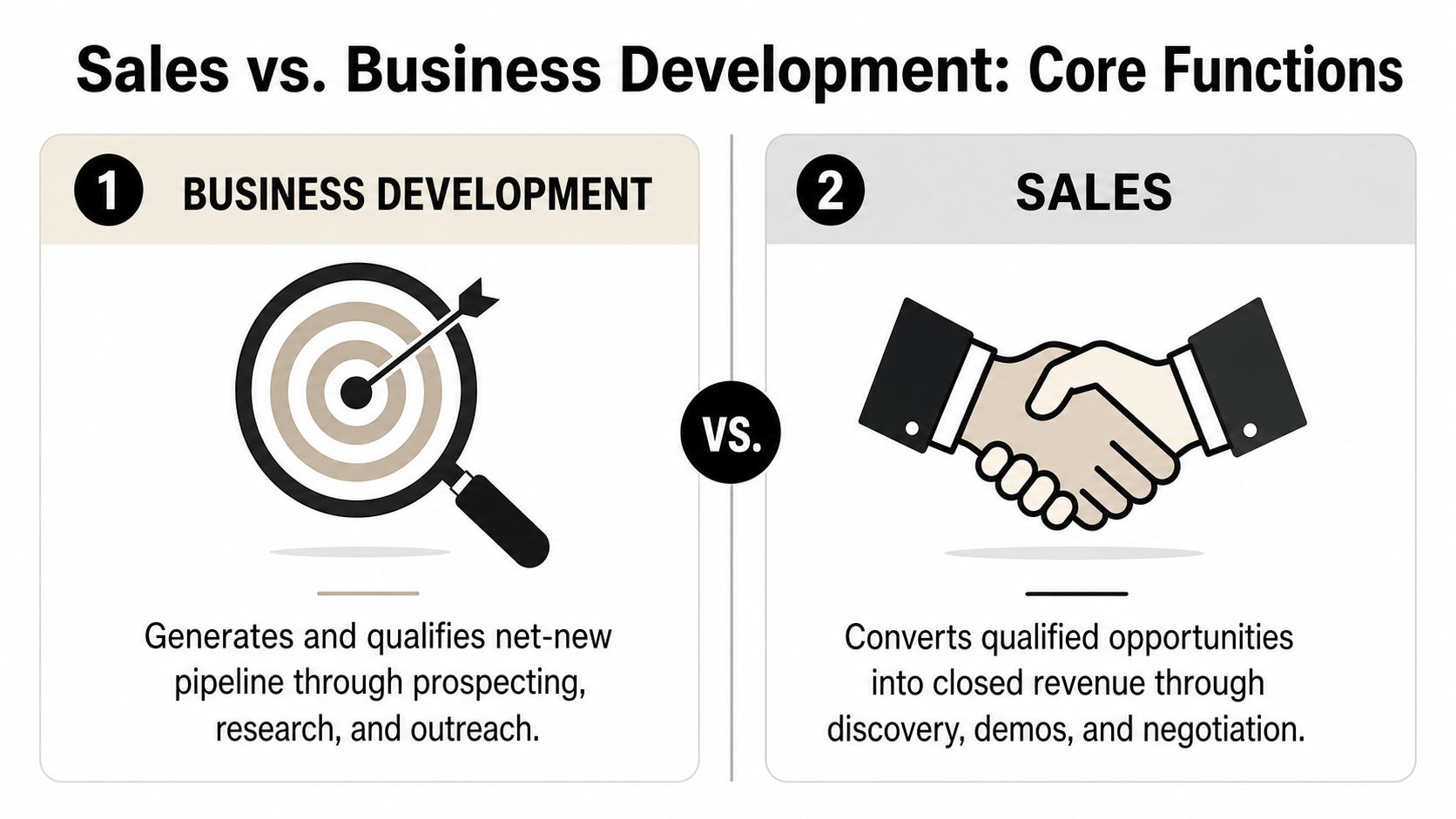
Business development creates market opportunity. Sales turns that opportunity into revenue. That is the cleanest way to explain it to a team, and it holds up better than the usual title debate because it describes the work, not the org chart.
Two motions, two jobs
Business development builds the conditions for a deal to happen in the first place. That can mean outbound prospecting, account research, partnerships, channel exploration, or entering a new segment. Sales starts later, once interest is qualified and the conversation needs discovery, demoing, negotiation, and closing.
The mistake I see most often is treating BD as a junior sales role. It is not. In a healthy revenue team, BD is a strategic, upstream motion, while sales is the execution layer that captures demand already in motion. The two functions sit next to each other, but they are not interchangeable.
Business development teams often work from a list of target accounts and then use tools, research, and outreach to create a meeting. Sales teams usually inherit a live conversation and are expected to move it through mutual evaluation, procurement, and close. That difference matters because it changes how you staff, coach, and measure both roles. It also changes how data enrichment fits the work, since better firmographic and contact data helps BD decide who to approach, while sales usually needs cleaner account context, stronger qualification, and tighter handoff notes once the conversation is already active.
For a practical breakdown of prospecting workflows and prospecting roles, the BDR page on hireSDR.io is a relevant companion read for teams that want to separate list-building from closing work.
Strategic split: business development asks, “Where do new opportunities come from?” Sales asks, “How do we win this one?”
If you're running a B2B company, especially one that sells data, software, or services into accounts that need education before purchase, that split matters even more. Upstream enrichment and qualification work shape how strong the pipeline looks before a salesperson ever joins the conversation. When the handoff is sloppy, sales spends time relearning account basics that BD should have captured. When the handoff is clean, the rep can focus on fit, urgency, and buying process instead of redoing the front end of the work.
A Day in Each Role and How the Work Feels Different
A good BD week feels like controlled accumulation. A good sales week feels like controlled momentum. The cadence is different, and many professionals know within a few days which one feels more natural.

What business development work actually looks like
BD work starts with research. Reps build target account lists, check titles, scan company signals, and decide who is worth reaching out to now versus later. Then comes outreach, usually personalized enough to feel relevant, followed by qualification, meeting booking, and handoff prep.
That work rewards patience and structure. A strong BD rep doesn't just send more messages, they build a cleaner motion over time, better segments, better targeting, better notes, better routing. The best ones are comfortable living in ambiguity because they're often selling a conversation before there's a real sales cycle at all.
What sales work actually looks like
Sales work feels more compressed. Discovery calls stack up, demo prep becomes a recurring ritual, and objections show up quickly because the buyer is now comparing vendors, budget, timing, and internal support. The closer spends less time creating the opportunity and more time protecting it from drift.
Sales is where weak qualification becomes expensive. If the wrong accounts make it through, the AE ends up spending time on deals that were never going to close.
The pace is different too. Sales reps often work around scheduled meetings, follow-up windows, and deal milestones, while BD reps spend more time in the build phase, making sure the next wave of meetings even exists. That's why people who love rapid conversation and negotiation often thrive in sales, while people who like research, systems, and persistence often do better in BD.
The split is useful as a self-selection tool. If someone wants variety but hates repetition, they may prefer sales. If they like creating process and opening doors, BD may fit better.
KPIs, Time Horizons, and How Each Role Is Measured
The KPI stack is where the distinction stops being theoretical. Sales and business development should not be measured the same way because they do not produce value on the same timeline. A useful way to build the right scorecard is to start with the function's job, then choose metrics that reflect that job, which is also why guides on finding true business KPIs are most helpful when they start from operating design, not vanity dashboards.
Sales KPIs versus BD KPIs
| Criteria | Sales | Business Development |
|---|---|---|
| Primary output | Closed revenue | Qualified pipeline |
| Best short-term signal | Closed-won deals | Meetings booked |
| Forecast lens | Near-term conversion and quota progress | Pipeline generation and opportunity quality |
| Time horizon | Short-cycle execution | Longer-cycle opportunity creation |
| Typical focus | Demos, negotiation, close rates | Research, outreach, partnerships, target account penetration |
Sales is optimized around revenue conversion. That means the most actionable measures are the ones tied to money coming in now, closed-won deals, conversion rates, quota attainment, and how quickly live opportunities move through the pipe. Business development is optimized around future pipeline, so the relevant signals are whether the team is creating qualified opportunities, opening new segments, and generating partnerships or account access that can pay off later.
A practical planning benchmark is to treat BD as a longer-horizon function and sales as a shorter-cycle function. In operating terms, that means you forecast BD by the quality and consistency of the pipeline it creates, while you forecast sales by how quickly active opportunities move and close. If you ignore that difference, you either overpromise revenue too early or underinvest in upstream growth.
This is also where bad dashboards do damage. If you judge BD only by closed revenue, you punish the function for not doing the job of sales. If you judge sales only by activity volume, you can inflate effort without improving outcomes. That's why scorecards should mirror the accurate handoff.
For teams building reusable scorecards, the performance scorecard templates from Icypeas are a practical way to think about role-specific metrics without collapsing both motions into one sheet.
Forecasting rule: if the metric can't tell you whether next month's pipeline is healthier, it probably belongs on a different scorecard.
The Handoff Between Business Development and Sales
The handoff is where revenue teams win or leak time. A clean one saves hours, a messy one creates rework, stalled deals, and blame between reps.
What clean handoff data looks like
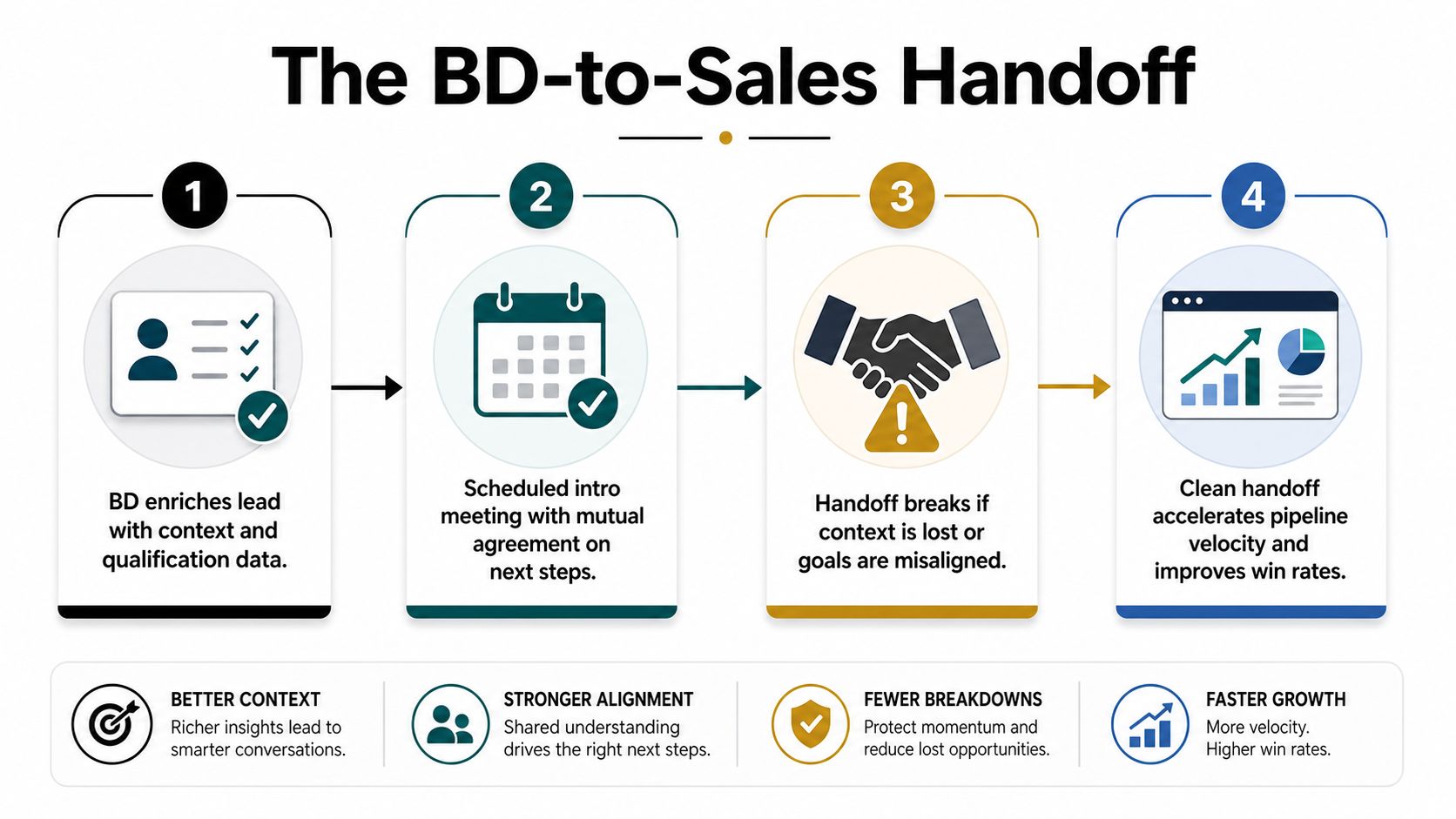
A BD rep books a meeting with a target account, but the work shouldn't stop there. The best handoffs include a verified contact record, company context, notes on why the account was targeted, and a clear sense of what was promised in the first conversation. Without that context, the AE has to rebuild the story before the actual sales conversation can start.
That's where enrichment matters. B2B teams that use verification and lead data upstream create cleaner pipeline before sales takes over, and the reason is simple, the handoff determines whether the organization has enough qualified pipeline or enough closing capacity. If the record is incomplete, the AE wastes time chasing basic facts instead of moving the opportunity forward.
In practice, a BD rep might use an email finder and verifier to reach the account, confirm the right contact, schedule the intro, and pass a richer record into the CRM. The AE then opens with context, not guesswork. When that workflow is clean, the buyer feels continuity instead of repetition.
Where handoffs break
Handoffs usually fail in three ways. First, the meeting was booked with the wrong person. Second, the notes are thin and the AE doesn't know why the account mattered. Third, expectations weren't aligned, so sales walks into a call that BD framed too loosely.
A good handoff feels boring. The AE knows who the buyer is, what the problem is, and what needs to happen next.
If you want a compact view of the closing side of that process, the close-the-deal guide on Icypeas is useful because it sits right at the point where prospecting work ends and deal work starts. That boundary is where enrichment data earns its keep.
When to Hire Which Role First
The right hire depends on the bottleneck, not the org chart. In early teams, I've seen founders hire the wrong motion first because the title sounded familiar, then spend months wondering why the problem didn't improve.
A simple hiring rule
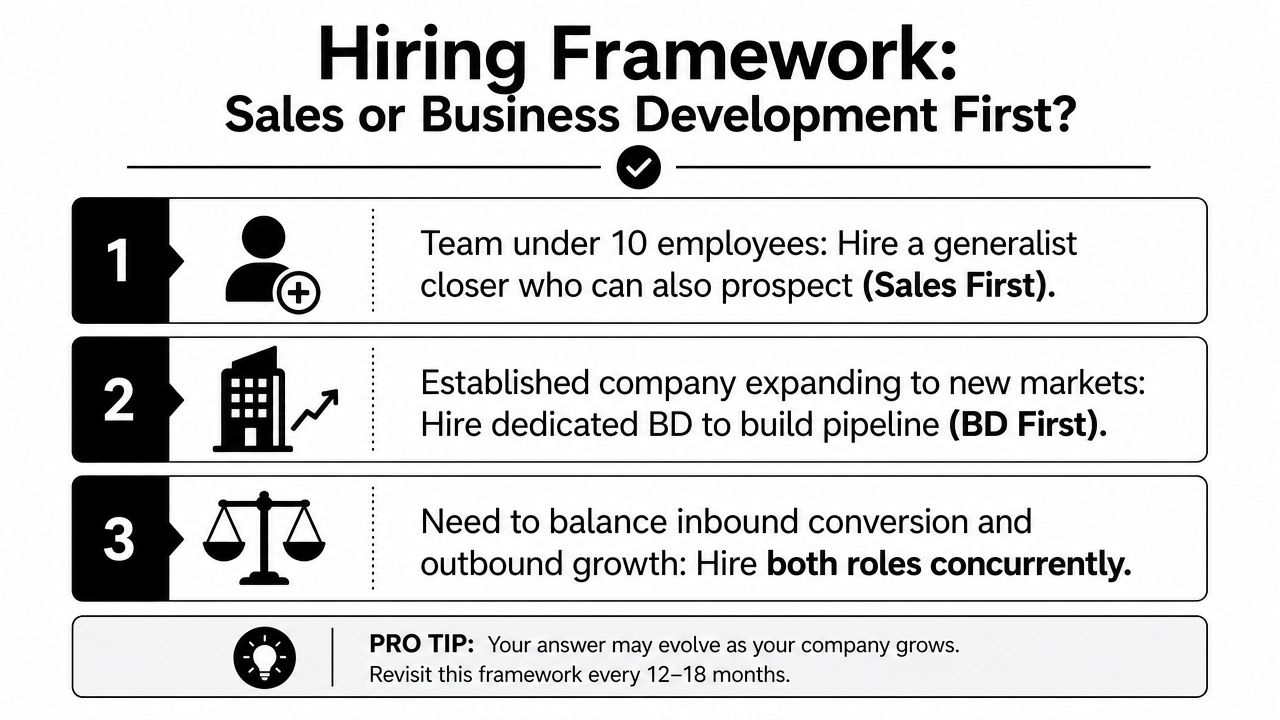
If the team is very small, usually under ten people, the first hire often needs to be a generalist closer who can also prospect. In that phase, the company needs revenue momentum more than specialization. The person has to carry the whole conversation, even if that means BD and sales live inside the same role.
If the company already has product-market fit but the pipeline is flat, the next hire should often be BD before another AE. More closers without more opportunities just creates idle capacity and pressure. You don't fix a dry pipe by adding more buckets.
If the company is mature, sells into multiple segments, or wants partner and channel revenue, a dedicated BD lead becomes more valuable. At that point, someone needs to think about market expansion, alliances, and strategic doors that a quota-carrying salesperson won't have time to open.
Hiring test: if your problem is “we're not getting enough qualified opportunities,” hire upstream. If your problem is “deals keep slipping after they're created,” hire for closing strength.
A few signals usually make the answer obvious:
- Too little pipeline: the team is busy, but the funnel isn't filling.
- Too many dead-end demos: the right accounts aren't getting qualified early enough.
- Strong interest, weak close: sales needs help with conversion, not more prospecting.
- New market motion: someone has to open territory before the quota team can capitalize on it.
The cleanest hire is the one that removes the actual constraint.
Tools, Playbooks, and Where Enrichment Fits In
Tools should match the job, not the title. BD needs speed in list-building and qualification. Sales needs context, conversation quality, and forecast visibility. The best stack keeps those motions separate without making them disconnected.
A practical stack for each function
For BD, the core tools are an email finder and verifier, a reverse lookup tool for inbound leads, and a lead database that can filter by company size, industry, and title. That's the upstream work: build the target list, confirm the contact, and make sure the record is clean before outreach starts. Icypeas fits naturally in that layer as one enrichment option for outbound list-building and inbound qualification.
For sales, the stack shifts. Conversation intelligence helps with call review, a CRM anchors pipeline stages to revenue, and quoting or proposal tools keep the deal process moving once the opportunity is real. Sales doesn't need more raw names, it needs better signals on what's likely to close.
A simple playbook for each motion
BD sequence:
- Build a targeted account list.
- Verify the contact data and personalize the first touch.
- Follow with a short sequence that references a real trigger, a role change, a product shift, or an expansion signal.
Sales workflow:
- Review account context before the call.
- Walk into discovery with a clear hypothesis.
- Log objections, next steps, and stakeholder detail immediately after the conversation.
If you want a broader operating lens on how tools support revenue motion, the founder's guide to sales growth from DMpro is a useful companion because it treats enablement as a system, not just a set of content assets.
The point of enrichment is not to add more data for its own sake. It is to reduce avoidable friction before a human rep spends time on the account.
For teams building their enrichment layer, the lead enrichment tools page on Icypeas is a practical reference for how upstream data work connects to both prospecting and qualification.
Mapping the Functions to Your Own Team
The cleanest summary is still the oldest one. Business development creates opportunities. Sales closes them. Everything else is implementation detail, including who owns the CRM cleanup, who books the meeting, and which tool sits in the middle of the workflow.
A short team mapping check
- If your pipeline is weak, look at BD, list quality, and outreach coverage.
- If your close rate is weak, look at sales discovery, qualification, and follow-up.
- If your handoff is messy, look at enrichment, notes, and CRM discipline.
- If automation can handle part of the work, reserve human time for the strategic judgment and live conversations that still matter most.
The modern wrinkle is AI. It's changing how much research, drafting, and qualification can be automated, which means the boundary is shifting toward strategic ownership versus execution speed. The teams that do this well won't argue about titles for long, they'll decide which activities need humans, which can be automated, and where the handoff should sit.
Core distinction: BD owns opportunity creation. Sales owns revenue conversion.
If you want to explain the difference inside your own team, say it this way, “BD opens doors and builds pipeline, sales turns qualified demand into booked revenue.” Then map your tools to that sentence, not the other way around.
If you're trying to clean up the handoff between prospecting and closing, Icypeas gives you the enrichment layer that both motions can use, from verified work emails to account context and lead data. Visit Icypeas to see how cleaner records can support both business development and sales without forcing your team into two separate point solutions.








































.png)



.webp)