.avif)
10 Best Email List Cleaning Tools for 2026


.avif)
You've got a campaign queued up, the list looked fine in the CRM, and then the send report comes back with more bounces than you expected. That's the moment many teams realize that email list cleaning tools aren't a nice-to-have, they're part of the infrastructure that protects sender reputation, wasted spend, and future inbox placement. The best tools do more than catch obvious typos, they help you manage SMTP checks, catch-all handling, disposable domains, and ongoing hygiene so the list stays usable between uploads and sends. For practical context on where the market is headed, see the Gritt.io investor search.
The reason this category matters is simple. Email data degrades quickly, with one 2026 guide putting decay at roughly 2 to 3% per month and noting that over 20% of a database can go bad in a year, which is why cleaning is treated as ongoing hygiene rather than a one-time purge (clean list guide). Pricing also makes the category easy to operationalize, since a 2026 overview pegs average costs at $0.003 to $0.01 per email, with a 250,000-email list costing about $750 to $875 on major tools, while real-time verification can catch 70 to 90% of bad addresses before they enter the database (category overview). That's why the best choice depends less on brand and more on the job you need done.
Table of Contents
1. Icypeas, Free Email Verifier
Icypeas is the first tool I'd look at when the job is quick, strict validation before a send. The free verifier is built for teams that want to trim risky contacts fast, without turning list hygiene into a separate project. It fits especially well when your real problem is not enrichment, but whether a contact should stay in the sendable pool at all. 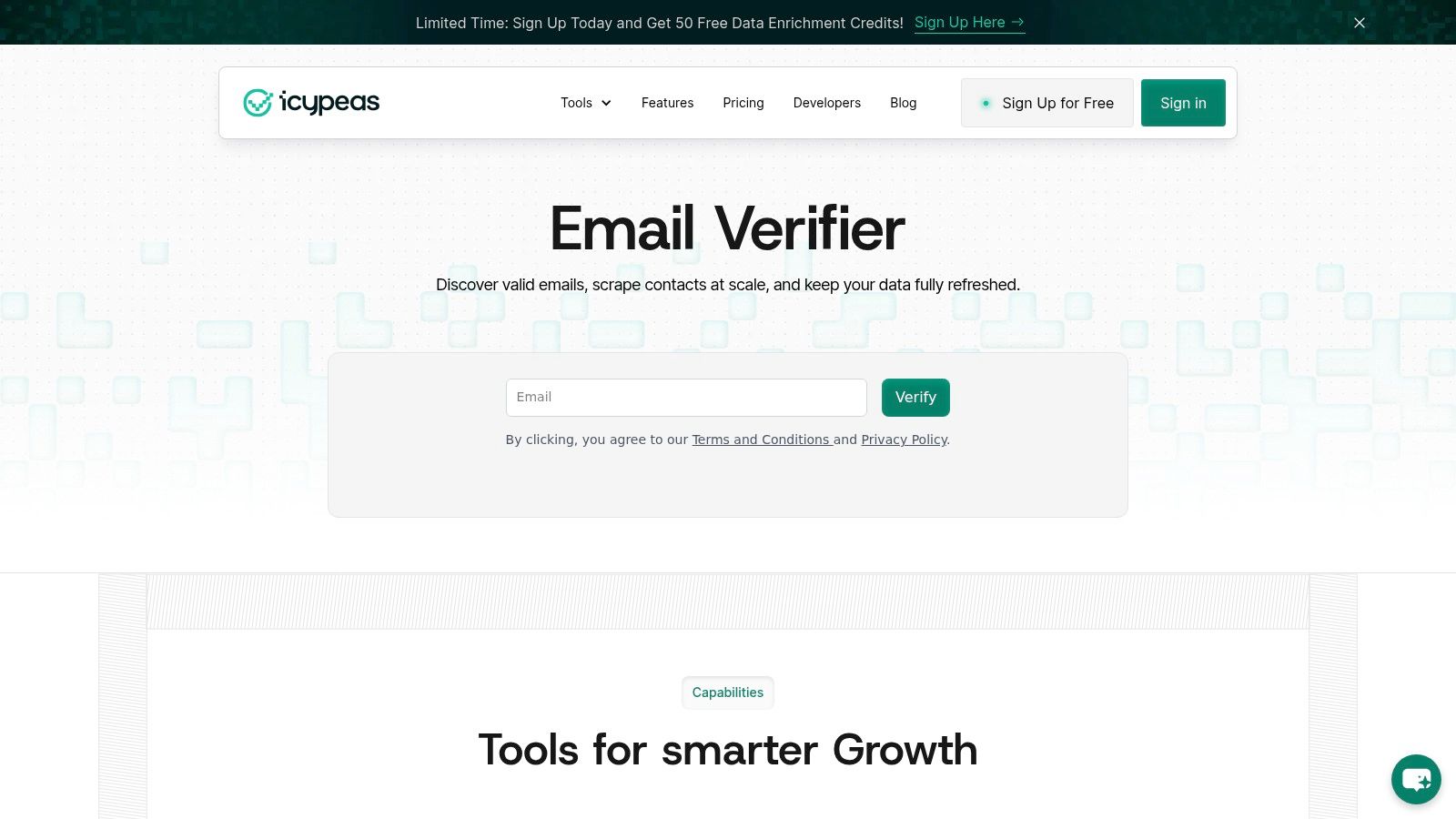
The practical edge here is the stricter validation posture, including Google and Microsoft catch-all verification in the broader Icypeas stack, which matters because catch-alls are exactly where a lot of false confidence comes from. Icypeas is also useful when you want a tool that can start as a web verifier and then scale into API-driven workflows without forcing a vendor switch later. That makes it a natural fit for sales ops, RevOps, and outbound teams that clean lists, sync CRM data, and keep signup flows tighter over time.
Why it works well in practice
Icypeas makes sense when you care about low-bounce decisions, not just raw volume. The broader platform is positioned around B2B contact data, so the verifier sits inside a workflow that can later expand into email finding, reverse lookup, and enrichment. For teams that need to clean, verify, and then automate follow-up data handling, that continuity is a real advantage.
Practical rule: use a strict verifier when the cost of a false positive is higher than the cost of checking one more time.
The trade-off is obvious. The free verifier is focused on validation, so if you need full enrichment like titles, company data, or profile context, you'll need other Icypeas tools or paid workflows. But if your immediate job is to protect send quality before a campaign, that narrower scope is often the right scope. Explore the tool directly on Icypeas.
2. ZeroBounce
ZeroBounce is a good fit when the job is bulk verification plus deliverability tooling in one place. Teams often reach for it when they don't want to stitch together a validator, blacklist monitor, and inbox-placement workflow across separate vendors. It's also one of the clearer choices for organizations that send on a schedule and want credits to stay available until they are used. 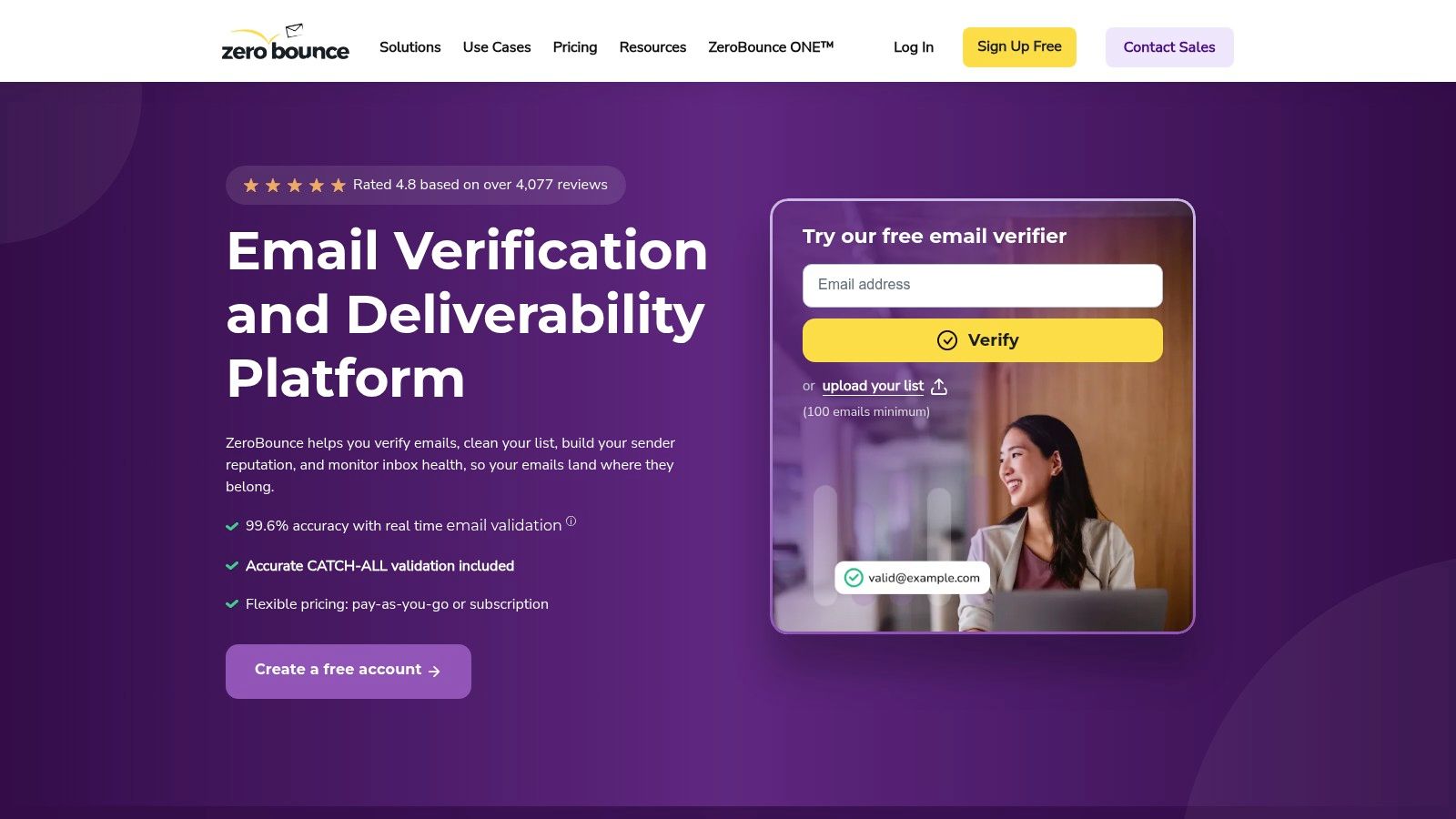
The strongest operational detail is its bulk and API verification layer, backed by a broader suite that includes inbox placement tests, blacklist and DMARC monitors, and warmup seeds. ZeroBounce also publishes a 99.6% validation accuracy claim, and its credits never expire, with unknown results not billed. Those policies matter for teams that clean intermittently, since wasted credits are a real friction point when campaigns happen in bursts.
Where ZeroBounce is useful
This is the platform to consider when verification is only one part of your deliverability process. If you want to review list health, monitor reputation signals, and keep a reusable credit bank for future checks, the product structure makes sense. It can also work well for teams that need support and don't want a bare-bones validator.
The drawback is that the pricing story is more bundle-oriented than some operators prefer. If you only need occasional list cleaning and not the surrounding suite, the platform can feel like more tool than you asked for. For a useful comparison of how validation and real-time verification are often discussed together, see the Icypeas guide to validation software.
3. NeverBounce
NeverBounce is the tool I'd put in front of a team that says, “We have a big list, we want to test it first, and we need the process to be operationally boring.” It's built for bulk jobs, real-time verification, and API usage that can sit inside a larger sending stack. The sample-run feature is especially practical, because it lets teams estimate bounce rate before committing credits. 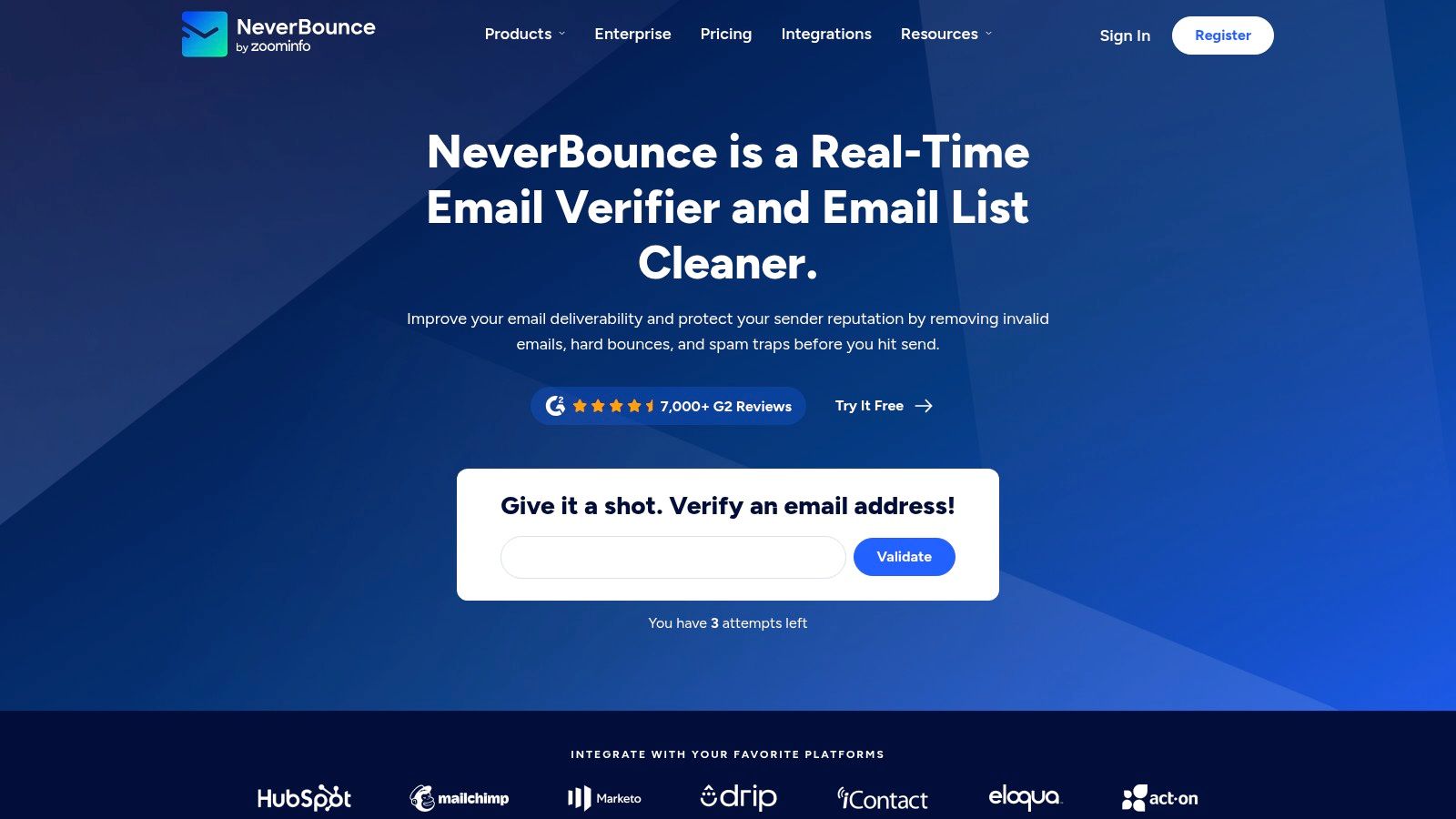
What stands out is the workflow discipline. Credits are charged only for syntactically valid, unique emails in a bulk job, and the product offers SDKs, webhook callbacks, and mature API documentation. That makes it a strong choice for teams that don't just upload lists, they automate cleaning as part of acquisition, routing, and CRM syncs.
Best for large operational lists
NeverBounce fits the “clean it, sync it, keep moving” model. If your team handles periodic list dumps from multiple sources, the hybrid model of real-time and historical intelligence is useful because it doesn't force a single usage pattern. You can use it as a periodic bulk scrubber or as an always-on safeguard around new captures.
The trade-off is pricing transparency. The main site is less explicit than some rivals about per-credit economics, so budget planning can take more digging. For teams that value clear implementation details more than visible sticker pricing, that's usually acceptable. For a related view on real-time verification workflows, read the Icypeas article on real-time email verification.
4. Kickbox
Kickbox works best when the job is straightforward validation with strong ecosystem fit. It's a good middle-ground choice for teams that do periodic cleaning, need a real-time API, and want to plug into common ESP and CRM stacks without a long implementation cycle. The product has been around long enough that many mainstream senders already trust the brand. 
The practical value comes from the mix of bulk verification, real-time verification API, and native integrations, including a HubSpot example in the product ecosystem. Kickbox also offers trial credits, which is useful if you want to test the interface before committing to a workflow. It's not the cheapest option for very large lists, but it's often one of the easier ones to onboard.
Where Kickbox fits
Kickbox is a solid answer for teams that need a dependable verifier more than a full deliverability suite. If the main requirement is to keep bounces down and move verified addresses into existing systems, the setup is uncomplicated. That simplicity is valuable when marketing ops owns the process and doesn't want a developer-heavy maintenance burden.
The main downside is cost at scale. Per-email spending can add up compared with cheaper bulk-oriented providers, so it's a better fit when ease of use and integration matter more than the absolute lowest unit price. If you already run a tight deliverability program, the Icypeas real-time verification guide is useful context for how always-on checks reduce cleanup work later.
5. Bouncer
Bouncer is the tool to review when the job is predictable verification with clear pricing behavior. It's popular with teams that want bulk and API checks without a lot of complexity in the interface or billing model. The fact that credits never expire makes it easier to buy for occasional campaigns without worrying about leftover balance going stale. 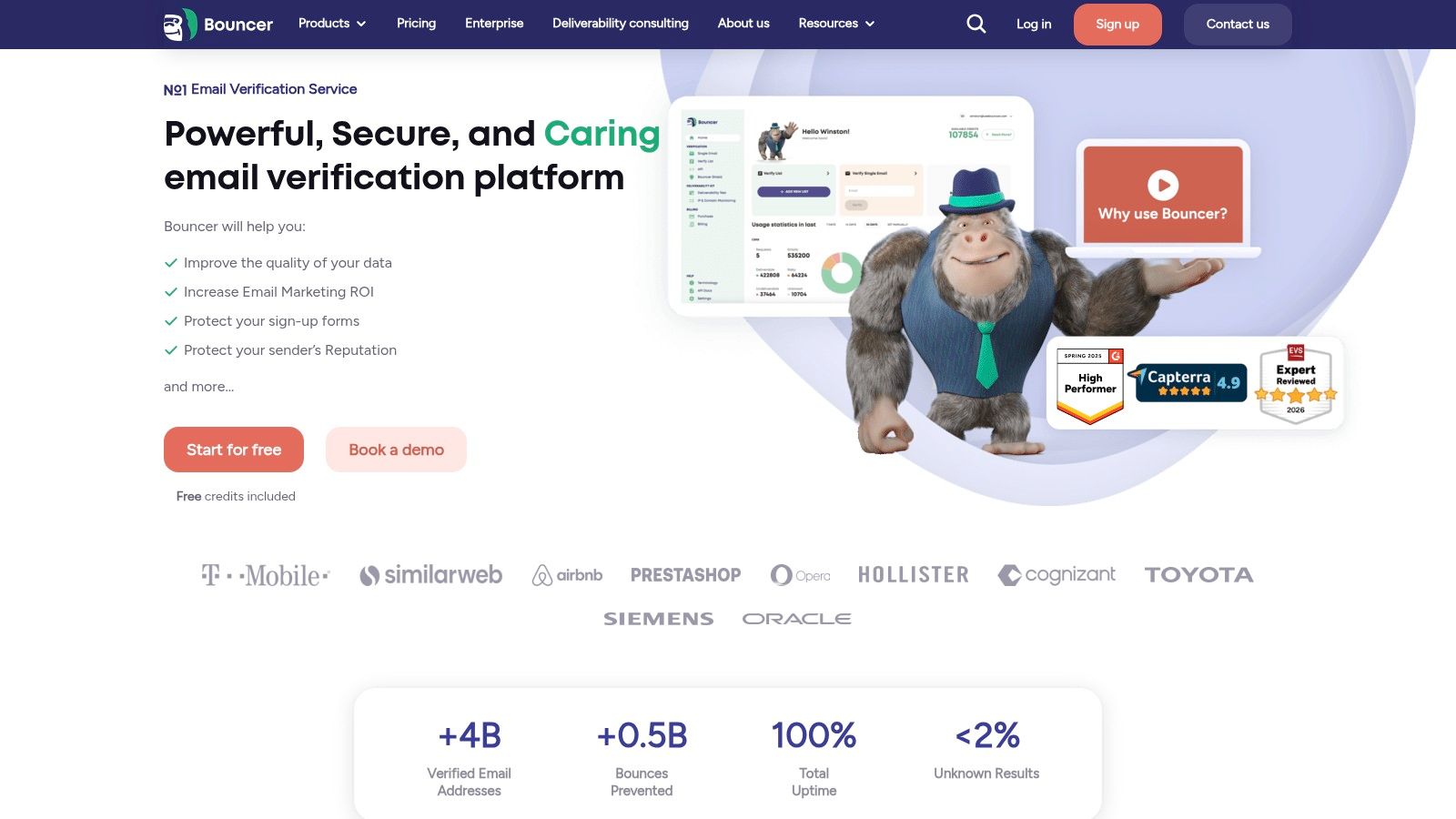
Bouncer's strengths are practical rather than flashy. You get bulk and API validation, detailed status results, and a public pay-as-you-go table. For teams that clean lists sporadically, that combination reduces procurement friction. It's also useful if you prefer a straightforward UI and a workflow that doesn't bury you in extra deliverability modules you may never use.
The cleanest use case
Bouncer makes sense when the team wants to clean a list and move on. That's not a weakness. For many operators, the most valuable tool is the one that clearly tells them which contacts are safe to send and which ones to suppress without creating extra noise.
A good cleaning tool should make the next send safer, not make the dashboard more interesting.
The main compromise is breadth. Bouncer is lighter on broader diagnostics than all-in-one suites, so if you want inbox placement testing or more extensive reputation tooling in the same interface, you may need something else beside it. But as a focused validator, it's easy to recommend for clean, repeatable operations.
6. MillionVerifier
MillionVerifier is a strong candidate when the job is cheap high-volume cleaning. Teams with large lists and tight budgets often care less about extra diagnostic layers and more about getting a lot of addresses checked without overpaying. The brand's positioning is clearly built around aggressive volume economics and automation-friendly usage. 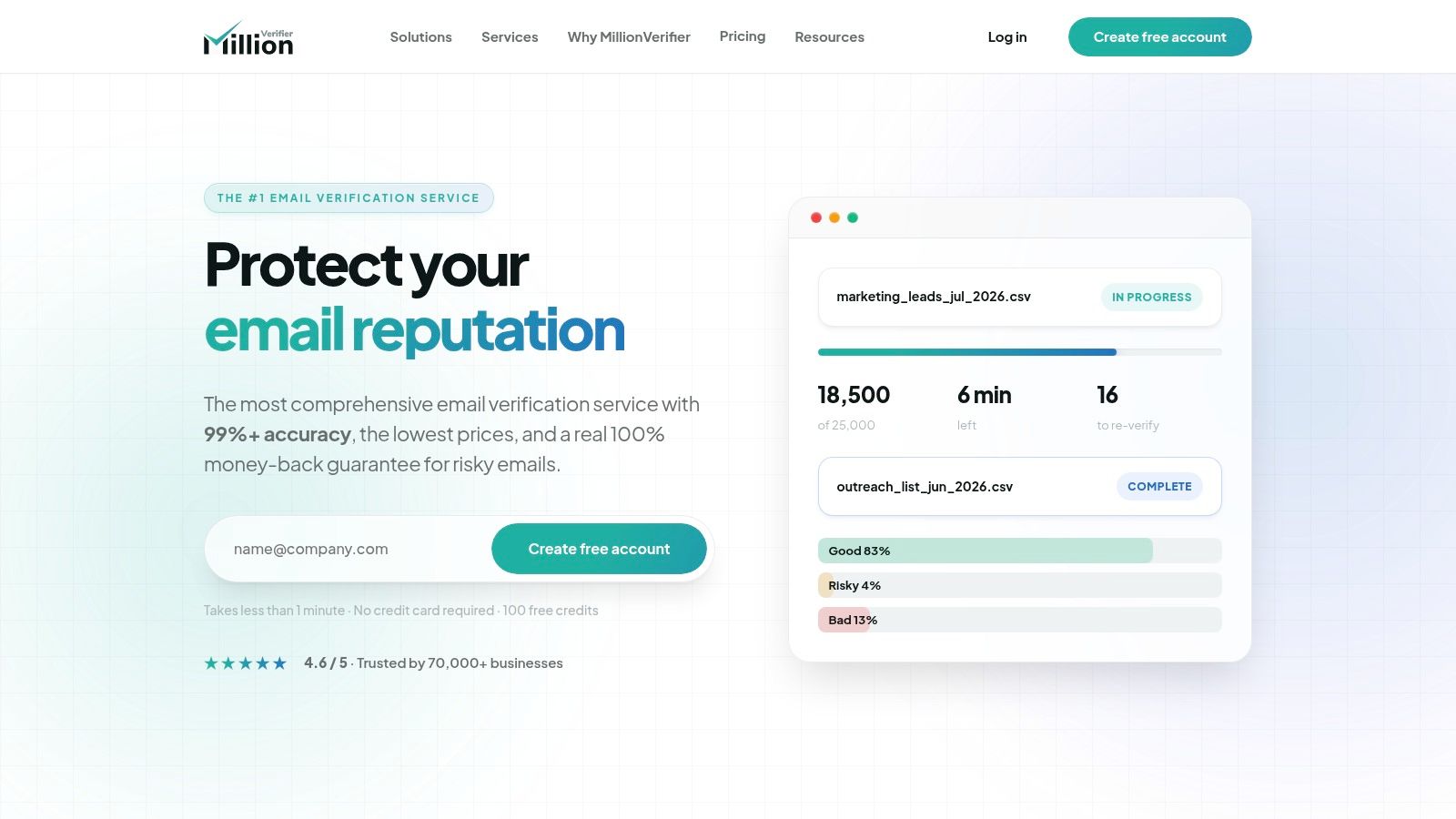
The most notable practical details are its bulk and API verification, automations for daily cleaning, and its policy not to charge for unknown or catch-all emails. The site also states that it can process up to 1M emails in hours, and that combination makes it appealing when list size, not UI sophistication, is the main constraint. It's the kind of tool you buy when the finance team notices cleaning costs before the growth team does.
Best for budget-sensitive scale
MillionVerifier works when your workflow is repetitive. If you need to clean imported lists, sync ongoing captures, or run scheduled hygiene without a lot of handholding, the product structure is aligned with that use case. The free trial credits also help teams test throughput before rolling it into operations.
The trade-off is that the reporting and experience are simpler than premium deliverability suites. That's not a dealbreaker for many teams, but it matters if you need deep diagnostics, inbox placement, or more nuanced reputation tooling. For teams that want a broader operational view, a validator plus separate deliverability stack can still be the better approach.
7. Emailable
Emailable is a good fit when the job is occasional cleaning with a predictable credit model. The platform is especially comfortable for teams that want bulk, API, or widget-based verification without having to think too hard about billing complexity. It feels built for operators who want to test, send, and keep the account tidy over time.
A few rules stand out. Credits never expire, duplicates and unknowns are refunded when they appear in the same list, and users get 250 free credits on signup. Emailable also adds optional deliverability tools like inbox reports and blacklist checks, which gives it a little more range than a bare validator. That transparency helps when you need to explain usage to stakeholders who don't want surprises on the invoice.
Why it feels predictable
Predictability is the reason to choose Emailable. If your campaigns are irregular and you don't want credits disappearing while the list sits untouched, the non-expiring model matters more than a tiny difference in unit cost. The product is also easier to justify internally because the billing logic is easy to explain.
The limitation is depth. If you need heavier diagnostics across inbox placement, content testing, or advanced deliverability troubleshooting, you may outgrow the built-in reporting. That's not a problem if cleaning is the primary job, but it is if you're trying to centralize the whole deliverability program in one place.
8. Clearout
Clearout is the tool for teams that want verification plus a broader hygiene toolkit. It sits well with sales and RevOps users because it goes beyond one-off list cleaning and includes finder, form guard, and prospecting features. That makes it useful when the job is not just removing bad data, but keeping data quality tighter at the point of capture. 
The standout operational detail is its documented ≤3% bounce guarantee for addresses flagged Guaranteed Deliverable, when policy conditions are met. Clearout also supports subscription or pay-as-you-go billing, which gives procurement teams more flexibility than a single pricing lane. For teams that like a named outcome category and a stated policy framework, that clarity is useful.
Best when you need rules, not just results
Clearout works best in organizations that care about how a contact got marked, not just whether it was removed. That matters in sales workflows, where a verified address can feed prospecting, enrichment, and follow-up. It also fits teams that prefer a pricing guide they can plan around.
The fine print matters here. The guarantee depends on timely sending and other conditions, so the policy needs a careful read before anyone assumes the result is absolute. The tool is strong for risk management, but only if the team uses the rules correctly.
9. DeBounce
DeBounce is a sensible choice when the job is ongoing hygiene with easy credit accounting. It gives operators a straightforward mix of bulk processing, real-time API verification, and list monitoring, which is useful when the list doesn't just need one clean-up, it needs repeated checks over time. The model is clear enough that teams can reason about it without a pricing spreadsheet.
The big practical draw is list monitoring. It re-validates and can sync results back to sending platforms, which helps counter the slow decay that makes old lists risky. DeBounce also keeps credit usage simple, with one credit per verification, and provides filters for disposable, role, syntax, MX, and other common issue types.
Good for scheduled hygiene
DeBounce fits teams that want a dependable maintenance layer. If you clean lists regularly and want a tool that can keep pace with new signups and recurring audits, the monitoring add-on matters more than a fancy dashboard. It's also a strong option for operators who want a developer-friendly workflow without overpaying for bells and whistles.
The trade-off is scope. DeBounce puts less emphasis on inbox placement and broader deliverability testing than all-in-one suites, so if that's part of your job, you'll need a second tool. As a validator and hygiene layer, though, it covers the job cleanly.
10. MailerCheck
MailerCheck is best when the job is verification plus lightweight deliverability checks in the MailerLite ecosystem. Teams already using MailerLite often like the convenience of keeping verification and deliverability testing under one roof. For smaller teams, that simplicity can matter more than having a specialist stack with more moving parts.
Its core billing rule is easy to understand, 1 credit = 1 verification, and the platform adds Email Insights and Inbox Placement tools billed in credits as well. It also offers a small free credit allotment so users can test the service before committing. The appeal here is clarity, especially for occasional cleaning and campaign prep.
Where it fits best
MailerCheck is a practical pick if your team already lives inside MailerLite or wants a single vendor for verification and basic deliverability tasks. It reduces tool sprawl, which is a real win for lean marketing teams that don't want to manage separate subscriptions for every hygiene task.
The downside is economics at the top end. Flat per-credit pricing can be less attractive for very large volumes than providers built around deep-discount bulk usage. For teams that send occasionally and value simplicity, that trade-off is often acceptable.
Top 10 Email List Cleaning Tools, Comparison
| Provider | Core features | Quality (★) | Unique selling point (✨) | Target (👥) | Price/value (💰) |
|---|---|---|---|---|---|
| Icypeas, Free Email Verifier 🏆 | Free web verifier; strict catchall-aware validation; scales to API & enrichment suite | ★★★★★ | ✨ GDPR/CCPA + ISO27001, integrates with 575M people DB; tight deliverability focus | 👥 Marketers, sales ops, growth teams, developers | 💰 Free one-off checks; scalable API credits (never expire) |
| ZeroBounce | Bulk & API validation; deliverability tools (inbox tests, DMARC, warmup) | ★★★★☆ | ✨ Deliverability suite; unknowns not billed | 👥 Deliverability teams & marketers | 💰 Credits never expire; freemium 100/mo |
| NeverBounce | Bulk + real-time; SDKs, webhooks; sample-run for bounce estimates | ★★★★☆ | ✨ Sample-run & hybrid real-time + historical checks | 👥 Large-scale list processors, ops teams | 💰 PAYG with in-app pricing (transparent in dashboard) |
| Kickbox | Bulk uploads, real-time API, ESP/CRM integrations | ★★★★ | ✨ Easy onboarding and ecosystem connectors (HubSpot etc.) | 👥 SMBs & periodic cleaners | 💰 Trial credits; straightforward pricing (per-email can add up) |
| Bouncer | Bulk & API validation; clear pay-as-you-go; non-expiring credits | ★★★★ | ✨ Competitive per-email costs & simple developer flow | 👥 Cost-conscious teams at scale | 💰 Pay-as-you-go; credits don't expire |
| MillionVerifier | High-volume bulk & API; fast throughput and automations | ★★★ | ✨ Aggressive volume discounts; written refund policy for excess bounces | 👥 High-volume senders | 💰 Very low per-email at scale; free trial credits |
| Emailable | Bulk, API, widget; transparent credit rules and basic deliverability checks | ★★★★ | ✨ Duplicates/unknowns refunded in-list; 250 free sign-up credits | 👥 Occasional campaign senders, SMBs | 💰 Predictable tiers; credits never expire |
| Clearout | Verification + finder + form-guard; integrations and flexible billing | ★★★★ | ✨ 'Guaranteed Deliverable' flag with ≤3% bounce guarantee (terms apply) | 👥 Risk-averse senders & list managers | 💰 Subscription or PAYG; transparent pricing |
| DeBounce | Real-time API + bulk; list monitoring and detailed filters | ★★★★ | ✨ Ongoing list monitoring that syncs results to platforms | 👥 Teams needing continual hygiene | 💰 1 credit per check; clear PAYG billing |
| MailerCheck | Bulk verification; inbox placement & content insights | ★★★ | ✨ Native MailerLite integration and inbox insights | 👥 MailerLite users & small teams | 💰 Flat per-credit model; small free credit allotment |
Choosing the Right Tool for Your Deliverability Goals
Choosing the right email list cleaning tool comes down to the job you need done. If your priority is API-first automation and strict validation for professional contact data, Icypeas is the strongest fit because it can start as a quick verifier and scale into broader B2B workflows without changing vendors. If your team needs a deliverability suite around the verifier, ZeroBounce and MailerCheck are more all-in-one, while NeverBounce and DeBounce are easier to justify when you need repeatable bulk jobs and ongoing hygiene.
The pricing model matters as much as the feature set. Tools with non-expiring credits are often the cleanest fit for teams that clean lists intermittently, because they don't penalize you for buying ahead of a campaign. Budget-sensitive operators usually lean toward platforms that make bulk cleaning cheap enough to run often, while teams with strict governance requirements care more about auditability, suppression handling, and reversible workflows than about the lowest unit cost. That last point is often overlooked, but it matters, because the best cleaning process is usually also a data-governance process.
For most B2B teams, the decision is whether the tool is helping you do one of three jobs well. First, prevent bad data from entering the system with real-time verification. Second, clean large legacy lists without making the workflow painful. Third, keep the database usable over time with monitoring, audit-friendly suppression, and repeat verification. The more clearly a vendor matches one of those jobs, the better the fit.
If your stack is developer-heavy, favor tools with APIs, webhooks, and clear status codes. If your team is marketing-led, favor tools with simple UI, transparent credit rules, and exports that make the next send easy. And if you manage multiple systems at once, pick the platform that makes it easiest to keep your list clean between acquisition, CRM syncs, and outbound sends, because that's where most deliverability issues start.
Icypeas gives you strict email verification for B2B workflows, plus the option to grow into enrichment and automation as your hygiene process develops. If you want a cleaner list, fewer bounces, and a path from one-off checks to API-driven workflows, visit Icypeas and see how it fits your stack.



















































































.png)



.webp)