.avif)
Top B2B Sales Enablement Tools for 2026

.avif)
Your reps probably have the same problem right now. They know the pitch, they know the target account, and still they waste minutes digging for the right deck, the right proof point, or the right contact detail before they can send anything useful. That's why modern b2b sales enablement tools aren't just “nice to have” software, they're the system that keeps content, readiness, engagement, and data working together so sellers can sell.
The big mistake is looking for one magic platform. There isn't a single best tool for every team, because enablement breaks into different jobs. Some tools manage content, some train reps, some guide outreach, and some keep your data clean enough that the rest of the stack doesn't fall apart. The smart move is to build a stack, not buy a slogan.
This guide breaks the scene into four practical layers, Content, Readiness, Engagement, and Data, then walks through ten tools that fit those jobs in a real GTM environment. The goal is simple, help you see what belongs at each layer, what overlaps too much, and where a specialist tool creates more value than another bloated all-in-one suite.
Table of Contents
1. Icypeas
If your enablement stack starts with content but your data is messy, everything downstream gets weaker. Icypeas sits at the foundation layer, because clean contacts, deliverable emails, and usable enrichment are what make sequencing, personalization, and CRM hygiene work.
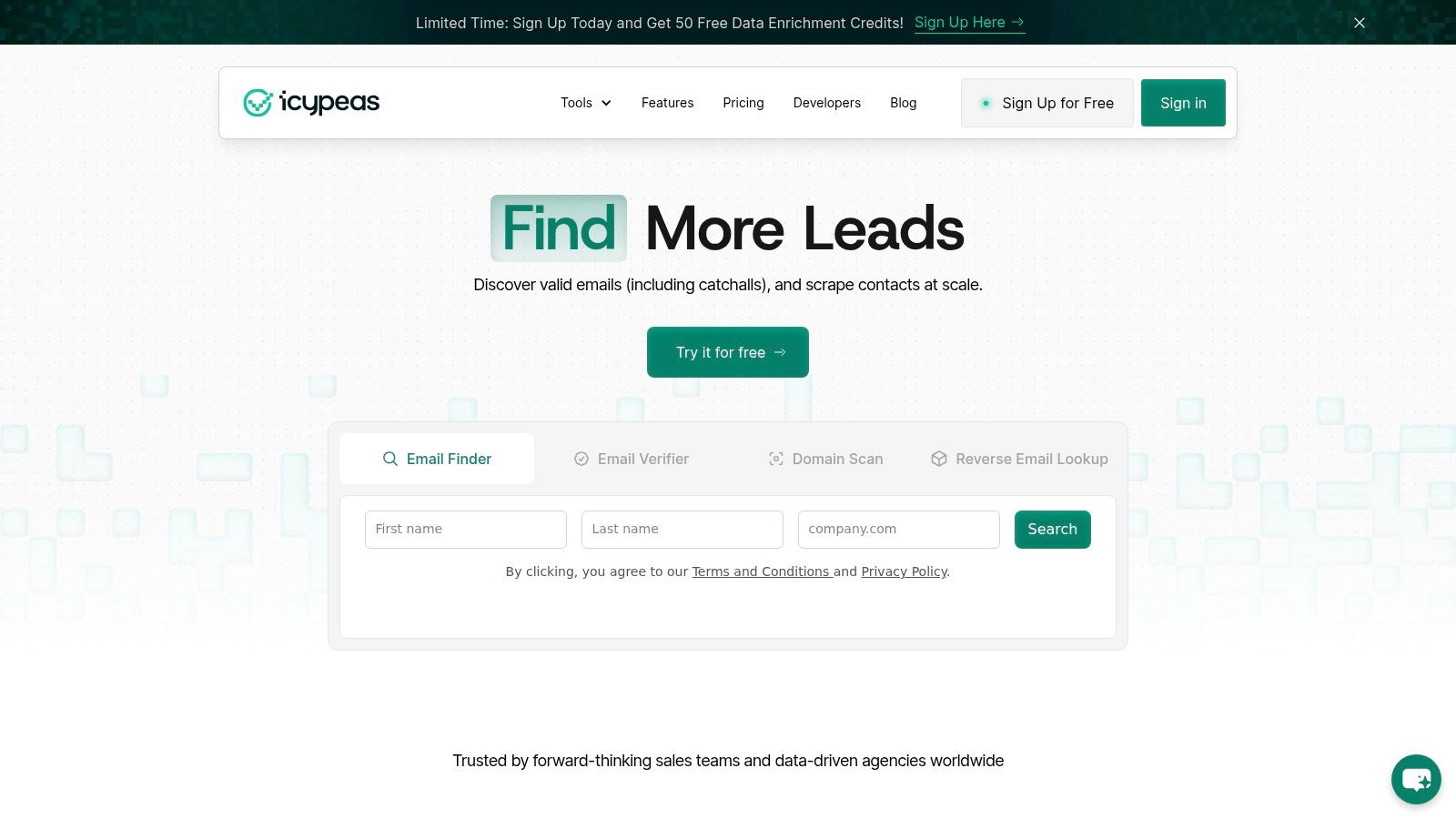
Its core value is practical. The Email Finder helps teams discover work addresses from names and domains, the Email Verifier is built for strict validation, including Google and Microsoft catchalls, and the Reverse Email Lookup can resolve an address into a fuller professional profile. For teams that live inside outbound motions, that combination matters more than a flashy dashboard.
Why it belongs first in the stack
Icypeas also stands out because it's built for operators and builders, not just buyers of large suites. It offers a developer-friendly API, flexible pay-as-you-go credits that never expire, and simple web tools for quick checks. The company also positions its data as open-source intelligence from cached public sources, with GDPR and CCPA alignment and ISO 27001-certified hosting, which makes it easier to defend from a compliance and data-governance angle.
Practical rule: if your team spends money on engagement tools before fixing data quality, you're paying to automate bad inputs.
The trade-off is that Icypeas is a specialist, not a full sales intelligence monument. It won't replace your CRM, your engagement platform, or your coaching layer, and it doesn't pretend to. That's exactly why it works well for teams that need deliverability, accuracy, and fast integration more than a giant suite with features they won't use.
The platform's value also comes from scale. Icypeas says it has a lead database of 575M people and 62M companies, refreshed monthly, and reports 7,000+ users. Those figures matter because this category only works when the underlying data is broad enough to support prospecting, enrichment, and list hygiene without forcing reps back into manual research. You can explore the product directly at Icypeas.
2. Seismic
Seismic is the enterprise answer to content governance. When marketing, legal, enablement, and sales all touch the same assets, the risk is usually not lack of content, it's the wrong version, the wrong claim, or the wrong file getting sent to a buyer.
Seismic is built for that problem.

The platform brings centralized content management, sales plays, learning, coaching, buyer engagement, and analytics into one system. That matters most in regulated or global environments where content approvals and usage controls can't be improvised by individual managers. If your team has multiple regions, multiple product lines, and multiple compliance gates, Seismic gives you a way to standardize execution.
Where Seismic earns its keep
The biggest win is governance. Reps can find approved material without guessing, and leaders can keep a tighter grip on what gets surfaced, personalized, and sent. That said, enterprise governance is never free. The trade-off is administrative complexity, and dedicated enablement ops resources are needed to keep the system useful rather than cluttered.
Seismic makes the most sense when your real problem is not “how do reps get content,” but “how do we make sure the right content is always the one they use.”
The platform also fits teams that want content analytics tied more closely to revenue execution than to simple asset storage. But buyers should be honest about fit. If your team is small, fast-moving, and still figuring out its messaging, Seismic can be more platform than you need. It is strongest when content sprawl is already a measurable operational burden.
3. Highspot
Highspot works best when content and readiness need to live together instead of in separate systems. That's useful for teams that don't just want reps to find assets, they want reps to know how to use them in the field.
Highspot combines content management, sales plays, training, coaching, buyer engagement, and analytics in an AI-driven GTM platform. It also leans into agent-style assistance, with features like Deal Agent and GTM Agent meant to surface next-best actions and adapt guidance as deals move.

That matters in mid-market and enterprise SaaS teams where managers want more than file storage. They want a system that supports methodology, coaching, and content usage in the same workflow. Highspot's strength is that it doesn't separate “where is the deck?” from “how should the rep sell with it?”
What makes it different in practice
The best use case is a team that already has content, but needs better adoption and cleaner execution. Highspot's analytics help leaders see which assets move deals, while its training and role-play features can reinforce the method behind the message. The platform also fits teams that care about structured coaching without wanting to bolt on a completely separate readiness stack.
Watch the hidden cost: advanced AI and agent features are only useful if your managers actually change their coaching habit to match them.
The trade-off is budget and change management. Highspot tends to live in enterprise conversations, and it usually needs buy-in from enablement, revenue ops, and frontline managers before the value shows up. For teams that want a lighter content repository, it can be too much. For teams that need a system that connects content to execution, it's one of the clearest fits.
For teams also optimizing process design, the practical benefit is that the platform can reinforce a better sales motion rather than just host files, which is why many operators pair it with workflow discipline like sales process optimization.
4. Showpad
Showpad sits in a useful middle ground. It's broad enough to support enterprise enablement, but it still keeps a strong emphasis on buyer engagement and coaching rather than turning into a giant content archive no one opens.
Showpad combines centralized content with learning, coaching, buyer engagement rooms, and governed AI through Showpad Genie. That makes it attractive for cross-functional teams where sales, marketing, and customer success all need to pull from the same approved set of materials.

The appeal is balance. Showpad doesn't force you to choose between content and readiness, and it doesn't treat buyer engagement as an afterthought. That makes it a strong option when the problem isn't a single department, but the handoff between them.
Where Showpad fits cleanly
It works especially well when reps need a guided place to share assets with buyers and then track what happens next. That buyer-facing layer matters because enablement isn't only internal. If the prospect never engages with the material, the rep still has to do the same follow-up work with less context.
The downside is the usual enterprise one, quote-based packaging and enough moving parts that some teams will still need admin help. Showpad is not the cheapest path to “good enough.” It's a better fit for organizations that want a real operating layer around enablement, not just a content folder with better branding.
5. Mindtickle
Mindtickle is the readiness-first choice in this group. If your biggest pain is onboarding, certification, skill measurement, and consistent manager coaching, it makes more sense than starting with a pure content platform.
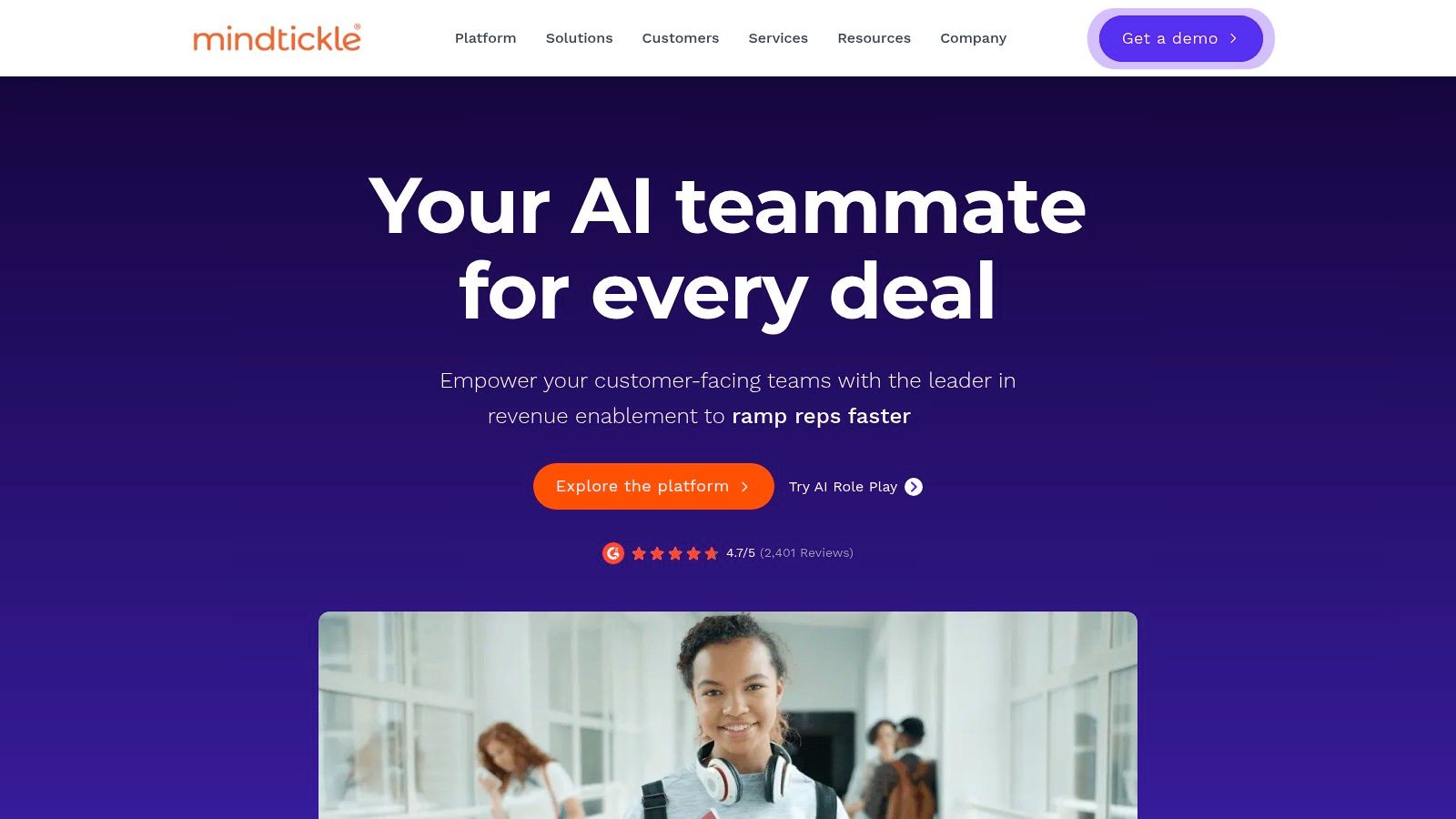
Mindtickle brings structured onboarding, certification, ongoing training, coaching, conversation intelligence, content, and digital sales rooms into one environment. That broad scope is useful when leadership wants to measure whether reps are ready, not just whether they attended training.
Best for readiness, not just learning
The best teams use Mindtickle to make onboarding more systematic. That means certifications, skill progression, and ongoing reinforcement instead of one-off sessions that disappear the moment a rep hits the field. It's particularly attractive where managers need proof that a rep can handle the conversations the job demands.
When readiness is the bottleneck, more content won't fix the problem. Reps need practice, feedback, and visible milestones.
The trade-off is overlap. If your company already pays for an LMS or conversation intelligence tool, Mindtickle can step on some of the same territory. It's strongest when you want a dedicated readiness layer and are willing to let it become part of the operating cadence, not just a training library that people ignore after launch.
6. Allego
Allego is a serious enterprise option for teams that care about learning, coaching, and compliance in the same system. It's especially relevant where every conversation and every asset needs structure, not just access.
Allego combines a unified hub for content, learning, and coaching with GenAI search and tagging, digital selling, and analytics. The pitch is simple, keep enablement discoverable and measurable without asking reps to leave the tools they already use.
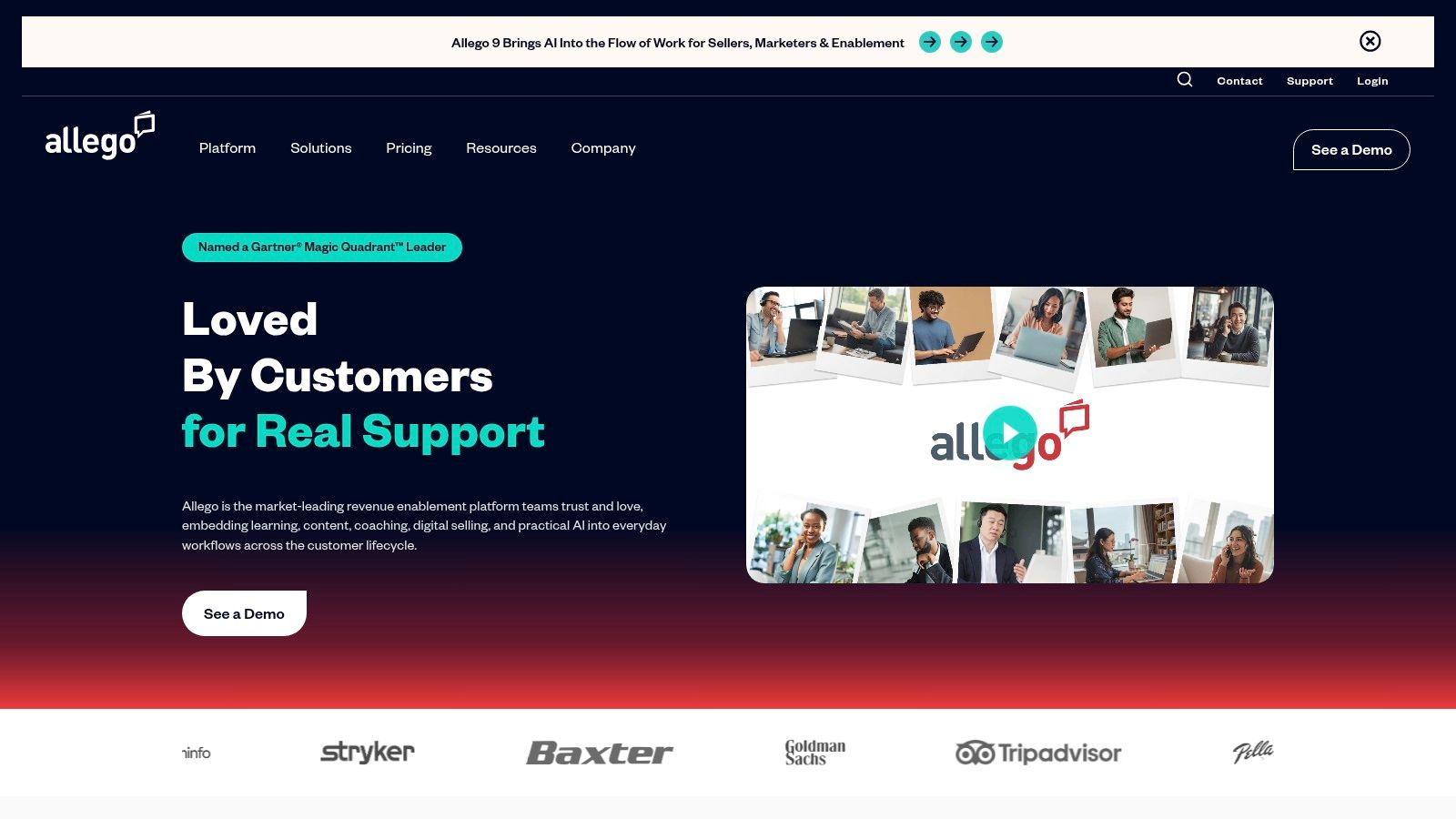
The platform's strongest use case is regulated industries and large organizations with tighter governance needs. If compliance approval, call documentation, and structured coaching all matter at once, Allego becomes more compelling than a lighter enablement tool.
Why some teams pick Allego over a broader suite
Its real advantage is that it packages coaching and conversation intelligence with readiness, so managers can work from one environment instead of stitching together multiple systems. That helps teams that want fewer vendor handoffs and a cleaner training motion.
The downside is that it can be more than a content-only team needs. If your reps mainly need easier access to approved assets, Allego may feel heavier than necessary. It's a better fit when readiness is central to your sales model, and when compliance is part of everyday work rather than a quarterly exception.
7. SalesHood
SalesHood is practical when you need enablement programs launched fast. It's less about enterprise sprawl and more about getting onboarding, SKOs, messaging, and peer learning running without a long setup cycle.
SalesHood blends a content hub, training, coaching, and program analytics with prebuilt templates for common enablement motions. That gives teams a head start on the work most companies procrastinate on, like building a structured onboarding path or standing up an SKO program that doesn't collapse after the event.

Where SalesHood is strongest
The value is speed and standardization. Smaller enablement teams often don't need a massive platform, they need a repeatable way to launch programs across the field and see whether people are participating. SalesHood is good at that middle layer where structure matters but enterprise complexity would just slow everything down.
The trade-off is depth. It's lighter than Seismic or Highspot for content operations, so if your team has a large, governed asset library, you may eventually outgrow it. For many teams, though, that's fine. The point is to solve the current enablement problem without buying the future one too early.
8. Spekit
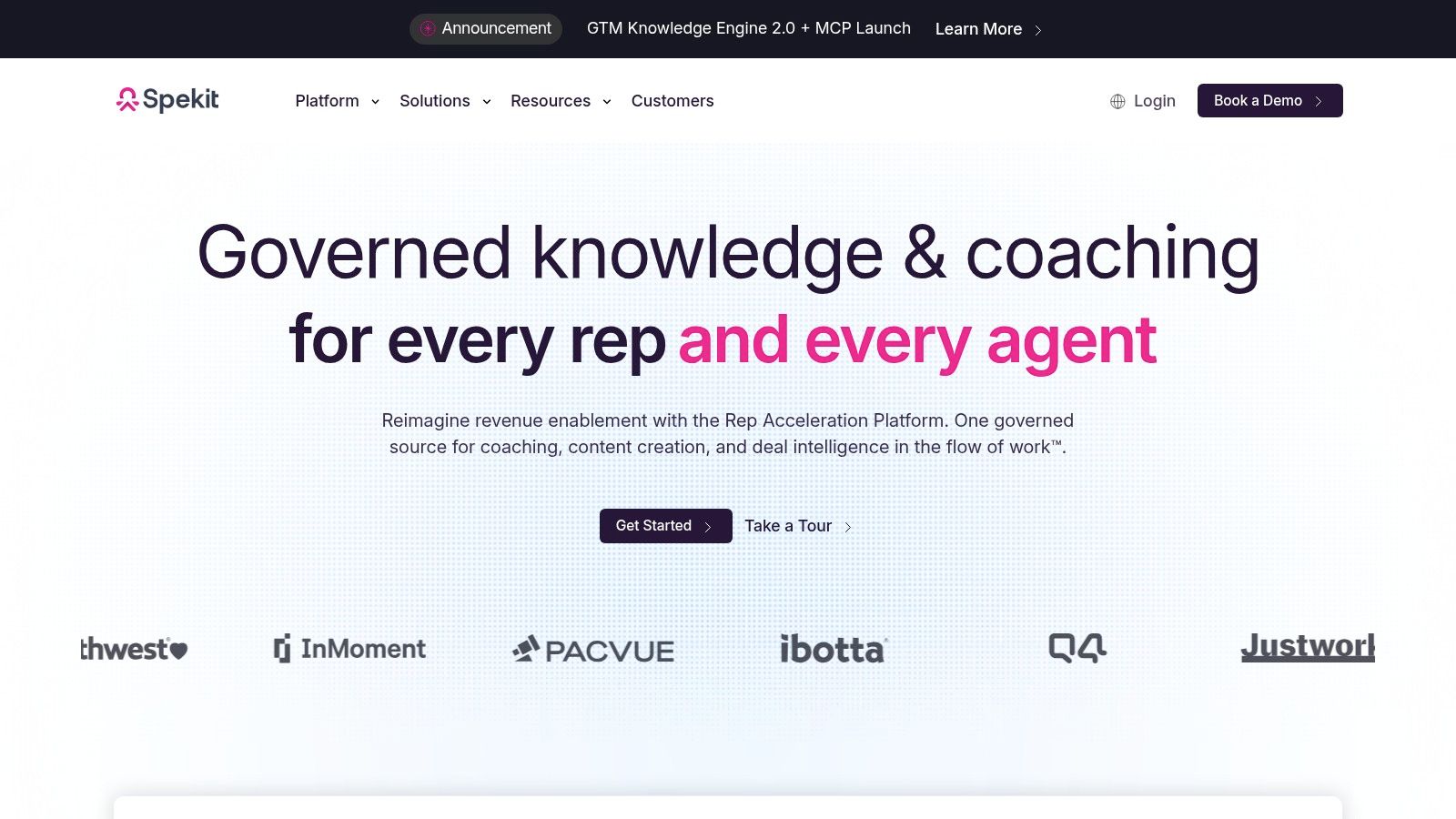
Spekit solves a different problem from most enablement platforms. Instead of asking reps to go looking for answers, it puts guidance inside the tools they're already using.
Spekit delivers contextual enablement in Salesforce and other GTM tools, with learning paths, communications, AI content creation, and analytics. That makes it especially useful for tool adoption, process reinforcement, and day-to-day reminders that need to show up in the flow of work.
Why reps actually use it
Reps use Spekit because it reduces friction. Nobody wants to leave Salesforce, open another tab, search a knowledge base, and then return to the task they were already doing. In-app guidance is easier to absorb and easier to repeat, which is why Spekit pairs well with heavier platforms rather than replacing them.
Best fit: teams that already have content and training elsewhere, but need adoption to happen inside the workflow.
The limitation is scope. Spekit is not a full content operations system, and it won't replace a deep enablement suite. It works best as a complement, especially when you need the last mile of reinforcement after a new process, product change, or playbook update.
9. Outreach
Outreach is what most sales teams reach for when execution has to scale. If you need structured sequences, multichannel outreach, and tight pipeline workflows, it belongs in the engagement layer of the stack.
Outreach supports email, calls, and social sequencing, with deep Salesforce integration and automation for SDR and AE teams. It's the platform that turns a sales motion into a repeatable operating cadence instead of a set of personal habits.

That's why it gets paired so often with data and enablement tools. Outreach is only as good as the list quality, messaging quality, and process discipline behind it. If those are weak, the automation just helps you move faster in the wrong direction.
Why it belongs beside enablement, not instead of it
The best use case is consistency at scale. Large SDR and AE teams need shared sequencing logic, shared follow-up behavior, and admin control over how outreach runs. Outreach gives you that backbone, but it doesn't solve content creation or coaching by itself.
For prospecting-focused teams, that's where enrichment matters. If the contact data is stale or incomplete, even the best sequence underperforms. Teams that treat Outreach as the answer to a data problem usually end up disappointed, which is why it pairs naturally with prospecting discipline and a clean enrichment layer like sales prospecting tools.
10. Gong
A manager finishes listening to a late-stage deal call and notices the rep missed the buying trigger the customer mentioned twice. That kind of moment is where Gong earns its place in a b2b sales enablement tools stack.
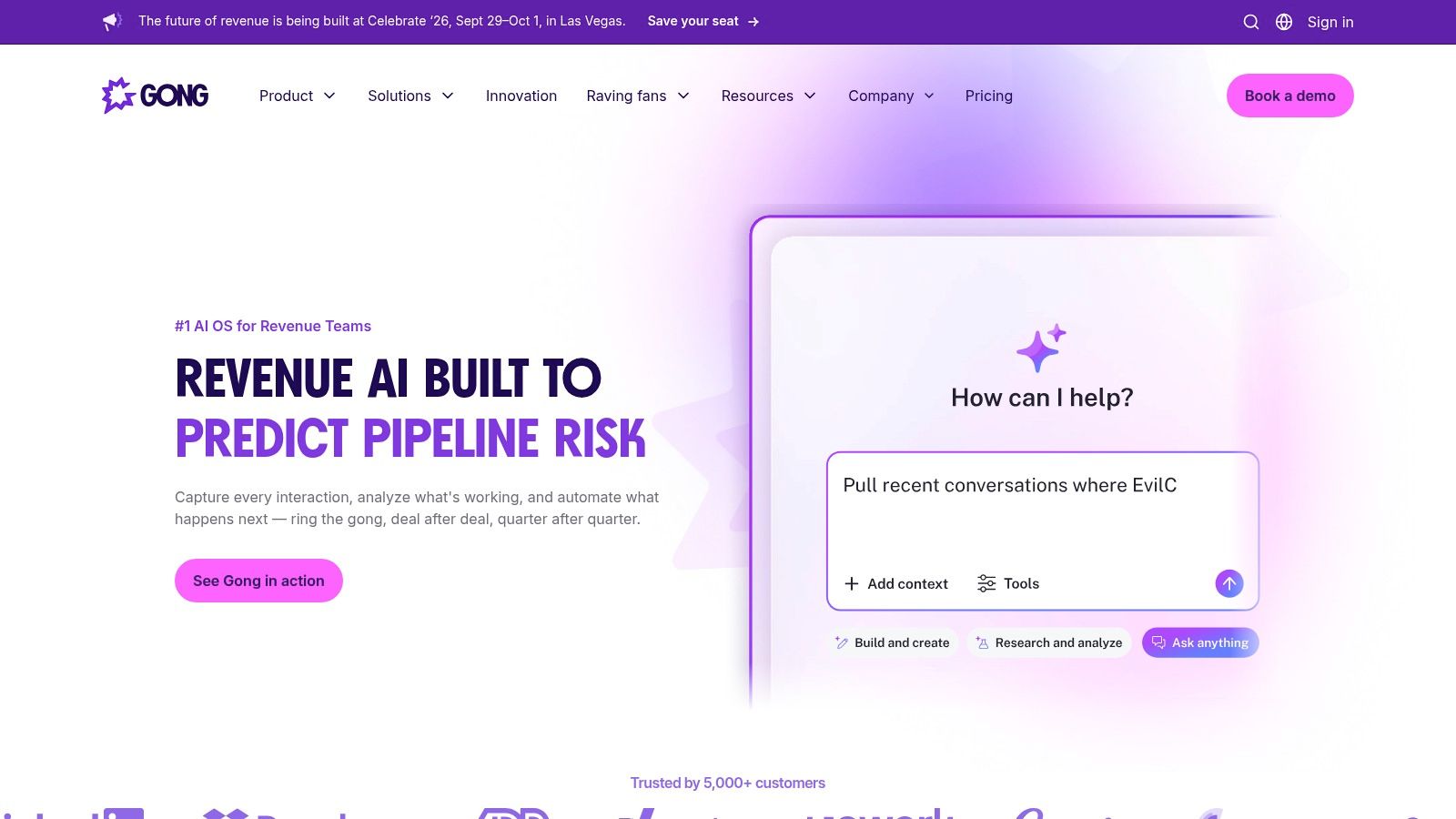
Gong sits at the intersection of coaching and revenue intelligence. It captures calls, demos, and meetings, then turns those conversations into coaching signals, deal-risk insights, and forecast visibility. Managers use it to see what is happening in real conversations so they can coach with evidence instead of intuition.
What makes Gong valuable
The strongest case for Gong is manager visibility. It helps teams spot deal risk, identify patterns across calls, and see where reps lose control of the conversation. That makes it a strong fit for organizations that care about coaching quality and pipeline inspection.
Gong also helps teams connect conversation quality with enablement work. A rep can follow the process, but if discovery is weak or objections are handled inconsistently, the recording makes that visible. For coaching teams, that kind of evidence is more useful than a rep's summary after the call. For a useful reference point on conversation and account analysis, see these b2b sales intelligence tools.
The trade-off is that Gong is diagnostic, not generative. It shows what happened and where the gaps are, but it will not create the next asset, sequence, or follow-up on its own. That means it works best as part of a stack, alongside content, readiness, and engagement tools that help reps act on what Gong surfaces.
There is also a practical coaching use case around transcript review. Managers can clip call moments, annotate them, and use those examples in training sessions. When a team is reviewing conversation patterns, a clear transcript terms for students style breakdown can help people understand how spoken language gets turned into searchable coaching material.
For teams that want tighter intelligence around prospecting and account context, Gong works better when it is supported by a broader sales intelligence workflow.
Top 10 B2B Sales Enablement Tools Comparison
| Product | Core focus & USP ✨ | Quality (Deliverability / Impact) ★ | Pricing & Value 💰 | Best for 👥 |
|---|---|---|---|---|
| 🏆 Icypeas | ✨ Email Finder, strict Email Verifier (Google/MS catchall), Reverse Lookup, 575M people / 62M companies, monthly updates | ★★★★★, industry-leading low-bounce verification, 99.9% uptime | 💰 Credit-based PAYG, credits never expire, 3–10x cheaper vs all‑in‑one; 50 free credits promo | 👥 Sales, growth, product teams, devs (builders & operators) |
| Seismic | ✨ Enterprise content mgmt, playbooks, buyer engagement, revenue analytics | ★★★★, scalable, secure for regulated orgs | 💰 Quote-based enterprise pricing | 👥 Large, regulated/global GTM organizations |
| Highspot | ✨ Content + training, Deal/GTM Agent, AI role-play & coaching | ★★★★, strong adoption, clear UI | 💰 Gated/enterprise pricing | 👥 Mid‑market → enterprise SaaS GTM teams |
| Showpad | ✨ Centralized content, Showpad Genie, buyer engagement rooms | ★★★★, balanced content & readiness features | 💰 Quote-based enterprise packaging | 👥 Cross-functional enablement (sales, marketing, CS) |
| Mindtickle | ✨ Onboarding, certification, conversation intelligence, coaching | ★★★★, excellent for systematic readiness | 💰 Quote/modular pricing (can add up) | 👥 Teams prioritizing onboarding, certifications, competency |
| Allego | ✨ Unified hub: content + learning + coaching, GenAI search/tagging | ★★★★, enterprise rollouts, analyst-recognized | 💰 Discovery-led / quote-based | 👥 Enterprises wanting single enablement system |
| SalesHood | ✨ Prebuilt templates, playbooks, fast SKO/program launch | ★★★★, quick time-to-launch, standardized programs | 💰 Gated pricing via discovery | 👥 Teams needing fast, repeatable enablement programs |
| Spekit | ✨ In‑app contextual guidance inside CRM, bite-sized playbooks | ★★★★, reduces context-switching, high day‑to‑day visibility | 💰 Mid-tier / complements larger suites | 👥 Reps & ops needing in‑flow training inside tools |
| Outreach | ✨ Multichannel sequences (email/calls/social), automation, Salesforce depth | ★★★★, battle-tested for large SDR/AE teams | 💰 Quote-based; can be costly at scale | 👥 Large outreach-heavy sales teams |
| Gong | ✨ Conversation & revenue intelligence, deal risk & coaching signals | ★★★★★, leader in conversation analytics & coaching | 💰 Quote-based premium | 👥 Revenue leaders, managers, enablement focused on conversation insights |
From Tools to System Building Your Enablement Stack
The best b2b sales enablement tools don't work because they're impressive on their own. They work when they fit together as a system. If your data is weak, sequencing suffers. If your content is hard to govern, reps improvise. If your readiness program is thin, managers coach by memory instead of proof.
Start with the foundation, because bad data breaks everything above it. That's why a specialist enrichment layer like Icypeas belongs at the bottom of the stack, before your CRM automations and outbound engine. Clean contacts, strict verification, and reliable enrichment make every other tool more effective, from Outreach to Gong.
Then choose one core content or readiness platform that matches your operational pain. Seismic is a strong fit for governed enterprise content. Highspot works well when content and coaching need to move together. Showpad, Allego, Mindtickle, and SalesHood each solve a different readiness or delivery problem, so the right one depends on how structured your motion already is.
From there, layer in execution and visibility. Outreach drives consistent engagement, while Gong shows you what's working in the field and what isn't. Spekit fills the last-mile gap by putting guidance inside the tools reps already use, which is often where adoption gets won or lost.
The cleanest stacks don't try to do everything in one platform. They separate data, content, readiness, engagement, and coaching into the right layers, then connect them tightly enough that reps don't feel the seams. That's the advantage in 2026, not owning more software, but building a stack that makes revenue work feel simpler for the people using it.
If you want the data layer that makes the rest of your enablement stack work harder, start with Icypeas. It helps sales, marketing, and product teams find, verify, and enrich professional contact data without adding friction to the workflow. Visit Icypeas to see how cleaner enrichment can improve your sales enablement stack from the ground up.
































.png)


.webp)