.avif)
Remcon Plastics Reading PA: Manufacturing Profile

.avif)
You might be staring at a vendor shortlist right now, with one supplier's name surfacing in searches and not much else to go on. That's exactly where buyers get stuck with Remcon Plastics Reading PA. The company has a long manufacturing history and a clear product focus, but the public record also leaves gaps that matter for sourcing, risk, and fit.
Table of Contents
- Why Supplier Verification Matters for B2B Buyers
- Why that timeline matters to buyers
- What to verify during initial outreach
Why Supplier Verification Matters for B2B Buyers
A plant manager needs replacement bins. A sourcing lead wants a custom hopper. A quality team is asking whether a plastic supplier can support sanitation standards without turning the purchase into a compliance problem. In that moment, a polished catalog is not enough. Buyers need to know whether the manufacturer is stable, whether it can produce at the promised scale, and whether the product claims match the factory reality.
That's the right lens for Remcon Plastics Reading PA. The company appears in sourcing searches, but public documentation is uneven, so the buyer has to do more than skim a website. Supplier verification is not about mistrust, it's about reducing avoidable risk before a purchase order locks in lead times, tooling, and operational dependency.
Practical rule: If a supplier's public footprint is thin, treat your first RFQ as a verification exercise, not just a pricing exercise.
A good onboarding process pulls these questions together early. DPP Grid's supplier onboarding page is useful as a framing reference because it shows how teams structure intake, approvals, and documentation before a supplier is activated. For buyers who want a broader investigative mindset, the open-source intelligence overview helps explain why public records, company pages, and third-party directories belong in the same verification workflow.
The main point is simple. In plastics manufacturing, the risk rarely shows up in one dramatic failure. It shows up in slow responses, vague capacity claims, inconsistent product descriptions, and no clear answer on who owns operations, engineering, or production quality. That's why a procurement analyst starts with verification before evaluation. You can't judge fit until you know what's there.
Company History and Founding Details
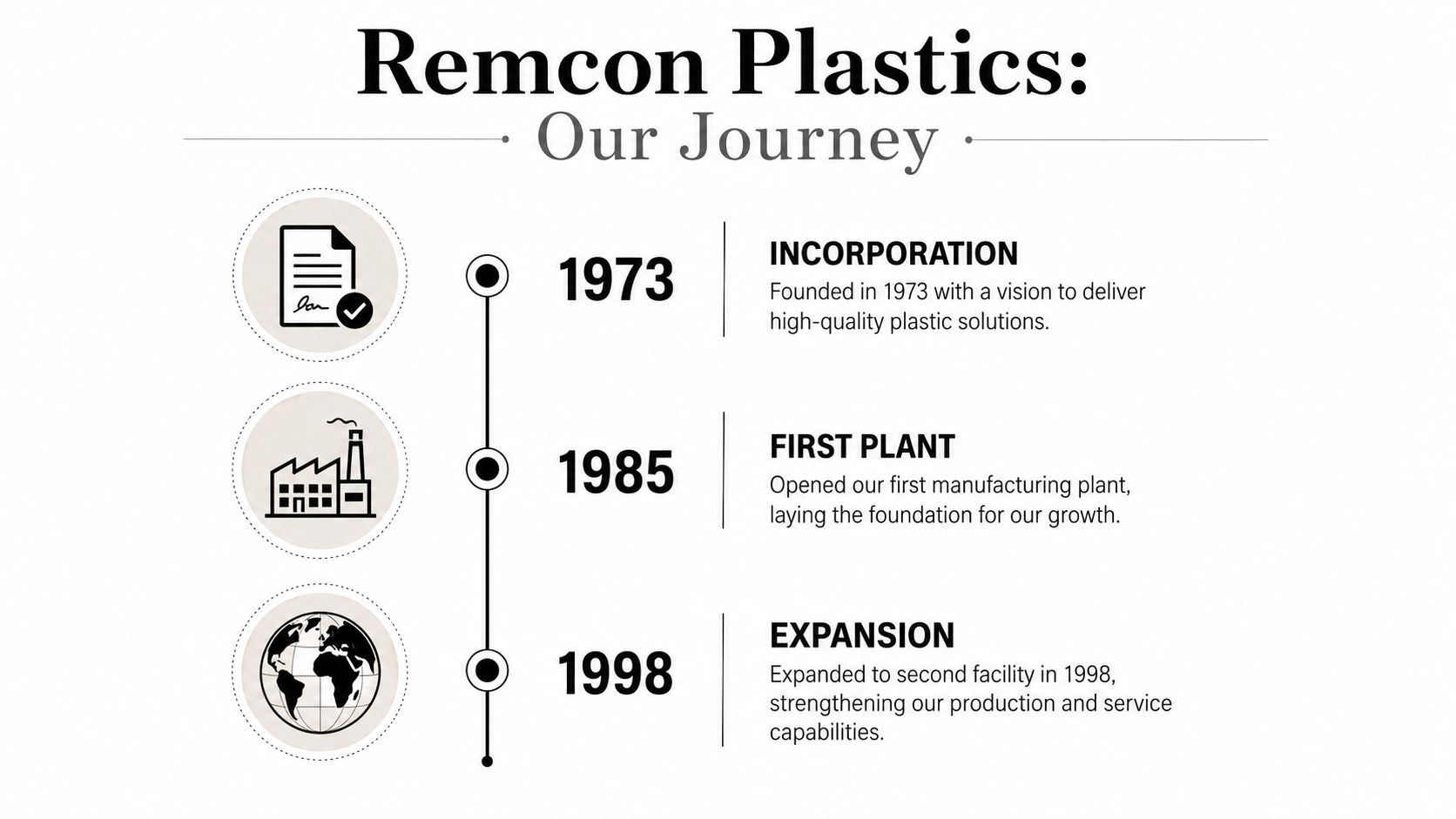
The public history for Remcon gives buyers a usable starting point, but it also shows why verification matters. The company says it was incorporated in Pennsylvania on November 3, 1982, and that its first rotomolding operation began shortly afterward in Conshohocken, Pennsylvania (Remcon about page). It later moved to Reading, Pennsylvania in 1990 and tripled the size of its plant, which is the kind of operational change that usually reflects a shift in demand, capacity planning, or both (Remcon about page).
Why that timeline matters to buyers
For a procurement team, founding year is less about branding and more about operating history. A supplier that has stayed in business across multiple cycles has likely built process knowledge, customer familiarity, and internal routines that newer firms may still be developing. That does not prove current capacity, but it does give context for how the company may handle long-running production relationships.
The Reading relocation matters for a different reason. A move tied to a larger plant suggests the business had enough production need to justify more space, which is a meaningful signal for buyers evaluating manufacturing maturity. Public company profiles also continue to identify 1982 as the founding year and Reading as the headquarters location, so the basic timeline appears consistent across the company's public footprint (see Remcon about page).
What to verify during initial outreach
Historical claims should lead directly to current-state questions. Ask for the present facility address, the date of the last major expansion, and whether the Reading site is the only operating plant or part of a broader network. If the supplier references legacy engineering improvements, ask which product lines still use them and whether those designs are standard or custom.
A supplier with a clear origin story still needs a current operating story. Buyers should verify both.
If a company's history is the strongest part of its public record, that can support confidence in its continuity. It can also mean the buyer should ask harder questions about recent ownership changes, plant investment, and production scope before treating the old timeline as proof that current capacity is unchanged.
Contact Information and Location Details
The public record points buyers to Reading, Pennsylvania as Remcon's headquarters location, but the larger issue is not the city, it's how to make first contact efficiently. When a supplier has a broad product list and limited recent disclosure, the fastest route is to send a focused inquiry that names the part, the use case, and the volume range you need. That usually gets a more useful response than a general “tell us what you do” message.
For contact discovery work, the business email address guide is a practical reference because it reminds buyers to confirm the right contact path before they start a quote cycle. In supplier sourcing, the wrong inbox can slow everything down. A generic info line might work for a brochure request, but technical questions should go to sales engineering, product management, or whichever role owns custom molding requests.
What to send first
Start with the basics:
- Part description: State whether you need bins, totes, pallets, hoppers, lockers, or barriers.
- Material and sanitation needs: Say whether the part must be easy to clean, crack-resistant, or suitable for regulated environments.
- Volume expectations: Share annual or monthly demand qualitatively if you don't want to disclose exact numbers yet.
- Timing: Note whether the request is for a prototype, replenishment order, or replacement program.
That information helps the supplier route the inquiry correctly. It also lets you gauge responsiveness, because a strong manufacturing partner usually clarifies assumptions rather than forcing you to restate them three times.
Which channel fits which need
Use a direct email request for formal RFQs, because it creates a written record of specifications and commercial terms. Use a phone call when you need to clarify whether the plant can support a custom feature, a legacy design, or a material concern. If you're still mapping the right contact person, ask for the name of whoever owns custom projects or industrial product lines.
What you're looking for is not just an address, it's a routing path. Once that path is clear, every later step, quote, sample, approval, and production scheduling, gets easier to manage.
Manufacturing Capabilities and Processing Methods
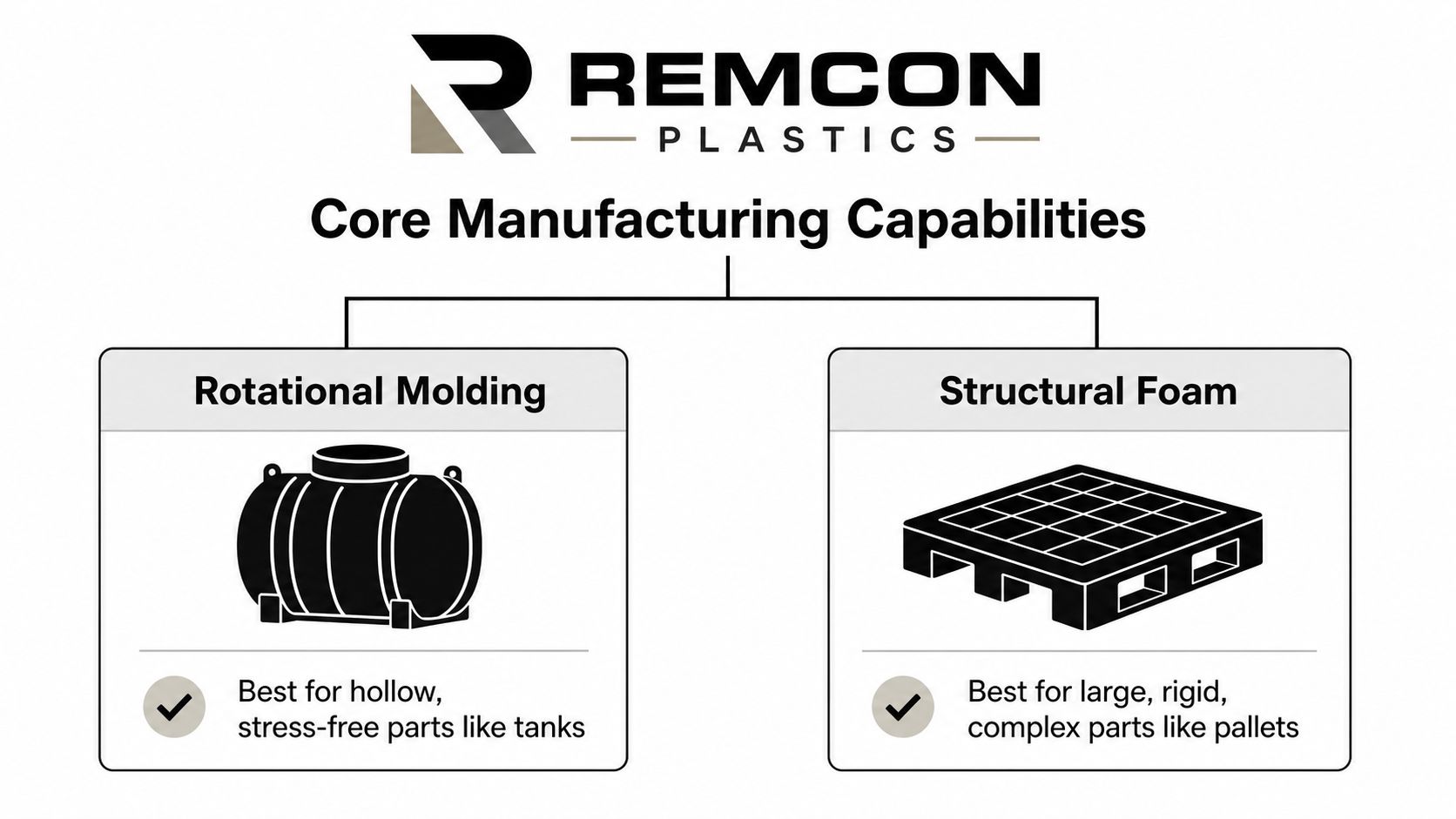
Remcon's profile centers on custom molding, material handling, and safety products. Industry directories also identify rotational molding and structural foam processing as part of its manufacturing mix (Safety+Health buyer's guide listing). For procurement teams, that detail is more useful than a broad catalog description because it shows what the plant is structurally equipped to produce.
Rotational molding versus structural foam
Rotational molding fits hollow, durable parts where wall consistency and stress distribution matter. That makes it a practical match for tanks, bins, hoppers, and similar products. Structural foam processing serves a different purpose, since it is better suited to large rigid parts where strength and dimensional practicality matter more than very fine surface detail. Buyers can use that split to judge application fit before they spend time on a quote.
Remcon's history page ties its engineering reputation to product changes that had measurable operational effects (Remcon history page). The reinforced top rim, or “R” lip, gave its combo bins a useful life 8 to 10 times longer than competitive products, while its rectangular hopper design increased useful volume by 8% and its square drum design delivered 20% more storage in the same floor space. Those are engineering outcomes, not generic marketing claims.
Why the engineering details matter
A custom cooling hopper for jawbreakers reportedly reduced cooling time by 75%, with a similar reduction in work-in-process inventory and more than 50% less floor-space requirement. For procurement teams, that point matters because it suggests the company has handled process bottlenecks, not only standard container orders. A supplier with that kind of record may justify deeper technical review if your operation has throughput, sanitation, or space constraints.
The more useful question for buyers is which manufacturing method supports the part geometry, duty cycle, and cleanability requirements. If the application calls for a hollow form, easy cleaning, and durability under handling abuse, the process profile points one way. If the requirement is for rigid, high-capacity industrial parts, the evaluation shifts toward a different set of tradeoffs.
Buyer check: Ask whether your part would be built as a standard mold, a custom mold, or a modified existing tool. That answer affects both cost structure and timeline.
Product Categories and Industry Applications
Remcon's catalog is focused enough to support supplier evaluation and broad enough to cover several common plant needs. The company's product and process profile includes polyethylene bins, totes, pallets, hoppers, lockers, and traffic-safety barriers, and those items are positioned for durable, easily cleaned, and crack-resistant use cases. The first public reference for that positioning appears in the Safety+Health buyer's guide listing. For B2B buyers, that matters because supplier strength in industrial plastics usually comes from fit between geometry, hygiene, and handling durability, not from catalog breadth alone.
Product categories by industry application
| Product Category | Primary Industries | Key Properties | Compliance Considerations |
|---|---|---|---|
| Polyethylene bins | Food processing, industrial operations | Durable, easy to clean, crack-resistant | Sanitation routines, contamination control |
| Totes | Food processing, pharma, general manufacturing | Durable, reusable, cleanable | Clean handling, workflow segregation |
| Pallets | Industrial, warehouse, distribution | Rigid, reusable, handling-friendly | Load handling, material cleanliness |
| Hoppers | Food processing, industrial processing | Material-handling efficiency, custom geometry | Process hygiene, product flow consistency |
| Lockers | Industrial facilities, controlled environments | Durable storage, easy maintenance | Cleanability, site access control |
| Traffic-safety barriers | Industrial sites, facility operations | Crack-resistant, durable, visible use case | Site safety procedures, durability expectations |
The food, pharma, and industrial sanitation angle is the clearest indicator of where these products fit. Those environments expose weak materials quickly. Residue retention, cracking during washdown, and repeated handling abuse all create maintenance burdens that procurement teams try to avoid. Remcon's positioning aligns with those requirements, especially for reusable plastic components that have to hold up under cleaning cycles and daily use. A later reference in the public record repeats that same general positioning, but the supplier signal is consistent rather than expansive, as noted earlier.
How to interpret product fit
A bin or tote is not just a bin or tote. In a regulated environment, the key question is whether the part supports cleaning, segregation, and traceability in a way that your site can sustain. A hopper may look like a simple receptacle, but if it is tied to process flow, the geometry and material behavior can affect uptime and housekeeping.
Buyers should match each product category to an operating need, not to a familiar purchasing pattern. If the part will sit in a sanitation-critical area, ask what material is used and how the design supports cleaning access. If the part will be used in a high-abuse area, ask how crack resistance and impact durability were validated in prior use. That line of questioning gives procurement teams a better way to separate standard catalog fit from applications where the supplier's design choices carry real operational risk.
Company Size and Operational Scale Assessment
For B2B buyers, the main issue with Remcon Plastics Reading PA is scale verification. Public references do not line up cleanly on headcount or revenue, which makes it difficult to treat the company size as a settled fact. One public profile places the business at roughly 45 employees, while another puts it closer to 82 employees and shows revenue ranging from about $1 to $10 million to $20.6 million in annual revenue (RocketReach profile). That spread is a procurement signal in itself. Buyers cannot assume they have a current, complete view of operational scale from open sources alone.
What the inconsistency suggests
Conflicting estimates usually point to a few possibilities. The company may be privately held and disclose limited operating detail. The figures may come from different directories collected at different times. Or the business may have a compact manufacturing core with a wider sales or channel reach that outside sources interpret differently. The public record does not let a buyer separate those explanations with confidence.
The clearest dated detail in the available sources is still historical. Remcon says it moved to Reading in 1990 and tripled plant size, but recent public material does not show the same level of detail on capacity expansion, automation, sustainability, or labor changes in the last 12 months (Remcon about page). For procurement teams, that gap matters. A supplier can have a credible operating history and still be a weak fit for a high-volume or fast-turn program if its current footprint is unclear.
Questions buyers should ask directly
Use the first call to reduce the uncertainty around scale:
- Current production footprint: Ask how many manufacturing sites are active now.
- Capacity allocation: Ask whether your program would run on standard capacity or need special scheduling.
- Shift patterns: Ask how the plant handles demand peaks and rush orders.
- Recent investments: Ask about tooling, automation, maintenance, or facility upgrades.
- Customer mix: Ask whether the business is built around repeat orders or one-off custom projects.
A supplier risk review should also compare the public footprint with internal demand. If your program needs predictable replenishment, current capacity matters more than legacy history. If your need is custom one-off engineering, scale may matter less than how quickly the supplier can respond with technical detail and production clarity.
If the public numbers do not align, verify them on the first call rather than after the quote arrives.
For sourcing teams, the due diligence question is operational, not theoretical. A smaller but stable supplier may be a better fit than a larger one that cannot explain how it handles production load.
Procurement Process and Lead Time Expectations
The cleanest procurement process starts with a tight RFQ. That means the buyer sends a part description, expected use case, material requirements, quantity assumptions, and any sanitation or handling constraints in one package. If the request is for a custom shape or modified existing part, the supplier should be able to tell you whether the project needs tooling, a prototype, or a design review before pricing becomes meaningful.
What the handoff should look like
A practical process usually moves in four steps. First comes the inquiry, where the buyer defines the need. Then technical review, where the supplier checks manufacturability and clarifies assumptions. Production follows once the part is approved. Shipping closes the loop when the order is completed and released.
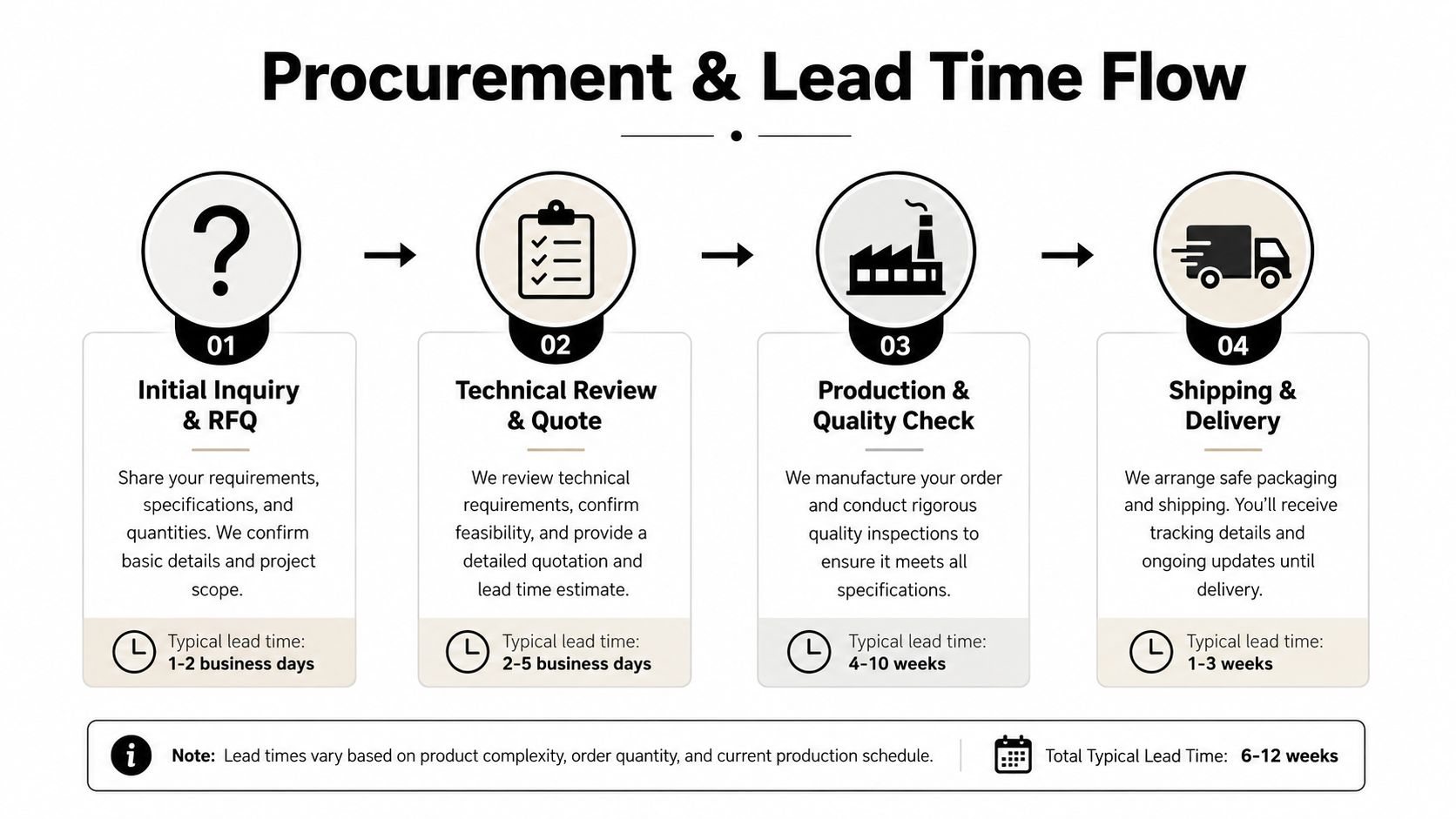
That flow matters because custom manufacturing rarely runs on a one-email transaction. If tooling or a modified mold is required, the schedule has to account for design review, sample approval, and production sequencing. If the product is standard, the process can still be delayed by missing specs, unclear destination requirements, or a mismatch between what the buyer wants and what the plant is set up to make.
What buyers should prepare before asking for a quote
The best RFQs make it easy for the supplier to say yes or no. Include the product family, intended environment, desired durability characteristics, and any cleaning or handling requirements. If the item needs to fit a specific workflow, explain the role it plays in that workflow, not just the dimensions.
A concise RFQ also protects the buyer. It reduces the odds of getting a quote that assumes the wrong material, the wrong finish, or the wrong production method. In a plant environment, those mistakes turn into back-and-forth, and back-and-forth turns into delay.
Lead time expectations should be discussed early, not after the order is approved. Buyers should ask whether the request is a stock item, a modified standard product, or a custom build. That distinction usually drives the whole schedule.
Supplier Verification Checklist for Due Diligence
A lot of buyers assume that a good product page means a good supplier. It doesn't. A manufacturer can have a credible catalog and still leave unanswered questions about quality systems, financial stability, or operational continuity. That's why due diligence needs a checklist, not a hunch.
For a broader vendor governance view, Market Edge's vendor network best practices is a useful complement because it reinforces the idea that supplier review should include documentation, performance follow-up, and role clarity. For buyers who want to think more strategically about how suppliers gather and present themselves, the competitive intelligence guide is a helpful framework.
What to verify before moving forward
Start with evidence, not promises:
- Facility confirmation: Verify the current Reading location and whether other active plants exist.
- Quality documentation: Ask for the documents that support product consistency, inspection, or sanitation claims.
- Reference check: Request a customer reference in a similar use case, especially if the part is custom.
- Financial stability signals: Look for signs that the business can support ongoing replenishment rather than a one-time project.
- Capacity clarity: Ask how the plant handles peak demand, custom orders, and routine restocking.
- Ownership of technical review: Confirm who signs off on moldability, tooling, and design changes.
Buyer rule: If a supplier can describe the product but can't describe the operating model, treat that as an open risk.
How to test the answers
The goal is not to collect paperwork for its own sake. It's to determine whether the supplier can support your program after the first order. If a representative can't explain who owns technical review, who approves production changes, or how quality issues get escalated, then the buying team should pause.
Use a short facility visit or virtual walkthrough if the order is important. Ask to see how materials move through the plant, where finished goods are staged, and how custom work is separated from standard production. Those details reveal far more than a sales deck does.
The strongest takeaway here is straightforward. A supplier like Remcon should be evaluated as a manufacturing partner, not just a catalog vendor. That means confirming the plant, the people, the process, and the proof behind the claims.
Decision Framework and Next Steps for Buyers
A supplier check on Remcon should start with a simple question. Does the company's public footprint support the part, service level, and replenishment model your program needs? The answer matters because the available information points to a real Pennsylvania manufacturer with an established product focus, but it also leaves room for ambiguity that buyers should verify before placing meaningful volume.
The verified record supports basic legitimacy. Public company materials describe a long operating history and a manufacturing base tied to industrial products, while the product record suggests engineering changes were made to improve how the products perform in use. That is a stronger signal than broad claims about durability because it shows the company has positioned products around specific functional outcomes, not just marketing language.
The open question is current scale. Public estimates for headcount and revenue do not line up cleanly, and recent operating detail is limited, so buyers should treat the company as a candidate for verification rather than a supplier whose capacity is already proven on paper. That does not point to unreliability. It points to the need for diligence that matches the size and repetition of the order.
How to decide what to do next
If you need a standard product and the purchase risk is moderate, begin with a focused RFQ. Ask for product fit, lead time, and the correct technical contact in one response. If you need a custom part or an ongoing replenishment program, move to a deeper vendor review and confirm production footprint, capacity handling, and quality process before you commit.
Regulated or sanitation-sensitive operations should place extra weight on how the supplier explains cleanability and material behavior. Operations that depend on quick replenishment should place extra weight on response speed and production clarity. Highly customized programs should place extra weight on engineering dialogue, tooling ownership, and change control.
A practical buyer should also verify contact paths before any serious procurement step. Using a contact discovery tool can help locate the right decision maker and confirm whether the organization can route technical questions to the correct person. That is where Icypeas fits into the outreach workflow, because accurate first contact reduces wasted cycles and improves the chance of getting a direct answer on the first pass.
The right conclusion is a structured go-forward decision based on verified history, current operating transparency, and fit for purpose. Remcon has enough public evidence to justify serious review, but not enough disclosed detail to skip supplier verification.






































.png)



.webp)