.avif)
Sales Enablement Platforms: 2026 Guide to Boosting Win Rates

.avif)
Sales enablement platforms have moved from support software to revenue infrastructure. Independent market estimates put the category at USD 5.23 billion in 2024 and USD 12.78 billion by 2030, with a 16.3% CAGR over that period, which tells you this isn't a fad or a niche budget line anymore, it's part of how B2B revenue teams are built today. The more revealing number is organizational, 76% of organizations now have a dedicated sales enablement function, up from 32% five years earlier (market growth and adoption data).
That shift matters because the category is no longer just about content libraries or onboarding decks. Teams are buying platforms to improve execution consistency, shorten ramp, and tie seller behavior to actual deal outcomes, which is why the best vendors are judged on adoption, coaching, analytics, and workflow fit, not just storage. If you're also tightening the rest of the sales motion, the broader sales process optimization playbook is a useful companion to this topic, because enablement only works when the process around it is clean.
Table of Contents
Why Sales Enablement Platforms Became a Revenue-Tech Essential
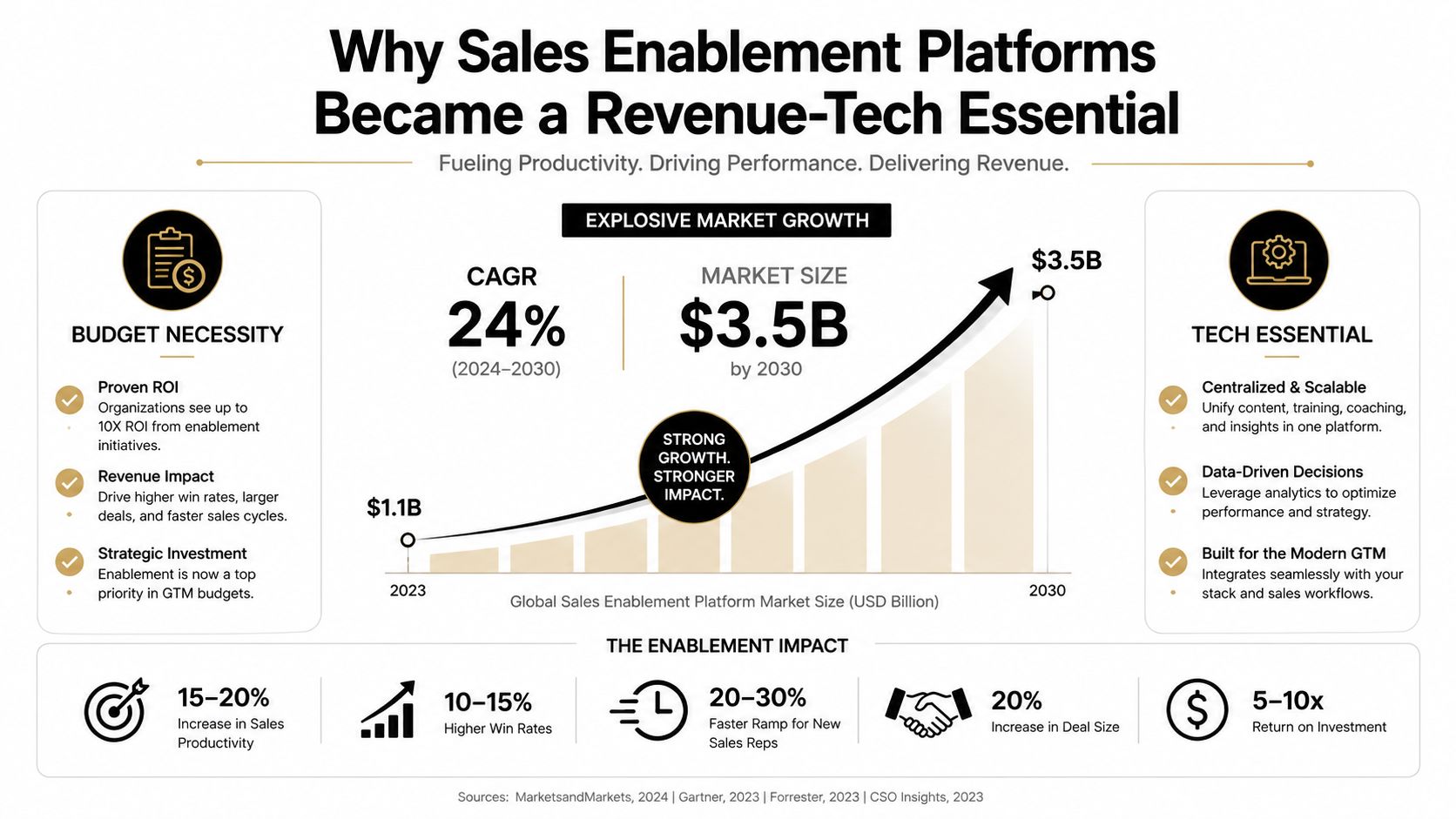
The market's growth curve is the first clue that the category has crossed into must-have territory. Independent estimates put the global market at USD 5.23 billion in 2024 and forecast USD 12.78 billion by 2030, while another report projects USD 6.36 billion in 2025 rising to USD 33.90 billion by 2036, both at roughly 16% CAGR (market trajectory estimates). When multiple market views point in the same direction, buyers should read that as a sign of durable budget priority, not temporary enthusiasm.
The organizational pattern underneath that growth is just as important. 76% of organizations already have a dedicated sales enablement function, up from 32% five years earlier (adoption data). That's the difference between a team asking managers to “help reps get better” and a team running an actual operating model with content governance, coaching, and measurement.
What changed for revenue teams
The practical change is that enablement now sits where RevOps, sales leadership, and field productivity overlap. That's why platform evaluations need to focus on whether the tool helps standardize how reps prepare, run calls, coach, and follow up, not just whether it hosts documents. Gartner's definition makes that broader scope explicit, since it ties enablement platforms to customer-facing execution and notes that the common building blocks are content, sales training and reinforcement, and sales coaching (Gartner market guide).
Practical rule: if a platform only solves asset storage, it's not a complete enablement purchase, it's a file cabinet with better reporting.
The budget case follows from that maturity. If your team is already paying for CRM, sales engagement, conversation analysis, and content systems, a formal enablement platform becomes the layer that makes those tools behave like one revenue system. That's also why practitioners compare these platforms against adjacent tools such as call analysis software, because the question isn't “does it store training?” but “does it change seller behavior in a way the business can measure?” For a concrete example of how adjacent tooling should be assessed, see best practices for sales call software.
Core Capabilities That Define Modern Enablement Platforms
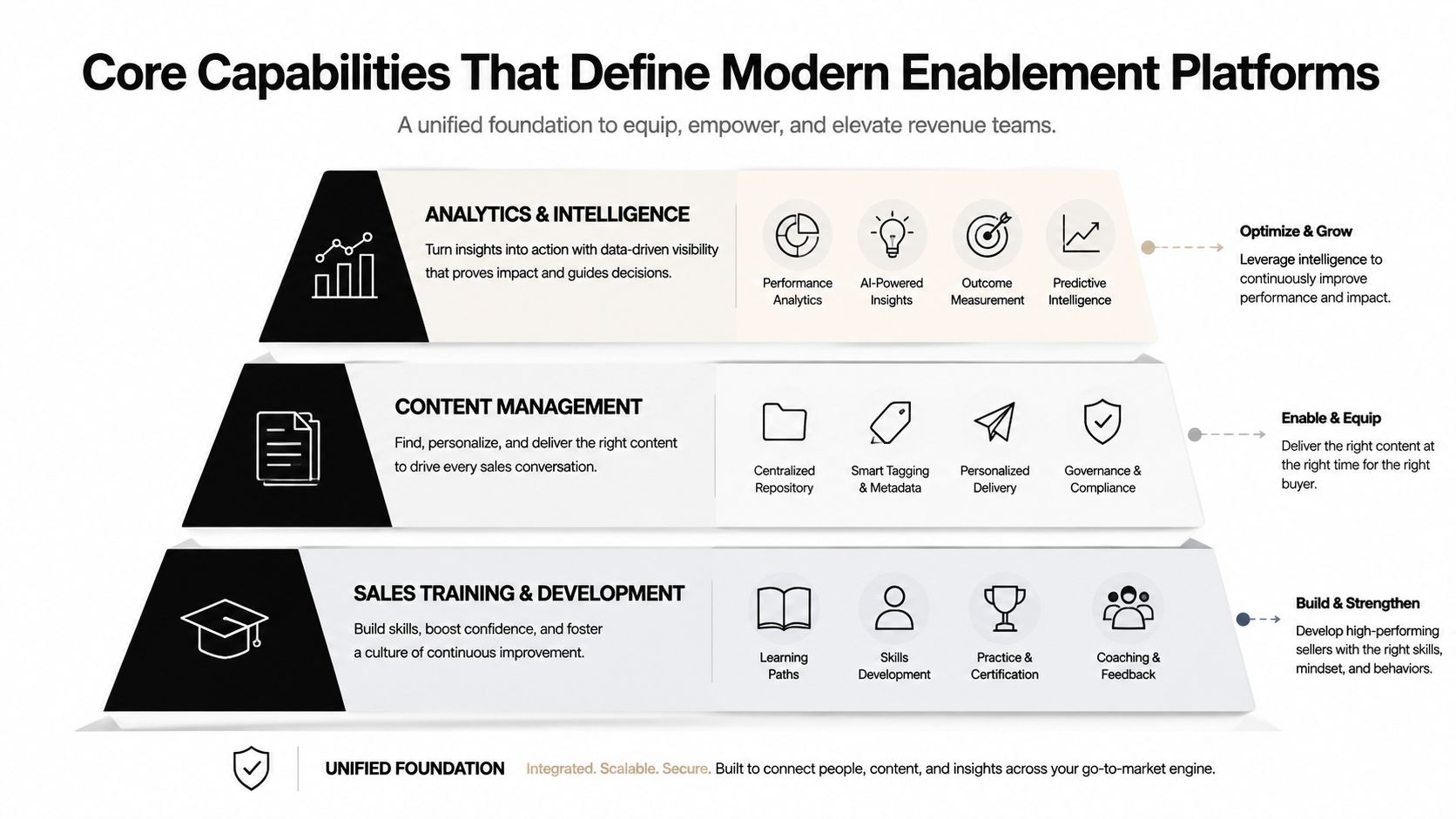
Gartner's framework is useful because it stops the category from being oversold. A real sales enablement platform usually unifies three things natively or through APIs, content, training and reinforcement, and coaching (Gartner market guide). That means the buying question isn't “does the platform have AI?” It's whether the AI sits on top of a governed workflow that reps and managers use.
The base layer is governed content and training
Start with content libraries, but only if they're governed. Reps need approved decks, battle cards, case studies, and one-pagers surfaced by role, deal stage, or persona. If the system can't tell which version is current, it creates confusion instead of speed.
Training sits next to content, not above it. In practice, that means onboarding paths, reinforcement, certifications, and practice workflows that help managers verify whether a rep can deliver the pitch. Industry analyses also describe modern platforms as tracking adoption, engagement, coaching activity, and downstream revenue impact, which is the line between a content repository and an enablement system (capability set overview).
The upper layer is analytics and in-deal execution
The platforms that earn budget are the ones that connect enablement activity to pipeline. That includes conversation intelligence, deal-level coaching, and analytics that show whether the rep used the right message in the right moment. If a manager can see coaching activity but can't connect it to deal outcomes, the platform is reporting motion, not progress.
A platform is only mature when it can answer two questions at once, what did the rep do, and what changed in the deal after that?
The best implementations also make the workflow feel native. Reps shouldn't have to bounce between a learning portal, a content hub, and a separate coaching tool to do one task. Gartner's note that platforms may use open APIs to connect components matters here, because modular architecture is often what keeps the stack flexible instead of bloated (Gartner market guide). That modularity is helpful, but only if the data model stays coherent across systems.
Measuring ROI and Business Impact from Enablement Investments
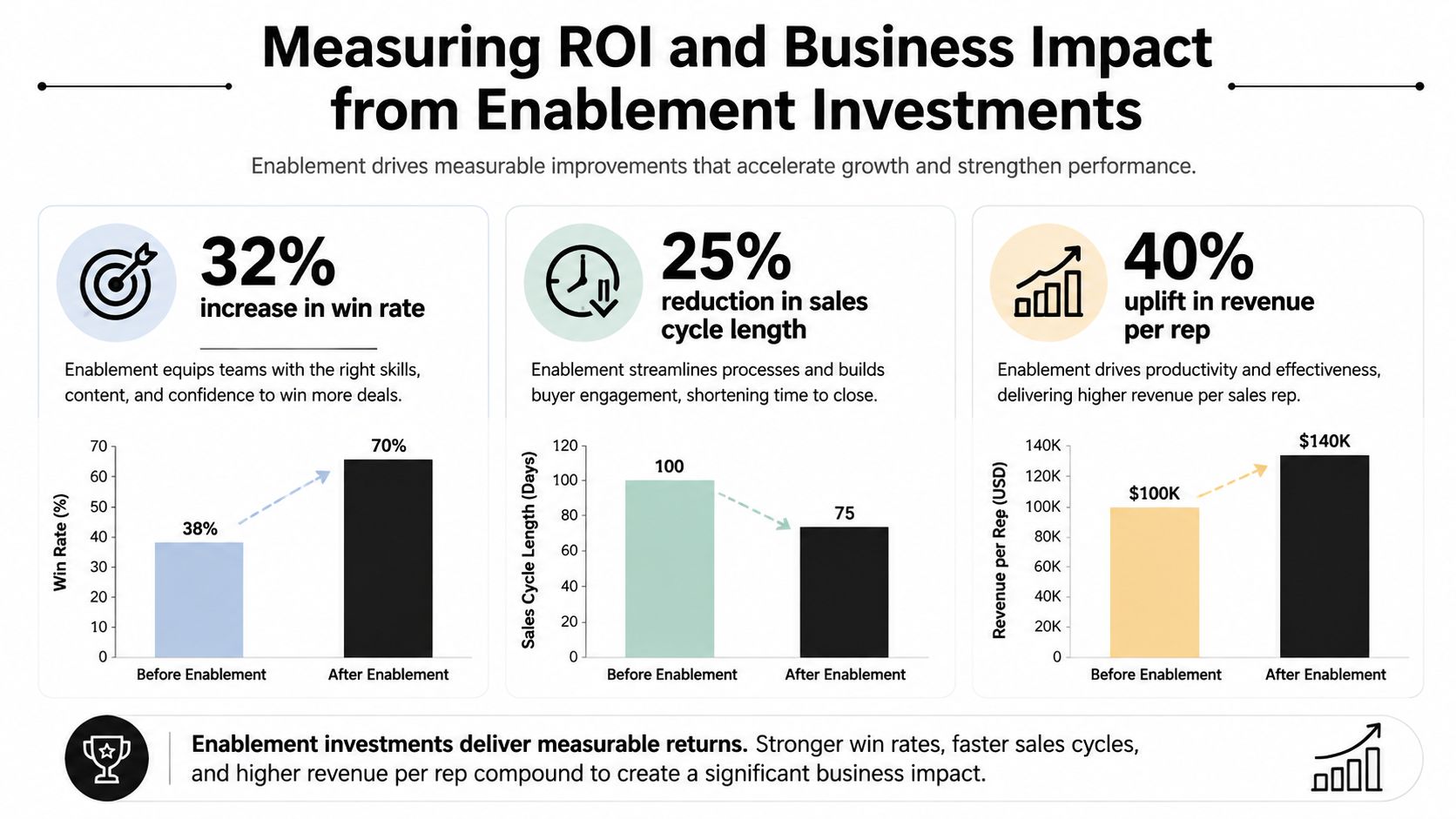
The cleanest business case for enablement is improved sales execution. Survey-based research cited in the source corpus says organizations using a unified enablement platform are 42% more likely to improve win rates, and another benchmark reports a 49% win rate on forecasted deals for companies with formal sales enablement programs versus 42.5% for those without them (enablement performance benchmarks). Those numbers don't guarantee lift in every org, but they do explain why serious teams budget for enablement as a performance system, not a content admin tool.
The metrics that actually matter
For enterprise motions, win rate and ramp time usually matter more than content views. The same research notes that enablement can reduce onboarding time by 40–50% (enablement onboarding benchmark). In a fast-moving pipeline environment, ramp time affects quota attainment, and quota attainment affects whether managers have enough productive reps to cover territory.
For smaller teams or faster sales cycles, the signal can show up differently. Adoption, rep confidence, and manager coaching consistency may be the earliest indicators, but they only matter if they correlate to opportunity progression. If a platform increases usage without improving deal quality, you've bought activity, not impact.
How to build a credible ROI story
A useful measurement stack usually has three layers:
- Behavior metrics: content usage, coaching completion, training certification, call review participation.
- Execution metrics: meeting quality, follow-up consistency, time to first conversation, onboarding speed.
- Outcome metrics: win rate, forecast accuracy, pipeline conversion, renewal expansion if the motion includes customer success.
Those layers matter because different sales motions surface value differently. Outbound teams care about execution discipline and ramp speed, while enterprise teams care more about consistency across long, complex deals. Either way, the platform has to connect enablement activity to actual revenue movement, or the dashboard becomes theater.
The best RevOps teams also resist over-crediting the tool. If a rollout coincides with a new comp plan, a better qualification framework, or cleaner routing, the platform shares the win but doesn't own it. That's why the business case should be built on trendlines and cohort comparisons, not one-off anecdotes from the first enthusiastic managers.
The Prospect Intelligence Gap in Mainstream Enablement Tools
Most enablement platforms still begin too late in the revenue cycle. They help reps execute once a lead exists, but they often do very little to help teams identify better prospects in the first place. That gap is especially painful for SDRs and outbound teams, because their first bottleneck isn't pitch quality, it's list quality, signal quality, and contact accuracy.
Why this blind spot keeps showing up
Traditional enablement descriptions focus on content, training, coaching, analytics, and buyer engagement. Even as the category expands, the upstream parts of the motion, account selection, contact enrichment, and buying signals, are still treated as adjacent rather than native capabilities. Recent market coverage now separates enablement from account intelligence, and one 2026 guide explicitly broadens the category to include account intelligence and buying signals, which is a sign that buyers are asking for more than a library and a dashboard (category expansion discussion).
That matters because reps don't lose deals only in late-stage execution. They also lose time chasing the wrong accounts, reaching stale contacts, and preparing for conversations that should never have happened. A platform can help a rep handle objections beautifully and still leave the rep prospecting into the wrong segment.
What to look for instead
The best stacks are starting to layer in account intelligence, meeting prep, and signal tracking. Some vendors surface buying signals inside the workflow, while others connect with external enrichment and research tools so the platform can stay focused on enablement without pretending to be a full prospecting database. That's the right split of responsibilities.
For teams that need actual contact enrichment, a dedicated data layer still matters. Icypeas fits that role as an enrichment and verification option, with tools for finding work emails, validating addresses, and resolving contacts into fuller professional profiles. It's a complement to enablement, not a substitute for it, but for SDRs that distinction is the whole point.
If your enablement stack starts with the first meeting and ignores how the list was built, you're optimizing execution on top of weak inputs.
This blind spot is why many teams end up with strong content adoption and weak pipeline creation. Enablement is valuable, but it shouldn't be confused with account selection. When the upstream data is poor, the platform helps reps perform the wrong motion more consistently.
Vendor Selection Criteria for Different Sales Motions
The right platform depends on what kind of selling you do. A mid-market team with a short sales cycle shouldn't buy the same stack as a global enterprise organization with multiple business units, complex governance, and heavy CRM orchestration. The point is to avoid paying for depth you won't use, while also avoiding a “lite” platform that can't support your actual process.
| Team Profile | Must-Have Features | Nice-to-Have Features | Integration Priorities |
|---|---|---|---|
| SMB team with lean ops | Fast content search, lightweight coaching, simple onboarding, basic reporting | AI recommendations, simple buyer rooms | CRM sync, email, calendar |
| Mid-market revenue team | Content governance, training paths, coaching workflows, engagement analytics | Conversation intelligence, guided selling, digital sales rooms | CRM, sales engagement, cloud storage |
| Enterprise enablement org | Modular architecture, approval workflows, analytics, manager dashboards, APIs | Advanced orchestration, multilingual support, deep personalization | CRM, call recording, content systems, BI tools |
| SDR or outbound-heavy motion | Strong contact workflows, account context, signal visibility, rep-friendly UX | Meeting prep, buying signals, enrichment connectors | CRM, enrichment, sequencing tools |
How to read the matrix
SMB teams usually need speed more than depth. If reps are still building habits, the platform has to remove friction or it won't get used. Mid-market teams tend to benefit from a balanced system that combines content, coaching, and analytics without forcing an enterprise services project.
Enterprise teams need to evaluate architecture as much as feature list. Gartner notes that platforms may be native or modular through APIs, which means the right choice depends on whether you want one system to do most of the work or a central layer that connects to specialist tools (Gartner market guide). That distinction matters when procurement, security, and RevOps all need different assurances.
Questions that separate real platforms from demos
Ask whether the vendor can show governed content, manager coaching, and usage analytics in one deal workflow. Then ask what happens when the process changes, because every real revenue org changes its playbooks. If the answer depends on a long services engagement for every adjustment, the platform may be more rigid than the demo suggests.
You should also ask how the platform handles adjacent data. If the vendor talks about account intelligence, confirm whether that means native enrichment, third-party integration, or just a passing mention in a roadmap slide. The cheapest mistake is buying a platform that looks broad but only covers one slice of the motion.
Implementation Patterns and CRM Integration Strategies
A good rollout starts with data flow, not feature rollout. If the CRM record is messy, the enablement platform inherits that mess immediately, and reps learn to distrust the recommendations. That's why the first implementation job is often less about configuration and more about cleaning the handoffs between CRM, content systems, coaching workflows, and enrichment sources.
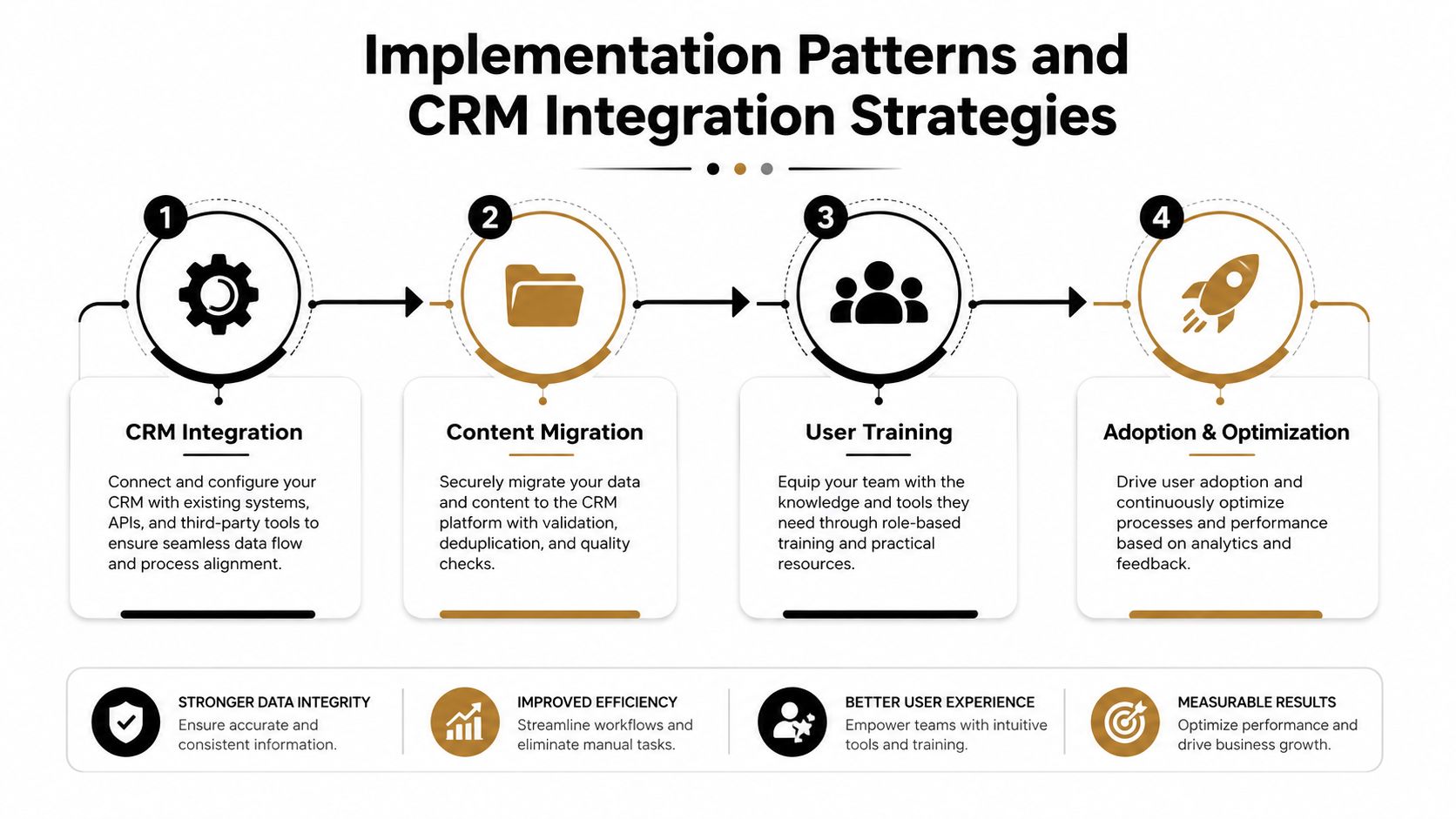
A practical deployment sequence
- Connect the CRM first. The platform should know accounts, opportunities, owners, and stage. Without that, every other workflow becomes manual.
- Migrate only governed content. Don't dump every old deck into the new system. Bring in the assets reps should use.
- Train managers before reps. Adoption tends to rise when managers can coach inside the tool and inspect activity without asking for status updates.
- Layer in enrichment and verification. When prospect data is pulled from an external source, it should feed the CRM and surface cleanly in the workflow, not sit in a disconnected side database.
That fourth step is where data enrichment becomes operationally important. A platform can recommend the right content, but if the contact record is stale, the rep still loses time. Icypeas fits into that data flow as an enrichment and verification layer for work emails and professional profiles, which is especially useful when teams are cleaning lists, updating CRM records, or preparing outbound sequences. For a deeper look at how those integrations usually work, see customer data integration guidance.
The fastest way to kill adoption is to ask reps to duplicate work they already do in the CRM.
What usually goes wrong
The most common failure isn't technical, it's operational. Teams launch too many workflows at once, reps ignore the new system, and managers revert to spreadsheets. Another common mistake is treating implementation as a one-time project when it's really an ongoing governance process.
The right pattern is incremental. Start with one motion, one team, and one measurable behavior change, then expand only after the tool is clearly saving time or improving execution. If the platform can't survive that first narrow test, it won't survive a full rollout either.
Your Enablement Platform Evaluation Checklist
A strong evaluation starts with the problem, not the vendor category. If the main issue is content chaos, the bar is different than if the issue is rep ramp, coaching discipline, or account intelligence. If the issue is upstream prospecting quality, the checklist needs an enrichment and signal layer, not just a training and content suite.
Use this checklist before you buy
- Define the core gap: content findability, coaching consistency, ramp speed, pipeline creation, or contact quality.
- Map the motion: SMB, mid-market, enterprise, inbound, outbound, or field sales.
- Check workflow fit: does the platform live where reps already work, especially CRM and email?
- Verify governance: can sales ops control content, permissions, and approval flows without constant vendor help?
- Test analytics: can the system connect activity to deal progress, not just surface usage reports?
- Audit integrations: CRM, call recording, sales engagement, cloud storage, BI, and enrichment.
- Confirm adoption plan: managers need a usable coaching path, or the tool will stall after launch.
- Look for upstream support: if prospecting quality is weak, decide whether you need native account intelligence, external enrichment, or both.
What a good answer sounds like
The strongest vendors will explain exactly how their platform fits into your process and where it stops. That honesty is a feature, not a weakness, because no single product should pretend to solve content, coaching, analytics, and prospect intelligence equally well. The best stack is the one that closes your biggest gap with the least friction.
If you're evaluating platforms now, start with the question most guides skip, does this help reps find better prospects, or only help them perform once the lead already exists? That answer will tell you whether you need a true enablement platform, a companion intelligence layer, or both.
If you're building a stack that covers both enablement and prospect data quality, visit Icypeas to see how work email finding, verification, reverse lookup, and CRM enrichment can fit alongside your sales enablement platforms. It's a practical way to tighten the upstream data your reps rely on, so the rest of the enablement motion has cleaner inputs.






































.png)


.webp)