.avif)
Precise Software Solutions Inc Federal IT Contractor

.avif)
What does Precise Software Solutions Inc sell today, a government delivery team, a product company, or a little of both? Public search results make that harder to answer than it should be, and that confusion matters when a buyer is deciding whether the company fits a federal procurement, a partner ecosystem, or a software evaluation.
The most defensible read is that Precise is a Rockville, Maryland-based federal IT contractor that also carries traces of an earlier product-oriented identity. Its current public capabilities point to cloud-native modernization, data engineering, and AI/ML delivery, while older materials and reposted references create ambiguity about whether it began as a software vendor focused on healthcare and IT performance tools. For a procurement team, the key question is not branding. It is whether Precise can deliver controlled modernization work, document the outcomes, and support regulated clients with the process maturity those projects demand.
Table of Contents
What Precise Software Solutions Inc Does Today
Public materials still leave buyers with a category problem. Some references frame Precise Software Solutions Inc as a federal IT consulting firm in Rockville, Maryland, while older content and reposted analyses describe a software company with healthcare and IT performance roots. That split matters because procurement teams cannot safely rely on the company name alone.
The most defensible read today is that Precise operates as a federal-focused technology services provider with an emphasis on application modernization, data engineering, cloud migration, and AI/ML-enabled automation. Its published capabilities include application modernization, data management and analytics, data migration, cloud strategy, cloud assessment, and cloud migration, plus delivery across AWS, Azure, Python, Salesforce, Appian, Drupal, Angular, Oracle, and Graph DB (HigherGov awardee profile). That profile fits a services firm built to modernize complex environments, not a single-product SaaS vendor.
How the identity confusion changes buyer diligence
The ambiguity is not cosmetic. A product vendor is evaluated on roadmap, packaging, and licensing. A federal contractor is judged on delivery discipline, security controls, integration ability, and past performance. Precise's public footprint points more strongly to the second category, even though older product-style references still cloud search results.
Practical rule: if a vendor's public story mixes product language and services language, force the conversation onto current delivery scope, contract vehicles, and recent project references.
For buyers, the key question is straightforward. What does the team do on an engagement? The evidence points to program work where legacy systems, data movement, workflow automation, and cloud transitions are the main challenge. That places Precise in the same decision set as mid-size federal IT contractors, not off-the-shelf software publishers.
The company profile and federal award records also show that it was founded in 2003 in Rockville, Maryland (LinkedIn company profile). That long operating history matters, but only as context. The key indicator of fit is whether the firm can explain how it moved from earlier identity confusion into its current modernization and AI delivery model.
Growth Trajectory and Revenue Milestones
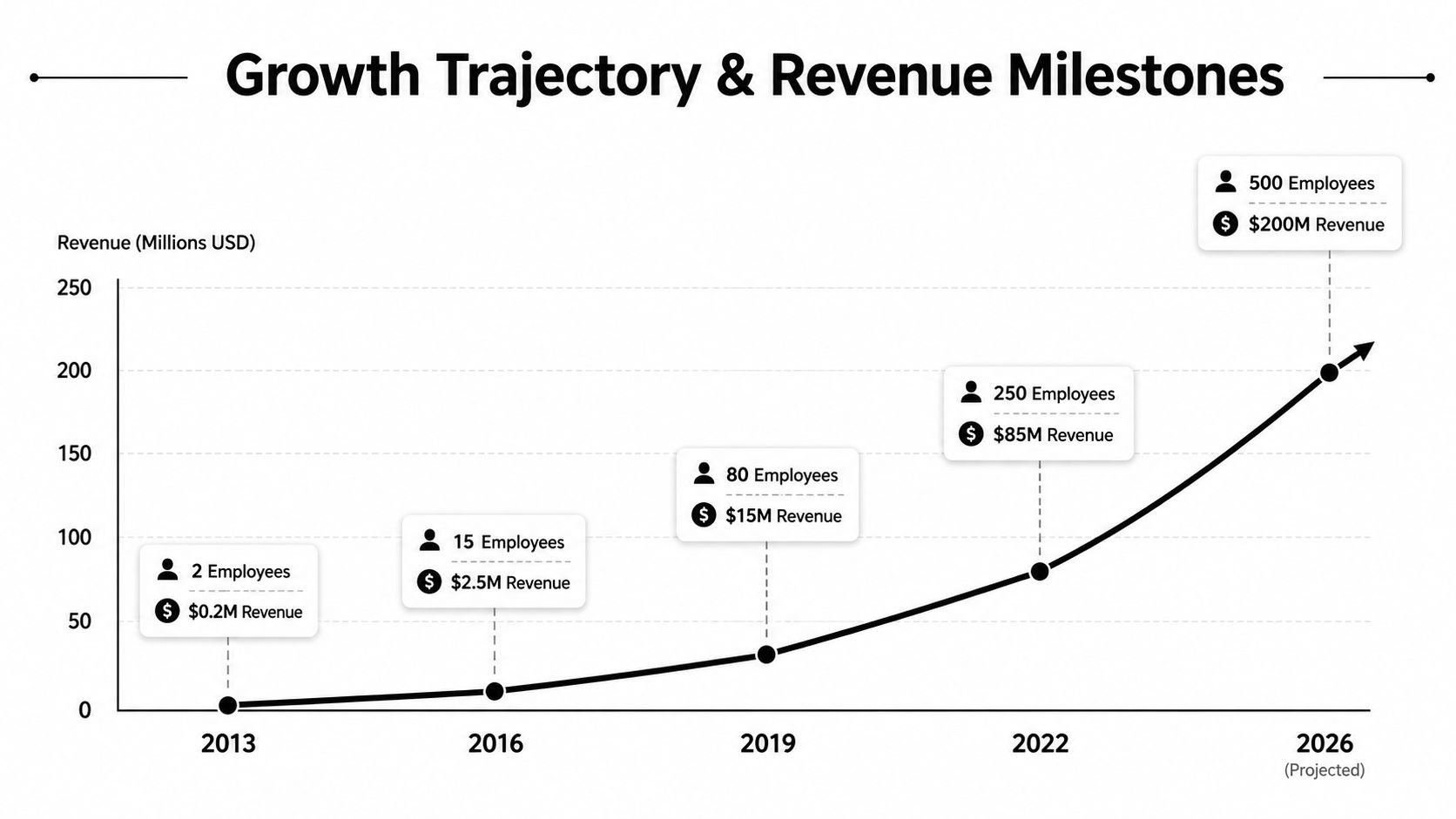
What does a rapid scale-up usually mean for a federal IT contractor, a one-off surge or a real operating shift? In Precise's case, the public record points to the latter. In 2013, the company had just two employees; by 2014, the SBA noted 16; and in 2015 it had added eight more workers, reaching 24 (LinkedIn company profile). That pace is notable because government delivery growth of that sort usually reflects demand that is already stretching the firm's original bench.
The revenue trend points in the same direction. Washington Technology reported $774,317 in 2013, $3,560,128 in 2014, $6,510,541 in 2015, $8,324,890 in 2016, and $17,598,829 in 2017 (SBA success story). The key point is the slope, not any single year. Precise moved from a sub-million-dollar business into a much larger federal contractor over a short period, which usually reflects a major contract win, broader task order volume, or both.
What the 8(a) milestone signals
The SBA later said that within one year of entering the 8(a) Program, Precise more than doubled revenue from $8.3 million to $17.5 million (SBA success story). That does not establish causation on its own, but it does show the company was able to convert federal market access into fast scaling.
For buyers, that kind of growth cuts both ways. It suggests the firm is not a small shop limited to narrow pilots. It also raises the diligence bar, because faster-growing contractors need tighter process control if headcount and award volume are rising at the same time.
A useful way to read the trend is through the business model. Precise appears to have started as a very small team, then used federal work and set-aside access to build a larger delivery engine. That is a familiar path for firms that succeed in public-sector work, but it also means buyers should verify current staffing stability, subcontractor management, and project governance instead of assuming past growth guarantees present capacity.
For a buyer trying to separate product vendor from services contractor, that distinction matters. A firm that scales by winning and delivering federal work should be evaluated on continuity, repeatable delivery methods, and how well it handles transfer of work across teams. In procurement terms, the question is less whether Precise grew and more whether that growth translated into a delivery model that still holds up under current workloads. A practical next step is to examine whether the firm's operating model supports repeatable handoffs and data-heavy workflows, including processes like data pipeline automation.
Buyer takeaway: fast early scaling is a positive signal, but it is not a substitute for recent references, team continuity, and repeatable delivery methods.
Core Technical Capabilities and Delivery Stack
What does Precise's stack tell a buyer about how the firm delivers federal work today? The clearest reading is that it is built for modernization programs where legacy systems, multiple data sources, and workflow handoffs all have to coexist. The company's public materials describe AWS, Azure, Python, Salesforce, Appian, Drupal, Oracle, and Graph DB as part of its delivery environment, which suggests a mix of cloud, application, and data tooling rather than a narrow product line.
That matters because the hard part of federal modernization is rarely just moving code. It is keeping identity, data, and business rules aligned while systems shift into new hosting or operating models. A contractor with this profile has to preserve integrations, sequence migrations carefully, and keep the system of record trustworthy while users move across platforms.
Why this stack fits heterogeneous federal environments
Salesforce, Appian, and Drupal point to work across case management, workflow, and digital experience layers. Oracle, Graph DB, Python, and cloud platforms such as AWS and Azure point to data integration and system modernization work. Read together, those tools suggest a firm that operates across application, workflow, and data tiers, not one that only delivers a packaged application.
The process certifications matter for that kind of work. Precise lists CMMI Level 3 and ISO 9001/20000/27001 designations in its public materials. Those labels do not guarantee project success, but they do indicate a delivery model built around documented processes, controlled execution, and security-aware operations. For federal buyers, that is often the difference between a contractor that can improvise and one that can manage change under governance.
The same logic applies to data movement. Modernization programs often rise or fall on how well data moves between systems, which is why buyers should examine orchestration and migration sequencing closely. A practical reference on data pipeline automation can help frame those architecture questions before a procurement team commits to a delivery path.
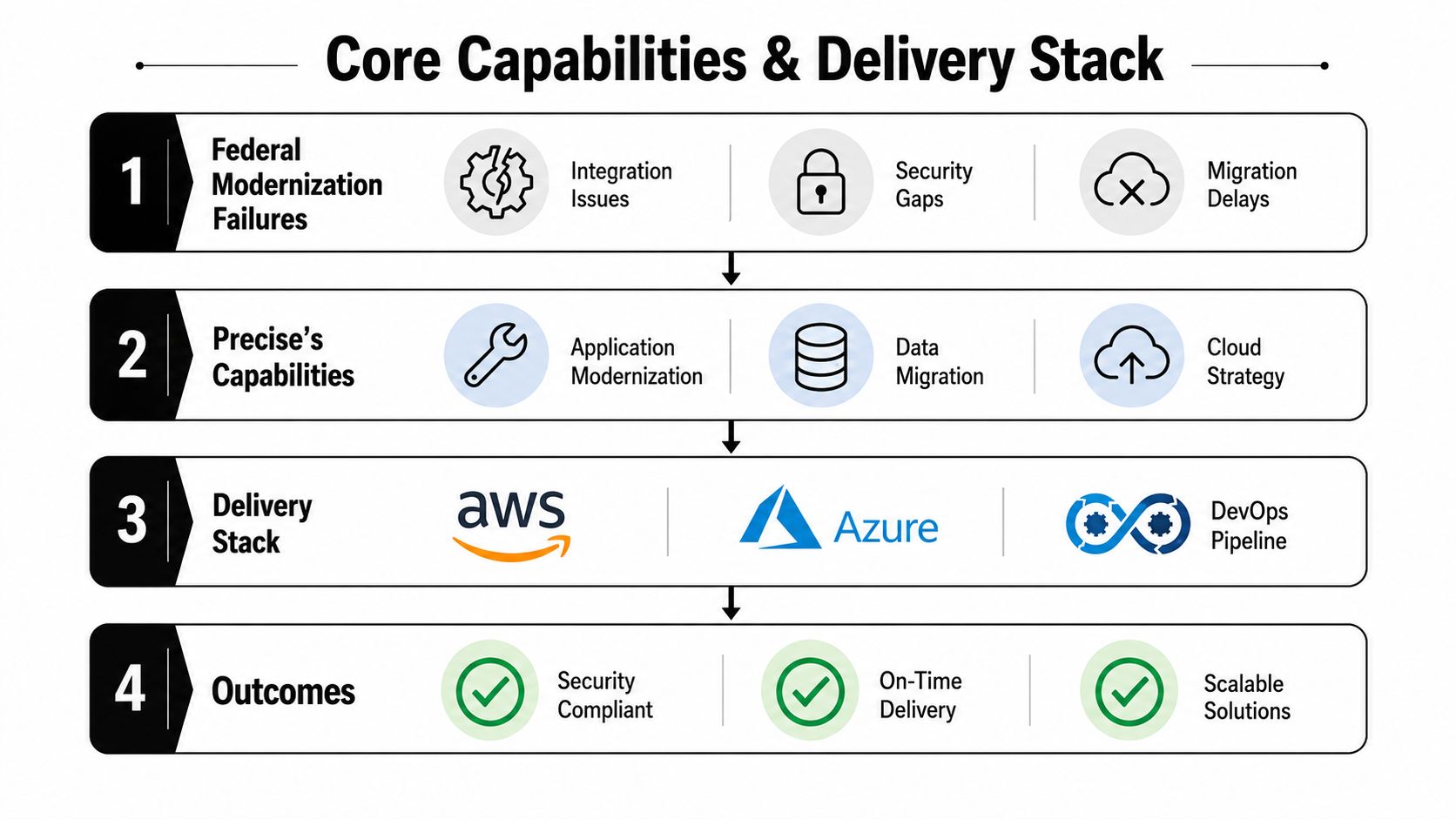
The buyer takeaway is straightforward. A stack this broad can support complex transformation, but breadth alone does not show where the team is strongest. Reference checks matter more here, because the core question is whether Precise can repeat this delivery pattern under current program pressure and not just describe it on a capability sheet.
AWS Machine Learning Platform in Federal Use Cases
Precise's clearest technical proof point is its AWS-based machine-learning platform for federal use cases. AWS says Precise implemented ML-as-a-service on AWS with capabilities including handwriting recognition, foreign-language label translation, form recognition, image recognition, content extraction, document understanding, and workflow automation (AWS Public Sector blog). That points to more than model development. It points to a document-processing chain that takes unstructured inputs, extracts usable content, and sends that content into downstream work.
For buyers, that distinction matters. A platform like this is only useful if the output is structured enough to support routing, review, and case handling. If OCR or classification quality slips, the business case weakens quickly, because human review fills the gap and the expected labor savings disappear.
What the platform implies
A separate partner announcement says Precise reached AWS Advanced Tier Services Partner status and built an enterprise ML-as-a-Service platform that delivers computer vision, natural language processing, and language translation to agency clients. That combination suggests a company that can work across content ingestion, machine learning, and agency workflow integration without treating those layers as separate problems.
Technical read: when a federal vendor can convert scanned forms and multilingual labels into structured data, the value is usually in reducing manual triage, not just in showing off a model.
The regulated-environment angle matters too. In public-sector settings, AI systems are rarely judged only by model performance. They are judged by how well they fit case management, exception handling, auditability, and human review. Precise's public AWS example fits that reality because it presents ML as an operational layer, not as a standalone research product.
The embedded video below is useful because it reinforces the platform perspective rather than a generic AI pitch.
Compared with a general integration project, the difference is the content flow. A basic system migration moves records. An ML document pipeline turns images, text, and language variation into structured operational inputs. That is a narrower and more technical niche, which is why it stands out in Precise's public record.
For teams evaluating API-driven workflow layers around this kind of system, a useful companion concept is what a data API does, because document intelligence often depends on how well systems expose, normalize, and consume structured outputs. Buyers also looking at procurement support can use Software for Government contracting as a reference point for how vendors present public-sector delivery capabilities.
How to Evaluate Precise as a Vendor or Partner
A buyer should evaluate Precise through the lens of mid-size federal contractor due diligence, not as if it were a pure software publisher. That means checking process maturity, contract history, and the actual shape of recent delivery. The public record gives enough to begin that review, but not enough to complete it.
Start with the credentials that are visible. Precise's materials point to SBA 8(a) Program history, CMMI Level 3, and ISO 9001/20000/27001 designations. Those signals matter because they speak to business access, quality controls, service management, and security posture. The next question is whether those certifications still map to the team you would staff on your project.
Questions procurement teams should ask
A useful diligence set is straightforward:
- Contract scope: Which recent agencies or state programs did the company support, and was the work prime, subcontract, or team-based?
- Delivery model: Which parts of modernization do they own directly, and which parts do they staff through partners?
- Security posture: How do they handle access control, audit support, and control inheritance across cloud and SaaS environments?
- Operational proof: What recent references show repeatable delivery beyond a single AWS case study?
- Commercial fit: Does the engagement need a contractor, a software vendor, or both?
For federal procurement teams comparing set-aside-eligible contractors, Software for Government contracting is a practical reference point for how firms present public-sector delivery capabilities. It helps separate eligibility from actual fit for the work.
The identity question also deserves a direct answer. What is Precise today? A federal IT services company with modernization and AI delivery capabilities. What is it not, based on the public record? A clearly packaged commercial SaaS vendor with a dominant product catalog. That distinction matters because vendor risk changes when the offering is customized service work rather than standardized software.
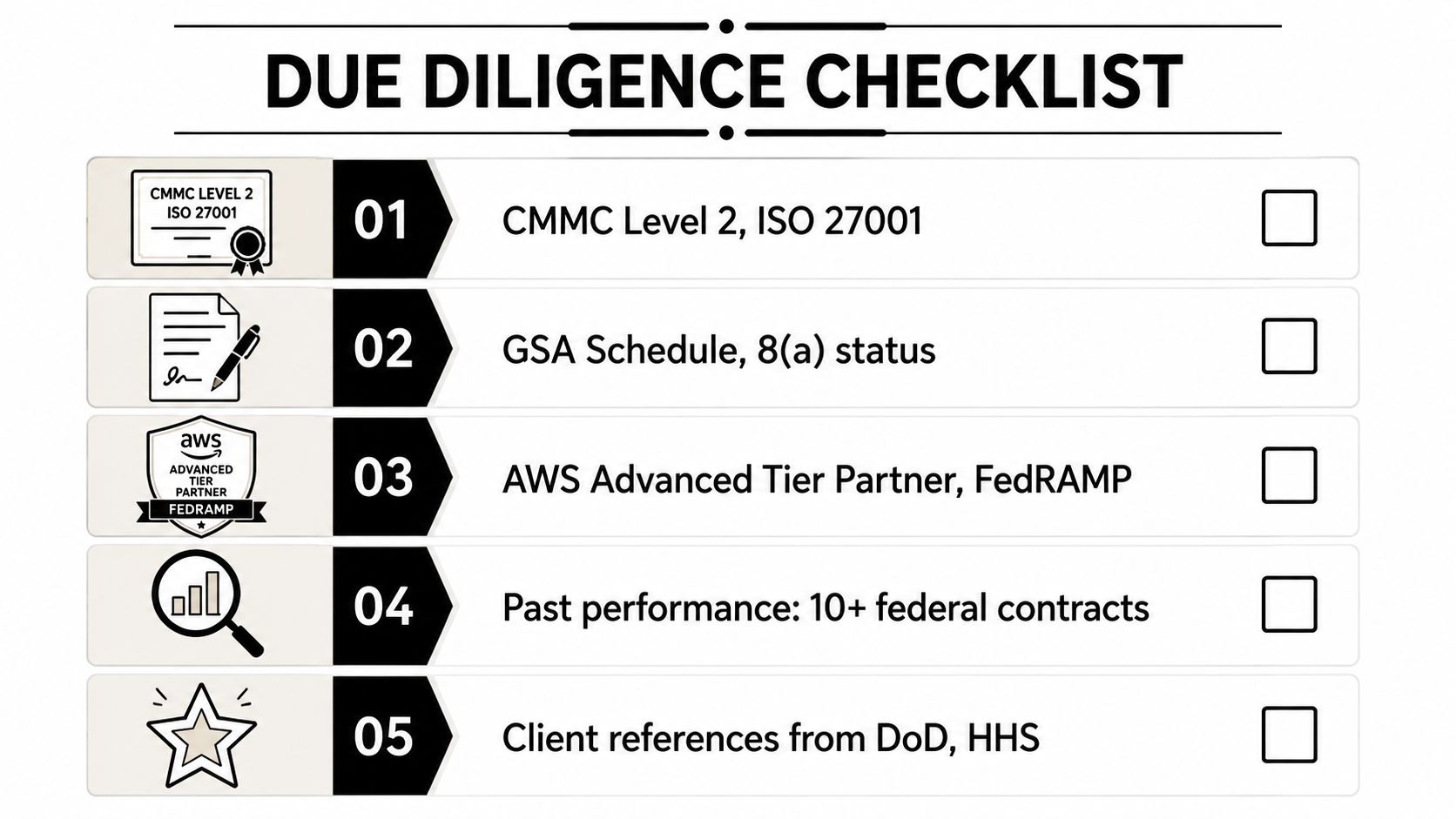
If you want to reduce uncertainty further, ask for named references tied to recent cloud or AI work, plus the contract vehicles used to win them. That is where the public materials are thinnest, and that is where a buyer should press hardest.
For additional security-focused screening, Precise's own public security references can be checked alongside Icypeas security information, especially if your team is building a broader supplier validation workflow.
The Missing Evidence on Outcomes and ROI
The public story around Precise is strong on capability and light on quantified outcomes. The company emphasizes modernization, cloud, AI/ML, and process automation, but the public record offers limited hard data on delivery results beyond broad claims such as saving time and money for a federal agency in the AWS example. That's a common gap in federal IT marketing, and buyers are less patient with it than they used to be.
The reason is simple. Agencies and primes now expect evidence of implementation value, not just a list of services. If a vendor says it can modernize applications, the next question is how it measures success across performance, security, and operational workload.
Buyer question: what changed after the project went live, and how did the team know the change was real?
A good sales conversation should ask for specifics. How did Precise measure review reduction, exception handling, or cycle-time improvement? What security metrics did it track during migration? Which controls were inherited, and which were rebuilt? What did the team do when a workflow or data rule failed in production?
The last 12 months have made that gap more visible because public-sector buyers are focusing harder on measurable modernization results and AI-enabled automation. Broad positioning isn't enough when procurement teams need to justify spend, de-risk integrations, and defend the implementation choice to stakeholders. Precise may well have those results internally, but the public materials don't yet present them in a way a buyer can independently verify.
That means the company's real test is not whether it can say the right words. It's whether it can document outcome, quality, and ROI in a format a sourcing team can evaluate without guessing. If it can, the firm moves up the shortlist. If it can't, buyers should treat the offer as promising but still unproven.
Final Verdict and When to Engage Precise
Is Precise Software Solutions Inc a government contractor, a product vendor, or both? Public evidence points to a mid-size federal IT contractor that also operates with enough technical depth to support cloud, data, and AI/ML delivery in regulated environments. Its public profile shows a mix of modernization, data engineering, and automation capabilities, and the AWS machine-learning case shows that the company has delivered applied work rather than only positioning itself as a generalist services firm. Its 8(a) history and certification posture, as noted earlier, also suggest a business that has been built to compete in federal procurement, not just in commercial software sales.
Engage Precise when the requirement calls for controlled modernization, content intelligence, or cloud and workflow integration inside a regulated program. That is the clearest fit for the public record. If a buyer needs a clearly packaged commercial software product, a broad library of quantified public case studies, or a vendor narrative that already answers ROI questions in detail, the public materials do not yet provide that level of proof.
The buyer verdict is therefore narrow but useful. Precise belongs on a shortlist when the acquisition strategy is looking for a mid-size federal IT contractor that can support modernization and automation work in complex environments. It should still be pressed on references, contract vehicles, and outcome measurement before award, because public sources do not yet show enough about repeatable results to close those gaps on their own.
If you're comparing federal IT contractors, Icypeas can help you verify company records, enrich contact data, and find the right people to speak with before outreach begins. Visit Icypeas to pull company and contact intelligence into your sourcing workflow and make vendor evaluation faster, cleaner, and more defensible.




























.png)


.webp)