.avif)
Condie Construction Utah: Your 2026 Project Partner

.avif)
If you're comparing contractors for a municipal upgrade, subdivision utility package, or roadway job in Utah, you already know the hardest part isn't finding a company name. It's separating the firms that can effectively manage buried utility work, concrete tolerances, and field coordination from the ones that only look good in a directory listing. Condie Construction Utah is worth a closer look because the public record shows a long operating history, a clear infrastructure focus, and enough scale to matter on real civil work.
Table of Contents
- Finding the Right Utah Infrastructure Partner
- Who Is Condie Construction A Company Overview
- Why Utah technical specs matter
- What kind of work does Condie Construction focus on
- Is Condie a small local contractor or a larger regional firm
- How long has Condie been active in Utah
- What should clients verify before hiring
- Does Utah's climate affect the type of work Condie handles
Finding the Right Utah Infrastructure Partner
Utah's infrastructure market rewards contractors that can handle utility-grade work without drifting into guesswork. A city engineer, developer, or GC needs more than a polished website, they need proof that the contractor understands buried utilities, surface restoration, staging around live traffic, and the documentation that keeps a project moving when inspectors get involved. For a broader lead-sourcing workflow, tools like MapLeads for Google Maps lead data can help teams build target lists, but the ultimate decision still comes down to who can execute in the field.
A useful way to evaluate a firm is to start with three questions. First, what kind of work do they self-position for. Second, how long have they been visible in the market. Third, do their public signals suggest they can carry a project from preconstruction through closeout without turning everything into a subcontractor relay race.
Condie Construction stands out because it fits the profile of a long-running regional heavy civil contractor, not a temporary entrant chasing a single cycle of work. That matters in Utah, where water, sewer, storm drain, roadway, pump station, and lift-station jobs demand coordination across utilities, design teams, and local jurisdictions. If you're building your own shortlist for condie construction utah, the right question isn't whether the name is familiar, it's whether the company's public footprint supports a serious due diligence process.
Practical rule: Start with public evidence, then verify license, insurance, bonding, and project history before you ask for pricing.
Who Is Condie Construction A Company Overview
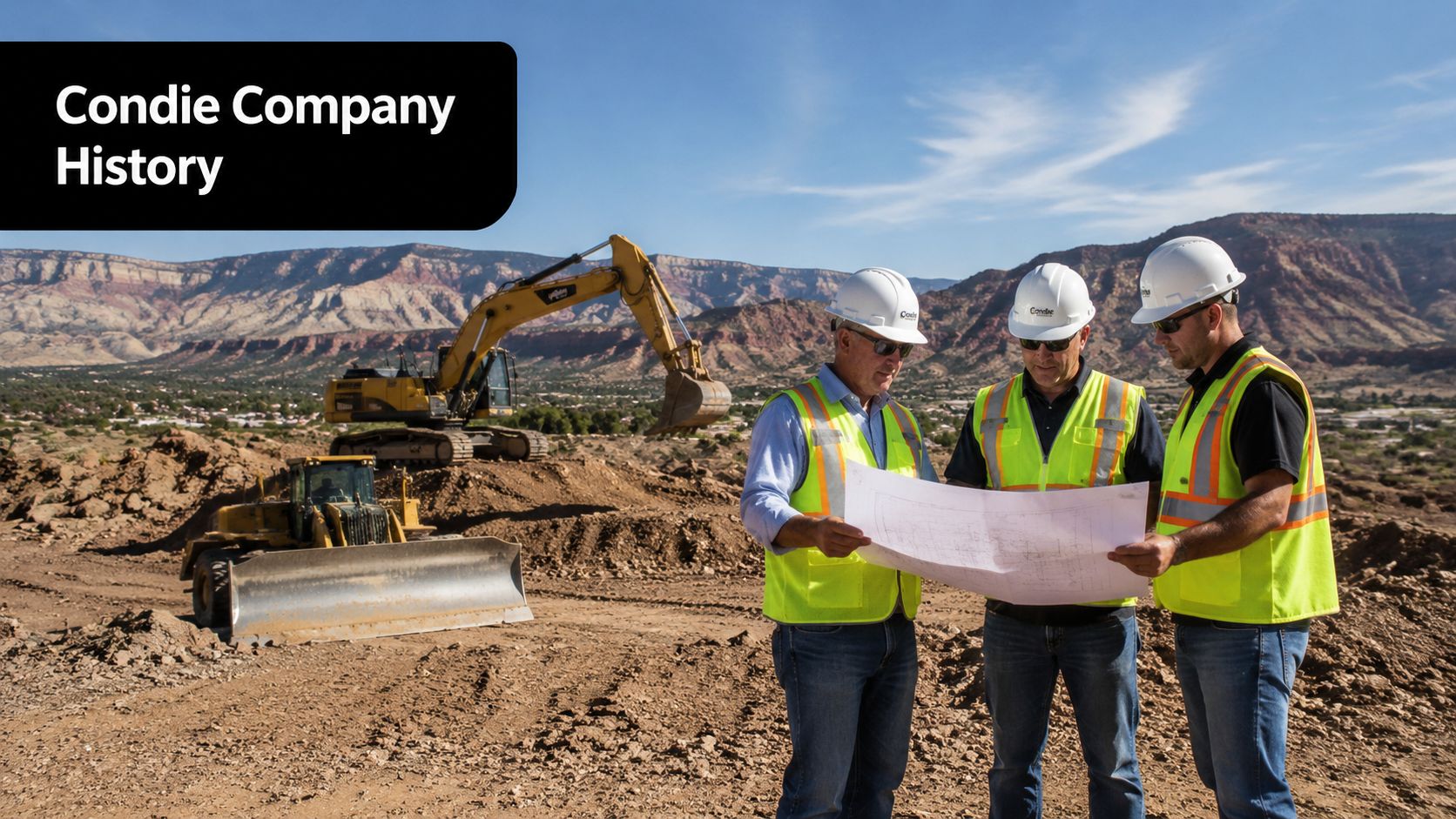
A project owner looking at Condie Construction for the first time is usually trying to answer a practical question, can this firm handle real infrastructure work without creating extra coordination problems in the field. Condie Construction Company, Inc. has a documented operating history going back to 1983, which places it among the more established Utah contractors in its lane. Its LinkedIn profile lists the company in Springville, Utah, identifies it as privately held, and shows 51–200 employees with estimated annual revenue of $50M–$100M (Condie Construction's LinkedIn profile).
That profile points to a mid-sized contractor with enough capacity to take on substantial civil work, while still remaining close enough to the work for clients to get direct attention. The company's headquarters is consistently shown at 53 N 1650 W, Springville, UT 84663 across business directories, and its official site describes the firm as specializing in large-scale infrastructure installation (Condie Construction official site). It has also been publicly listed in the construction marketplace ecosystem since 2009 through The Blue Book, which adds another layer of visibility in both public and private bidding channels.
For buyers, that combination matters because infrastructure contractors are judged less by presentation and more by whether they can keep crews coordinated, documentation current, and field decisions aligned with the owner's requirements. Public signals like these do not replace license, insurance, bonding, or project-by-project verification, but they do help separate a long-standing regional contractor from a company with little operating history. In Utah's heavy civil market, that distinction affects how much confidence a client can place in preconstruction discussions, scheduling commitments, and closeout discipline.
For suppliers and subcontractors, the same profile suggests a firm that is established enough to support an ongoing relationship, but still demands normal vetting on scope fit, payment habits, and how it manages changes in the field. A useful reference point for building that kind of contact and company profile review is Icypeas company background.
Core Services and Technical Specializations
Condie's service mix points to the kind of work that keeps a growing Utah community functioning. Water mains, sewer lines, storm drain systems, roadways, pump stations, and lift stations are connected parts of the same utility network, and each one creates its own field risks, inspection checkpoints, and handoff requirements. A contractor that handles this work well has to coordinate excavation, bedding, concrete, reinforcement, utility protection, and final restoration while still keeping the owner's schedule intact.
A water project is about pressure, alignment, and long-term reliability. Sewer work is about grade, invert control, and avoiding maintenance problems later. Storm drain systems have to move water fast enough to protect roads and lots while still fitting tight civil plans. Roadway work adds traffic control, compaction, tie-ins, and surface restoration, so sequencing matters as much as the equipment on site.
Pump stations and lift stations raise the level of coordination further. These facilities often sit at the center of a system's reliability, and the contractor has to manage mechanical, structural, and utility interfaces at the same time. Firms in this lane get judged on more than visible earthwork. They are judged on how cleanly they coordinate the parts that owners only notice when something fails.
A practical way to evaluate Condie's offering is to map each service category to the project need it serves:
| Service Category | Project Examples |
|---|---|
| Water infrastructure | Water mains, service tie-ins, pressure-related utility installation |
| Sewer infrastructure | Gravity sewer, manhole work, system extensions |
| Storm drain systems | Catch basins, conveyance lines, drainage improvements |
| Roadway construction | Street grading, utility corridor restoration, roadway reconstruction |
| Pump and lift stations | Structural and utility support for wastewater or water movement |
| Large-scale infrastructure installation | Multi-utility civil packages, public works-style site systems |
Why Utah technical specs matter
Utah public-spec documents often require buried concrete to meet a 4,000 psi minimum compressive strength and above-ground members to meet 5,000 psi minimum, using Type II cement to handle freeze-thaw cycles (Utah public specifications). That is not a paperwork detail. It affects mix design, placement discipline, and the durability of structures that sit in soil contact or exposed conditions.
Those same specifications also point to the need for tight quality control on permeability, air content, and aggregate gradation. In a climate that punishes weak concrete, small execution errors can shorten service life and create costly callbacks. A contractor working in this segment has to treat a utility structure as a long-term asset, not just a concrete pour.
For sourcing, estimating, and contact verification around technical service lines, a resource like Icypeas explains how it finds contact data can help teams understand how public-company details are assembled and checked.
What works: field teams that treat specs as build instructions, not paperwork.
What doesn't: crews that assume one mix or one placement method fits every civil condition.
Condie's profile also aligns with the estimating and scope-control demands that come with utility-heavy work, which is why tools such as Exayard construction estimating software are relevant when teams need tighter bid consistency and cleaner preconstruction planning.
Verifying Credentials and Operational Capacity
A contractor can look credible on paper and still leave risk on the owner's side. Before a client awards a public works package or a private utility job, the first filter should be credentials. Licensing confirms the contractor is authorized to operate. Insurance protects the project if an accident or claim arises. Bonding capacity shows whether the company can support performance and payment obligations at the scale the job requires. If any one of those is unclear or incomplete, the risk profile changes quickly.
A company profile alone does not settle the question. The real test is whether the contractor can show the paperwork, the field systems, and the financial structure that match the size and complexity of the work. For teams comparing estimating workflows, it also helps to see how tools like Exayard construction estimating software fit into preconstruction planning, especially where scope control and bid consistency affect project outcomes.
Reading the workforce signal
Public profiles show Condie with roughly 65 employees on ZoomInfo, while LinkedIn places the company in the 51–200 employee range (ZoomInfo profile, LinkedIn profile). That points to a firm that is larger than a small specialty subcontractor, but not a national contractor with unlimited bench depth. In practical terms, project fit matters. A mid-sized utility and infrastructure team may be the right match for Condie's operating model, while oversized or highly concurrent programs deserve closer scrutiny around staffing, supervision, and schedule support.
Labor conditions make that review more important. A University of Utah Gardner Institute post notes that construction jobs are not keeping up with construction activity, which signals labor bottlenecks across the industry (Gardner Institute coverage referenced in the brief). In that setting, headcount alone does not tell the full story. Clients still need to ask how the company assigns foremen, how much it depends on subcontractors, and how well it can absorb delays without losing control of the work.
What clients should ask for
Ask for the documents before the meeting gets too far along.
- Licensing: Request current Utah licensing details and confirm they match the exact entity bidding the work.
- Insurance: Verify general liability and workers' compensation coverage directly, not through a verbal summary.
- Bonding capacity: Ask how the company supports performance and payment guarantees for work of your project's size.
- Key personnel: Identify who will run the job in the field, not just who signed the proposal.
- Project load: Ask whether the company is self-performing, subcontracting, or balancing multiple active jobs.
For contact-data workflows and outreach planning, Icypeas contact guidance on finding contact data is useful when internal teams need to build accurate stakeholder lists before they call on a contractor.
A Portfolio of Utah Infrastructure Projects
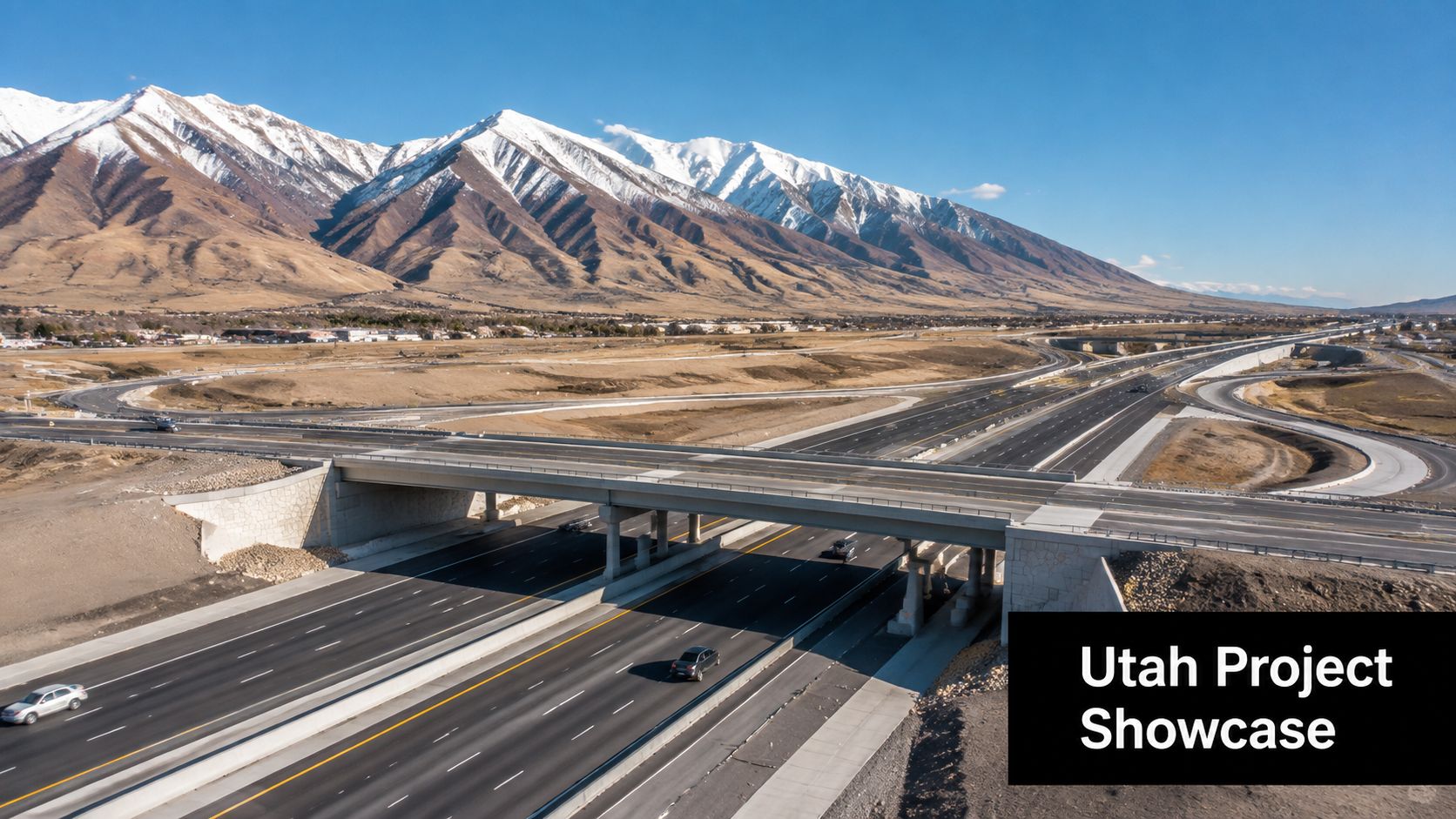
A contractor's portfolio says more than a brochure ever will. For a Utah infrastructure buyer, a key question is whether the firm has handled work that lives under traffic, beside active utilities, and inside tight public-right-of-way constraints.
Condie's public positioning points toward project types that fit Utah's utility and heavy civil market, not decorative building work. The emphasis is on systems that keep neighborhoods, roads, and public assets functioning over time, which means the useful lens is project risk, not project branding.
A municipal water main replacement is rarely just trenching and backfill. It can require service continuity for nearby customers, coordination of shutoffs, careful tie-ins, and pavement restoration that leaves the corridor usable. A storm drain package for a growing subdivision creates a different pressure point, because drainage has to function before homes are occupied, not after residents discover standing water at the curb.
Lift stations and pump stations raise the coordination burden again. Those jobs usually combine structural concrete, utility interfaces, and mechanical requirements inside a compact footprint. A contractor that can manage that mix is showing it can keep multiple scopes aligned without letting small details threaten the system's reliability.
Public visibility also matters. The company's long-term market presence suggests it has stayed active through multiple bidding cycles and has remained in the heavy civil and utility conversation long enough for owners, engineers, and suppliers to form real impressions of its field performance. That does not guarantee a perfect project record, but it does indicate staying power in a demanding segment of the market.
Utah's ongoing investment in roadway work, buried utilities, and the support systems that let communities expand creates steady demand for the kinds of trades Condie promotes. A useful portfolio review checks whether a contractor's stated strengths match the actual conditions a buyer faces in the field. In that sense, the public profile points toward civil work where sequencing, utility coordination, and technical compliance matter more than presentation.
For teams building outreach lists or vetting local contractors, contact data workflow guidance can help organize the right decision-makers before the first call.
How to Partner with Condie Construction
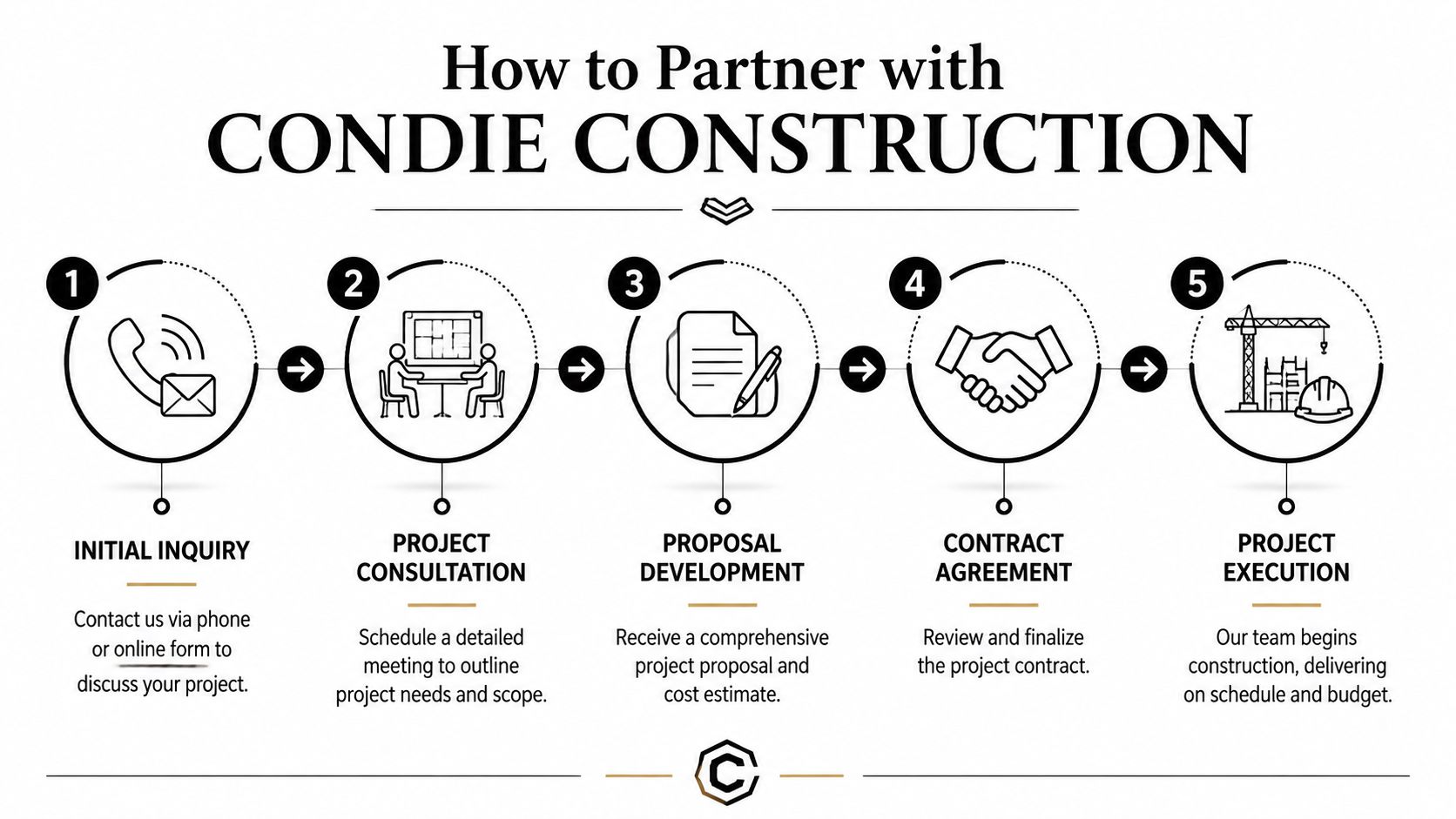
The cleanest way to start with any infrastructure contractor is to bring a complete scope package, not a vague ask. For Condie, that means a bid invite or project conversation should include location, utility type, expected schedule, plan set status, and any site constraints that affect excavation or staging. That helps the estimator decide whether the job fits the company's capabilities and whether the schedule is realistic.
A practical outreach sequence looks like this:
- Initial Inquiry. Use the company's main contact path to introduce the project and the timing.
- Project Consultation. Walk through the scope, utility conditions, and site constraints.
- Proposal Development. Request a written estimate tied to the documents in hand.
- Contract Agreement. Confirm pricing, scope exclusions, insurance, and bond requirements.
- Project Execution. Align field contacts, submittals, and schedule expectations before mobilization.
That sequence matters because many project problems start before mobilization. If the owner, GC, and contractor don't agree on scope boundaries early, the field team inherits ambiguity later. Good preconstruction discipline protects both sides.
Subcontractors should use the same discipline. Send a concise trade summary, relevant credentials, and current availability. Don't assume the contractor wants a long pitch when it needs fast clarity on whether you can support the job. For formal contact routing and outreach organization, Icypeas contact support can help internal teams keep stakeholder records clean and usable.
The strongest partnership conversations are specific. If you're a city, ask how the company handles utility tie-ins and traffic restoration. If you're a developer, ask how they sequence site work around grading and underground utilities. If you're a vendor or trade partner, ask where they need the most dependable support right now.
Frequently Asked Questions About Condie Construction
What kind of work does Condie Construction focus on
Condie Construction's public profile centers on water, sewer, storm drain, roadway, pump station, and lift-station projects. That places the firm in heavy civil and utility work, where installation quality, sequencing, and long-term performance matter more than visual finish. For a client, that usually means evaluating how well a contractor manages subsurface conditions, utility interfaces, and restoration details, not just how quickly it can mobilize.
Is Condie a small local contractor or a larger regional firm
Public profiles point to a mid-sized regional infrastructure contractor rather than a small subcontractor. LinkedIn places the company in the 51–200 employee range, and ZoomInfo lists about 65 employees, with estimated annual revenue of $50M–$100M. That size profile suggests enough scale for municipal and utility work, while still leaving room for close field oversight and direct communication.
How long has Condie been active in Utah
The company's documented operating history reaches back to 1983. Public business listings also show long-standing market visibility. For clients, that kind of tenure usually signals repeat work, local familiarity, and a track record that can be checked through references, past projects, and permit records.
What should clients verify before hiring
Clients should verify licensing, insurance, and bonding capacity before they award work. They should also ask who will supervise the job in the field, how change orders are handled, and how the company plans to coordinate schedule, subcontractors, and utility conflicts. Those questions separate a contractor with good marketing from one that can effectively control a job once excavation starts.
Does Utah's climate affect the type of work Condie handles
Yes. Utah public-spec documents commonly call for 4,000 psi minimum compressive strength for buried concrete, 5,000 psi minimum for above-ground members, and Type II cement where freeze-thaw exposure is a concern. Those requirements favor contractors that pay attention to mix selection, placement, cure time, and seasonal field conditions. They also raise the cost of mistakes, since poor material control shows up later in cracking, settlement, or premature repair needs.
A contractor working in that environment needs more than equipment. It needs disciplined crews, consistent inspection habits, and a practical approach to weather and sequencing.


































































.png)


.webp)