.avif)
What Is Data Accuracy and Why It Matters for B2B Teams

.avif)
Data accuracy is the degree to which a record matches the world it's supposed to represent, and it's never a static property. In production pipelines, it decays unless you keep checking it against reality.
You know the moment already. An SDR pulls a fresh list of enriched contacts, launches the sequence, and the inbox starts telling the truth. Replies thin out, a few messages bounce, and the titles in the CRM don't match the people who own the problem anymore. The list looked clean. The pipeline didn't.
That gap is why what is data accuracy can't be treated like a textbook definition. In B2B operations, accuracy is a live property of a record, not a badge on a dataset. If the email, title, company, or account relationship no longer reflects reality, the record may still look neat in the CRM and still be wrong where it matters.
Table of Contents
- Precision tells you how often your claimed matches are right
- Recall tells you how much of the valid universe you captured
- Verification rate tells you what survives an independent check
- Bounce rate tells you what happened after send
- Start with verification that can survive real deliverability
- Enrich carefully and respect the rules
- Monitor the right things, not just the loud ones
The Moment Bad Data Costs You a Deal
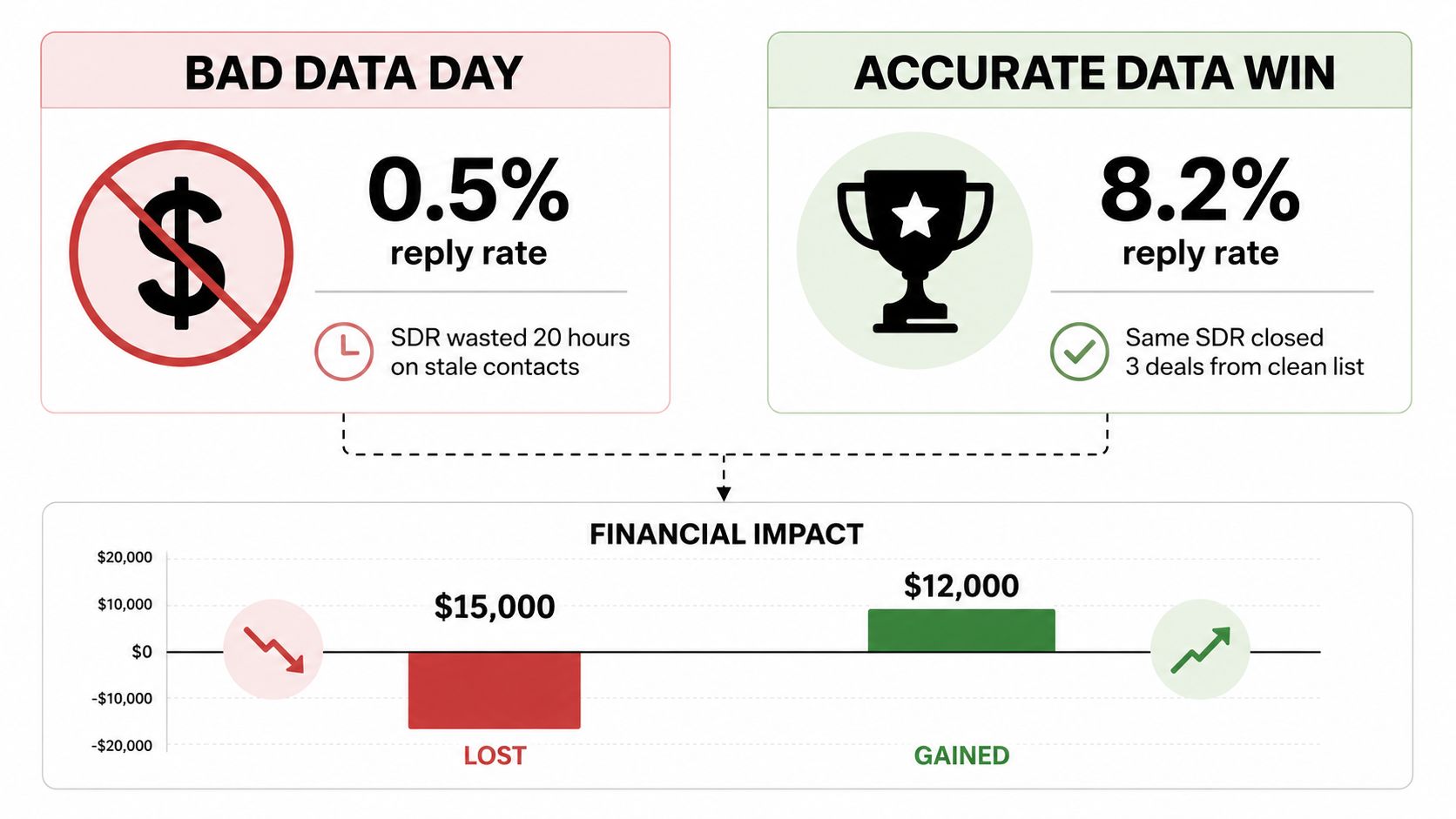
For an SDR, data accuracy is wasted time, dead replies, and a manager asking why a “qualified” list underperformed. The list was enriched, formatted correctly, and imported without errors, but half the titles were stale and a chunk of addresses no longer belonged to the people in the file.
That's the trap. Completeness means the fields are filled in. Format validity means the values follow the expected shape. Recency means the data was updated recently. None of those guarantees that the record is true. A contact can have a complete profile, a valid email, and a current-looking job title, while still being the wrong person for the campaign.
What accuracy means in practice
In statistical and data management terms, accuracy is the closeness between a stored value and the true value it represents. The practical standard is straightforward, a field is accurate only if it still matches the external reality it is supposed to describe. Error can come from nonresponse, noncoverage, measurement error, processing error, and computational error, which is why validation against reality matters, not just internal consistency. Statistics Canada data literacy guidance
That matters in B2B because a record can be internally tidy and still be operationally wrong. A job title may look plausible, but if the person changed roles last quarter, the account owner is now chasing the wrong buyer. A lead may have every required field, but if the inbox is stale, the campaign still misses.
Practical rule: treat accuracy as a behavior of a record over time, not as a property you check once during cleanup.
| Dimension | Definition | B2B Example |
|---|---|---|
| Accuracy | The record matches reality | A contact still works at the listed company |
| Completeness | Required fields are present | Name, title, and email are all filled in |
| Format validity | The value fits the expected structure | The email passes syntax checks |
| Recency | The record was updated recently | The profile was refreshed this month |
The key shift is mental, not technical. If you run outbound, route leads, or enrich CRM data at scale, accuracy is something you monitor like a pipeline health metric. It is a standing operational concern, and it can sit in different states, from acceptable to risky to unusable, depending on how much the record has drifted from reality.
A Working Definition Beyond the Dictionary
A record can look clean and still miss the target. In production, data accuracy is the degree to which a stored value matches the real-world object, person, or event it is supposed to represent. IBM describes it as a reference-conformance metric, which is the useful test for RevOps teams, does this field line up with the external truth you operate against, or is it only passing internal checks? IBM on data accuracy
That distinction matters because pipeline hygiene and reality are not the same thing. A CRM value can be formatted correctly, enriched correctly, and still be wrong if the contact changed jobs, the account was acquired, or the buying center shifted. In practice, accuracy is the part of data quality that keeps deliverability stable and keeps revenue from decaying as records age.
A useful way to manage it is to treat accuracy as a KPI with thresholds, not a label you apply once and forget. A contact list can sit in an acceptable range, drift into a risky range, and then fall into a range that starts hurting routing, outreach, and forecast quality. The record does not need to be broken to be costly. It only needs to be stale enough that your team keeps acting on yesterday's truth.
Reference-conformance is the practical test
Reference-conformance means the value can be checked against a trusted outside source or a known real-world reference. For a B2B team, that might be a corporate domain, a current role, an active office location, or an account's parent organization. If the record no longer matches the reference you depend on, it is not accurate enough for production use.
That is why accuracy shows up first in operational work, not in theory. An SDR sequence sent to a defunct inbox, a routing rule built on an outdated title, or an enrichment feed that points to the wrong legal entity all create the same problem. The system keeps running, but the output no longer maps to the market you are trying to reach.
This is also where tiered monitoring beats a binary pass or fail. A record that is close to reality may still be usable for one workflow and too risky for another. A broad account segment can tolerate more drift than a direct-dial queue or a high-value lead route. The right standard depends on how much error your process can absorb before inbox placement, response rates, or handoff quality start to slip.
Accuracy is stable only when the reference stays current. Once the outside world changes, the record starts losing value even if no one edits it. That is why B2B operators need recurring truth checks, not one-time cleanup.
Why Accuracy Is Now a Revenue KPI
Poor accuracy shows up first in the inbox and later in the forecast. A stale contact list creates bounced emails, and bounced emails damage deliverability. Misrouted leads waste SDR time. Wrong firmographics distort segmentation. Bad inputs also poison downstream automation, including AI workflows that learn from the wrong records and then amplify the error.
The economic stakes aren't small. One 2026 roundup reported that 85% of big data projects fail because of poor data accuracy, that poor accuracy costs organizations an average of $12.9 million annually, and that 27% of records contain at least one critical accuracy error. The same source said accuracy issues affect 41% of AI model performance degradation and that 33% of CRM data becomes inaccurate within 12 months. Those figures line up with the way B2B data behaves in the field, especially for contact records that age fast. Data quality statistics roundup
The revenue path from bad data to bad decisions
In outbound, the loss is usually cumulative. A bad title sends the message to the wrong person, the wrong person ignores it, the sequence looks weak, and the team blames copy. In reality, the list was the problem. The same thing happens with routing, where a stale role field sends a lead to the wrong owner or the wrong play. The CRM still works. The process still runs. The outputs just get less useful.
That's why accuracy belongs in the revenue dashboard, not just the data governance folder. If your team relies on contact-level data to trigger outreach, personalize messaging, or score accounts, accuracy is part of pipeline performance. It's also part of compliance risk, because bad records can create consent, retention, and routing mistakes that are hard to unwind.
For teams building a control layer around this problem, the basic governance advice at best practices for data governance is worth reading alongside any outbound playbook. The point isn't process for its own sake. The point is making sure the data feeding automation is trustworthy enough to deserve automation.
The business argument is straightforward. If the record no longer reflects reality, every downstream decision inherits the error. That's why accuracy is now a revenue KPI, not a back-office hygiene metric.
The Four Metrics That Measure Accuracy
A lot of teams collapse accuracy into one vague number. That is hard to use in operations. Separate metrics matter because each step in the workflow fails differently, and each failure has a different cost in deliverability and revenue decay.
Precision tells you how often your claimed matches are right
Precision is the share of records your system says are correct that are correct in practice. In a lead-enrichment flow, that means checking the records you marked as valid against a trusted source or master record. If a team calls a list “accurate,” precision asks whether the verified subset holds up under review.
Recall tells you how much of the valid universe you captured
Recall is the share of all valid records you successfully found. That matters when you are building account lists, not just cleaning records you already have. A list can score well on precision because the records inside it are accurate, while still missing too many good prospects to support the campaign.
Verification rate tells you what survives an independent check
Verification rate is the percentage of records that pass an external deliverability or identity check. For B2B email data, that usually means strict validation, MX checks, SMTP handshakes, and catch-all handling. It is closer to an operational truth check than a metadata check, because it tests whether the field can still work in practice.
Bounce rate tells you what happened after send
Bounce rate is the downstream reality check. It measures hard and soft bounces per send, and it is the number mailbox providers and deliverability teams care about first. If the verification layer looks healthy but bounces keep rising, the problem is usually decay, routing, or a weak verification standard.
A useful comparison is capture quality versus send quality. Precision and recall are quality-of-source metrics. Verification rate and bounce rate are quality-of-deliverability metrics. Healthy programs track both, because a record can be clean at intake and still fail at send time.
For a practical adjacent example, the speech to text accuracy tips guide shows the same split between recognition quality and downstream usability. The system can be mostly right and still miss the point where the workflow needs it most.
Operational shortcut: if the complaint is “our data seems wrong,” start with precision. If the complaint is “our campaigns don't reach,” start with verification and bounce rate.
Where Inaccuracy Actually Comes From
Most accuracy problems don't start with one dramatic failure. They come from drift. People change jobs. Companies merge. Domains age out. Someone exports a list, dedupes it badly, and writes over clean records. Then a validation step checks only the format and the bad field keeps moving downstream.
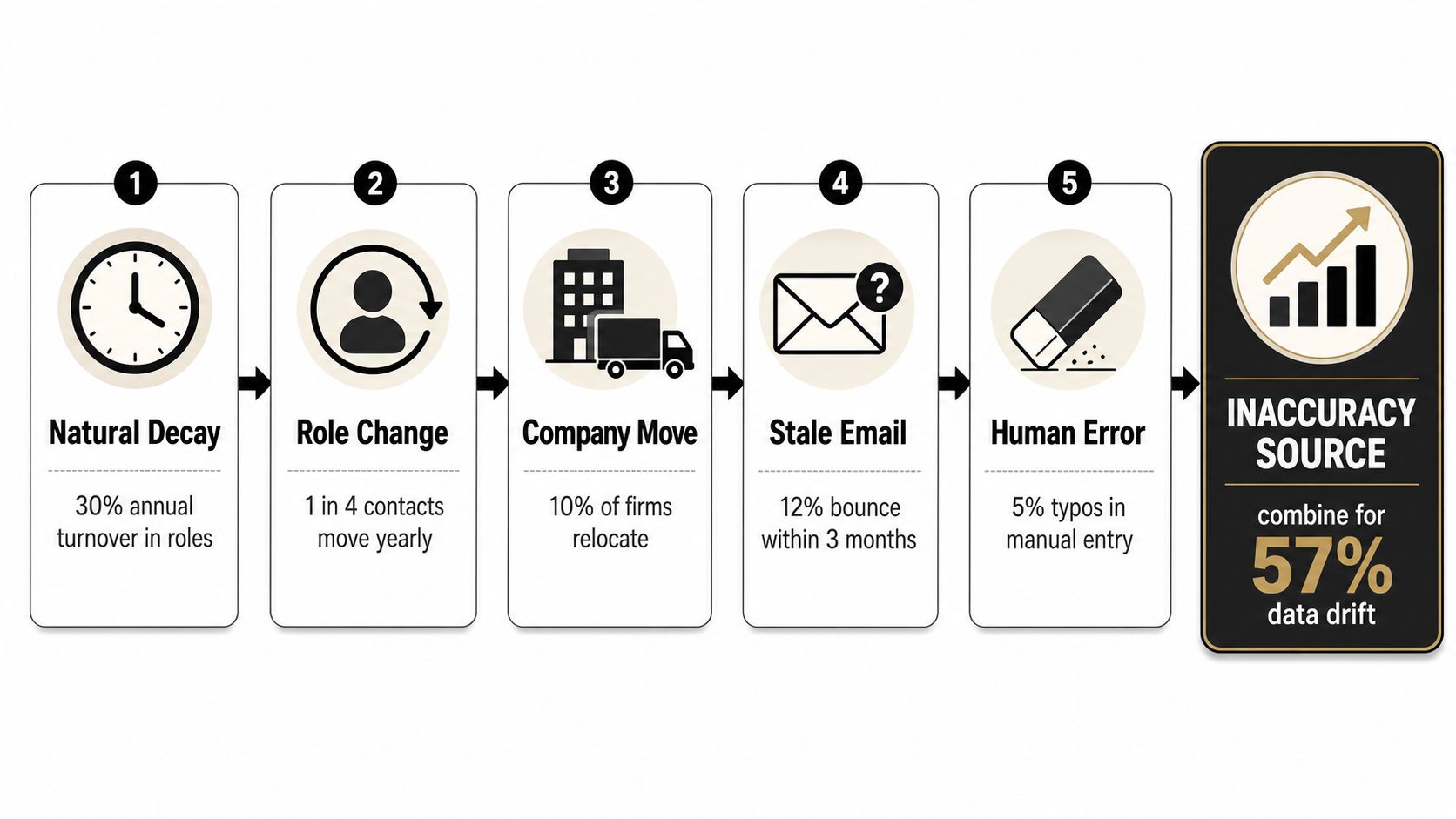
The five drivers that show up in B2B pipelines
Natural decay is the simplest one. Roles change, companies get acquired, and emails churn. You'll see it as rising soft bounces, more “not the right person” replies, and a steady drop in sequence relevance.
Source gaps show up when a provider doesn't cover every edge case. That's normal. No source has perfect visibility into every firmographic detail. The symptom is inconsistent company metadata, especially in niche markets or newly created accounts.
Enrichment drift happens when repeated lookups return slightly different values over time. One refresh says one title, the next says another, and the team starts arguing about which field is right. That usually means the underlying source is probabilistic, not fixed.
Workflow pollution is self-inflicted. Manual edits, bad imports, deduplication errors, and overwrites can corrupt clean fields faster than outside data decay. The symptom is internal inconsistency, like different owners or titles for the same contact across systems.
Verification shortcuts are the last one. Teams check syntax and call it done. That misses catch-all behavior, recent role changes, and the kinds of identity changes that matter most for outreach.
If you want a deeper explanation of identity matching across sources, the guide on what is identity resolution is useful because it shows why matching people and companies correctly is a prerequisite for measuring accuracy at all.
For teams that want a broader systems view, the database backup for sales teams article is a good companion read, because accuracy problems often get worse when teams don't preserve clean recovery points before imports and merges.
What the symptoms look like
- Rising soft bounces usually point to stale inboxes or weak verification.
- Mismatched job levels usually point to decay or source gaps.
- Campaigns that underperform on paper often point to workflow pollution, not messaging.
- Repeatedly changing fields usually point to enrichment drift or unstable sources.
A quick internal signal can be seen in systems that use cached profile refreshes rather than fragile live scraping. The difference matters because cached data gives teams a consistent reference window, while live scraping tends to introduce more variance.
The useful mental model is simple. Don't treat bad accuracy as one problem. Treat it as a cluster of root causes, each with a different symptom and a different fix.
Building a Remediation Workflow That Sticks
A remediation workflow only works if it's repeatable. Ad hoc cleanup feels productive, but it rarely survives the next import, the next campaign launch, or the next sync from a third-party source. The loop that holds up in production is verification, enrichment, monitoring.
Start with verification that can survive real deliverability
Strict verification should check more than format. It should include MX checks, SMTP handshakes, and catch-all handling, especially for Google and Microsoft domains where the surface-level signal can be misleading. A high catch-all verification rate is more meaningful than a vanity accuracy claim because it tells you how many records are safe to send against, not how many looked plausible in a spreadsheet.
If you want a practical checklist for this stage, HarvestMyData lead validation is a useful reference point because it frames validation as an ongoing control rather than a one-off cleanup pass.
Enrich carefully and respect the rules
Enrichment should help you fill gaps, not create new risk. Prefer open-source intelligence over invasive scraping, and document lawful basis, retention windows, and deletion handling for GDPR and CCPA workflows. If a contact asks to be removed, the process has to honor that request. If a dataset has a consent flag, the enrichment layer should respect it instead of overwriting it.
In practice, cached and regularly refreshed profiles are more stable than fragile live scraping for API-driven workflows. That's especially important when you need consistent outputs across systems. It's also why teams should use tools as infrastructure, not as magic. One useful reference for the cleanup side of that workflow is CRM data cleaning, because the best enrichment stack still fails if the CRM keeps reintroducing dirty records.
Monitor the right things, not just the loud ones
Watch verification rate drift, bounce trends by domain and campaign, decay indicators on core fields like title and company size, and the share of records that get flagged for re-verification. Manual audits still matter because they catch the edge cases automated rules miss. A workflow that never rechecks itself eventually trusts old truth.
The best accuracy program doesn't try to eliminate uncertainty. It makes uncertainty visible early enough to act on it.
A responsible-use checklist belongs in the same workflow. Keep data minimization tight, define retention windows, run vendor due diligence, confirm ISO 27001 hosting expectations, and make sure deletion requests propagate. That's what turns enrichment from a one-time fetch into a controlled operational system.
KPIs SDRs and CRM Managers Should Track Weekly
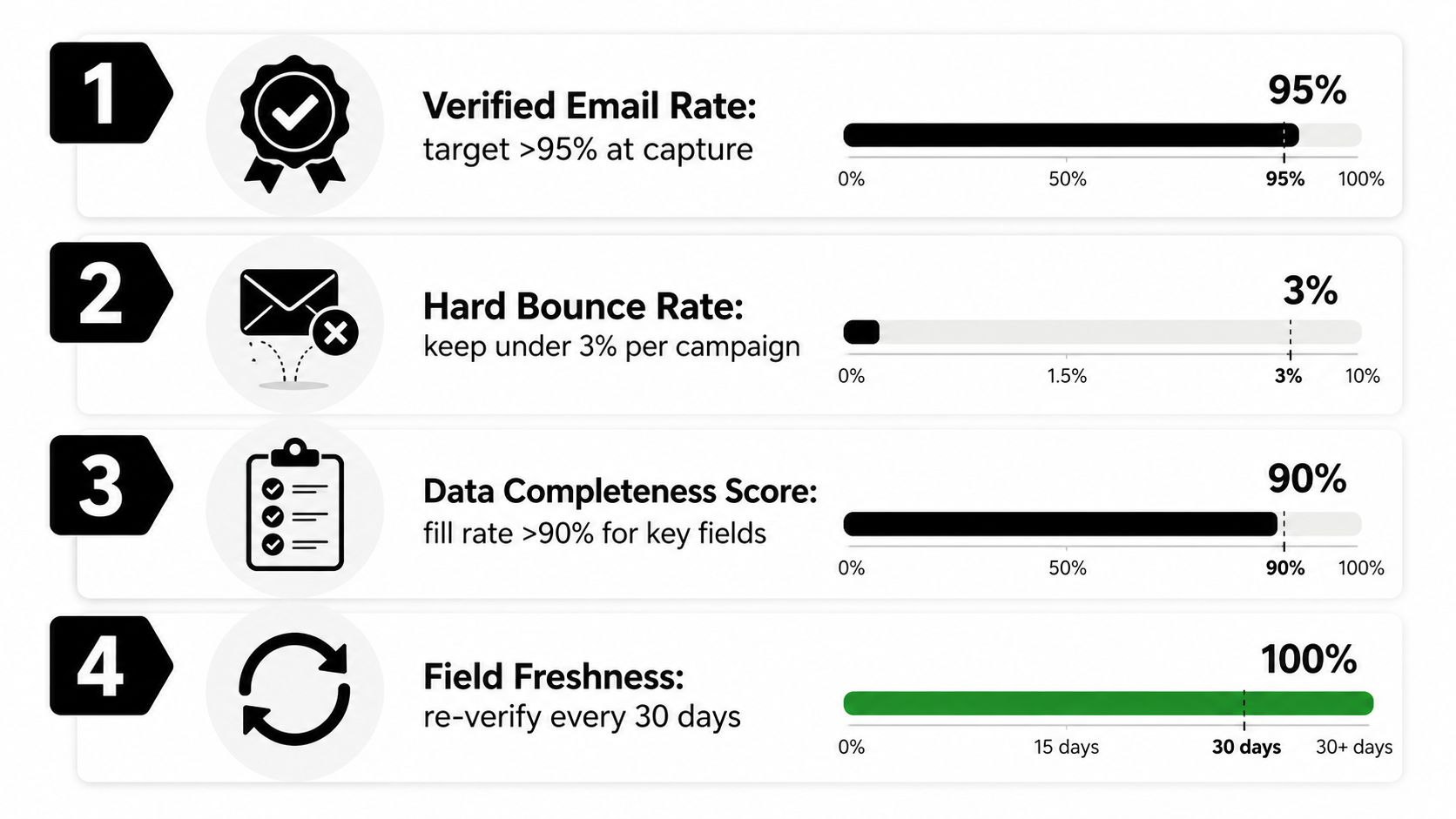
Many organizations overcomplicate this dashboard. You don't need twenty metrics. You need a small set that tells you whether data is accurate at capture, stays accurate in the field, and still delivers cleanly once it hits the send layer.
The weekly scorecard
Verified email rate at capture. Healthy net-new records should land above 95% on your own internal standard, but only if you're clear about the sample and the field being tested. A provider with documented refresh cycles, like Icypeas-style monthly profile refreshes, makes this easier to defend because freshness isn't guessed, it's part of the data contract.
Hard bounce rate per campaign. Keep it under 3% per campaign as a practical watchpoint, and treat any spike as a sign that verification or freshness is slipping. If the number jumps on one domain or one sequence, don't blame the copy first.
Decay rate of key fields. Track job title, company size, and seniority over rolling 30- and 90-day windows. Fields that move often should be re-verified on a predictable cadence, not when someone notices a problem in the CRM.
Share of records flagged for re-verification. This tells you how much of the database is aging out of trust. A rising share isn't necessarily bad. It means your monitoring is working and catching drift before it hits deliverability.
How to read the numbers
A “95% accurate” claim means almost nothing unless you know which fields were tested, which records were sampled, and what time window was used. That's the whole problem with accuracy as a vanity metric. It sounds reassuring, but it doesn't tell you whether your outbound list, routing logic, or CRM is still aligned with reality.
The better question is whether the data is fresh enough for the use case. If the answer is no, then the record needs re-verification, enrichment, or both. That's the practical difference between a database that looks healthy and one that supports revenue work.
If you need a clearer system for finding, verifying, and refreshing B2B contact data, Icypeas is built for that workflow. It gives sales and RevOps teams tools for email finding, strict email verification, reverse lookup, and monthly-refreshed contact data, which makes accuracy easier to monitor instead of guessing at it. Visit Icypeas to see how that fits into your own outbound and CRM cleanup process.
















































.png)



.webp)