.avif)
Psychology in Selling: Essential B2B Tactics for 2026

.avif)
Most advice on psychology in selling gets it backwards. Reps are told to add pressure, scarcity, and sharper framing, but in complex B2B that often makes buyers feel managed instead of understood. The better move is subtraction, remove the cues that feel manipulative, then use cognitive ease, transparent limits, and verified context so the message feels credible before anyone gets on a call.
That matters because buying choices are rarely made in a clean, fully rational sequence. Research on selling psychology points to a large share of decisions happening outside conscious awareness, and other summaries place a strong emotional influence on decisions before logic is used to justify them later (selling psychology research). In B2B, buyers often define requirements before they speak to sales, and deals still stall after that, which means the psychological work starts before the demo and keeps going after it.
The practical takeaway is straightforward. If your contact data is wrong, a title is stale, or profile context is thin, the psychology does not land cleanly. Verified records and accurate buyer context are the floor, not the finish line, and without them even a well-timed message reads as generic. For a useful example of how professional presentation cues shape perception before the first conversation, AI headshot alternative for consultants is a solid reference.
Table of Contents
- Loss aversion works better than feature lists
- Social proof should be specific, not decorative
- Authority has to match the buyer's world
- Reciprocity should feel like help, not bait
- Commitment should be incremental
The Uncomfortable Truth About Psychology in Selling
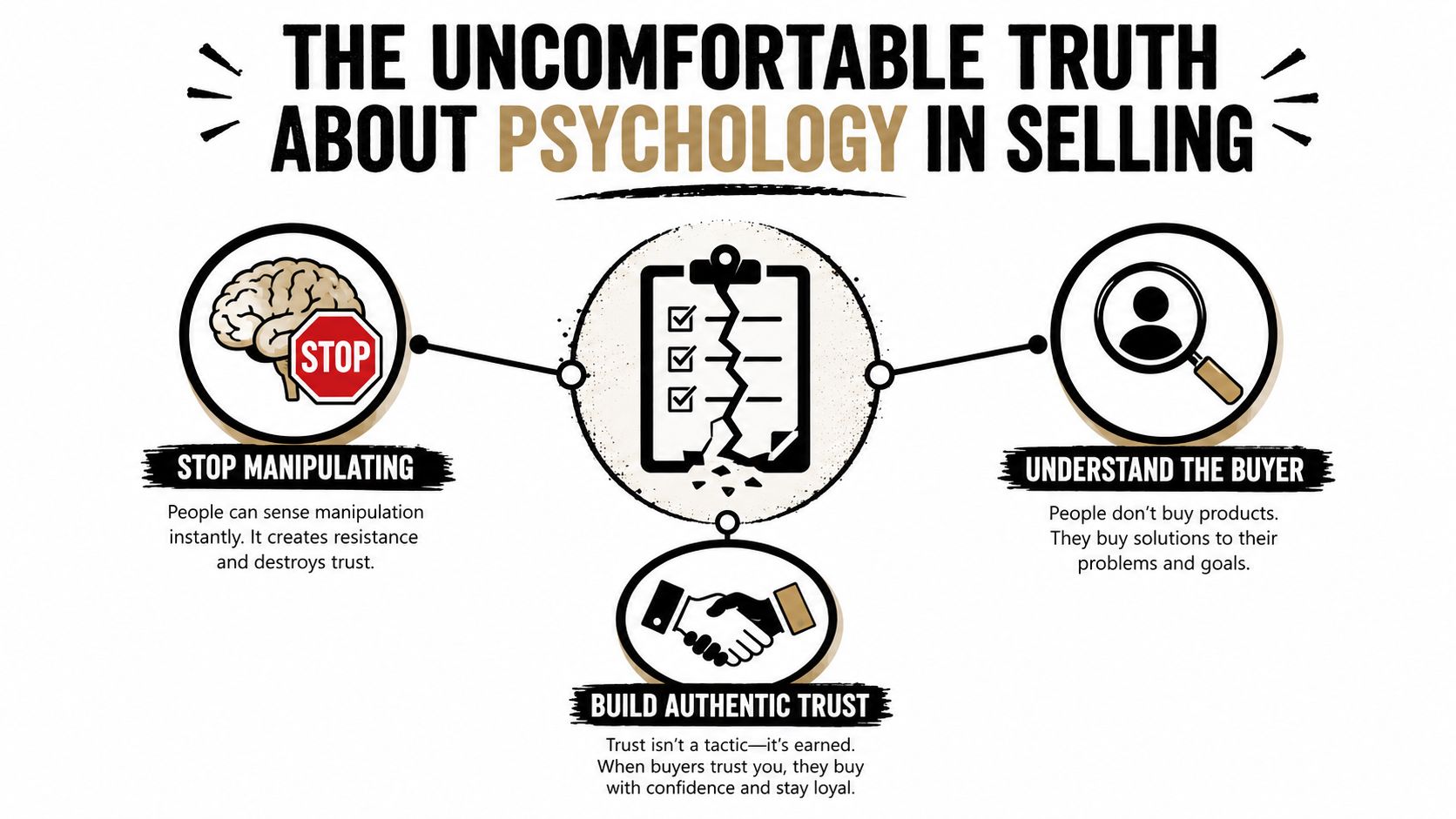
The most popular sales advice assumes that persuasion is an additive game. Stack on urgency, add scarcity, borrow authority, then keep pushing until the buyer gives in. In trust-sensitive B2B, that formula often creates the opposite result, because the buyer is not looking for theatrical pressure, they're looking for a reason to lower risk.
Practical rule: if a tactic makes the rep feel sharper but makes the buyer feel watched, rushed, or manipulated, it's the wrong tactic for an enterprise deal.
That's why the contrarian move is to remove friction first. Clear pricing, plain limitations, accurate job titles, and specific use-case context usually beat clever wording because they reduce ambiguity. Recent sales-psychology guidance even warns that hidden surprises erode trust and recommends addressing constraints upfront, which fits the reality of long B2B cycles where buyers need transparency and consensus, not a nudge and a hard close (psychology of selling guidance).
There's also a tool problem hiding inside the psychology problem. If you're working from outdated records, bad segmentation, or shallow enrichment, every cue you add looks synthetic. A well-timed message still fails when the recipient can tell the rep doesn't know who they're talking to. For a team evaluating how much context is enough to make a message feel human, build detailed buyer profiles is a useful resource because the quality of the profile often decides whether the psychology feels credible or forced.
Why Buyers Decide Before They Talk to You
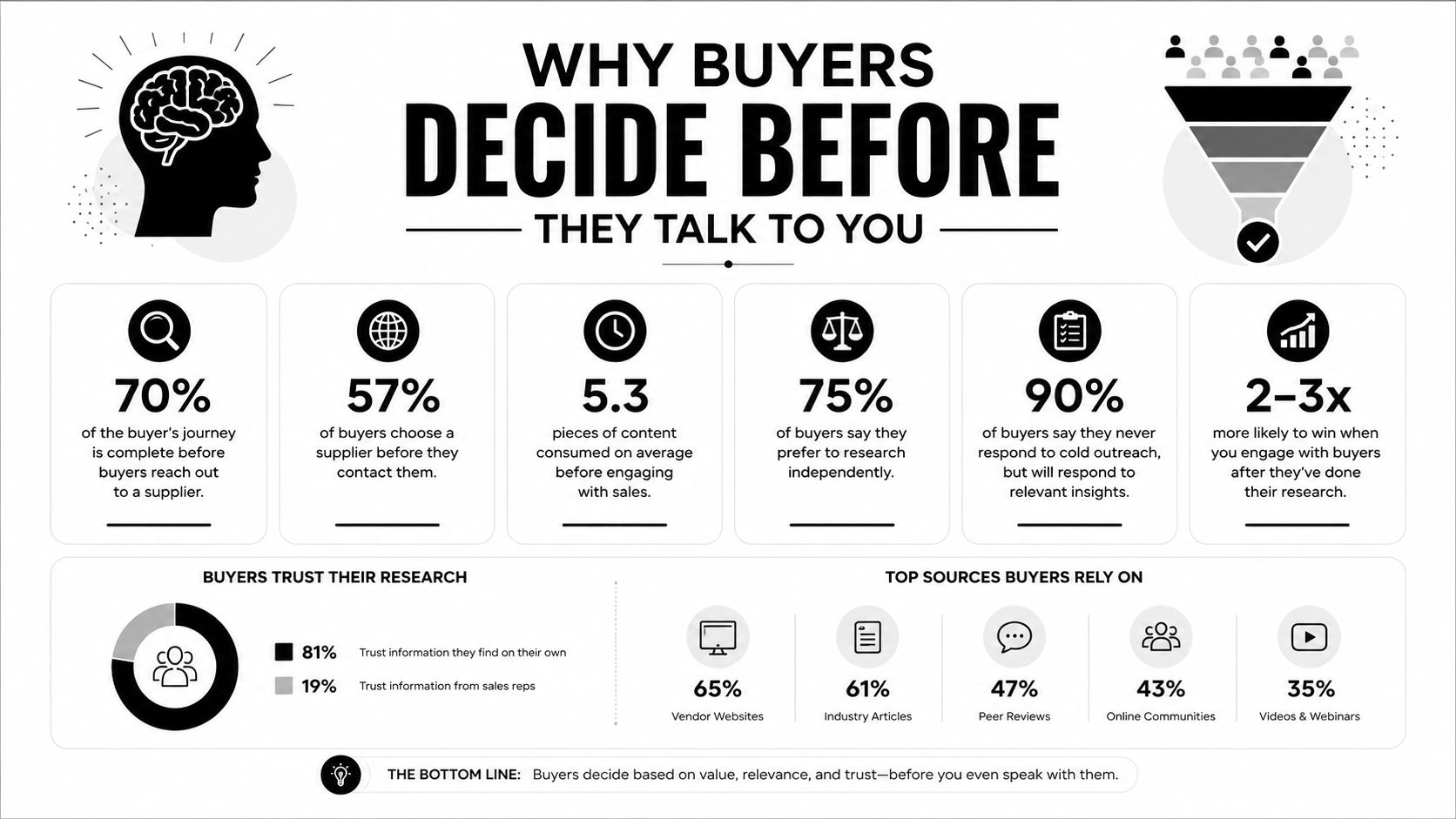
Buying usually starts in the buyer's head, long before a rep sends the first email. By the time outbound reaches the inbox, the buyer has often already formed a view of the problem, the category, and whether the conversation is worth their time. That is why psychology in selling matters most when it helps sales teams match an existing frame, not try to create one from scratch.
The practical shift is simple. The opener's job is not to manufacture need, it is to recognize the buyer's internal logic and show that the offer fits it. If the message sounds like it was written for a broad audience, it gets filtered out. If it matches the buyer's situation, the next step becomes easier.
What that means for outbound
Research on selling psychology says many purchasing choices happen outside conscious reasoning, and emotion often shapes the decision before logic is used to justify it (selling psychology research). In B2B, that does not mean people buy on impulse. It means the first touch has to speak to risk, relevance, and timing before it asks for commitment.
Outbound teams feel this every day. The buyer is usually not waiting for a general pitch. They are checking whether the rep understands their role, their constraints, and the context behind the outreach. That is why the rep's job changes from creating interest to confirming fit, then showing enough specificity to make a meeting feel useful.
Many teams still miss that point. They lead with features while the buyer is scanning for a reason to care. They open with capabilities while the buyer is still deciding whether the category deserves attention at all. They personalize with a first name and company name, then wonder why the message still feels generic. The psychology is not the problem. The data behind the message is.
Buyers do not respond to “personalization” when the record is clearly stale. They respond when the rep sounds like they already understand the buyer's environment.
That is why verified contact data, accurate titles, and clean firmographic context matter as operational inputs, not hygiene extras. If the message lands on the wrong role, the wrong team, or the wrong trigger, the buyer has already made a judgment before the logic shows up. The rep spends the first few seconds recovering from bad context instead of moving the conversation forward.
For teams trying to operationalize this, the key question is not “How do we persuade harder?” It is “What context do we need so the buyer's unconscious filter does not reject us instantly?” A strong next step is to audit the fields that shape that first read, then compare them with how your best reps consistently open conversations. For teams that want to build detailed buyer profiles, build detailed buyer profiles gives a useful starting point because profile quality often decides whether the psychology feels credible or forced.
The Five Psychological Levers That Actually Move B2B Deals
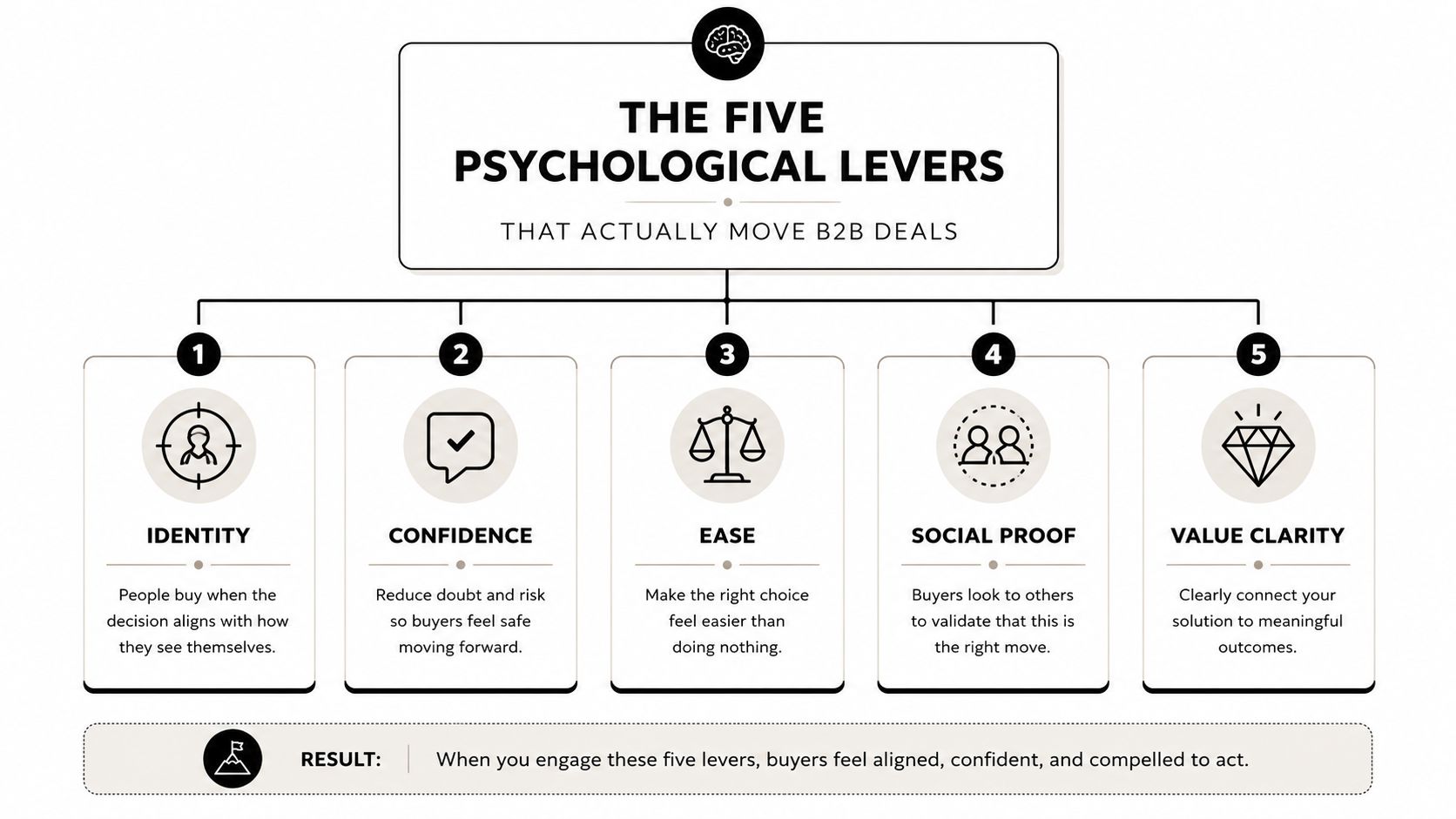
The levers that matter most in B2B aren't mysterious. They're the ones that consistently reduce uncertainty or increase the cost of doing nothing. Loss aversion, social proof, authority, reciprocity, and commitment all show up in selling, but they work differently in a long buying cycle than they do in a retail cart.
Loss aversion works better than feature lists
The clearest sales guidance now pushes teams to rewrite value propositions in terms of what the buyer risks losing by inaction, not what they might gain if everything goes right (sales psychology guidance). That's a better fit for B2B because buyers protect budgets, reputations, and internal momentum. A feature-led pitch talks about possibility. A loss-framed message talks about exposure.
Social proof should be specific, not decorative
Named customer references, category relevance, and recognizable peer contexts beat vague praise. In B2B, “lots of companies use us” doesn't help much. “Teams in your segment use us to clean up bad contact data before outbound” lands better because it tells the buyer where the product fits and what problem it solves.
Authority has to match the buyer's world
Authority cues work when they're precise. A founder talking about strategy may help early, but a RevOps manager wants evidence that the tool fits workflow, governance, and reporting. Authority becomes noise when it isn't role-aligned.
Reciprocity should feel like help, not bait
Ungated insights, useful benchmarks, and honest diagnosis create goodwill. Gated fluff does the opposite. Buyers can tell when “value” is really just a lead capture tactic.
Commitment should be incremental
Small asks outperform big jumps. Reply first, then meeting, then pilot. Each step should feel like a natural continuation, not a trap. That's the part many teams miss when they try to compress the cycle.
The operational lesson is that each lever needs the right data to work. Without verified contact data and role context, even a good principle can feel off-target. Without that context, you're not really using psychology, you're gambling on tone.
Timing, Persistence, and the Hidden Psychology of Responsiveness
A rep who responds fast doesn't just look efficient, they change the buyer's emotional state. A prompt reply signals that the vendor is attentive, that the inquiry was routed correctly, and that the buyer's problem was noticed while it still feels active. According to a HubSpot/TBIG conference compilation, responding within 5 minutes makes a seller 9 times more likely to convert, and 35% to 50% of sales go to the vendor that responds first. The same compilation also shows why persistence matters, with 44% of salespeople giving up after one follow-up and 80% of sales requiring five follow-up phone calls after the meeting (sales statistics compilation). Those numbers are about more than speed, they're about how quickly trust attaches to relevance.
I've seen this play out in outbound teams that assumed persistence was the main issue. It wasn't. The first reply came too late, then the follow-up sequence tried to recover attention after the prospect had already formed a soft preference for another vendor. The sale didn't die because the message was bad. It died because the buyer moved on.
| Touchpoint | Psychological Lever | Operational Requirement |
|---|---|---|
| First response | Recency and responsiveness | Correct lead routing, verified inbox, fast assignment |
| Second touch | Mere exposure | Clean cadence, same context, no bounced record |
| Case-study nudge | Reduced uncertainty | Accurate company data, relevant peer reference |
| Breakup email | Loss aversion | Clear next step, honest constraint, no fake urgency |
Persistence works only when the sequence has a reason to exist. A cadence with no context feels like pressure. A cadence with relevant data and a clear buyer fit feels like professional follow-through.
The operational issue is that cadence psychology collapses if the contact data decays between touches. A sequence can't build familiarity if the email is bad, the title is wrong, or the profile is stale by the third touch. If the buyer can't recognize the relevance, persistence reads as noise.
For teams that want a practical framework for structured appointment-setting follow-up, requesting for appointment is a useful reference point because timing only works when the motion behind it is disciplined.
Diagnosis Before Pitching The Discovery Conversation as Psychology
The highest-impact psychological move in B2B is often to stop talking early. In a field study of 1,000 B2B sales conversations, top-performing reps used much more back-and-forth dialogue, and prospects in stronger conversations talked significantly more during discovery (sales conversations study). That pattern matters because the buyer is more likely to trust a solution they helped define.
Why buyer talk changes the deal
Open-ended questions reduce information asymmetry. When the buyer explains the problem in their own words, they disclose priorities, constraints, and internal politics that a rep can't infer from the surface. The eventual proposal feels self-generated, not imposed. That shift is subtle, but it changes how resistance shows up.
Three question patterns work well here.
- Problem framing, ask what's breaking, slowing down, or being left unfinished.
- Consequence mapping, ask what happens if the issue stays unresolved for another quarter.
- Capability audit, ask what the team has already tried and where the current process falls short.
A SaaS renewal conversation is the cleanest place to see this. If a customer says they're “just reviewing options,” the weak response is a pitch dump. The stronger response is a short sequence of questions that surfaces what changed, what they're measuring, and what would make the current setup worth keeping. That's not fancy persuasion. It's a structured way to let the buyer tell you what matters.
What to listen for
The best reps don't just ask more questions. They listen for language that reveals risk, delay, or internal disagreement. Once you hear that, the pitch becomes shorter and more precise. You're no longer convincing a stranger. You're solving a problem the buyer has already named.
That's why diagnosis and persuasion aren't separate motions. Diagnosis is what makes persuasion credible. If the buyer doesn't feel understood, every lever from the earlier section looks like a sales trick.
Data Quality as the New Persuasion
A lot of modern outbound has a credibility problem, not an attention problem. Buyers are already surrounded by automated outreach, shallow personalization, and AI-generated copy that sounds polished but feels generic. The question is no longer whether they noticed the message. It is whether they believe the sender knows enough to deserve a response.
That is where data quality becomes persuasion. A verified work email, an accurate title, normalized company attributes, and recent profile context all reduce perceived risk. They show that the rep did the work before asking for time. When those signals are missing, personalization can trigger reactance, because the buyer sees the message as automated dressing over weak targeting.
Don't personalize a bad record. Fix the record first, then write the line.
This is the part most selling content skips. It talks about empathy, curiosity, and authority, but leaves out the operational layer that makes those cues believable. For teams that want a closer look at how enrichment supports outreach quality, B2B data enrichment tools is a useful resource because it connects context-building to execution, not just messaging.
Icypeas fits naturally here as one option for the operational work. Its Email Verifier helps validate addresses, its Reverse Email Lookup resolves emails to professional profiles, and its Lead Database and People Scraper support the context that makes personalization feel grounded rather than guessed. That matters because the psychology of outreach is only as strong as the record behind it.
The same logic applies to broader enrichment workflows. If the data is incomplete, the rep overcompensates with pressure or gimmicks. If the data is accurate, the rep can be simpler, more specific, and more human. In trust-sensitive B2B selling, subtraction is often the advantage.
A Practical Playbook for SDRs and Outbound Teams
A good outbound team doesn't need more tricks. It needs a tighter system for choosing which cues to remove and which ones to keep. Start with the subject line, because that's where loss framing can help without sounding manipulative. One sentence that names the risk of inaction is usually enough, as long as it's specific to the buyer's world.
Then move to the opener. Put social proof early, but only if it's relevant to the segment you're targeting. A named peer reference or a role-matched outcome works better than generic praise. If the rep sounds like they know the buyer's category, the rest of the message gets more room to breathe.
Use authority cues sparingly and accurately. A technical buyer wants proof that the workflow is real. A revenue leader wants proof that the process won't create chaos downstream. The same message can't serve both unless the data and context are clean.
For teams building a repeatable outbound engine, intelligence-led growth with Visbanking is a useful reference if you want to compare how context and targeting shape lead generation motions in practice.
A simple checklist helps keep the psychology honest.
- Verify the contact first: don't add personalization until the email and role data are clean.
- Frame one risk, not five: keep the subject line tied to a single loss or bottleneck.
- Lead with one relevant proof point: use a peer, a category, or a workflow that matches the prospect.
- Ask for a small next step: reply, then meeting, then pilot.
- Refresh context before each follow-up: stale data turns persistence into spam.
The best outbound teams also remove one thing aggressively, fake urgency. If the buyer doesn't have a real deadline, inventing one only trains them to ignore future messages. That's where the psychology in selling becomes operational discipline, not copywriting theater.
Measuring Whether the Psychology Is Actually Working
Psychology in selling only matters if it changes the numbers you care about. The cleanest test is a 14-day comparison between a loss-framed sequence and a gain-framed sequence, with the same audience, same sending window, and same qualification rules. If the loss-framed version doesn't improve the leading indicators, it doesn't deserve to stay.
Track reply rate, qualified meetings booked, and opt-outs first. Those tell you whether the message is landing cleanly or creating friction. Then watch the lagging indicators, pipeline created and win rate, because a sequence that gets replies but no real meetings is just generating noise.
The buying committee question comes up a lot. The short answer is that committee selling usually needs more transparency, not more pressure. Each stakeholder is filtering for a different risk, so the message has to stay simple enough to survive internal forwarding without losing credibility.
AI-assisted personalization needs a different guardrail. If the enrichment is shallow, the output sounds uncanny. If the data is accurate, concise personalization can help. The line is easy to see in practice, if the note reads like a real account plan, it helps, and if it reads like a machine guessed at the buyer's life, it hurts.
Remove any tactic that increases replies but lowers trust. The metric that matters is not attention alone, it's qualified momentum.
Stop adding pressure where context is weak. Start stripping friction from the record, the message, and the cadence. Measure whether the buyer feels understood before you measure how clever the sequence sounded.
Icypeas helps teams work from verified contact data, enrichment, and profile context instead of guesswork, which is the foundation that makes psychology in selling land. If you want cleaner records, more credible personalization, and fewer bounced attempts at trust, visit Icypeas and see how its enrichment workflow fits your outbound motion.




































.png)



.webp)